This wonderful old postcard is another I found at the Festival of Cards at North Petherton.
I loved the photos on the front and I turned it over and saw the writing, quickly looking at it I could see some names and thought it was worth taking a chance I could identify the family.
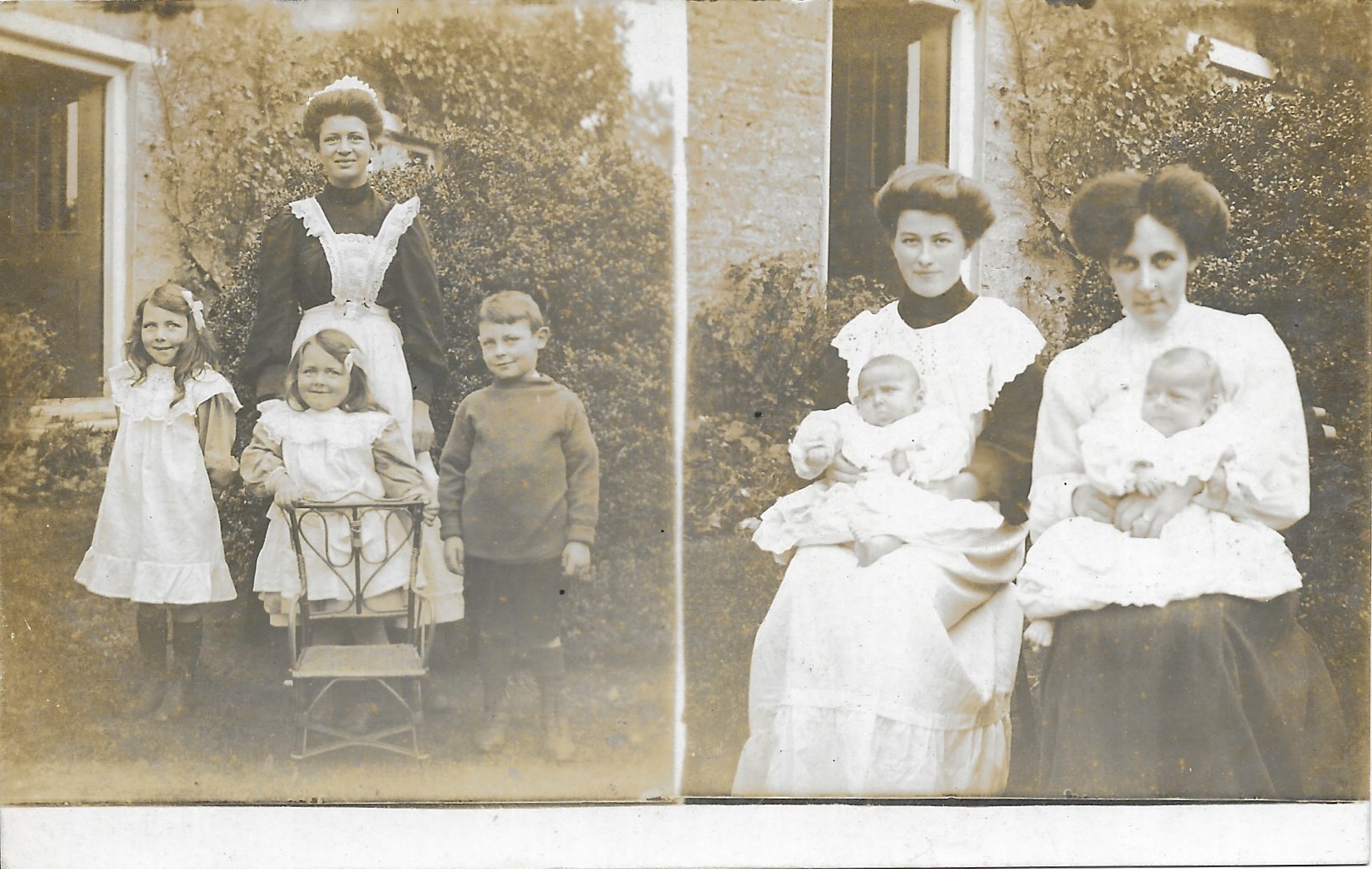
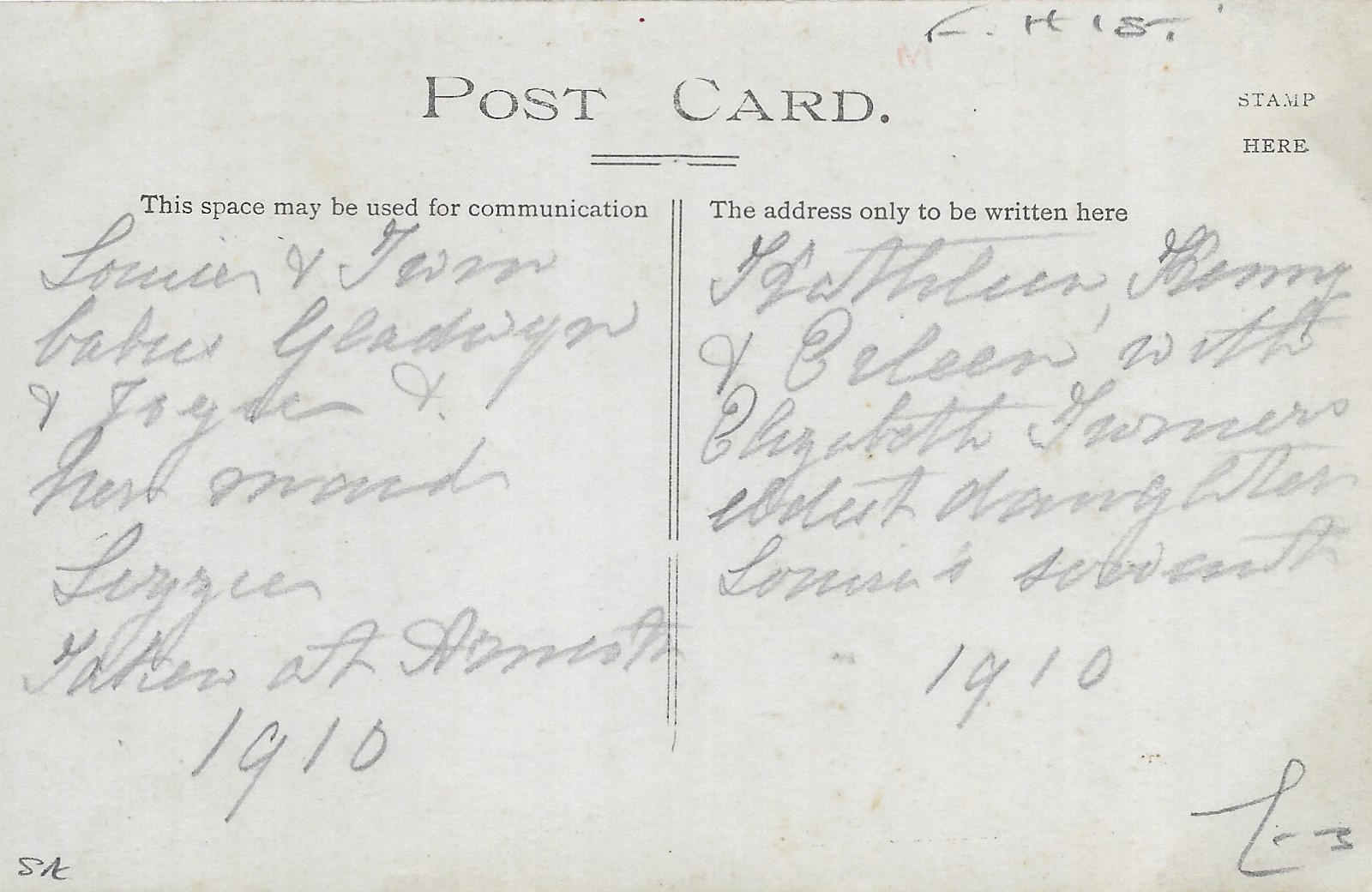
So both photos are dated 1910. I first thought the writing said:
1) Louisa & twin babies Gladys & Joyce & her maid Lizzie.
Taken at A????? 1910. No Surname!
2) Kathleen, Henry & Eileen with Elizabeth Turner. Eldest daughter Louise’s servant.
My first thoughts were the Twins. If I could find a match in the Birth records for a Gladys and a Joyce, same details and same area that would be great.
As it was dated 1910 I thought that the best thing to do was to go to FreeBMD and copy and paste each quarter for 1909 and 1910 into ChatGPT, it would save me hours.
This video below was just one quarter of births Gladys, this is September 1910.
I’d already gone through 1909 for Gladys and Joyce and even after all of 1910, no matches apart from 2 in Ledbury with different mothers maiden names, but on next pages to each other, was there an error, I got the digital copies and they were correct, so not Twins.
I decided to be thorough and go through 1911, but still no matches.
So I had a chat with my good friend and research partner Linda who said have I got it transcribed by AI, no I hadn’t, Linda did the image through Gemini, it wasn’t totally accurate BUT it said Gladwyn and not Gladys! I can see that now, note to self, spend more time looking at the names first!
So we both agreed that that was correct and I was wrong initially. So the Twins were Gladwyn and Joyce.
So putting Gladwyn into FreeBMD for 1909-1910 there were only five! Checking each one on the GRO there were different transcriptions of two, Gladwys, and another was an unmarried mother and after looking at marriages for the surnames and maiden names, there was just one that had the name Louise. It was also the only one that was Male, the others were female births.
Emma Louise Hadland married Ernest Reginald Winfield on 10 June 1903 in Ambroseden, near Bicester, Oxfordshire.
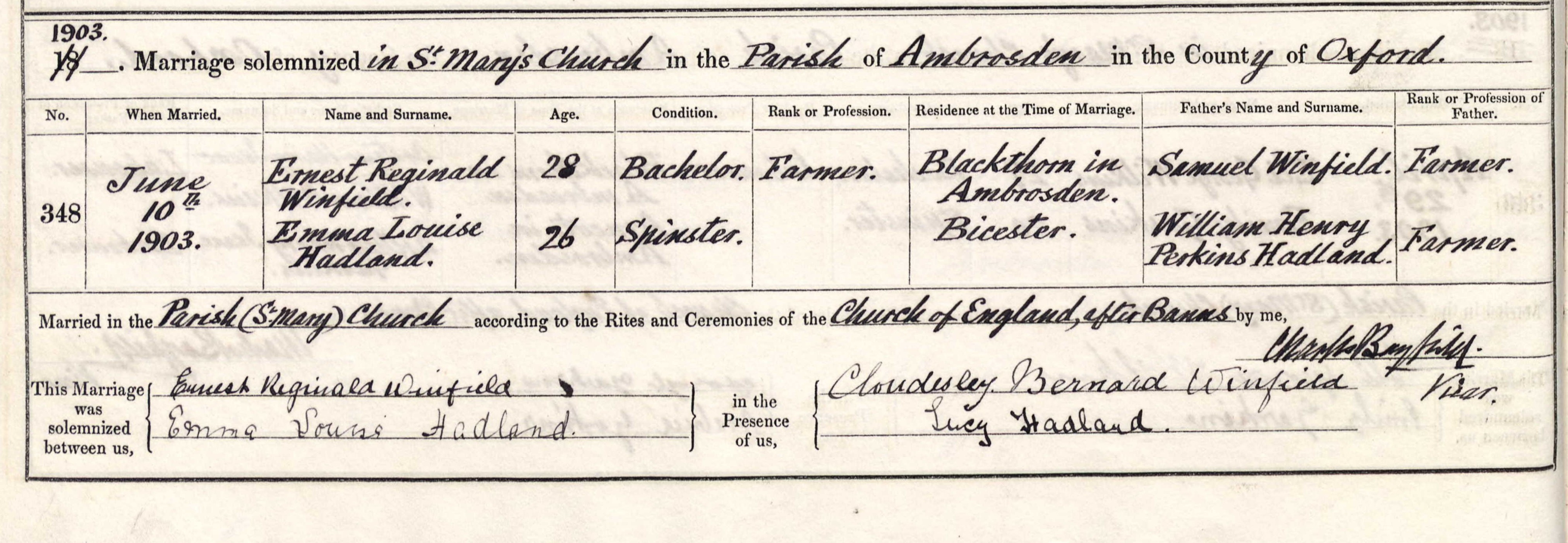
Ernest was a Farmer in Blackthorn. As you can see both fathers were also farmers.
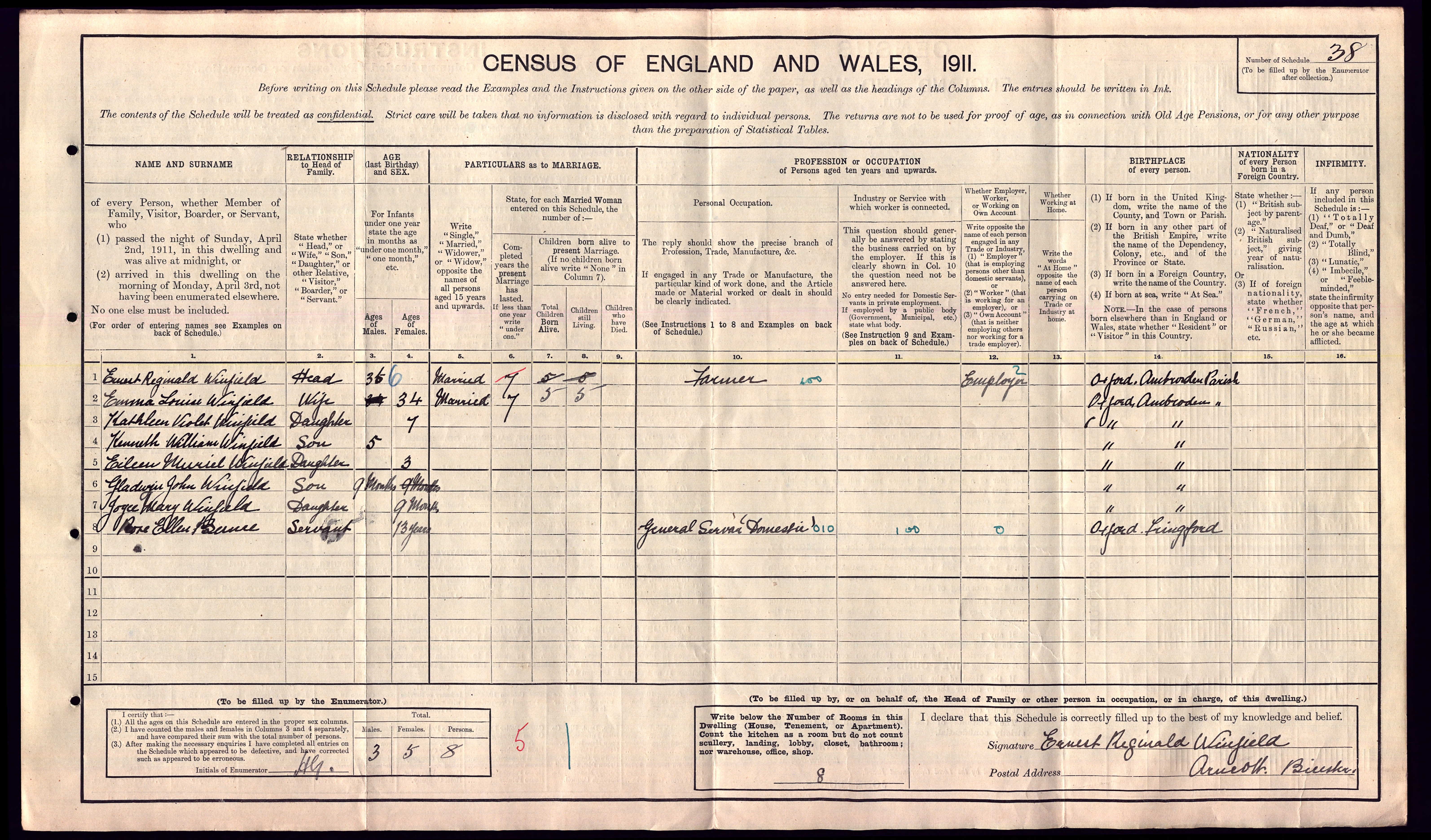
Of course, now I was easily able to find the 1911 census for the family and everyone was correct except that there was no Henry and I realised it actually said Kenny for Kenneth.
As you can see, even though there were many less babies born called Joyce in 1909-1911, her full name was Edith J.M. on the registration of Births records, and I would never have found them without knowing the name Gladwyn.

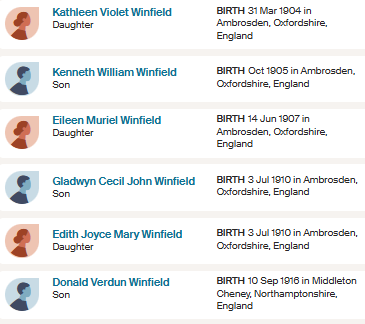
I spent over 3 hours searching but it was definitely worth it and I was thrilled to find them, now I could get cracking on the family tree.
A Farming Family Across Three Generations.
Some families leave behind grand houses or remarkable fortunes. Others leave something just as valuable, generations of quiet hard work, deep roots in one community, and lives measured by the changing seasons.
The Winfield family were very much the latter. For over a century their story was woven into the villages of Ambrosden, Blackthorn, Arncott and later Middleton Cheney, where farming shaped almost every aspect of their lives.
At the heart of this story stand Samuel Winfield and Amelia May, whose marriage united two farming families and laid the foundations for a remarkable dynasty.
Samuel was born in 1839 in Hardwicke, Gloucestershire, while Amelia May was born in April 1847 in Stoke Lyne, Oxfordshire, the daughter of Samuel and Elizabeth May. They married on 16 September 1869 at Stoke Lyne, beginning what would become thirty-six years together.
Like many Victorian farming families, they moved where opportunity led. Their first three children, Amy Mary (1871), Cloudesley Bernard (1872) and Frederick Borton (1873) were born in Charlton, Wiltshire, before the family settled permanently in Oxfordshire.
On 19 September 1874, their fourth child, Ernest Reginald Winfield, was born at Ambrosden.
Over the following seventeen years the household continued to grow with the births of Winifred, Norman Frank, Louisa Ethel, Olive, Ellen Elizabeth, Douglas, Lillian and finally Leonard May in 1891.
Twelve children in twenty years ensured that the Winfield home was never a quiet one.
By 1881, Samuel had become one of the district’s substantial farmers. The census records him at Manor Farm, Ambrosden, farming 208 acres and employing nine men and three boys.
It was a sizeable enterprise requiring constant management, and Amelia’s role as wife and mother was equally demanding as she cared for a household of growing children while supporting the running of the farm.
The family’s standing in the local farming community continued into the next decade. In 1891, Samuel appeared in Kelly’s Directory as the farmer at Upper Arncott, while the census found the family living at Blackthorn. Farming clearly remained successful enough to support both a large family and a considerable workforce.
After Samuel died in October 1905, aged sixty-six, Amelia demonstrated remarkable resilience. Rather than retire, she continued managing the farm herself. The censuses of 1911 and 1921 both describe her as a farmer, showing that even into her seventies she remained at the head of the household and the business. She died on 1 August 1929, aged eighty-two, bringing to a close sixty years of Winfield farming under her and Samuel’s stewardship.
Ernest Reginald Winfield
Growing up at Manor Farm meant Ernest experienced farming from his earliest years. In 1881 he was already listed simply as a scholar, but home life revolved around the rhythms of agriculture. By 1891 and 1901 he was still living with his parents at Blackthorn, undoubtedly helping with the family farm while preparing to establish one of his own.
His future wife, Emma Louise Hadland, had been born nearby on 13 February 1877 at Ambrosden. She came from another respected farming family.
Her father, William Henry Perkins Hadland, farmed around 200 acres, employing five men and two boys in 1881, while her mother, Emma Maria Pearson, managed a household of seven children.
Emma enjoyed educational opportunities that many country girls never received. By 1901, aged twenty-four, she was living in Ullenhall, Warwickshire, working as a schoolmistress, suggesting intelligence, independence and ambition before marriage brought her back to Oxfordshire.
Ernest and Emma married in St Mary’s Church, Ambrosden, Bicester taking place on 10 June 1903.

They immediately began building a family.
Their first child, Kathleen Violet, arrived on 31 March 1904.
A son, Kenneth William, followed in October 1905, only weeks before Ernest lost his father.
Then came Eileen Muriel on 14 June 1907.
Perhaps the greatest excitement arrived on 3 July 1910, when Emma gave birth to twins Gladwyn Cecil John and Edith Joyce Mary.
Finally, after the family had moved into Northamptonshire, their youngest son, Donald Verdun, was born on 10 September 1916 at Middleton Cheney.
The 1911 census records Ernest as head of the household at Arncot, working as a farmer.
By 1914, the family had moved to Glebe Farm, Milton, Northamptonshire, and by 1921 they were established at Rectory Farm, Middleton Cheney, where Ernest continued farming with the assistance of his growing son Kenneth.
Like both his father and father-in-law, Ernest devoted his life to agriculture. Three generations of farming knowledge passed naturally from one generation to the next.
Emma Louise Hadland
Emma’s own childhood had been remarkably similar to Ernest’s. Raised among fields and livestock, she watched her father William build a successful farming business while her mother Emma Maria raised seven children.
Her years as a teacher must have broadened her horizons before marriage returned her to rural life.
Although census records simply describe her occupation as “House Duties,” Emma’s contribution was undoubtedly far greater.
Running a farmhouse with six children required organisation, resilience and endless work. She balanced motherhood with supporting Ernest’s farming business throughout more than fifty years of marriage.
She lost her mother in 1924, her father in 1930, and eventually her husband on 23 October 1960 after fifty-seven years of marriage.
Emma herself lived until 4 February 1968, reaching the remarkable age of ninety.
The Children.
Kathleen Violet Winfield (1904–2008)
The eldest daughter enjoyed an adventurous life.
Born on 31 March 1904, Kathleen became a schoolteacher, following the same profession her mother had once held before marriage.
By 1931 she was living in Hampstead, London.
Her teaching career enabled her to tour around the world. In December 1934 she sailed from London to Sydney, Australia.

A year later she departed from Auckland, New Zealand, arriving in Honolulu before continuing to the United States.
Records show further international travel during 1936, illustrating her love of adventure, unusual for an unmarried woman of her generation.
In September 1939, she was in England and was working as a schoolteacher in Middlesex.
Kathleen never married and had no known children, but she enjoyed extraordinary longevity.

She outlived every one of her brothers and sisters before dying in Banbury on 22 December 2008, aged 104, having witnessed more than a century of change.
Kenneth William Winfield (1905–1986)
Kenneth combined his father’s practical farming upbringing with professional ambition.
The 1921 census records him assisting Ernest on the family farm, but within ten years his future lay overseas.
In March 1931, aged twenty-five, he sailed from Southampton for New York, described as a civil engineer.
Only weeks after arriving, on 11 April 1931, he married Esther Wilkes Gorman in Buffalo, New York.
Together they raised four children:
Kenneth Byrnes Winfield Jr. (1933)
Esther A. (about 1937)
David Frederick (about 1944)
Gretchen Wilkes (1950)
His career evolved from engineer to assistant buyer and later buyer, reflecting a successful professional life in America.
Although thousands of miles separated him from Oxfordshire, he remained connected to his family, outliving both parents before dying on 4 August 1986 in Ohio, aged eighty. He was buried in Buffalo, where his American life had begun.
Eileen Muriel Winfield (1907–1999)
Born on 14 June 1907, Eileen experienced both happiness and heartbreak.
She married Arthur Frederick Knowles, and together they had two children.
Tragically Arthur died in Reading on 7 July 1946, aged only forty-four.
Three years later Eileen found happiness again, marrying Percy George Joel in April 1949.
Sadly, Percy also died relatively young in 1961, after only twelve years of marriage.
Despite these losses, Eileen remained close to Northamptonshire, later living in Banbury before dying in Brackley in February 1999, aged ninety-one.
Gladwyn Cecil John Winfield (1910–1997)
Born alongside his twin sister Edith on 3 July 1910, Gladwyn’s life was dramatically altered by the Second World War.

Serving as a Lance Bombardier with the 85th Anti-Tank Regiment, Royal Artillery, he had signed up on 17 April 1939, he became one of the thousands captured when Singapore fell on 15 February 1942.
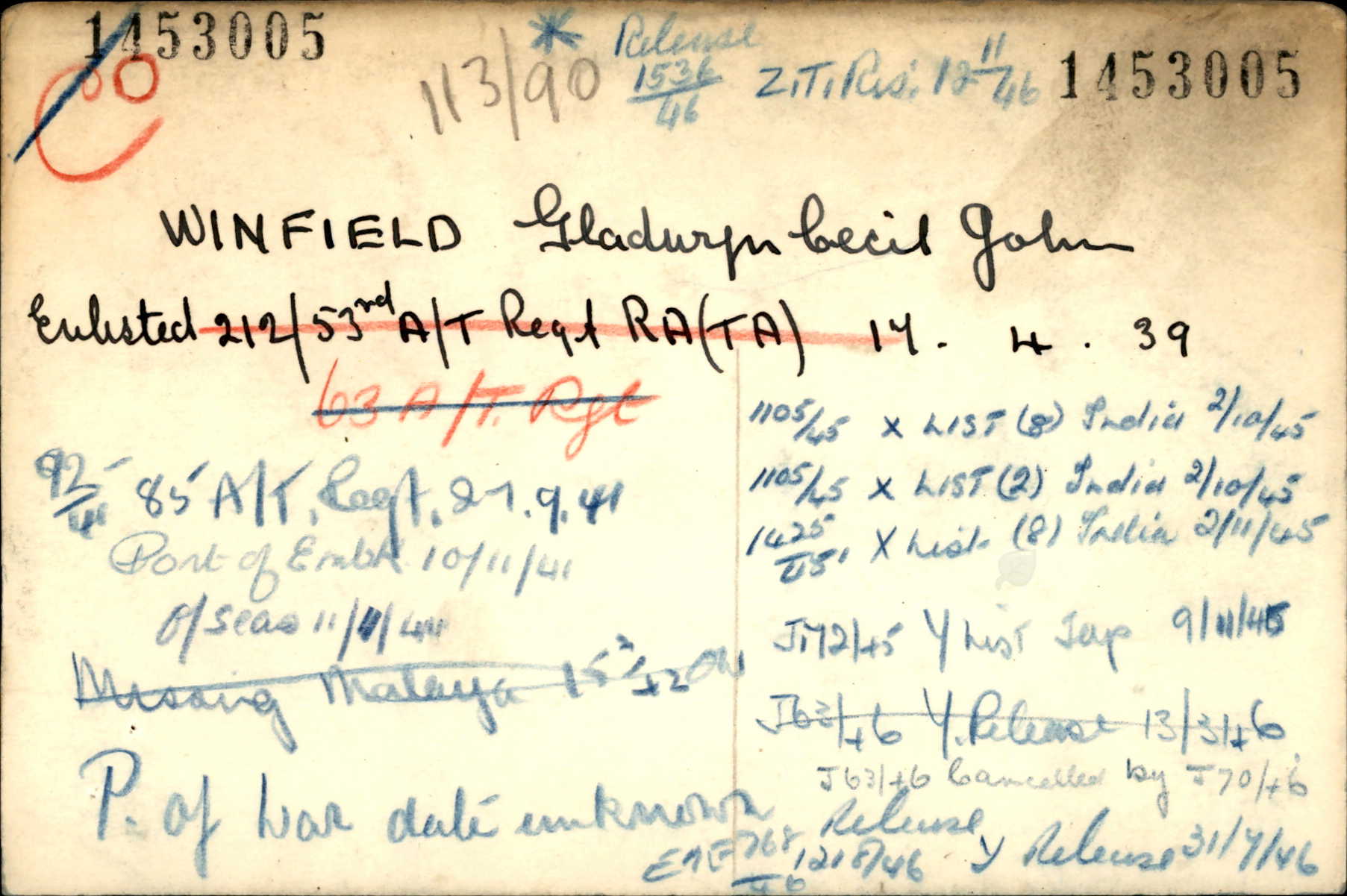
Japanese prisoner-of-war records confirm that he spent years in captivity in the Far East.
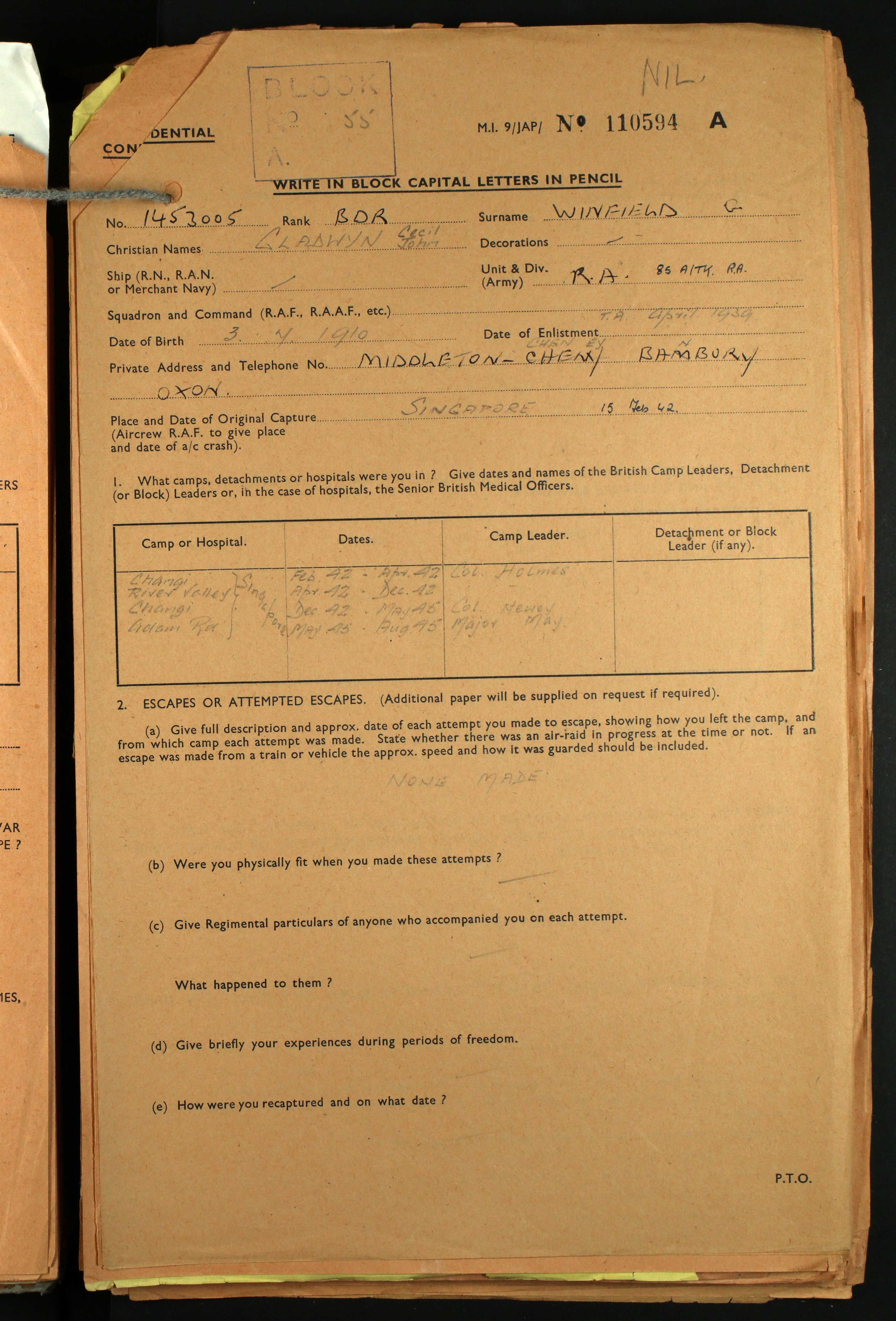
The hardships endured by Allied prisoners in Japanese camps are well documented, making Gladwyn’s survival a remarkable achievement.
Following the war he married Ethel Roseline Pulman in January 1948 at Chard, Somerset.
The couple had no known children.
Gladwyn died in Yeovil in October 1997, aged eighty-seven, having lived a life shaped by experiences far removed from the peaceful Oxfordshire farm where he was born.
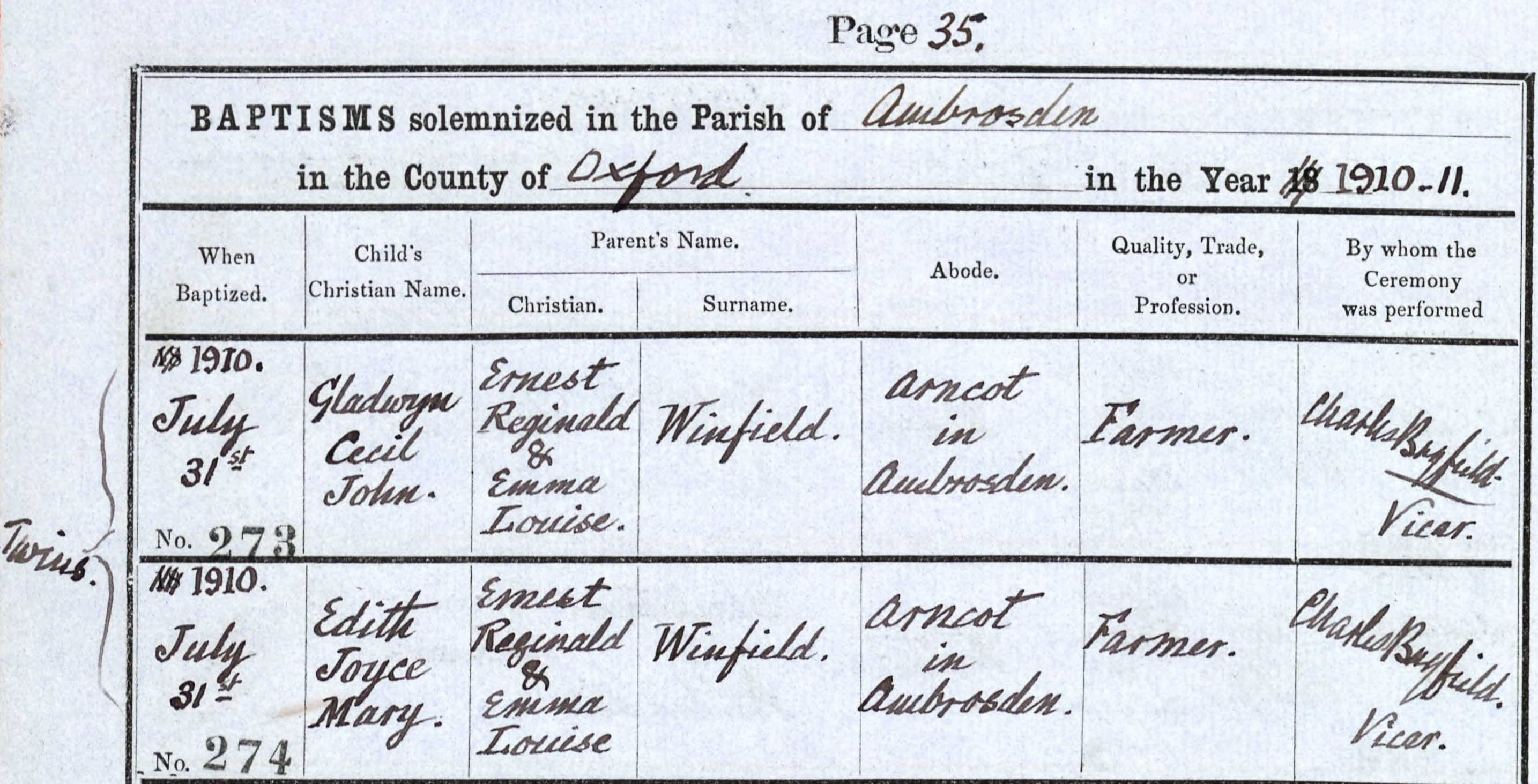
As with the writing on the parents’s marriage certificate the Twins Baptism record was so beautifully written and clear.
Edith Joyce Mary Winfield (1910–1995)
Gladwyn’s twin sister Edith appears to have lived a quieter life.
The 1939 Register shows her still at Rectory Farm, carrying out domestic duties, suggesting she remained closely involved with caring for her parents and maintaining the family home.
She never married and had no known children.
Edith died in Taunton, Somerset, during July 1995, aged eighty-five.
Donald Verdun Winfield (1916–1988)
The youngest child arrived after the family’s move to Northamptonshire.
Born on 10 September 1916 at Middleton Cheney, Donald inherited the family’s strong sense of duty.
Like his older brother Gladwyn, he served during the Second World War with the 85th Anti-Tank Regiment, Royal Artillery, he signed up just a short time after his brother on 1 September 1939.
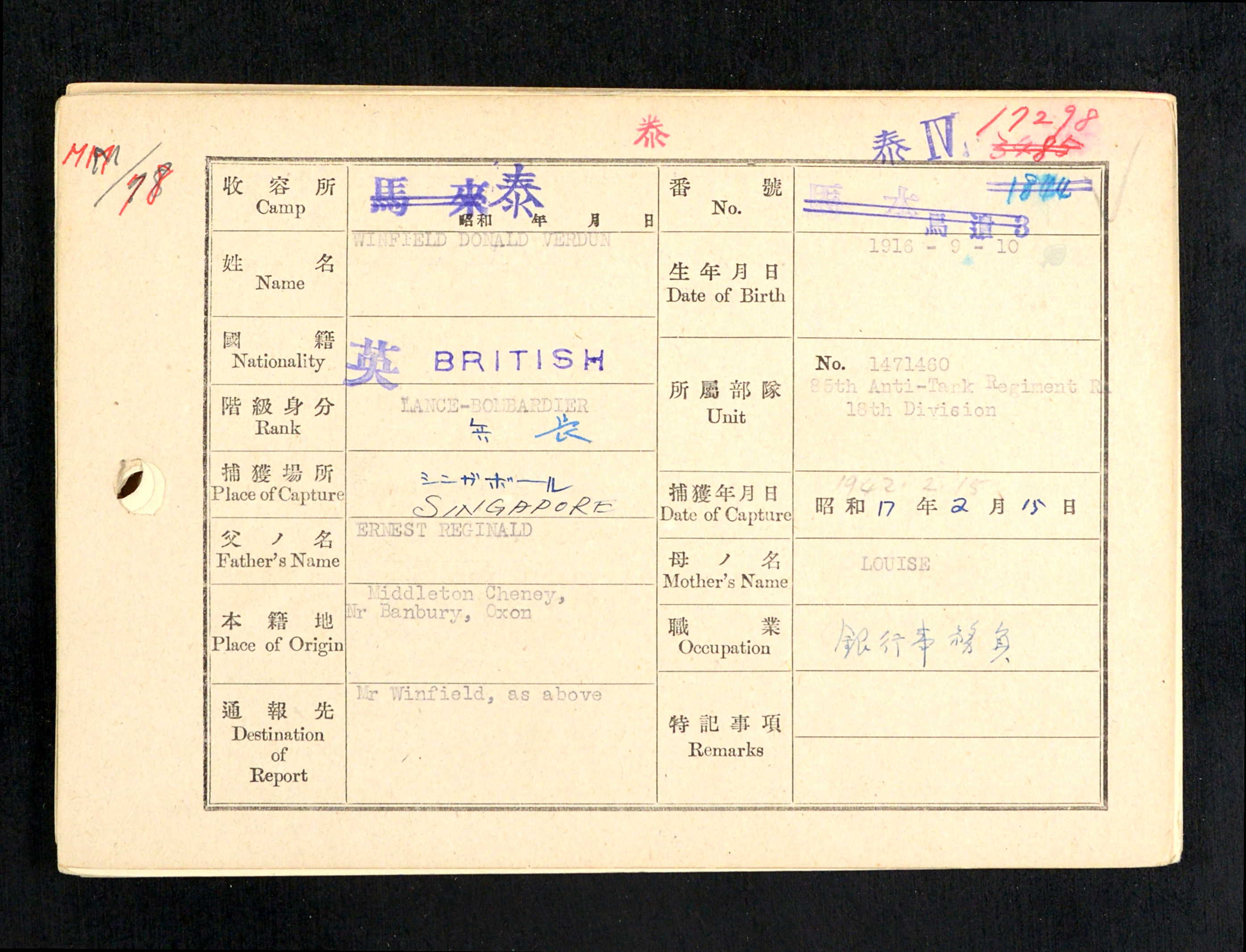
Captured after the fall of Singapore on 15 February 1942, he spent years as a Japanese prisoner of war in Thailand. Surviving such conditions demanded extraordinary endurance.

Following the war, Donald returned home and eventually married Anita V. Bound in October 1961.
They had one son, Martin J. Winfield.

Donald spent his later years back at Rectory Farm, dying there on 22 November 1988, aged seventy-two. In many ways his life completed the family’s long association with the farm.
The Fall of Singapore. 15 February 1942.
On 15 February 1942, Singapore, Britain’s most important military base in Southeast Asia, fell to the Japanese in what Winston Churchill described as “the worst disaster and largest capitulation in British history.”
The Japanese invasion had begun on 8 December 1941, when their forces landed in Malaya. Advancing rapidly down the peninsula with overwhelming air superiority, they reached Singapore in just 70 days.
Although the island had long been regarded as the “Gibraltar of the East,” its defences were designed mainly to repel an attack from the sea, leaving it vulnerable to an assault from the north.
After fierce fighting, dwindling supplies and severe water shortages, Lieutenant General Arthur Percival surrendered to General Tomoyuki Yamashita at the Ford Motor Factory on the afternoon of 15 February 1942.
Around 80,000 British, Australian and Indian troops became prisoners of war, making it the largest surrender of British-led forces in history.
Many endured years of brutal captivity, with thousands sent to forced labour camps, including the notorious Burma–Thailand Railway, where disease, starvation and harsh treatment claimed countless lives.
Renamed Syonan-to, meaning ’Light of the South’ by the Japanese, Singapore remained under occupation until September 1945.
The fall of the island shattered the myth of British military invincibility, transformed the course of the war in Southeast Asia, and became one of the defining events of the Second World War.
A Family Photograph
The photograph of Ernest and Emma Louise Winfield’s family captures far more than a single moment in time.
Here’s the small public family tree I have compiled on Ancestry: Winfield Family Tree
It records a family that experienced prosperity, world travel, emigration, teaching, military service, imprisonment during war, widowhood, remarkable longevity and the changing face of twentieth-century Britain.
From the prosperous Victorian fields of Manor Farm, Ambrosden, where Samuel employed nine men and three boys, to Rectory Farm, Middleton Cheney, where Donald spent his final years, the Winfields remained closely connected to the land for over a hundred years.
Their children scattered in different directions. Kathleen travelled across the world as a teacher. Kenneth built a new life in America. Gladwyn and Donald endured the horrors of Japanese prisoner-of-war camps before returning home. Eileen overcame personal tragedy to rebuild her life, while Edith quietly remained close to the family home.
Born into a Victorian farming world powered by horses and hand labour, they lived to see tractors, motorcars, air travel, television and even the dawn of the computer age.
For one family photograph to contain such an extraordinary collection of stories is amazing.
It is not just a portrait of mother and children, it is a record of service, family devotion and more than a century of English rural life.
You can contact me either by commenting here or via email at lynnswaffles@gmail.com
Till next time then………

