Isn’t this hand tinted CDV absolutely gorgeous. The artist has done a good job here, they’re not always so nice.
I spotted this CDV for sale on eBay last November and couldn’t resist, although I was a bit dubious about being able to identify her.
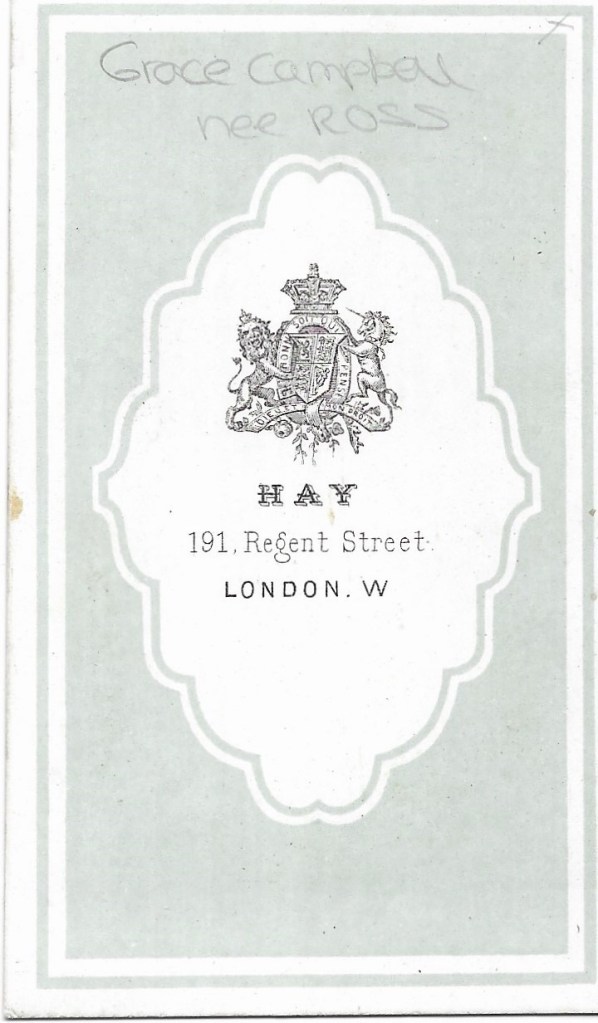
The name written on the back says Grace Campbell nee Ross.
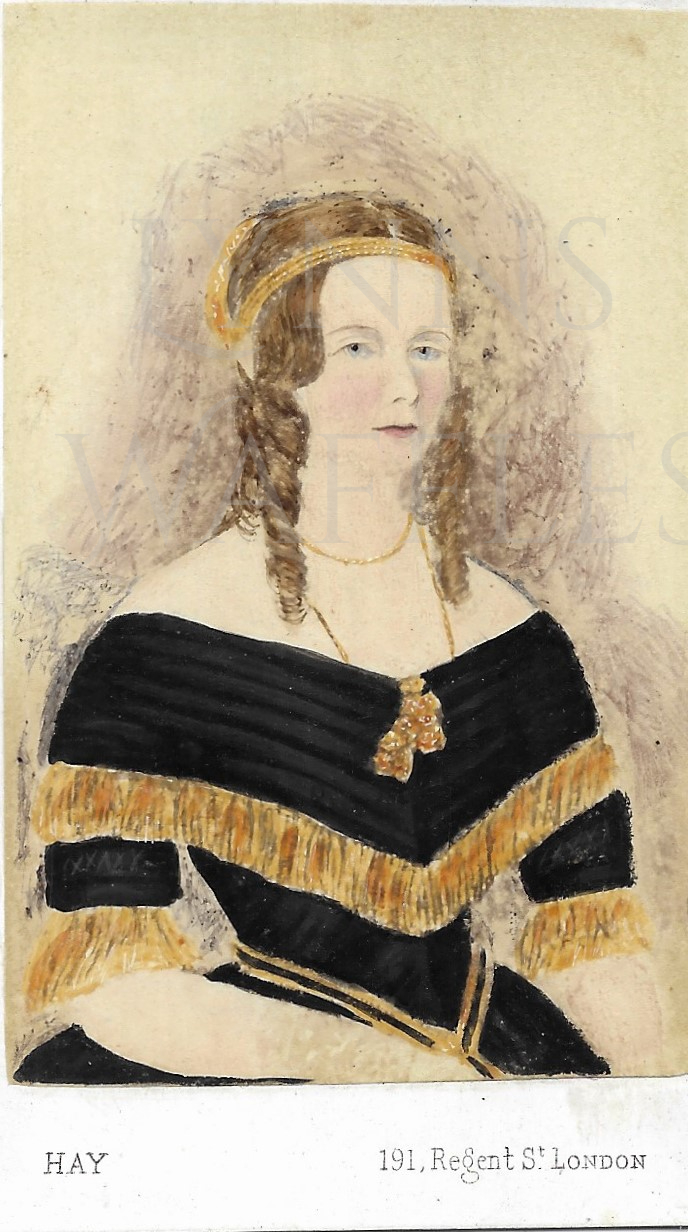
I’m not at all sure that I have got the correct Grace, because this one I decided to research was a Crofters daughter, and I do wonder, would she have been able to afford to get this beautiful portrait done?

But nevertheless I have researched this family as best I can with the limited resources that I can access online without getting an extra subscription to what I have already.
Please do let me know if you recognise Grace from your own family or you have any other information to add.
The Family of Grace McKenzie Ross and John Campbell.
The story of Grace McKenzie Ross and John Campbell begins in the far north of Scotland, among the communities of Sutherland and Caithness, before their lives eventually brought them together in Leith and then back to Grace’s native Tongue.
Their family would span generations and, through their son Donald Ross Campbell, eventually cross the Atlantic to Pennsylvania, USA.
Grace McKenzie Ross. A daughter of Tongue.
Grace McKenzie Ross was born on 7 October 1847 at Tongue, Sutherland, the daughter of Donald Ross and Margaret Munro.
Her parents were already in middle age when Grace was born: Donald was about 42 and Margaret about 41.
Grace’s childhood was marked by an early loss. On 10 April 1849, when Grace was only eighteen months old, her father Donald Ross died at Tongue, aged just 44.
The 1851 census places four-year-old Grace at Clashran and Lamigo, Tongue, where she was recorded as a niece within the household.
By 1861 she was living at Kincardine, Ross-shire, recorded as the daughter of the head of the household.
Her childhood and teenage years were spent within the northern Scottish counties with which her family was closely associated.
Another family bereavement came in 1865, when Grace’s brother William Ross died at Tongue on 19 February, aged only about 20. Grace was seventeen at the time.
By 1871, at the age of 24, Grace was living at Strathy, Sutherland, where she was recorded as a lodger.
It was during the following few years that her life changed considerably.
John Campbell. The blacksmith from Caithness.
John Campbell was born about 1846 at Reay, Caithness, the son of James Campbell and Mary Mackay. His father, James, was about 51 when John was born, while his mother was about 44.
John grew up in Reay with a large family. He had four brothers and three sisters, making him one of eight children.
His connection with the skilled trade that would define his working life can already be seen in the 1861 census.
At about fifteen years of age he was living with his family in Reay, Caithness, and was recorded as a blacksmith.
By 1871, John had moved south to Bothwell, Lanarkshire. At 25 he was living as a lodger and still working as a blacksmith.
The move from rural Caithness to the industrialised central Lowlands would have brought him into a very different world, with the growing towns of Lanarkshire providing considerable opportunities for skilled tradesmen.
It was perhaps during this period away from his native Caithness that John met Grace.
I’m thinking did she have the portrait taken when she met John? Maybe about 1870?
Later when you read the Photographer’s story you will see that it is entirely possible for him to have come back to Scotland during his time of working in London and did he take Grace’s photo, hand painted/tinted, and use one of his London CDV cards?
A Marriage in Leith.
On 19 November 1875, Grace McKenzie Ross and John Campbell were married at Leith, Midlothian, Scotland.

Grace was 28 and John about 29. John was already established in his trade as a blacksmith, an occupation he would continue throughout his married life.
Their marriage joined two families whose origins lay in the northern counties of Scotland. Grace’s Ross and Munro family from Sutherland, and John’s Campbell and Mackay family from Caithness.
Their first two children were born in Glasgow, suggesting that the newly married couple initially made their home in the west of Scotland.
The Campbell family grew steadily during the following decade.
Their first son, James Campbell, was born about 1877 in Glasgow, Lanarkshire.
A second son, Robert Campbell, followed about 1880, also in Glasgow.
By the time their third son was born, however, Grace and John had returned to Grace’s native north. Donald Ross Campbell was born on 23 April 1882 at Tongue, Sutherland. He was named Donald Ross, preserving the name of Grace’s father within the next generation.
Their fourth and final child was a daughter, Mary Campbell, born about 1885 at Tongue.
Grace and John had four children:
James Campbell, born about 1877, Glasgow
Robert Campbell, born about 1880, Glasgow
Donald Ross Campbell, born 23 April 1882, Tongue
Mary Campbell, born about 1885, Tongue
Unfortunately, the common names of James Campbell, Robert Campbell and Mary Campbell make it extremely difficult to confidently follow their later lives through the available records. Donald, however, left a much clearer trail, one that would eventually lead far beyond Scotland.
By 1881, Grace and John were living in Tongue Village, Sutherland. John was the head of the household and was recorded as a blacksmith, while Grace was his wife.
Tongue was familiar territory for Grace. She had been born there, had lost her father there as a baby, and had lost her brother William there as a teenager. Now she was raising her own young family in the same community.
In 1888, Grace suffered another family loss when her mother, Margaret Munro, died at Tongue on 9 August, aged 82. Grace was then 40.
The 1891 census again finds the Campbell family in the Tongue area, at Kirkiboll village, with John still working as a blacksmith. By 1901 they remained in Tongue, John continuing in the same occupation.
Grace’s sister Jane Sutherland died at Tongue on 31 July 1901, another bereavement for Grace during her later years.
The Campbell family in the twentieth century.
After 1901, the trail of John Campbell becomes uncertain. There is no confirmed record provided here for his death, and he does not appear to have been located in the 1911 census. It is therefore safest to say that John is believed to have died sometime between 1901 and 1911, although this has not yet been confirmed.
Grace remained connected with Tongue for the rest of her life.
On 23 June 1918, at the age of 70, Grace McKenzie Ross died at Tongue, Sutherland.
She had lived through an extraordinary period of change. Born in 1847, during the reign of Queen Victoria, she had seen Scotland transformed by industrialisation and the expansion of the railways. Had moved from Sutherland to the Lowlands after her marriage, raised children in Glasgow and then returned to her native Tongue.
Most remarkably, one of her children would eventually carry the family story across the Atlantic.
Donald Ross Campbell. Tongue to Pennsylvania.
Of Grace and John’s four children, their third child, Donald Ross Campbell, is the one whose adult life can be followed with some confidence.
Donald was born on 23 April 1882 at Tongue, Sutherland, the third son of Grace and John. He was nine years old when the 1891 census recorded him living with his parents in Tongue, and nineteen in 1901, still living with them there.
At some point after 1901 Donald made a momentous decision: he left Scotland and emigrated to the United States.
His recorded arrival in New York City was on 13 August 1907.
He subsequently settled in Erie, Pennsylvania, where the Scottish blacksmith’s son established a new life. In the 1910 census, Donald was living in Erie Ward 1 as a boarder and was unmarried.
By 1917–1918, he was living at 630 State Street, Erie, and his draft registration described him as of medium build, with light brown hair and brown eyes. His father’s name, John Campbell, was recorded on the registration, providing a useful link back to his Scottish family.
Donald was in America when his mother died in Scotland in 1918. Grace died at Tongue on 23 June 1918, and Donald, thousands of miles away in Pennsylvania, would have had to learn of the death of the woman who had raised him in Sutherland.
Marriage & Family in America.
Five years later, Donald’s life entered a new chapter.
On 14 June 1923, aged 41, he married Agnes Brown Smith at Chautauqua, New York.
Their only child, Grace Ross Campbell, was born on 2 March 1925 in Erie County, Pennsylvania.
The name Grace was particularly poignant. Donald had lost his mother, Grace McKenzie Ross, seven years earlier, and his daughter’s middle name preserved the Ross family connection.
Donald established himself firmly in Erie. In the 1930 census he was living there as head of his household and working as a blacksmith, following the same skilled occupation that had been practised by his father John in Scotland.
He remained in Erie through the 1930s and 1940s. In 1938, he formally pursued American citizenship, with his naturalisation declaration dated 12 January 1938 at Erie, Pennsylvania.
The record gives his arrival date as 13 August 1907 and names his wife Agnes and daughter Grace.
The 1940 census again records Donald as a blacksmith and head of his household.
He was also recorded in Erie during the Second World War period in 1942, and continued to work as a blacksmith into later life.
The 1950 census still finds him in Erie, married and working in his trade.
Donald had spent more than six decades of his life in America, but his roots remained firmly connected to northern Scotland.
He died on 15 January 1974 at Erie, Pennsylvania, aged 91. He was buried in Millcreek Township, Erie County, Pennsylvania.
Grace Ross Campbell. A granddaughter carrying the family name.
Donald and Agnes’s only child was Grace Ross Campbell, born 2 March 1925 in Erie County, Pennsylvania.
She grew up in Erie as the only child of Scottish-born Donald and Agnes.
The censuses of 1930, 1935 and 1940 show her living with her parents, first as a young child and later as a teenager.
By 1950 Grace was married to Robert Joseph Killmeier and was living in North Girard, Erie County. The couple had a son, Robert Killmeier, born about 1946 in Pennsylvania.
Her husband Robert died on 8 Dec 1951, a veteran of the Korean War.
By 1956, Grace was living at 3708 Allegheny Road, Erie.
Her parents both lived into their nineties.
Her father, Donald, died in Erie on 15 January 1974, aged 91. Just over two years later, her mother Agnes Brown Smith died on 11 June 1976, aged 90.
Grace herself eventually moved to Florida.
She died on 28 October 2015 at DeLand, Volusia County, Florida, aged 90.
The Highlands to Pennsylvania.
The story of Grace McKenzie Ross and John Campbell is one of movement, family and continuity.
Grace was born in Tongue, Sutherland, in 1847, into a Ross family rooted in the far north of Scotland. She lost her father as a baby and her brother as a teenager, but remained connected to the community where she had been born.
John Campbell came from nearby Reay in Caithness, and trained as a blacksmith. Their marriage in Leith in 1875 brought together two northern Scottish families, after which they began their married life in Glasgow before returning to Tongue.
There, their four children were born or raised. Three, James, Robert and Mary, remain elusive in the records so far, their common names making it difficult to distinguish them from the many other Campbells of Scotland.
Their son Donald Ross Campbell, however, took a very different path.
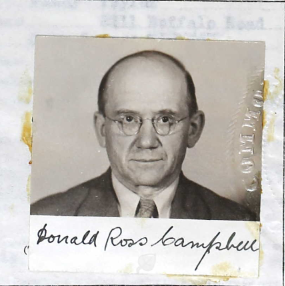
In 1907, at about 25 years of age, he crossed the Atlantic to begin a new life in America. He settled in Erie, Pennsylvania, married Agnes Brown Smith, raised a daughter and spent his working life as a blacksmith — just as his father had done before him.
Through Donald’s daughter Grace Ross Campbell, the family continued into another generation in America. Grace was born in Pennsylvania, carried her grandmother’s name, lived through most of the twentieth century and eventually died in Florida in 2015.
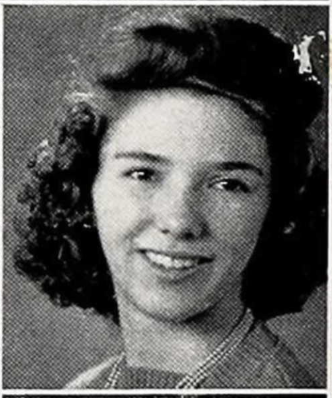
From Tongue in the Scottish Highlands to Erie, Pennsylvania, and finally DeLand, Florida, the family story stretches across more than 160 years. Yet running through it is a strong thread of continuity: the Ross and Campbell names, the blacksmith’s trade passed from father to son, and the name Grace, carried from Grace McKenzie Ross in nineteenth-century Sutherland to her granddaughter Grace Ross Campbell in twentieth-century America.
The lives of James, Robert and Mary Campbell remain an intriguing unfinished part of the story. With such common Scottish names, identifying them with certainty will require careful work with birth, marriage, census and death records. Their stories may still be waiting to be found.
George Heron Hay. Photographer.
When I looked up the photographer in my trusty Directory of London Photographers by Michael Pritchard, it states that George Heron Hay operated at this address in London between 1865 and 1870. Did Grace travel to London?
I think she looks to be in her early twenties maybe, and she was 28 when she married in 1875.
The ringlet hairstyle with a headband was most common for young, unmarried, or newly married women.
The off-the-shoulder neckline was fashionable across all ages, but with the hairstyle, it points to a younger woman.
Women in their late teens or early twenties were often photographed at: Coming of age, Engagement, Early marriage.
George Heron Hay. Photographer of Regent Street, London.
Lots of the information below is from the absolutely excellent EdinPhoto website.
Direct link here: EdinPhoto
George Heron Hay was born in 1824 at Montrose, Angus, Scotland, into a family that would develop an unusual connection with the emerging art of photography.
(Other sources say he was born June 21, 1831 in Leith, Scotland.)
His parents were John Hay, a hairdresser, perfumer and dealer in fancy goods, and Jane Napier. John and Jane had nine children, and remarkably, photography was to become the occupation of several of their sons.
George was not alone in possessing an artistic talent. His younger brother David Syme Hay, born in Montrose in 1826, also became an artist and photographer.
Both George and David exhibited their work at the Royal Scottish Academy, showing that their interest in photography developed from an established artistic background rather than simply from the commercial opportunities offered by the new photographic industry.
Another two of their brothers, John and Samuel Hay, also became photographers for periods of their lives.
The Hay Brothers.
By the middle of the 1850s photography was developing rapidly, and George and David recognised its possibilities.
In 1855, the brothers established a photographic business in Edinburgh under the name G. & D. Hay.
Their first premises were at 79 Princes Street, opposite the Mound.
They advertised themselves as Photographic Artists, offering portraits and copies of paintings in oil or watercolour.
Their early advertisements proudly proclaimed improvements in portrait photography, with portraits that could be viewed from different angles and taken within seconds.
The brothers soon moved to larger premises at 68 and 70 Princes Street.
Their business offered portraits on paper, both plain and coloured, as well as photographic portraits for stereoscopes, lockets and brooches.
The ability to produce coloured photographic portraits is particularly interesting when looking at George’s later work, as his Regent Street studio produced portraits that could be highly embellished and hand coloured like mine.
George and David were evidently ambitious photographers. They experimented with some of the latest photographic processes, including glass positive portraits.
At the Photographic Society of Scotland’s exhibition in 1857, their work was particularly prominent; contemporary comments noted that their examples were among the most numerous glass-positive portraits displayed.
In 1858 they exhibited no fewer than 49 photographs, most of them portraits.
The brothers were also interested in photographic invention.

In December 1855, George Heron Hay and David Syme Hay were jointly associated with a patent concerning improvements in photographic pictures. (Fleming Photo History)

A Family of Photographers.
Photography was evidently something of a family occupation for the Hays.
George and David’s brother John Hay also worked as a photographer and was later associated with Inverness.
A surviving letter written by John to his mother in August 1855 gives a wonderful glimpse of the family business. John wrote that he was busy taking photographs and had made £7 during the week, sending £1 to his mother.
He also mentioned that David and George were doing well in Edinburgh.
Their brother Samuel also became a photographer, although his life subsequently took a much darker course.
He became involved in a serious dispute with his brother John concerning forged promissory notes and eventually served a prison sentence.
His later life ended tragically in suicide.
These events belong to another part of the Hay family story, but they show that the apparently prosperous photographic family had its difficulties as well as its successes.
From Edinburgh to London.
During the 1860s George began to establish a presence in London.
His London studio was at the prestigious address of 191 Regent Street, London W, and photographic directories place him there from approximately 1865 until 1870.
Regent Street was an excellent location for a portrait photographer.
By this time the carte-de-visite had become enormously fashionable, allowing people to have relatively inexpensive photographic portraits made and exchange them with friends and relatives.
A photographer with premises in such a prominent part of London could attract a fashionable and affluent clientele.
George’s work was not confined to ordinary studio portraits.
His surviving photographs demonstrate that he photographed people of some distinction.
Was Grace an important lady of distinction?
The National Portrait Gallery holds a carte-de-visite of the Scottish artist Thomas Faed, photographed by George Heron Hay in the mid-1860s. (National Portrait Gallery)
The Gallery also holds a portrait of George Charles Mostyn, 6th Baron Vaux of Harrowden, made by Hay in the 1860s. (National Portrait Gallery)
These surviving examples provide valuable evidence of the standard of Hay’s work and the sort of clientele who visited his London studio.
The Regent Street Portraits.
One of the most fascinating surviving examples of George’s London work is a carte-de-visite showing four facial images on one CDV, now in the Rijksmuseum.
It is dated approximately 1864–1869 and bears the inscription:
G. H. Hay
Diamond Portrait W & B
191, Regent St.
It is an albumen carte-de-visite mounted on embossed card. (Rijksmuseum)
This is particularly relevant to the photograph of Grace Campbell née Ross, because her CDV also carries Hay’s 191 Regent Street address.
Her portrait is rather different from an ordinary plain albumen CDV.
My photograph has been extensively hand-coloured, almost transforming it into a painted portrait.
Her black dress, gold-edged cape, jewellery and gold decoration in her hair have all been carefully coloured.
This type of work fits really well with the Hays’ earlier Edinburgh advertisements, in which they specifically offered plain or coloured portraits.
The photograph of Grace therefore provides a lovely example of the artistic approach that George Heron Hay had brought with him from Scotland.
Studio Lighting.
There is also an interesting contemporary comment concerning Hay’s approach to photographic studios.
In 1868, during a discussion about photographic studios, a Mr Hay spoke in favour of having abundant light and plenty of room.
He referred to his brother’s studio in Regent Street, explaining that it had an excellent north or south light and that an exposure of only about five seconds could be sufficient.
This gives us a small glimpse inside the working environment where portraits such as Grace Campbell’s would have been made.
The photographer needed much more than a camera.
Successful Victorian portraiture depended upon the design of the studio, the direction and amount of light, the positioning of the sitter and the ability of the photographer to produce a flattering likeness within the limitations of the photographic process.
George’s background as an artist must surely have helped him in this respect.
A Photographer remembered by his Portraits.
George Heron Hay’s photographic career in London appears to have been relatively short. His 191 Regent Street studio is documented from about 1865 to 1870, after which the trail becomes much less certain.
The National Portrait Gallery describes him as “George Heron Hay, 1824–active 1870”, reflecting the fact that his later life has not yet been firmly established. (National Portrait Gallery)
Following the death of his brother David in 1872, George moved to London and was recorded as an artist in Westminster in the 1881 census, according to research into the Hay photographic family.
This is an intriguing detail.
Although his career as a photographer at 191 Regent Street had apparently ended, he continued to describe himself professionally as an artist.
Perhaps that is the best way to think of George Heron Hay.
He belonged to that fascinating generation of Victorian photographers who came to photography through the older traditions of art.
For him, the camera was not simply a means of recording a person’s face.
His portraits could be carefully posed, beautifully lit and then enhanced by hand.
George Heron Hay & the Photo of Grace.
The CDV of Grace Campbell née Ross provides a tangible link with this little known Scottish born photographer.
When Grace sat for her portrait, probably in the mid to late 1860s, she entered a studio in Scotland, or maybe at 191 Regent Street, and became one of the many people whose likeness George Heron Hay preserved during his London career.
Her portrait has survived when so much of Hay’s work has disappeared.
But I have a question here. Did Grace go to London? Or did George the photographer go to Scotland with a CDV from his London studio. Or have I got the wrong Grace entirely?
The later inscription identifying her as Grace Campbell, née Ross, adds another layer to the photograph: someone in the family remembered exactly who she was and took the trouble to record her maiden name.
Today, the identity of Grace remains elusive, as I am not sure if I have the correct Grace, but the photographer himself is no longer quite so mysterious.
From a family of nine children in Montrose, through an artistic education and partnership with his brother David in Edinburgh, George Heron Hay became a photographic artist in one of London’s most fashionable streets.
One source tells me that he died on August 31 1913 in Edinburgh, Scotland. I cannot confirm this.
His surviving portraits in the National Portrait Gallery and elsewhere demonstrate that he was a serious practitioner of the early photographic art.
And somewhere among those surviving Victorian cartes-de-visite is the portrait of a woman named Grace Campbell née Ross, quietly preserving her likeness for generations to come.
If you do know who Grace is please let me know!
George Heron Hay (b1824–active 1860-1870)
Artist and photographic artist
G. & D. Hay, 79 Princes Street, Edinburgh – 1855
G. & D. Hay, 68–70 Princes Street, Edinburgh – later 1850s–1860s
George Heron Hay, 191 Regent Street, London – c.1865–1870
You can contact me either by commenting here or via email at lynnswaffles@gmail.com
Till next time then……..

