I haven’t bought anything from eBay for quite a while, and I just happened to be scrolling through one evening recently, and came across this little family. Not much information but I hoped there was enough for me to identify them.
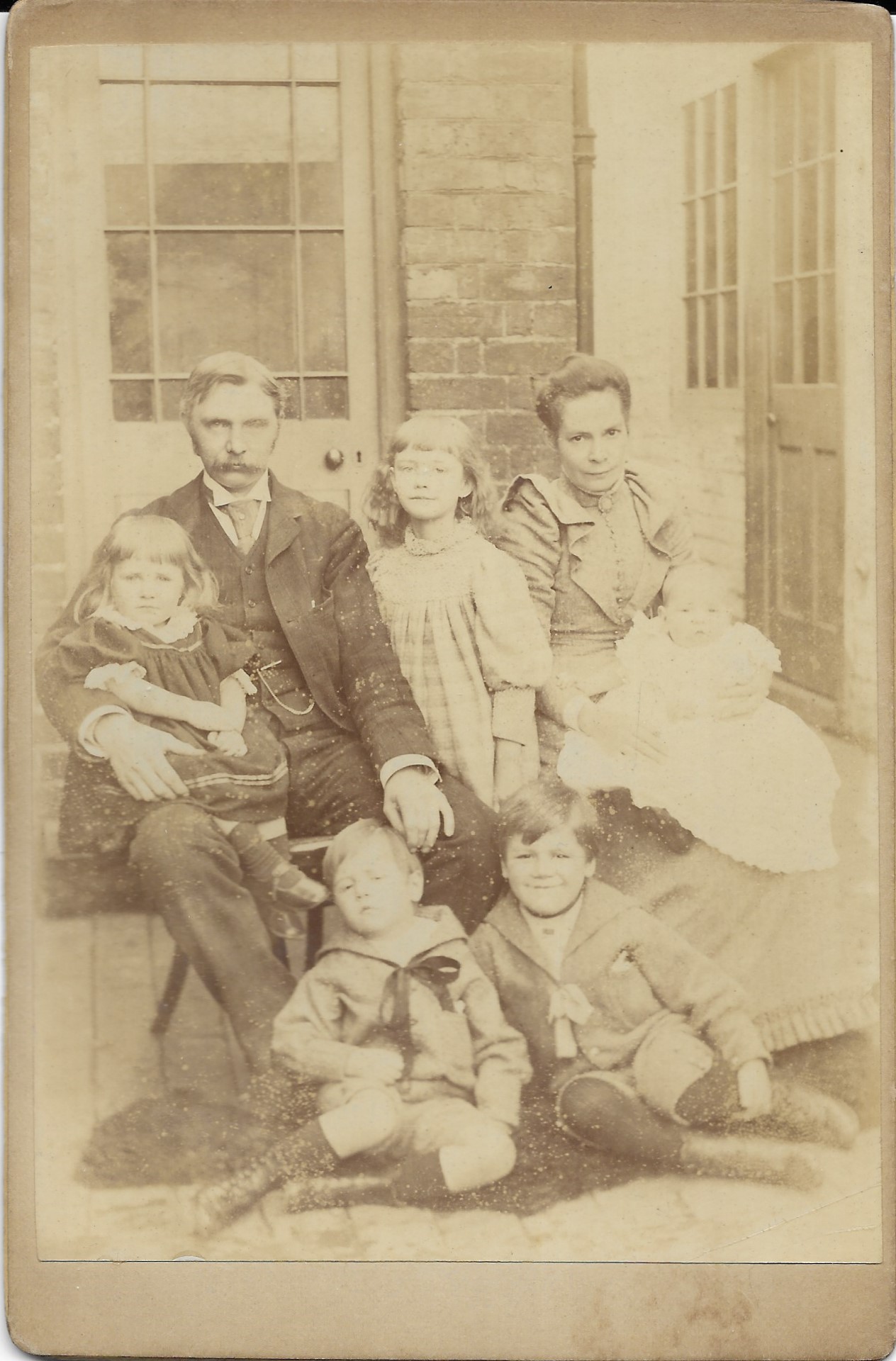
Looking at the back of the Cabinet Card it says Mr Chester’s and family. Alice born 1890 (on lap). Amazingly the only Alice born in 1890 was this one, record below.
The record also shows that the mother’s maiden surname was Chester’s, exactly the same as the father’s surname. So could it be that cousins married?
CHESTERS, ALICE BERTHA CHESTERS
GRO Reference: 1890 S Quarter in NORTH WITCHFORD Volume 03B Page 539.
North Witchford, is in the county of Cambridgeshire. What an excellent start, also a Chesters who married a Chesters.
So I added all this information to begin a family tree on Ancestry.
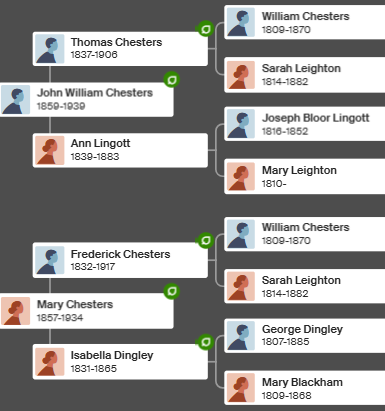
I added the 1891, 1901 and 1911 census details to the tree. The parents photographed here were John William Chesters and Mary Chesters, and according to the 1911 census the couple just had the five children.
So this means that it was the youngest, Harold George Chesters, who was born in the September quarter of 1893, who was the baby on his mother’s lap, and not Alice born in 1890.
But without Alice being written on the back of the photo, I might not have identified the family so easily, as there were four Harold Chester’s born between 1890 and 1895.
The Chesters Family: From the Potteries and Railway Works to the Schoolroom.
The story of the Chesters family is one of changing occupations, industrial progress and family connections that reached across several counties. For generations, the family was associated with Staffordshire, where the great pottery industry shaped the lives of thousands of people.
Alongside the potters and tradesmen were men who helped build and maintain the railways, an industry that transformed Victorian Britain.
Among this family was John William Chesters, born in 1859, who took a rather different path from many of his ancestors.
While his father worked with railway engines and other members of the family made their living through railway employment, John became a schoolteacher.
His story, and that of his wife Mary, also reveals how closely connected Victorian families could be: John and Mary were first cousins, their fathers being brothers.
William Chesters and the family’s Staffordshire roots.
The story begins with William Chesters, born in 1809, who became a tailor and draper. His work placed him in the world of traditional trades, serving the everyday needs of a growing population. Clothing was an essential purchase, and a tailor and draper occupied an important position in a local community.
William married Sarah Leighton, who was born in 1814. The couple raised a family that included Frederick, born in 1832; John, born in 1833; Mary, born in 1835; Thomas, born in 1837; and Albert Ernest Alfred, born in July 1844. The birthplaces recorded for the children include Dudley, Audley and Newcastle-under-Lyme, all in Staffordshire.
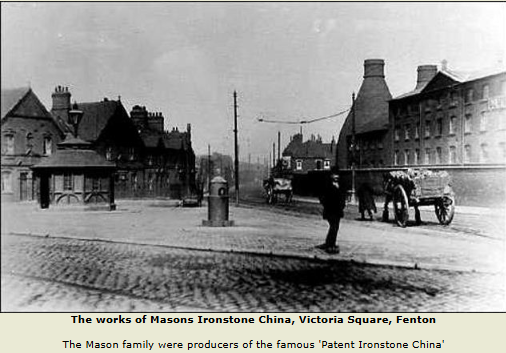
William’s family was growing up during a period of considerable industrial change. The Staffordshire Potteries, comprising the six towns of Burslem, Fenton, Hanley, Longton, Tunstall and Stoke-upon-Trent, had become famous for their production of pottery and ceramics. Factories, workshops and bottle ovens were familiar features of the landscape, while the industry provided employment for potters, decorators, mould makers, kiln workers, labourers and many others.
The Potteries were not simply a collection of factories. They were communities in which generations of families lived and worked, and where occupations could be passed from parent to child. The industry also supported a wide range of other trades, from shopkeepers and clothing makers to transport workers.
William, however, was a tailor and draper rather than a pottery worker. His children would go on to follow a variety of occupations, and it is particularly interesting to see how strongly the railway industry featured in the lives of his sons and descendants.
William died on 22 December 1870 in Staffordshire, aged 61. Sarah survived him by twelve years, dying in December 1882 in Northamptonshire at the age of 68. By then, members of the family had established lives well beyond their original Staffordshire home.
Thomas Chesters: From the Potteries to the railway works.
Thomas Chesters was born in Audley, Staffordshire, in 1837. His father, William, was 28 at the time of his birth, and his mother, Sarah, was 23.
In the 1851 census, fourteen-year-old Thomas was living in Halmer End, Staffordshire, as a son in the family household. His future would bring him into contact with two of the region’s important industries: pottery and railway engineering.
On Christmas Day, 25 December 1858, Thomas married Ann Lingott in Fenton, Staffordshire. Thomas was 21 and Ann was 19.
Ann had been born in Fenton in 1839, the daughter of Joseph Bloor Lingott and Mary Leighton. Her birth registration appears in the March quarter of 1839, registered in the Stoke upon Trent district. Her father, Joseph, was born in 1816 and died in April 1852, aged just 35.
Ann’s father was described as a potter, presumably employed in one of the many pottery factories in the district. His occupation provides another direct link between the family and the ceramics industry that dominated the area.
Ann’s childhood had not been an easy one. She was living in Fenton Culvert in 1841, and by the 1851 census, at only twelve years of age, she was recorded as a servant in Fenton. Her younger sister Maria was born in Longton in January 1851 but died on 1 October that year. Another sister, Margaret, died in September 1852, only months after their father’s death.
When Ann married Thomas in 1858, she was beginning a new chapter in her life. The couple would have eight children over the following twenty-one years.
Their eldest child, John William Chesters, was born on 6 November 1859 at Great Fenton and was baptised on 11 December 1859 in Fenton.
The other children followed:
Margaret Chesters, born in 1863 in Fenton.
Mary J Chesters, born in 1867 in Fenton.
Sarah A Chesters, born in 1870 in Fenton.
Hannah M Chesters, born about 1873 in Fenton.
Joseph T Chesters, born about 1876 in Fenton.
Albert E Chesters, born about 1878 in Fenton.
Frederick C Chesters, born about 1880 in Fenton.
The family’s early years were spent in and around Fenton. In 1861, young John William was recorded as a grandson in his grandparents’ household, while his father Thomas was described as a mechanic and fitter of railway engines and as a son-in-law in the same household.
By 1871, Thomas was recorded as head of his own household in Fenton. The following decade brought a change of location and a clearer picture of his working life.
In 1881, Thomas and Ann were living in Stoke-upon-Trent, where Thomas’s occupation was recorded as an engine fitter at the railway works.
This was a skilled occupation. Railway locomotives were complex machines requiring regular maintenance and repair, and engine fitters were essential to keeping them in working order. Their work demanded practical knowledge of metalwork, machinery and the many components that made a steam locomotive operate.
The growth of the railway network created new opportunities for people with engineering skills. The London and North Western Railway, formed in 1846, became one of the largest railway companies in Britain.
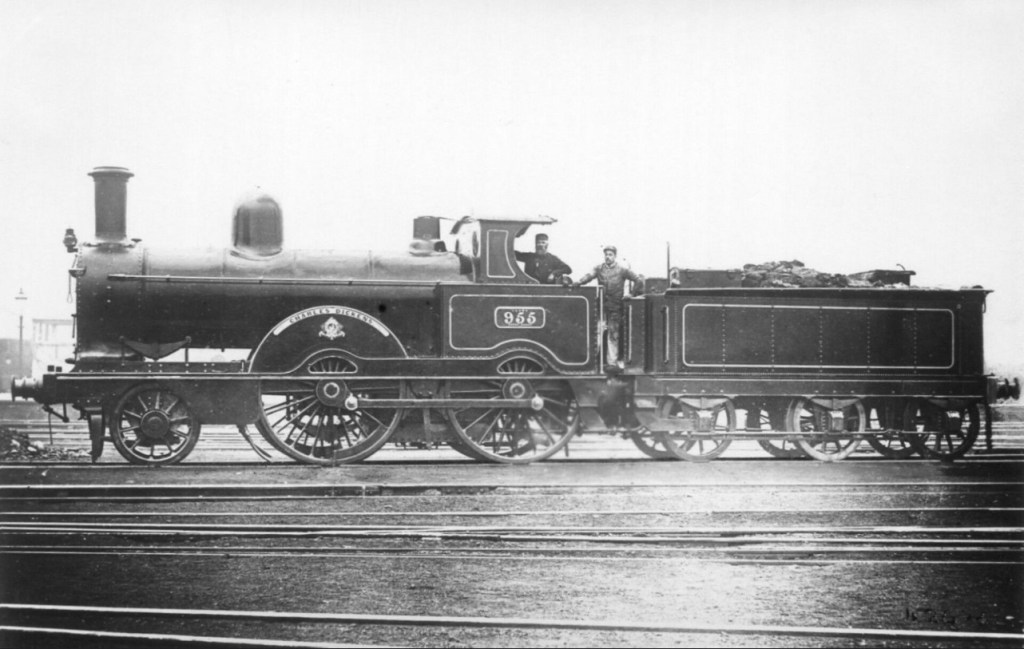
Its major locomotive works at Crewe, established in 1843, developed into an enormous industrial complex employing thousands of people. Railway workshops were increasingly important centres of employment, attracting skilled men whose work supported the expanding network of passenger and goods services.
Thomas’s recorded occupation does not, by itself, establish the exact railway company or works where he was employed. Nevertheless, his career illustrates the growing importance of railway engineering in the lives of Staffordshire families.
Ann died on 8 September 1883 in Fenton, aged 44, and was buried on 12 September. She and Thomas had been married for nearly twenty-five years. Her death left Thomas with a large family of children, the youngest only about three years old.
Thomas survived his wife by more than twenty years. He died in Fenton in 1906, aged 69.
Frederick Chesters: A life on the railways.
Thomas’s elder brother Frederick Chesters followed an even more substantial railway career.
Frederick was born in 1832 in Dudley, Staffordshire, when William was 23 and Sarah was 18. He married Isabella Dingley on 3 October 1852 in Stafford, Staffordshire. Isabella, born in Handsworth in 1831, was the daughter of George Dingley and Mary Blackham.
George Dingley was an important figure in the railway engineering world. He worked as a foreman for the London and North Western Railway at Crewe Works, where he was involved in the building of locomotives.
His reputation was such that Sir Richard Moon, chairman of the railway company, later praised him as a particularly worthy foreman.
In a tribute recalling the construction of the company’s 3,000th engine, Moon referred to Dingley as the man under whom so many engines had been built at Crewe Works. He noted that Dingley had died when the works was only about 140 or 150 engines short of that milestone.
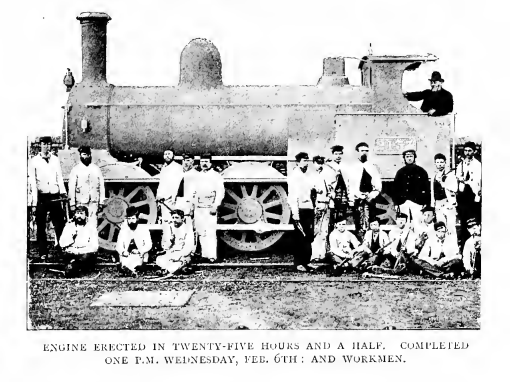
the Cornell University Library.
I have found reference to this old photo above that says that George Dingley is the bowler hatted man standing in the engine. The image can be seen in the book ‘A Pictorial Tribute to Crewe Works‘
Frederick and Isabella had a family that included:
Frederic William Chesters, born in 1854 in Vauxhall, Warwickshire.
Mary Chesters, born on 18 January 1857 in Birmingham, Warwickshire.
John Henry Chesters, born about 1859 in Audley, Staffordshire.
Isabella born in Birmingham in the first quarter of 1861.
George Chesters, born about 1863 in Wolverhampton, Staffordshire.
The family lived in several places as Frederick’s working life progressed. In 1861, he was recorded as head of household in Birmingham, where he was living with Isabella and their children.
Sadly, Isabella died in 1865, aged only 34, leaving young children behind.
Frederick married again on 30 January 1866, this time to Jane Berks.
By 1881, Frederick was living in Northampton, Northamptonshire, where his occupation was recorded as railway locomotive foreman. His career had therefore progressed from railway employment to a position of responsibility overseeing locomotive work.
In 1911, at the age of 79, Frederick was living in Wistaston, Cheshire, and described as a railway pensioner. He died on 30 April 1917 in Nantwich, Cheshire, aged 85, and was buried in Wistaston on 4 May.
Frederick’s life illustrates the opportunities that railway employment could offer. The industry required not only fitters and mechanics but also foremen, clerks, inspectors and administrators. It could provide a lifetime’s career, with the prospect of a pension in old age.
His daughter Mary would become particularly important in the story of the Chesters family, for she married her first cousin, John William Chesters, the son of Frederick’s brother Thomas.
John William Chesters and Mary Chesters: First cousins who married.
John William Chesters was born on 6 November 1859 in Great Fenton, Staffordshire. His parents were Thomas Chesters and Ann Lingott.
Mary Chesters, his future wife, was born on 18 January 1857 in Birmingham, Warwickshire. Her parents were Frederick Chesters and Isabella Dingley.
The relationship between John and Mary is straightforward when the family tree is followed back one generation. John’s father, Thomas, and Mary’s father, Frederick, were brothers. Both were sons of William Chesters and Sarah Leighton. John and Mary were therefore first cousins.
Mary’s childhood was marked by the early death of her mother. Isabella died in 1865, when Mary was only eight years old. Her father Frederick continued to work in the railway industry, and the family eventually settled in Northampton.
In 1881, Mary was living in Northampton, where she was recorded as a dressmaker. This was a useful skilled occupation for a young woman, requiring care, patience and the ability to cut and sew garments at a time when much clothing was made or altered locally rather than bought ready-made.
John William, meanwhile, had grown up in a household closely connected with railway engineering. His father Thomas was an engine fitter, and his uncle Frederick had developed a career in railway locomotive management.
Yet John chose a different direction.
In January 1883, John William Chesters married Mary Chesters in Northampton, Northamptonshire. The marriage is also recorded with the date 10 February 1883.
John was 23 and Mary was 26. Their marriage united two branches of the same family, bringing together the descendants of William Chesters and Sarah Leighton.
The couple would have five children.
Their first child, Winifred Mary Chesters, was born on 23 June 1886 in Doddington, Cambridgeshire. She was followed by Frederick Thomas Dingley Chesters, born on 24 July 1887, and John William Chesters, born on 26 November 1888, both in Doddington.
Their daughter Alice Bertha Chesters was born on 22 August 1890 in the North Witchford registration district, with Doddington recorded as her birthplace. Their youngest child, Harold George Chesters, was born on 25 May 1893 in Northampton.
The family’s movements suggest that John’s career took them away from Staffordshire, first to Cambridgeshire and then to Northamptonshire. By 1891, the family was living in Doddington, where John was recorded as head of household.
John had found his vocation in education, rather than following his father and uncle into railway engineering.
A schoolteacher among railwaymen.
John William Chesters’s career is one of the most interesting aspects of this family history. In a family with such strong railway connections, he became a teacher, eventually rising to the position of headteacher.
By the 1911 census, John was living in Kingsthorpe, Northamptonshire, and was described as an elementary head schoolteacher. His work would have placed him at the centre of local community life, educating children at a time when elementary education had become increasingly important.
The 1921 census gives us a particularly useful detail. John was living in Northampton and employed as a teacher by Northampton Borough Education Authority. His place of work was St Paul’s School, Northampton.
He is recorded as part of the school’s faculty on the 1921 Census, he was serving as an assistant master / assistant teacher. During that period, the Head Teacher of St Paul’s Mixed School (or “St Paul’s Church of England School”) was William S. Cornwell (William Stephen Cornwell), who oversaw the rapid expansion of the school’s mixed and boys’ departments during the early 1920s.
John William Chesters worked alongside several other assistant teachers to manage the school’s massive enrollment of over 700 local working-class children in the Semilong district.
John’s choice of profession is a reminder that the children of working families did not always follow the same occupations as their parents. The railway industry offered skilled and administrative work, but education also provided a route into a respected professional career.
John’s decision may have reflected his own interests and abilities, although the surviving facts do not tell us exactly why he chose teaching. What we can say is that he built a long career in education and remained a schoolteacher into his later life.
His wife Mary’s work as a dressmaker before marriage would also have required skill and precision, although the later census returns record her as occupied with home duties.
Mary died in Northampton in January 1934, aged 77. John lived for another five years, dying in December 1939 at the age of 80. The 1939 Register described him as a retired schoolteacher and recorded him as widowed.
They had been married for more than fifty years, building their family life in Cambridgeshire and Northamptonshire rather than in the Staffordshire communities where their fathers had grown up.
The next generation: Railway clerks and teachers.
The occupations of John and Mary’s children show that the family’s links with the railways continued, even though their father had chosen teaching.
Winifred Mary Chesters (1886–1943)
Winifred was born on 23 June 1886 in Doddington, Cambridgeshire. She remained unmarried and followed her father into education.
In 1911, when she was 25, she was recorded as an elementary schoolteacher in Kingsthorpe. By 1921, she was an assistant teacher in Northampton. The 1939 Register again described her as a schoolteacher, living in Northamptonshire.
Winifred died on 20 February 1943 in Northampton, aged 56. Her probate was recorded on 21 May 1943 in Exeter, Devon.
It is interesting that teaching became a profession for both father and daughter. John had chosen education instead of railway work, and Winifred followed his example, developing her own career in the classroom.
Frederick Thomas Dingley Chesters (1887–1966)
Frederick was born on 24 July 1887 in Doddington, Cambridgeshire, and baptised on 9 August that year.
He took a different path from his father and sister. By the 1921 census, he was living in the Wandsworth district of London, where he was recorded as a railway clerk, general, and was boarding away from his immediate family.
On 16 September 1966, his probate was recorded in London. He died on 7 April 1966 at Barnes Hospital, Mortlake, Surrey, aged 78.
Frederick married Maggie Davis in the Brentford district in July 1923. Maggie had been born in 1889 and died in 1966, the same year as her husband. No children are known from their marriage.
His occupation continued the family’s association with the railways, although his work was administrative rather than mechanical.
John William Chesters (1888–1944)
The second son named John William was born on 26 November 1888 in Doddington, Cambridgeshire.
He too entered the railway service. In the 1911 census, when he was 23, he was recorded as a railway clerk while living with his parents in Kingsthorpe.
He married Gwendoline Daisy Mary on 26 July 1919 at St Matthew’s, Moorfields, Gloucestershire. Their daughter, Patricia Mary Clark Chesters, was born on 2 August 1920 in Northampton.
In the 1921 census, John was described as a staff clerk with the London and North Western Railway Company. This is a particularly valuable record, because it identifies his employer by name and shows that he was working in a clerical position within the railway organisation.
By 1939, he was living in Gloucestershire and described as a railway outdoor representative. His work had therefore developed beyond that of a railway clerk.
John died on 9 January 1944, aged 55. His daughter Patricia survived him, living until 2015.
Alice Bertha Chesters (1890–1978)
Alice was born on 22 August 1890 in Doddington and baptised on 21 September that year.
She married Thomas Burrows and was living in Northampton in 1921, when she was recorded as a wife occupied with home duties.
The 1939 Register places Alice at the Lord Palmerston public house in Market Square, Northampton. Her husband was recorded as the licensee, while Alice was described as undertaking unpaid domestic duties.
This adds another occupation to the family story: that of publican. Running a public house was a demanding business, involving the management of customers, supplies and premises, as well as the long hours associated with the licensed trade.
Alice died in Northampton in March 1978, aged 87.
Harold George Chesters (1893–1965)
Harold was born on 25 May 1893 in Northampton and baptised on 17 September that year.
His railway career began early. A record dated 13 December 1909 places him at Thrapston in connection with the London and North Western Railway staff registers, when he was only sixteen.
By the 1911 census, at eighteen, he was living with his parents in Kingsthorpe and working as a railway clerk. In 1921, he was described as a bookkeeping clerk while boarding in Thrapston.
Harold married Dorothy Ellen Ellis in the Thrapston district in April 1923. Dorothy had been born in 1897 and died in October 1954 in Luton, Bedfordshire, aged 57. The couple had been married for 31 years.
In 1939, Harold was living in Bedfordshire and still working as a railway clerk. He died in April 1965 in Southend-on-Sea, Essex, aged 71.
Harold’s career, like those of his brothers Frederick and John, demonstrates how railway employment continued to offer opportunities for the next generation. The railway service needed far more than engineers and locomotive fitters. Clerks, bookkeepers and representatives were essential to the organisation of a large railway company.
A family shaped by industry, but not defined by it.
Looking across the generations, the Chesters family provides a small but revealing picture of working life in nineteenth- and early twentieth-century England.
William Chesters earned his living as a tailor and draper. His daughter-in-law Ann Lingott came from a family associated with pottery, and her father Joseph Bloor Lingott was a potter. Thomas Chesters became an engine fitter at the railway works, while his brother Frederick rose to become a railway locomotive foreman.
Frederick’s father-in-law, George Dingley, was a respected foreman at Crewe Works, placing that branch of the family close to the heart of Victorian locomotive construction.
The next generation continued these railway connections. Frederick Thomas Dingley Chesters became a railway clerk, his brother John William worked for the London and North Western Railway and later as an outdoor representative, and Harold George Chesters pursued a career in railway clerical work.
Yet John William Chesters, born in 1859, chose a different path. He became a schoolteacher and eventually a headteacher at St Paul’s School in Northampton. His daughter Winifred also became a teacher.
The story is not simply one of occupations being passed from father to son. It is a story of families adapting to a changing world, in which traditional trades, pottery factories, railway engineering, clerical work, education and the licensed trade all offered different ways of making a living.
John and Mary’s marriage also brings the family story full circle. As first cousins, they united the descendants of William Chesters and Sarah Leighton. Their five children carried forward a mixture of the family’s traditions, with some entering the railway service and others following their father into education.
From the pottery towns of Staffordshire to the railway communities of Crewe and Northampton, the Chesters family lived through a period of enormous industrial and social change. Their records preserve the details of births, marriages, occupations and deaths, but together these details reveal something more: a family whose working lives reflected the opportunities and demands of the age in which they lived.
Lots more information here about the subjects covered in this blog: The Staffordshire Potteries
Crewe Railway Works: Crewe Heritage Centre
The London and North Western Railway Society: LNWRS
You can contact me either by commenting here or via email at lynnswaffles@gmail.com
Till next time then……..

