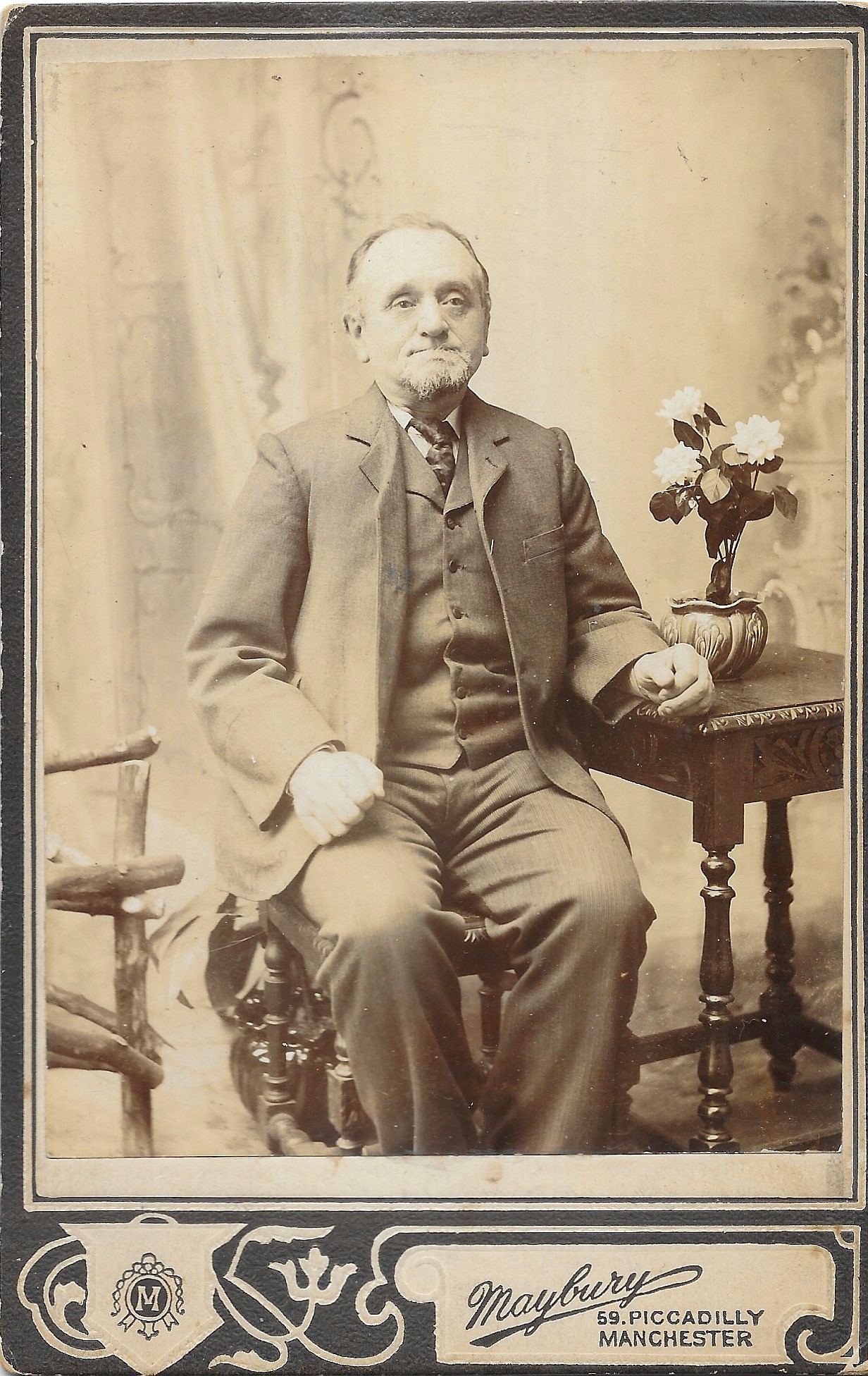
The story of two cabinet cards I bought at the fabulous Shoreham Postcard Fair back in December 2024. It often takes me a while to catch up on my buys, purely because I have so many in my queue.
These have turned out to be really interesting, and I was lucky that they hadn’t been separated.
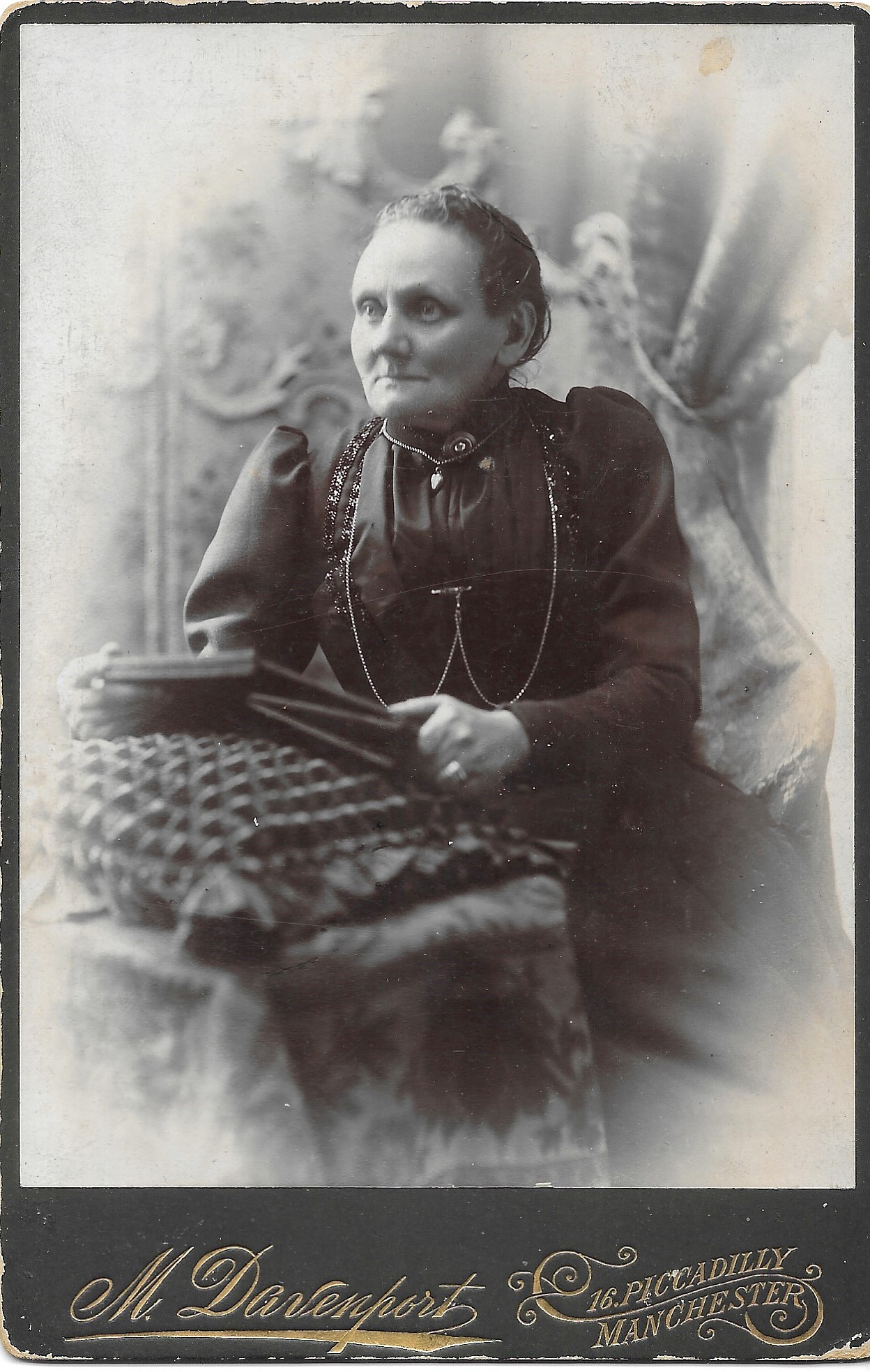
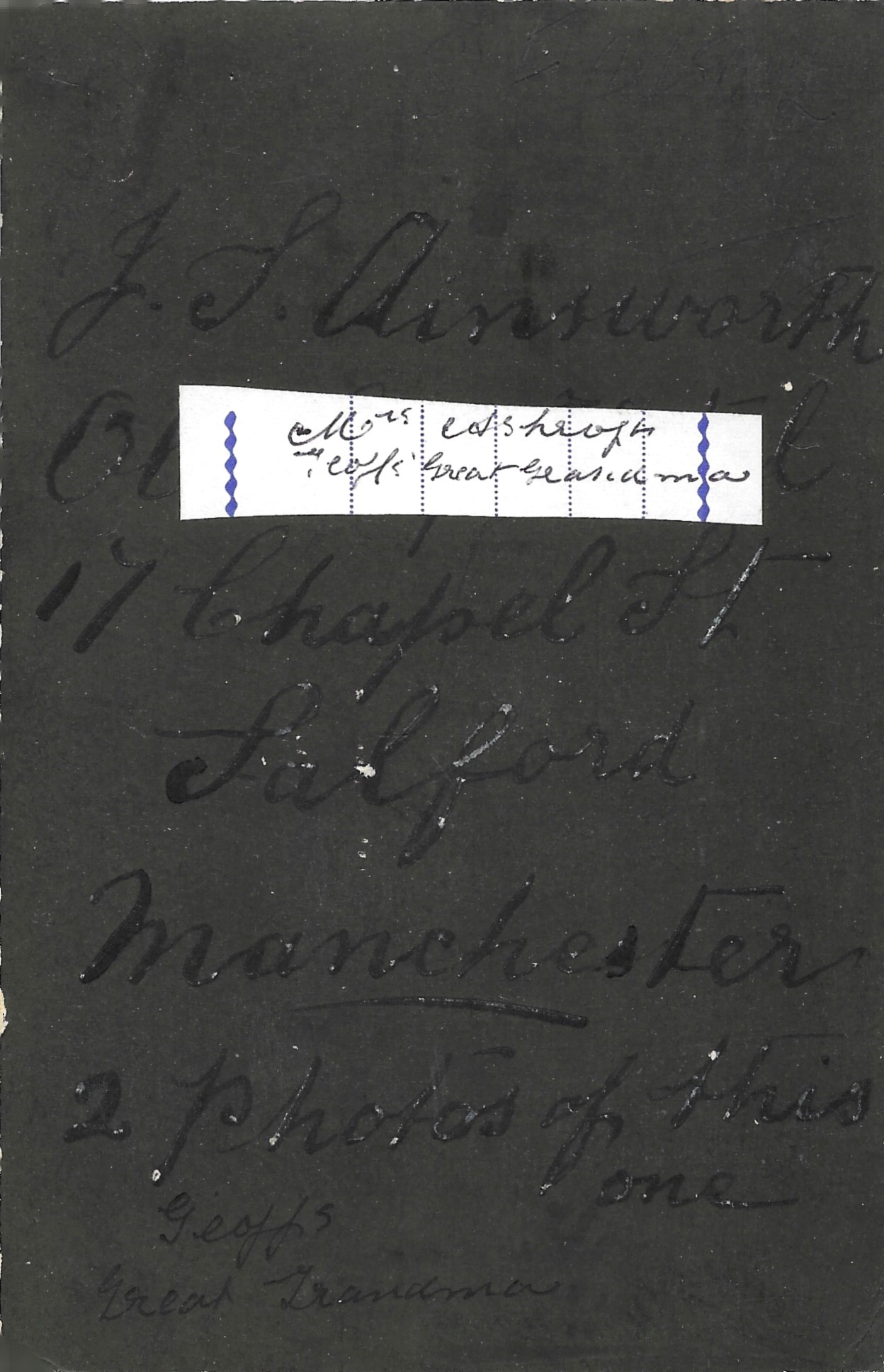
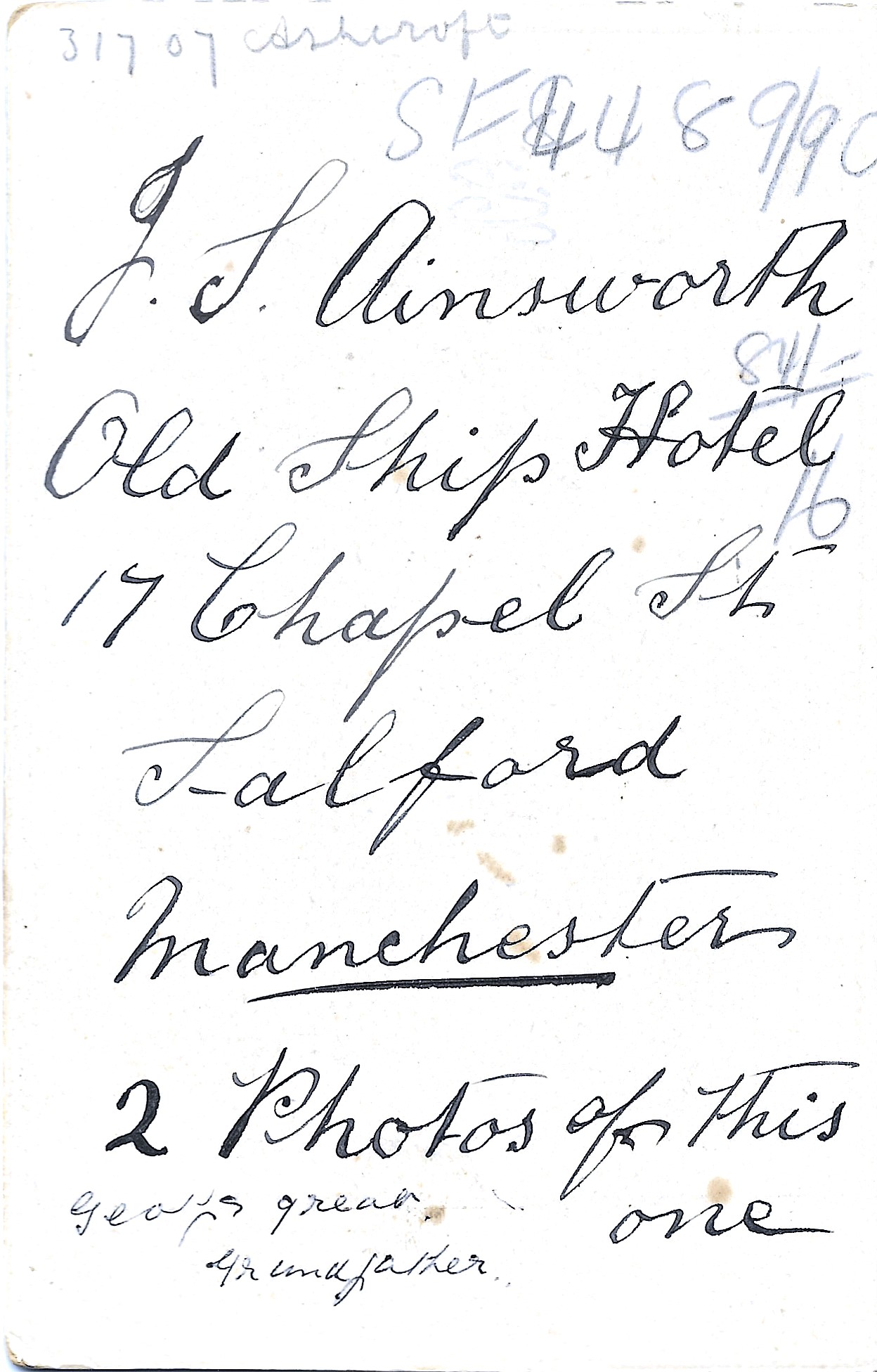
After writing down everything from the back of each photo I decided to look first at the 1911 census. So searching for the exact surname of Ainsworth living in the exact place of Salford, Lancashire, there were 61 results. So I started searching through them and it wasn’t too long, in fact the thirteenth person, that I found:
Mrs Mary Alice Ainsworth (1911): Recorded as the resident licensee/Hotel Manageress, in the 1911 Census, of the Ship Hotel, 17 Chapel Street, Salford.
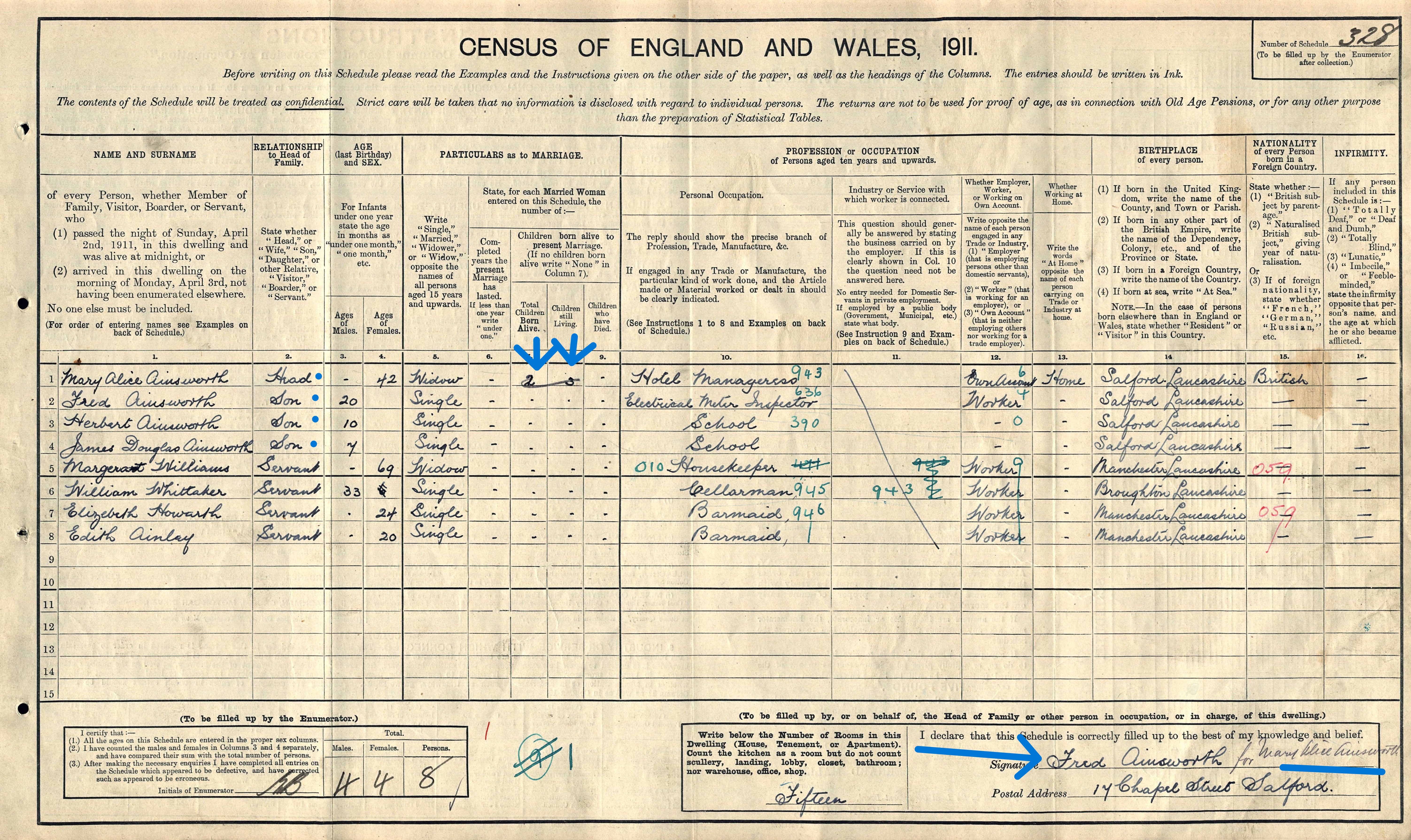
She was a widow. She hadn’t written the entries on this document the eldest son Fred Ainsworth had, on her behalf. It was written that she had 2 children born alive, and 3 children still living.
The eldest son was Fred, he was a son of her husband’s first wife. Then there was Herbert and James.
A very good start for researching this family and for starting a family tree.
Also on the back of both these cabinet cards it says that these were the Geoff’s Great Grandma and below, Geoffs Great Grandfather. So I will be looking to identify Geoff too.
Right at the top of this writing it says Ashcroft.
The Ainsworth Family of Salford.
James Spencer Ainsworth, Mary Alice Ashcroft and the Old Ship Hotel.
There is something particularly poignant about researching an old photograph or newspaper cutting when it opens the door to a very real family story.
In the case of James Spencer Ainsworth and his second wife, Mary Alice Ashcroft, a small newspaper report reveals the tragic ending to James’s life and places the family firmly inside the history of one of Salford’s old public houses, the Old Ship Hotel at 17 Chapel Street.
James and Mary Alice’s story was played out in the rapidly changing streets of nineteenth and early twentieth-century Salford, a city of industry, crowded streets, public houses and working families.
Their lives included marriage, children, bereavement and, ultimately, a devastating accident which left Mary Alice a widow with a young family.
James Spencer Ainsworth, a Salford childhood.
James Spencer Ainsworth was born on 18 November 1858 in Salford, Lancashire, the son of Robert Ainsworth and Betty Rothwell. Both of his parents were 31 years old when James was born.
He was baptised at Manchester Cathedral, St Mary, St Denys and St George, on 30 October 1859. His father Robert was recorded at the baptism as a moulder, an occupation which would later be reflected in James’s own working life.
In the 1861 census, three-year-old James was living in Salford with his family. He was joined by a growing number of brothers and sisters. His brother Prince Frederick was born in 1861, followed by Edmund in Bolton in about 1862, Betsey in Salford in 1865, Joseph in 1867 and Emily in 1869.
By 1871 James, aged thirteen, was still living in Lancashire with his family.
When he was 23, the 1881 census records James living in Salford and working as an iron moulder. It was a skilled industrial occupation and one which connected him to the manufacturing world for which Salford and neighbouring Manchester were famous.
James and Fanny Woodhouse Clough.
On 23 January 1889, James married Fanny Woodhouse Clough at St Stephen’s Church, Salford. James was 30 and Fanny was 25.
Fanny had been born in about April 1863 in Chorlton, Lancashire, and in the 1881 census, when she was eighteen, she was living in Salford and working as an under-barmaid at a wine and spirit vault.
James and Fanny began their married life in Salford.
Their first child, Fred Ainsworth, was born in July 1891.
The 1891 census found James, aged 33, as the head of the household in St Stephen’s, Salford, with his occupation recorded as iron moulder.
In March 1894, another son was born. Sadly, the child, also named James Spencer Ainsworth, died on the same day he was born.
On 16 November 1896, James’s wife Fanny died at 55 Bury Street, Salford. James was present at his wife’s death. She died at the Crown and Anchor pub, 55 Bury Street, Salford, Manchester.
Fanny was only 33 years old.
She and James had been married for just seven years.

James was therefore left a widower with his surviving child, Fred.
From iron moulder to publican.
James’s life was beginning to take a different direction before the death of Fanny. In August 1893 James had taken over the license of the Crown and Anchor, Bury Street, Salford.
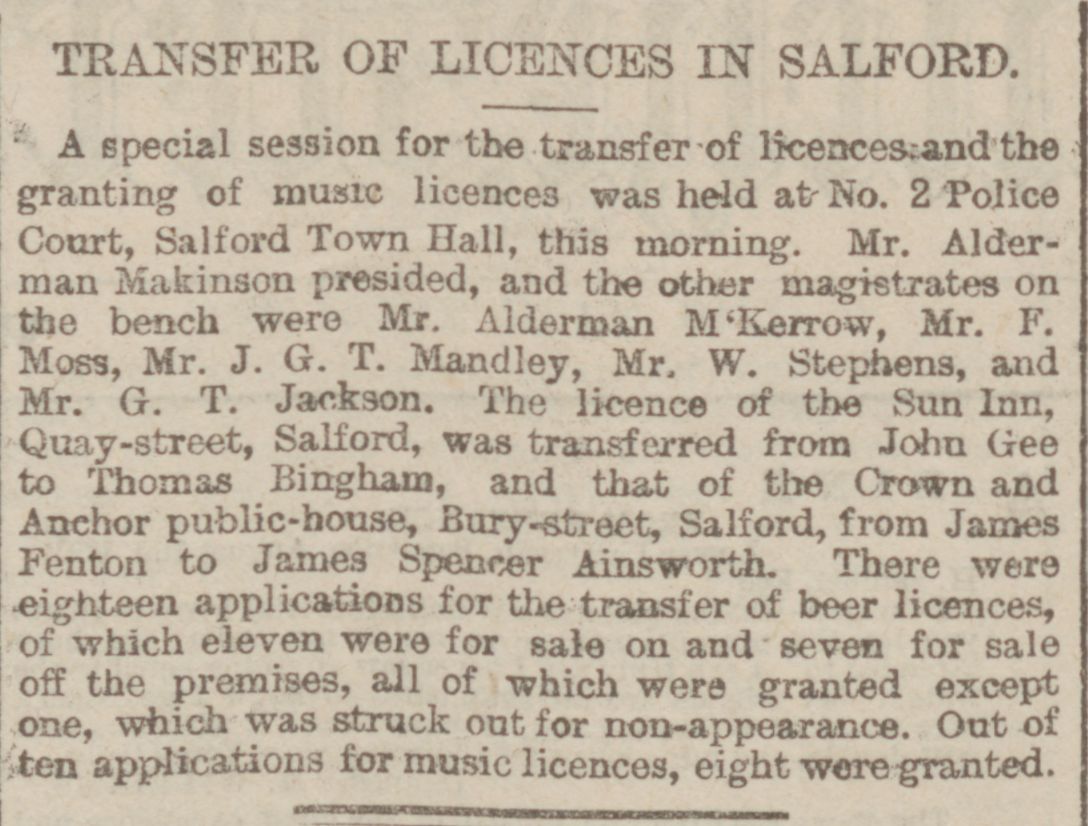
By 1895, in a city and county directory records him as the proprietor of the Crown and Anchor, 55 Bury Street, Manchester.
This was an interesting change from his earlier occupation as an iron moulder, maybe he thought he could provide for his family better.
James had moved from industrial work into the licensed trade, a change which would eventually bring him to the Old Ship Hotel in Chapel Street, Salford.
His own family was also changing. His father, Robert Ainsworth, died on 8 May 1899, aged 72.
Three years later James’s mother, Betty Rothwell, died on 29 March 1902, aged 75.
It was during this period of considerable personal change that James met Mary Alice Ashcroft.
Mary Alice Ashcroft.
Mary Alice Ashcroft was born in September 1867 in Salford, the daughter of Richard John Ashcroft and Sarah Jane Taylor.
Her father was 25 and her mother 29 when Mary Alice was born.
Mary Alice grew up in Salford as part of a large family.
Her siblings included:
Margaret Ann Ashcroft, born 14 September 1871
Sarah Jane Ashcroft, born 1872
Emily Ashcroft, born 1875
Richard John Ashcroft, born 1877
In the 1881 census, Mary Alice was fourteen and living in Salford with her family. Her occupation was recorded as domestic servant.
By 1891 she was still living in Salford, recorded as the daughter of the household.
Herbert Ainsworth or maybe Ashcroft?
Then Mary Alice had a son, Herbert, he was born as Herbert Greaves Ashcroft, on 21 March 1901 at 190 Bedham Road, Newton, North Manchester. Was the name he was given a clue to his father’s identity? Mary Alice, was unmarried and a Barmaid at the time.

This information above was a huge breakthrough in my research of this family.
I originally had Herbert possibly emigrating to America after the 1921 census, getting married and having two children there. It looked the obvious Herbert in the records.
BUT for me it just didn’t feel right, the more I looked at his name the more I questioned it.
So I searched out everything I could to give me more facts in the records in America, hoping that might lead me to a yes or no!
First he said he was born in June 1901, that didn’t match with the 1921 census. (On 1921 census it says he was 20 years and 3 months old, so he would have been born approximately between 20 February 1901 and 19 March 1901). Then a revelation, his mother’s maiden name was Hardy!
Yes, there was an Ainsworth that married a Hardy in the area of Manchester, and at the same time, but they were still living when he was listed as Mary Alice’s son and I couldn’t find a connection between the families.
So I started again with Herbert from scratch, and his birth, if he wasn’t adopted then he most likely would have been born to Mary Alice Ashcroft before her marriage as a spinster to James Spencer Ainsworth, and Herbert took on the name of Ainsworth when the couple married.
Searching through the birth records for a Herbert Ashcroft, I hadn’t found another Herbert Ainsworth previously, there was just one in 1901, registered in Prestwich (North Manchester) that didn’t have a maiden name listed on the GRO, so likely born to an unmarried mother.
I took a chance that it was correct as I didn’t want to spend a fortune on birth records, I was so lucky that I got it right first time! After that I found a Baptism record for Herbert.
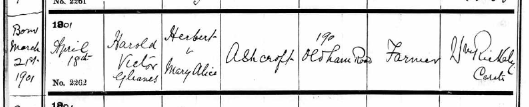
Following this I found his marriage record, and everything started to slot into place. He has changed his surname back to his birth name of Ashcroft.
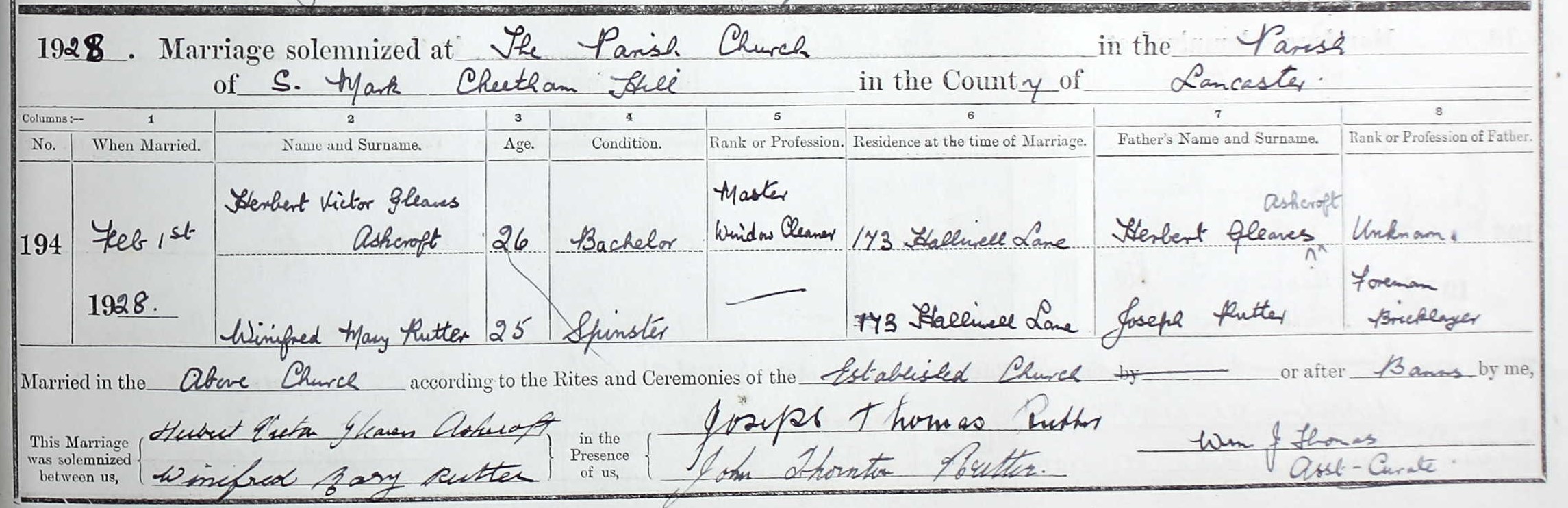
There are a few Herbert Greaves in the area in and around Manchester, so that may well be correct, one actually died in 1902 aged 31, of course I have no idea which one was correct.
Herbert’s wife Winifred Mary Rutter was born on 2 April 1902 in Manchester, Lancashire, her father, John, was 36, and her mother, Mary, was 33.
She married Herbert Victor Gleaves Ashcroft (Ainsworth) on 1 February 1928 in Cheetham, Lancashire. She died in April 1997 at the age of 95.
They’ll be more about Bert and Winnie, as they were known locally, further down the blog.
James and Mary Alice.
On 3 September 1902, James Spencer Ainsworth and Mary Alice Ashcroft married at Christ Church, Timperley, Cheshire.
James was 43 and Mary Alice was 35.
They had one child together:
James Douglas Ainsworth, born 9 June 1904 in Salford.
James Douglas was baptised on 27 July 1904 at Christ Church, Timperley.
For Mary Alice, the marriage brought her into the Ainsworth family and gave her a husband who was already an experienced publican.
But their married life would be tragically short.
The tragedy at the Old Ship Hotel.
This small newspaper cutting provides the most dramatic and personal piece of evidence in this family story.
The report appeared in the Manchester Courier on 6 February 1907, under the local news. It reads:
“Yesterday morning Mr. James S. Ainsworth, the licensee of the Old Ship Hotel, Chapel-street, Salford, fell down his cellar steps and was so seriously injured that he died almost immediately.”
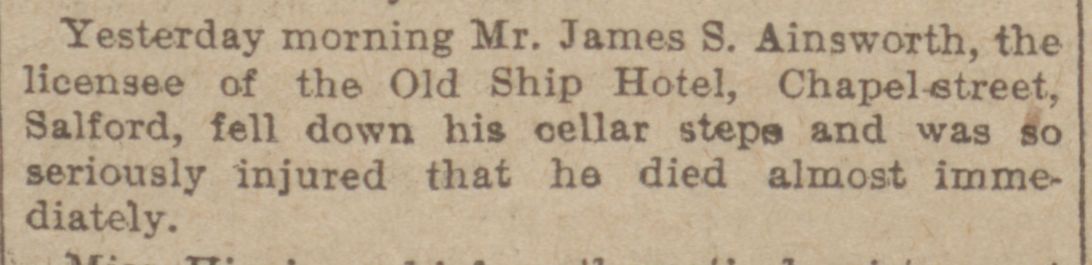
Published Wednesday, 6 February 1907.
It is a remarkably brief report, but those few lines tell us something that cannot be obtained from a census entry alone.
James was not simply recorded as having died in Salford. He died at the premises where he worked, the Old Ship Hotel in Chapel Street, following a fall down the cellar steps.
The tragedy must have been devastating for Mary Alice.
James was only 48 years old.
His youngest child, James Douglas, was not yet three years old.
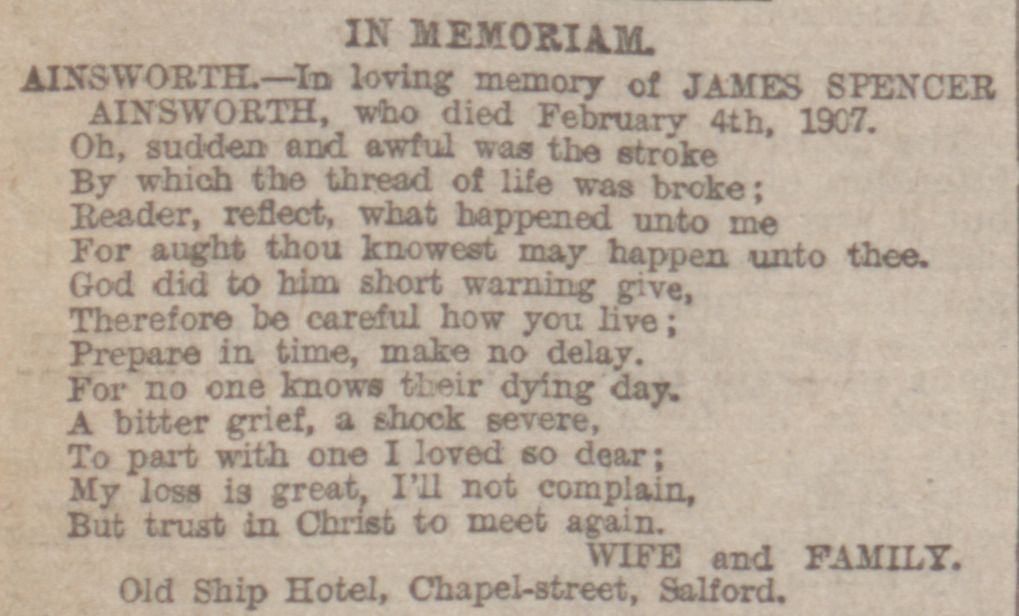
The family information records James’s death as 4 February 1907 in Salford, followed by his burial at Eccles on 8 February 1907. Probate was recorded on 12 March 1907.
The newspaper cutting gives a slightly different indication of the date because the report, dated 6 February, says the accident happened “yesterday morning.” A small discrepancy without the original death certificate.
Whatever the precise date of the accident, the outcome was the same: Mary Alice was suddenly widowed and left to raise a young family without James.
Nevertheless as his life partner she decided to take on the license herself after he died.
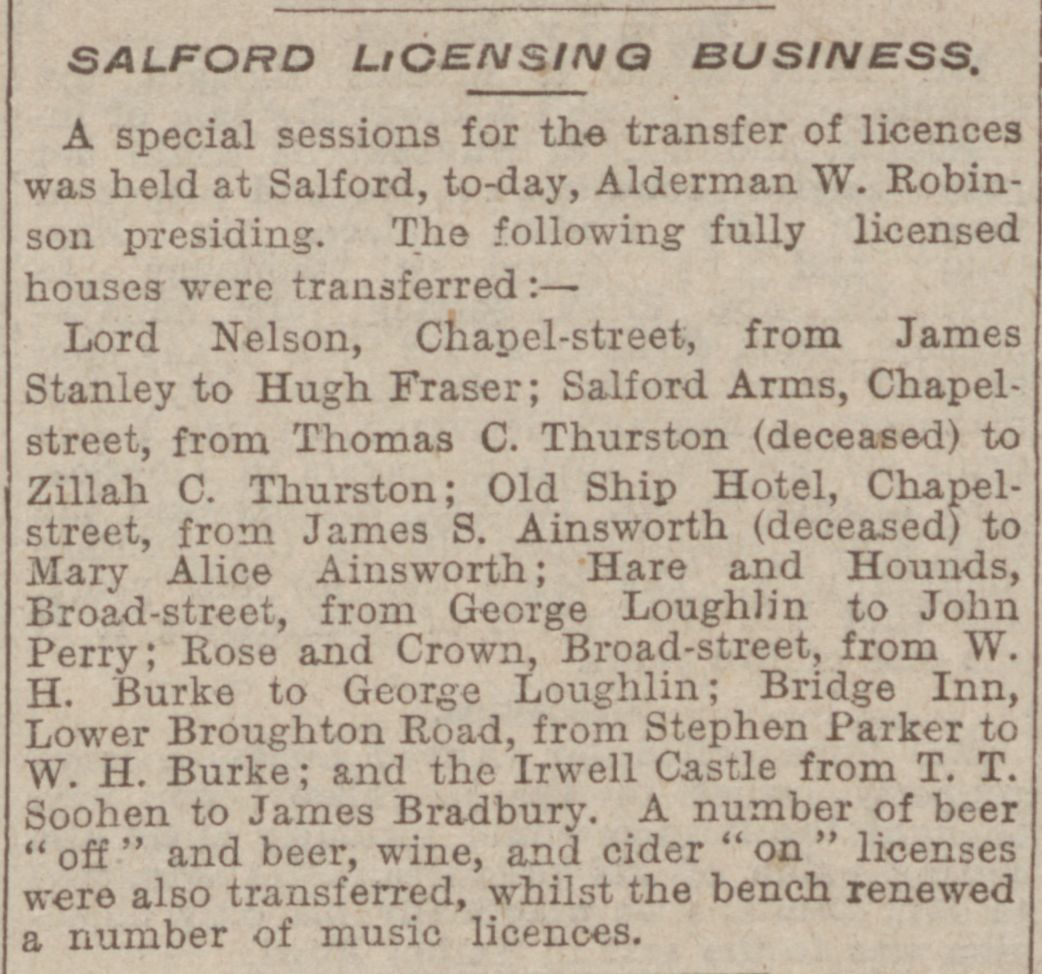
But she and the family obviously missed James very much.
Mary Alice, the widowed hotel manageress.
Just four years later, the 1911 census provides a fascinating glimpse into Mary Alice’s life.
On 2 April 1911, Mary Alice, aged 43, was living at:
The Old Ship Hotel, 17 Chapel Street, Salford.
She was recorded as:
Widow. Head of household. Hotel Manageress.
This is one of the most remarkable details in the story.
Following the sudden death of her husband, Mary Alice had not simply left the licensed trade. She was still running the hotel herself.
Her young son James Douglas, aged six, was also living with her. The census records him as her son.
Mary Alice was therefore still managing the Old Ship Hotel while bringing up her young family.
A second marriage.
Mary Alice’s life changed again later in 1911.
In June 1911, she married Joseph Taylor in Salford or did she?
I found a marriage between a Mary Alice Ainsworth and a Joseph Taylor after the 1911 census, so thought it was her, but then after more research, I finally found on Find A Grave a Joseph Taylor and wife Mary Alice Taylor, they died in Crumpsall, Manchester and she died in 1928, ten years before the correct Mary Alice.
So here’s my theory, as I have found no other possible marriage, I think for some reason she decided to take on her Mother’s maiden surname when she moved away from the Old Ship Hotel and became Mrs Mary Alice Taylor. But I cannot be certain.
By the 1921 census, Mary Alice was living in Lancashire and was recorded as married and working as a houseworker, with the household headed by her.
Her potential husband Joseph was not with her and so far I’ve been unable to identify him without a marriage certificate.
Her probate record also only mentions her son James Douglas and not her husband.
She was still alive to see her children grow into adulthood.
Her son James Douglas Ainsworth, eventually married Belinda Wallwork in Manchester in April 1927.
They had one son, Geoffrey Douglas Ainsworth, born in Manchester in July 1928.
Yay, I found the Geoff mentioned on the backs of the photos.
James Douglas worked as an electrical engineer in 1921 and later, in 1939, was recorded as a telephone and telegraph fitter.
The later Ainsworth family.
James Douglas and Belinda remained married for 68 years.
Their son Geoffrey D Ainsworth, born in July 1928, married Marjorie D Gordon in Cheshire in April 1952. They had 3 children as far as I can see.
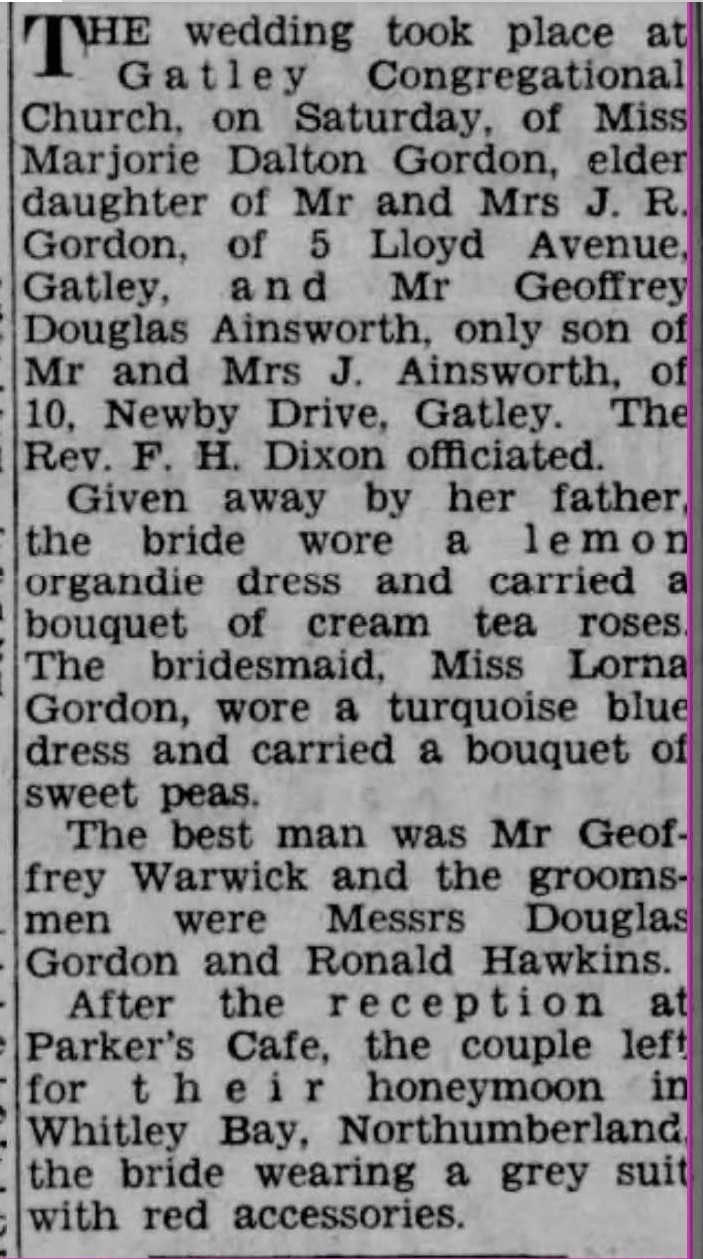
James Douglas Ainsworth died in August 1995 in Colwyn, Denbighshire, aged 91.
His wife Belinda survived him by several years and died in December 2002 in Colwyn, at the amazing age of 102.
So although James Spencer Ainsworth’s life ended tragically at only 48, his family line continued for many decades and still continues.
Mary Alice’s final years.
Mary Alice lived on for more than thirty years after James’s death.
Her brother William Charles Ashcroft died in January 1934 in Salford.
Mary Alice herself died on 18 July 1938, aged 70.
Her death was recorded at 20 Nell Lane, Manchester, and probate followed on 29 November 1938.
The probate record says that she left £7 13s 9d.
Her life had taken her from a childhood in Salford, through domestic service, motherhood, marriage to a publican, the sudden loss of her husband and the responsibility of running a hotel, before eventually entering a second marriage and seeing her son James Douglas establish his own family.
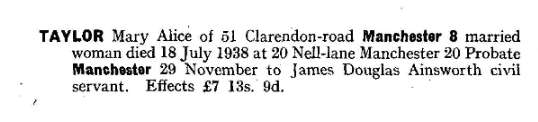
It took me a while to figure out when she died, as Taylor is not an uncommon name, but then I found the probate record on Find My Past thankfully.

Here’s the direct link to the public family tree I have compiled on Ancestry: Ainsworth J S Family Tree
The Old Ship Hotel, 17 Chapel Street, Salford.
A separate history.
The story of James and Mary Alice is inseparable from the history of the Old Ship Hotel at 17 Chapel Street, Salford.
The Old Ship was an established Salford public house long before James Ainsworth became its licensee. Local research places the pub at 17 Chapel Street by 1849, although its history as a licensed premises goes back considerably further. Research into the pub’s licensees has traced them back into the 1760s.
Pub Histories.
The Old Ship stood on Chapel Street on the approach towards Victoria Bridge, with Hatton’s Court alongside it. Hatton’s Court took its name from the Hatton family, who kept the Old Ship for approximately thirty years from 1807.
The surrounding area was a fascinating mixture of public houses, shops, courts, workshops and densely occupied housing.
A particularly interesting neighbouring building was an old timber-framed structure with lath-and-plaster walls, divided into five shops. One of these premises became the Fishermen’s Hut beerhouse around 1850. The adjoining shops and Fishermen’s Hut were eventually demolished in 1894.
The earlier Old Ship Hotel.
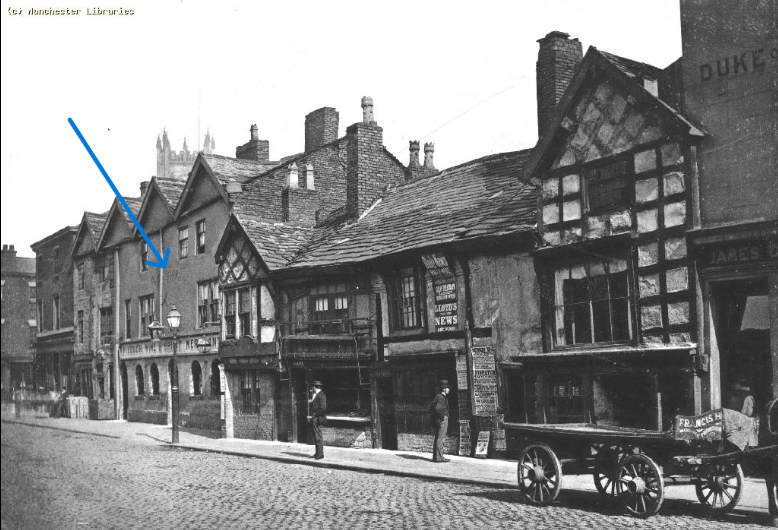
There is also this wonderful early photograph of Chapel Street, held by Manchester Libraries, Information and Archives, catalogue reference M77249.
Thanks to the work of Victorian photographer Alfred Brothers, we can still see the Old Ship Hotel and Chapel Street as they appeared around 1870- 1878, more than thirty years before James Spencer Ainsworth became its licensee.
https://creativecommons.org/licenses/by/4.0/
Local history researchers have identified the tall building in the photograph as the Old Ship and they date the image to approximately 1870. The photograph is credited to A. Brother.
With the help of ChatGPT I have found a copy of the original by Alfred Brothers.
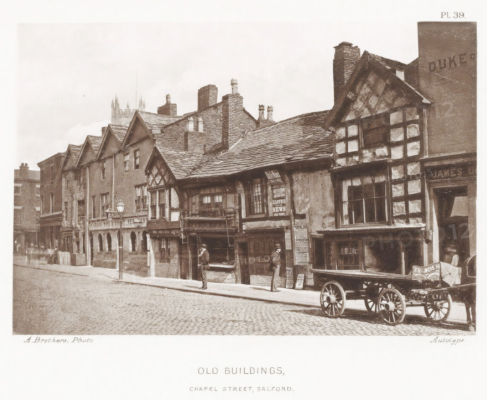
Reference LZT26A98_485
Alfred Brothers. Photographer of Victorian Manchester.
Alfred Brothers (1826–1912) was a remarkable Victorian photographer whose work gives us an invaluable visual record of nineteenth-century Manchester and Salford.
Born in Sheerness, Kent, on 2 January 1826, Brothers initially worked in the insurance business. By 1856, however, his interest in the relatively new art of photography had become his profession, and he established a photographic studio in St Ann’s Square, Manchester. His studio at No. 14 St Ann’s Square was to remain associated with his name for many years.
Brothers was far more than a conventional portrait photographer. He photographed the Manchester Art Treasures Exhibition of 1857, experimented with the use of magnesium light for photography, and became particularly interested in astronomical photography. His photographs of the solar eclipse of 22 December 1870 were used by astronomers in their study of the Sun’s corona.
His interests also took him underground. In January 1865 he photographed inside the Blue John Caverns in Derbyshire, using magnesium illumination. His work there has been described as one of the earliest, and possibly the earliest successful, underground cave photographs.
Brothers also photographed buildings and streets, making his work particularly valuable to anyone interested in the history of Victorian Manchester. In 1875, his name appeared as the photographer responsible for reproducing Old Manchester, a series of views showing ancient buildings in Manchester and its vicinity as they had appeared decades earlier.
It therefore seems very appropriate that his name should be associated with the old Ship Hotel in Chapel Street, Salford. The photograph which shows the Ship is catalogued by Manchester Libraries as “Chapel Street”, reference M77249, with the photographer credited as “A Brother”. Local historian Alan Jennings subsequently identified the Old Ship in the image and dated the view to around 1870.
Although the catalogue credit says “A Brother”, the evidence strongly suggests that this is Alfred Brothers. We can now add an interesting piece of supporting evidence: another historic view of Chapel Street is specifically catalogued as being photographed by “Brothers, Alfred”, dating from approximately 1868–1878.
So Alfred Brothers may have left us not just one glimpse of the Old Ship and its surroundings, but a wider photographic record of this fascinating part of Victorian Salford.
This is particularly significant because it shows the earlier Old Ship building, decades before James Ainsworth became its licensee.
1900–1911. The Old Ship rebuilt.
The Old Ship was rebuilt in 1900, creating the building that James Spencer Ainsworth would have known when he became its licensee.
Unfortunately, despite searching for a contemporary photograph, I have so far been unable to locate a surviving image showing the rebuilt Old Ship during the years when James and Mary Alice Ainsworth were associated with it.
The earliest photograph currently identified shows the earlier Victorian building, while later photographs record the post-war replacement.
Perhaps one day a photograph of the 1900 building will turn up in a local collection or family album.
That means the building in which James S. Ainsworth was working in 1907 was the newly rebuilt Old Ship, only about seven years old when he died.
James wasn’t simply working in an old Victorian pub, he was the licensee of the new Old Ship building erected around the beginning of the twentieth century.
And Mary Alice was still there four years later, managing the hotel in the 1911 census.
The Old Ship remained at 17 Chapel Street for many more decades. A 1929 directory records the address as:
Old Ship, 17 Chapel Street, Salford, Fred Walton Pritchard, licensee.
The later history of the building was much more turbulent. According to the local-history research, the rebuilt Old Ship survived until the Christmas Blitz of 1940, when it was destroyed. A new pub was subsequently built on the site during the mid-1950s.
The later Old Ship eventually disappeared too. The property at 17 Chapel Street was recorded as being sold in November 1999, and the pub was subsequently demolished.
Today, the original Old Ship is gone, but the address remains part of the documentary history of Chapel Street.
Bert and Winnie and the Horse Shoe Inn.
Sometime between his marriage in 1928 (he was a Master Window Cleaner) and 1939, Herbert took over the Horse Shoe Pub.
As on the 1939 Register he is listed as the “Licensed Publican at the Horse Shoe Inn, 34 Thomas Street, Salford. He was also a Senior ARP Warden.
Horseshoe Inn.
Lost Pubs of Manchester website: The Horseshoe Inn, Cheetham Hill.
By Neil Richardson (all information compiled and edited for my blog)
Standing at the corner of Thomas Street and Coke Street on the border of Broughton and Cheetham Hill, The Horseshoe Inn (often recorded simply as The Horseshoe or The Three Horseshoes) was a classic, old-school boozer that served as a core social hub for the local working-class community for over a century.
A Unique Neighbourhood Fixture.
The first records of the Horse Shoe date back to the 1850s, when it opened as a local beerhouse. Over the decades, it passed through several hands, owned by the Adelphi Street Brewery by the 1880s before moving under the umbrella of Yates’s Castle Brewery.
In 1924, ownership was taken over by Stockport’s family brewer, Robinsons Brewery. Locals fondly remember it as the only Robinsons house in the immediate vicinity, making it a unique stop for local beer drinkers. By the 1950s, it was a thriving ‘Robbies’ house, deeply embedded in neighbourhood life to the point of running its own local football team for residents and patrons.
The Surrounding Landscape.
The Horseshoe stood in a tightly-knit industrial and residential landscape of Victorian terraced housing. Right around the corner on Thomas Street and Cheetham Hill Road were several iconic local landmarks:
Cheetham Hill Methodist Primary School
The Globe Cinema (affectionately nicknamed “The Bug Hut” by locals)
Woolworths on Cheetham Hill Road
Closure and Demolition.
Like many traditional pubs in the area, the Horseshoe was caught in the sweeping slum clearances and urban redevelopment of the mid-20th century. Lost to a compulsory purchase order, the pub closed its doors for good in 1967 along with much of the surrounding Victorian streets, schools, and shops.
To replace the lost community hubs, The Kildare (often remembered locally as The Kildadkin) was built a hundred yards or so to the south for the newly constructed estate.
Today, while Coke Street still runs through part of Broughton near Cheetham Hill (though it no longer connects with St Mark’s Lane as it once did), the original street layout has completely changed. The historic footprint of The Horseshoe Inn now lies beneath modern developments.
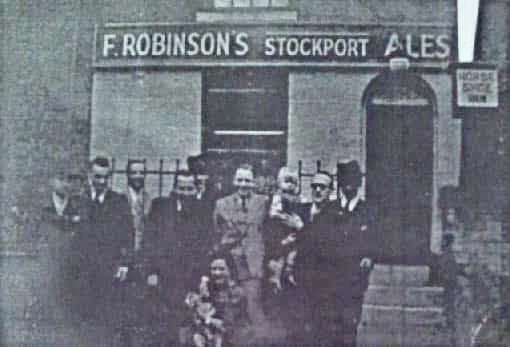
It’s a wonderful website with lots of information that also allows comments. The comments on this post were really interesting about people’s memories, especially the first one.
Lynn O’Shaughnessy left this comment on 30 October 2012.
Winnie and Bert Ashcroft ran the Horse Shoe Inn on Coke Street for years. Winnie was my great auntie as my Nanna was her sister.
Bert died young and so she, Auntie Winnie, carried on running it until she was moved out when they pulled it down.
She lived the rest of her life in Floral Court, Bury New Rd. She live until 95. An amazing lady she was.
Anonymous — 29 November 2024.
Remember this pub well as I played in the football team with mates Barry Holden, Alan McGinty, Stanley Morris and other great lads who my memory fails me.
I left the area in 1962 when the family moved to Hattersley a good way off 3 seperate buses to get there.
I had just started work at a box makers close to Colgate Palmolive near Old Trafford. So it was difficult to return as I had no car in those days.
I was sad to miss the comradeship and the crack of a Good Friday/Saturday night in this friendly pub.
Anonymous — 7 August 2026.
Alan McGinty and Barry Holden both went to north Salford secondary modern, Barry was a good footballer
Les Crook and Garry Stanton great players, both went to north Salford, Les played for Oxford Utd.
I love seeing and reading memories from people on these types of local posts.

You can contact me either by commenting here or via email at lynnswaffles@gmail.com
Till next time then……..

