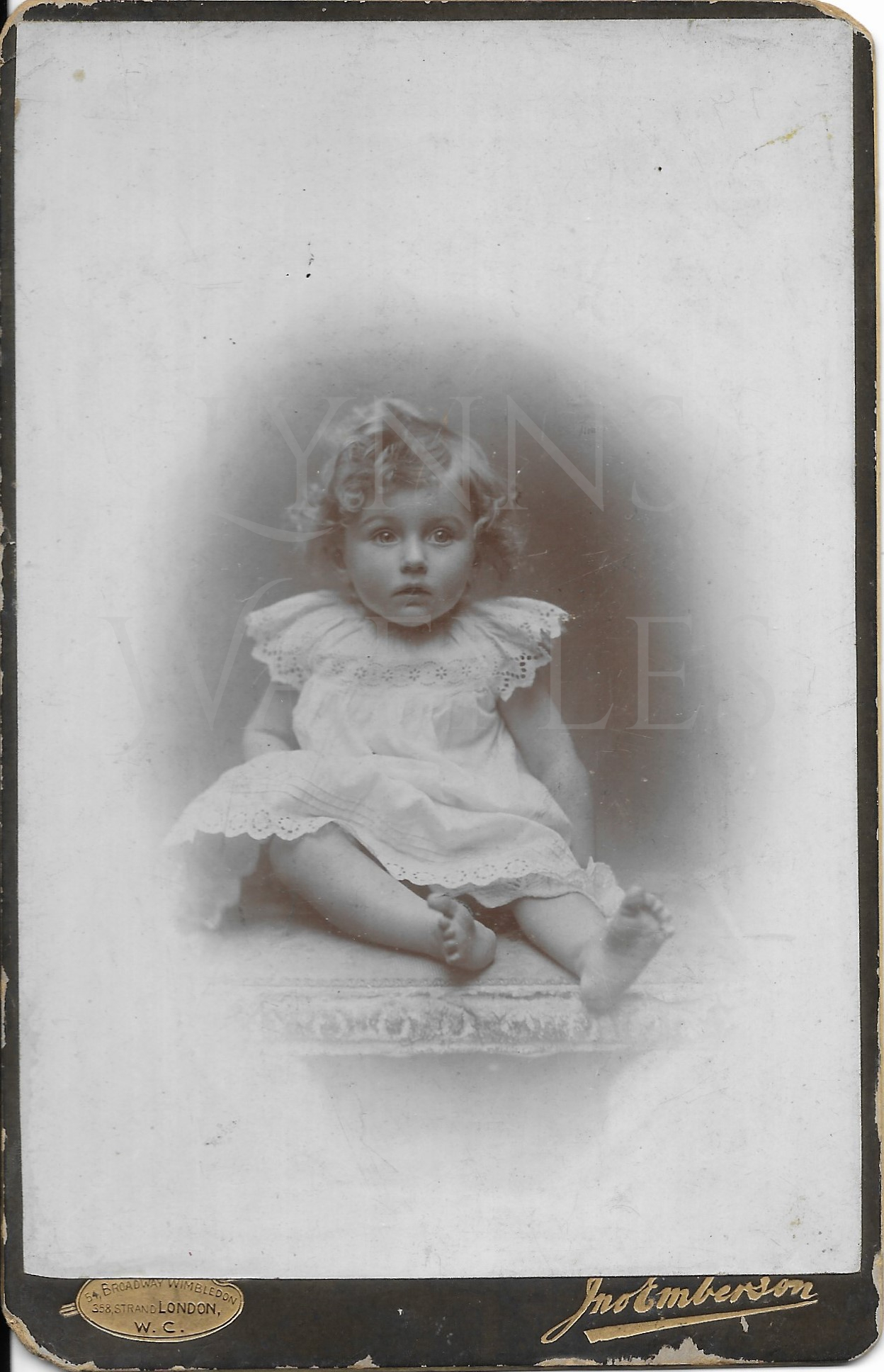
On Saturday, 21st December 2024, I made my first and only visit so far to Shoreham Postcard Fair, and it didn’t disappoint. I came away with a great haul of old photos and a few old postcards. This beautiful cabinet card was one of my finds that day.
Little did I know what this gorgeous little girl would become.
Obviously, I had no idea at the time who she was. But what a find! Keep reading to find out her story.
Birth registration record: BAKER, VIOLETTE MURIEL DONEY. GRO Reference: 1905 D Quarter in KINGSTON Volume 02A Page 409.
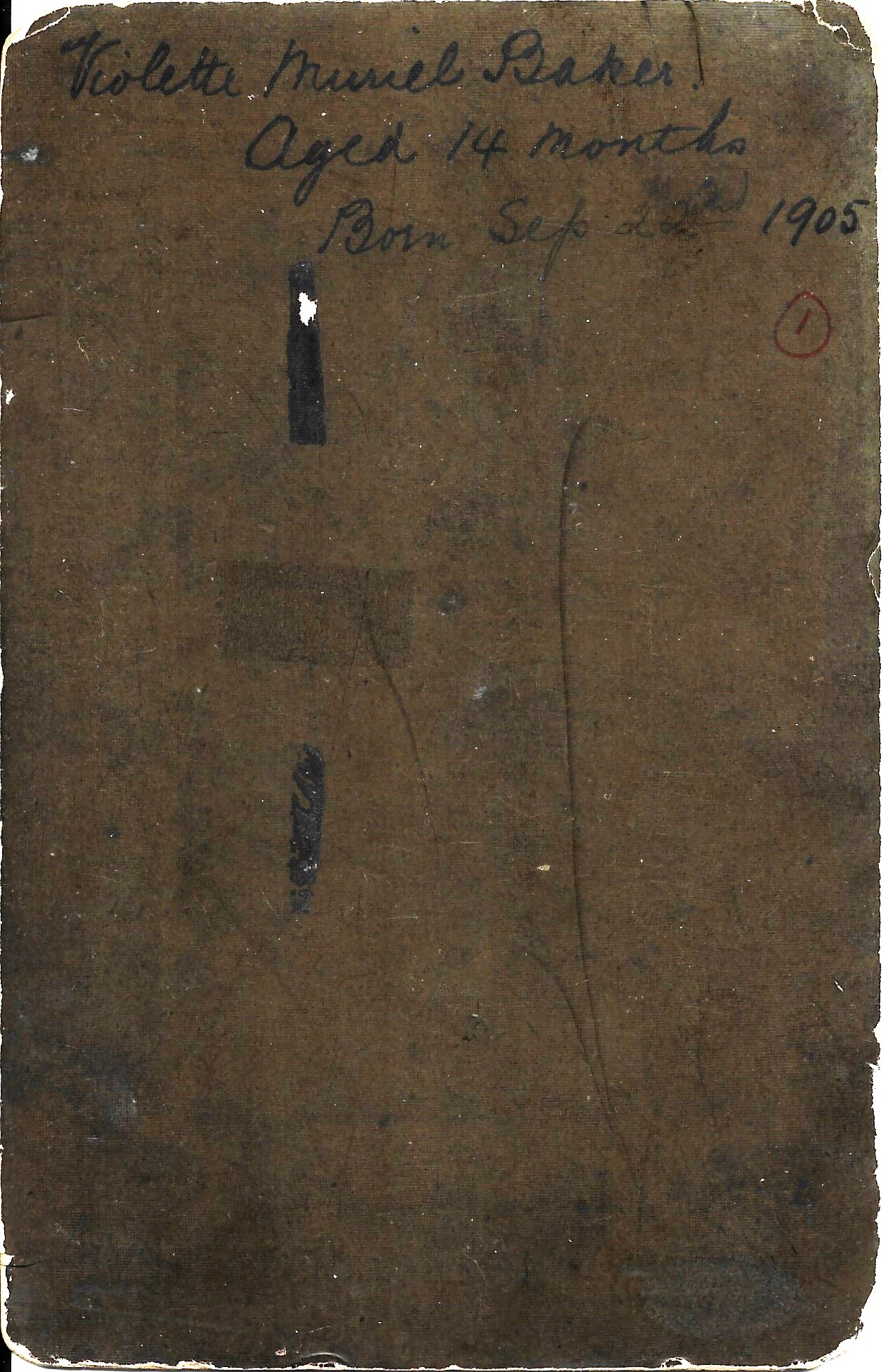
I’ve played about with the contrast and brightness on this scan of the back view of the cabinet card to be able to read this, and you can now see Violette Muriel Baker. Aged 14 months. Born September 22nd 1905.
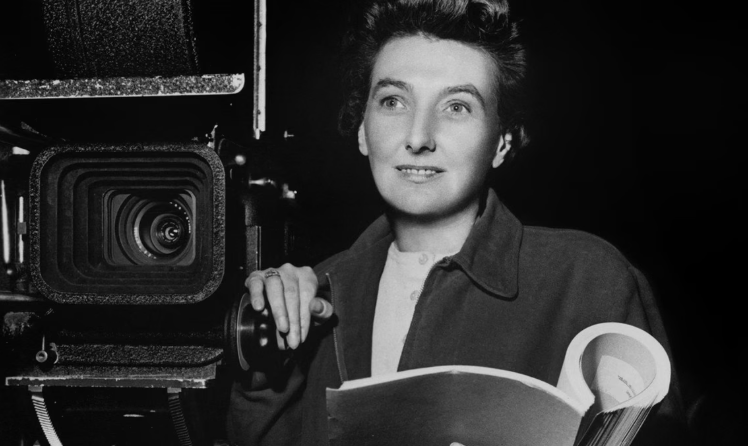
I’ve written this blog about Violette Muriel Baker in two parts, the first is more about the lady she became and her career and the second part is all about her Family History.
Violette Muriel Baker. The Little Girl Who Became a Pioneer of British Cinema.
When I look at this super photograph of a little girl, just 14 months old, it is extraordinary to think about the life that lay ahead of her.
Her name was Violette Muriel Baker, although she would become much better known as Muriel Box, one of the most remarkable and, for many years, overlooked women in the history of British cinema.
She was born on 22 September 1905 at Simla, Poplar Grove, New Malden, Surrey, the third child of Charles Stephen Baker and Caroline Beatrice Doney.
Her father worked as a clerk for the South Western Railway at Waterloo, while her mother had been a pupil teacher, a maid and even an assistant in a magic-lantern shop.
The family was what Muriel herself would later describe as living in “respectable poverty”. Yet it was a household in which ideas, curiosity and independence were encouraged. Her mother in particular held progressive, left-wing views, which were to influence Muriel throughout her life.
The family called the little girl “Tiggy”.
Muriel attended St Matthew’s School at Tolworth before moving to Holy Cross Convent in Wimbledon in 1915. Her time there did not last long. She was expelled, largely because she had not been baptised, and subsequently transferred to Surbiton High School.
It was during these childhood years that another passion began to take hold.
Muriel loved the cinema.
She regularly went to the pictures and became fascinated by the world of moving images. She even admitted to secretly reading Picture Show magazine beneath her school desk. She dreamed of somehow working “on the films”, although, as she later recalled, the idea that she might one day become a film director would have seemed completely “outlandish”.
She initially imagined herself in front of the camera rather than behind it. She took ballet lessons and studied drama with Sir Ben Greet, while also making unsuccessful attempts to become a professional actress and ballet dancer.
But it was behind the scenes that her future was waiting.
In the 1920s, Muriel met Joseph Grossman of Stoll Pictures, which led to her appearing as an extra in The Wandering Jew and in the thriller series The Old Man in the Corner.
Then, in 1929, she left a typing job at Barcley Corsets in Welwyn Garden City and entered the scenario department of British Instructional Pictures.
As the new era of talking pictures arrived, Muriel was given the rather unglamorous job of reading unsolicited manuscripts. Yet this apparently modest position gave her something far more valuable: an opportunity to learn how stories and dialogue worked.
She progressed to become a continuity clerk on Anthony Asquith’s Tell England (1931) and then moved to British International Pictures at Elstree, where she worked on Alfred Hitchcock’s Number Seventeen (1932).
She was steadily learning her craft.
It was also around this period that she met the man who would become both her husband and her most important professional collaborator.
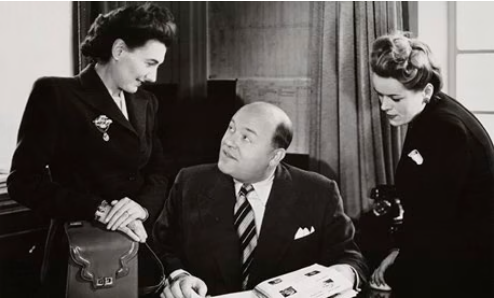
Sydney Box.
Muriel met journalist Sydney Box at an awards ceremony connected with amateur theatre. When they first met, Sydney had little experience of the film world, whereas Muriel already had considerable practical experience of working on film sets and was working in the Wardour Street offices of producer and director Michael Powell.
They began corresponding, with Sydney writing to Muriel that it was “tremendously refreshing” to come into contact with someone in the film world.
Their relationship developed quickly. Sydney eventually moved into Muriel’s bedsit, and their personal and professional partnership would last for 36 years.
They married in 1935.
Together they discovered a remarkable talent for playwriting, producing nearly forty short plays, many of them written specifically for amateur theatre groups and featuring predominantly female roles.
The following year, in 1936, their daughter Leonora was born.
Then came the Second World War, and another important turning point.
Wartime films.
Muriel and Sydney established their own production company, Verity Films. Initially the company made short wartime propaganda and public-information films.
For Muriel, this provided her first real opportunity to direct.
In 1941, she directed The English Inn, a short film produced for the British Council. It was credited to her at the time as Muriel Baker.
The wartime shortage of male directors also opened doors that might otherwise have remained firmly closed to women. Muriel herself later believed that she probably would not have had the opportunity to direct documentaries during the war “but for the scarcity of male directors”.
The Boxes eventually moved into fiction, and in 1945 came the film that changed everything.
The Seventh Veil
Muriel and Sydney co-wrote The Seventh Veil, a powerful romantic melodrama dealing with psychiatry, trauma and obsession, starring Ann Todd and James Mason.
It became a spectacular success.
The film was the highest-grossing British film of 1945, selling nearly 18 million cinema tickets in Britain. In the United States alone it took more than a million dollars against a production budget of approximately £92,000.
Then came the ultimate recognition.
At the Academy Awards, Muriel and Sydney won the Oscar for Best Writing, Original Screenplay.
Muriel became the first woman to win the Academy Award for Best Original Screenplay.
The achievement was extraordinary, but it was only the beginning of what she would accomplish.
The success of The Seventh Veil brought Sydney to the attention of the Rank Organisation, which appointed him to run Gainsborough Pictures. Muriel became head of its scenario department.
She was now working at one of Britain’s major studios.
Gainsborough and the road to directing.
At Gainsborough, Muriel wrote scripts at remarkable speed, including a number of light comedies and two films for the young star Petula Clark, Easy Money and Here Come the Huggetts, both released in 1948.
She also worked as a dialogue director and sometimes re-shot scenes during post-production.
Her screenwriting credits accumulated rapidly. Among her work during these years were The Years Between, When the Bough Breaks, Holiday Camp, Dear Murderer, The Brothers, The Man Within, A Girl in a Million, Portrait from Life, Good-Time Girl, Daybreak, The Blind Goddess, Christopher Columbus and others.
But Muriel wanted something more.
She wanted to direct.
And this was where the barriers really began.
The British film industry was overwhelmingly male, and many producers simply did not believe that a woman had the “experience or knowledge” necessary to control a feature film.
One proposed project, a modern Romeo and Juliet story that Muriel had written in 1950, was abandoned after Michael Balcon questioned her competence to direct a large-scale production.
Her planned directorial debut on So Long at the Fair (1950) was another painful episode. Star Jean Simmons insisted that Muriel be replaced, and Simmons was powerful enough to get her way. Terence Fisher ultimately directed the film instead.
It was a particularly bitter irony: Muriel was not only facing opposition from men in the industry. At times, other women were among those who wanted her removed.
Later, Kay Kendall attempted to have Muriel replaced on Simon and Laura (1955), although on that occasion she was unsuccessful. Muriel Pavlow was also cited as having taken a similar stance.
The press did little to help. Newspapers were fascinated by the novelty of a woman directing films, but their coverage was frequently patronising rather than admiring.
One 1953 newspaper even joked that Muriel might win a directing prize at a foreign film festival, provided she changed her name to something like “Muriello Boxiana”.
Muriel nevertheless persisted.
Finally, her first feature.
In 1952, Muriel finally got her opportunity with The Happy Family.
Even then, precautions had to be taken.
The film was initially presented as a joint directing effort by Muriel and Sydney. But once filming began, Sydney quietly stepped away, leaving Muriel to direct the film herself.
When the truth emerged, one of the principal financial backers, John Woolf, withdrew.
Muriel carried on.
And she succeeded.
The Happy Family, an Ealing-style comedy about a working-class family trying to save their home from demolition during preparations for the Festival of Britain, proved successful enough to open the door that Muriel had spent more than twenty years trying to reach.
She was now 47 years old.
The little girl who had loved going to the cinema had finally become a feature-film director.
A woman making films about women.
Throughout her career, Muriel repeatedly returned to one subject above all others: The experience of Women.
Her films tackled subjects that were often considered uncomfortable, controversial or simply unsuitable for mainstream cinema.
Street Corner (1953) was particularly important. Based on an original screenplay by Muriel and Sydney, it explored the work of Britain’s female police officers and was the first film to focus specifically on women police officers.
Unlike many films of the period, it treated its women protagonists seriously, showing their courage, professionalism and capabilities.
Muriel was especially proud of the production because the technical crew she assembled was predominantly female.
In one of her diaries she wrote, as a lifelong feminist, that she was delighted to refute the idea that women could not work together harmoniously. She described Street Corner as the happiest and most carefree film she had made.
The press, however, did not always see it that way.
Headlines referred to “nymphs of the law” and “beauty on patrol”, while one critic complained about “too much girlish chit-chat”. Yet others recognised exactly what Muriel had achieved.
One male critic wrote that the film succeeded in making audiences love, respect and admire policewomen, while the distinguished critic Dilys Powell simply wished the film had been longer.
Muriel’s films continued to explore women, relationships and society.
The Beachcomber (1954), based on Somerset Maugham’s story Vessel of Wrath, starred Glynis Johns as a determined Welsh missionary alongside Donald Sinden and Robert Newton.
Eyewitness (1956) again worked with Donald Sinden and paid tribute to nurses, just as Street Corner had celebrated women police officers.
Then came two of Muriel’s most ambitious films.
The Truth About Women.
Muriel described The Truth About Women (1957) as “the film personally significant to me above all others.”
It was an ambitious, episodic story examining women’s lives and the status of women in different societies from the turn of the century onwards.
Its central message was that women should be regarded as equal partners in the business of life, rather than submissive wives.
The film featured Laurence Harvey, Diane Cilento, Julie Harris, Elina Labourdette and Mai Zetterling, and combined humour with a serious examination of gender inequality.
Muriel was deeply disappointed when the distributors, British Lion, refused to give the film a West End premiere. To her, it was yet another indication that the male-dominated industry remained uncomfortable with its subject.
The Passionate Stranger.
Also released in 1957 was The Passionate Stranger, and this has since become one of the films most admired by critics who have rediscovered Muriel’s work.
It is a wonderfully inventive mixture of reality and fiction.
A successful novelist, Judith, played by Margaret Leighton, is suffering from writer’s block. The arrival of an Italian handyman, Carlo, played by Carlo Giustini, inspires her to write a sensational romantic novel in which a character based upon Carlo becomes involved in an illicit affair and a plot to murder her husband.
When Carlo reads the manuscript, the film suddenly moves into Judith’s fictional world.
The picture even switches from black and white into colour.
Then it returns to reality, with Carlo mistakenly believing that the novel reveals Judith’s true feelings.
The result is both comic and remarkably sophisticated.
BFI writer Neil Young has described the film as one of the most fascinating and accomplished British films of its time, suggesting that its use of metafiction looks decades ahead of its era.
It is remarkable to think that a film made in 1957 could be experimenting with ideas that would feel entirely at home in much later cinema.
Controversy.
Muriel was never afraid of difficult subjects.
This Other Eden (1959) dealt with Irish politics, commemoration, hypocrisy and illegitimacy.
Too Young to Love (1960) was even more controversial. It dealt with teenage sex, abortion and syphilis, following a 15-year-old girl whose life becomes increasingly troubled after drifting into a world of alcohol, marijuana, parties and casual sex.
The subject matter caused considerable controversy, and the film was banned by several local authorities and caused trouble with certification boards.
Other films dealt with relationships, marriage and the continuing battle between the sexes.
Her films included Simon and Laura (1955), a satire on early television soaps; The Passionate Stranger (1957); The Truth About Women (1957); Subway in the Sky (1959); This Other Eden (1959); and Too Young to Love (1960).
Her final film was Rattle of a Simple Man (1964), starring Diane Cilento.
By then Muriel had directed a remarkable body of work.
Between 1952 and 1964, she became Britain’s most prolific female feature-film director, personally directing twelve fictional features, alongside shorter films and her earlier co-directing work on The Lost People.
She also directed the 1962 Children’s Film Foundation featurette The Piper’s Tune and the 1953 short A Prince for Cynthia.
But recognition remained elusive.
Muriel had hoped to work in Hollywood, but her agent could never persuade an American producer to employ her.
Her explanation was painfully simple:
The mere mention of her sex was enough to damage her prospects.
She later recalled that reviews of her films in America were consistently better than those she received in Britain, yet she could not break through the barrier.
The irony was extraordinary. She had won an Oscar. She had directed more British feature films than any other woman of her generation. She had worked in the industry for decades.
Yet she still had to prove that she belonged there.
The end of her film career.
After Rattle of a Simple Man received a disappointing reception in 1964, Muriel’s directing career effectively came to an end.
There was also profound personal upheaval.
Her marriage to Sydney Box ended in divorce in 1969, after 36 years together.
Sydney had fallen in love with another woman and eventually left for Australia with his nurse, whom their grandson Ben later remembered as a very glamorous, tall blonde.
Muriel wrote about the heartbreak honestly, but remarkably, she and Sydney remained on friendly terms. Their lives and work had become so intertwined that, as Muriel herself expressed it, their affairs were “inextricably entangled”.
The end of her marriage did not end her creativity.
Instead, Muriel turned increasingly towards literature.
Femina.
In 1965, just a year after directing her final film, Muriel co-founded Femina Books, a pioneering British feminist publishing company, eight years before the establishment of Virago Press.
For Muriel, publishing provided a more rewarding outlet for her feminism.
She wrote novels, including The Big Switch, which imagined a world dominated by women.
She also published her memoir, Odd Woman Out, in 1974.
The book was more than a record of her career. It was Muriel’s attempt to encourage other women not to give up when they felt discouraged or depressed.
She later wrote Rebel Advocate, a biography of her second husband.
In 1970, Muriel married Gerald Austin Gardiner, the former Labour Lord Chancellor. Their marriage appears to have brought her great happiness, which she described as being of “the kind most individuals aspire to but rarely achieve.”
Gerald died in 1990.
A grandmother’s films.
Muriel’s daughter Leonora became an artist, studying at the Royal Academy from 30 September 1957 until December 1960, and exhibiting at the Royal Academy of Arts exhibitions in both 1959 and 1960.
She later admitted that, when she was growing up, she did not fully appreciate what her mother had achieved.
“I know what a director does now,” she later reflected, “I didn’t place that much importance on it back then.”
Her grandson Charlie Dossett inherited boxes of Muriel’s papers and personal archive. Among them were detailed manuscripts and writings covering virtually every aspect of her life.
One manuscript, an inch thick, concerned Leonora’s birth and early life. Muriel had turned even the experience of having a baby into a story. Charlie read: “We were not lovers of children as such, but this did not prevent my desire to bring into the world a living thing, whose growth I could watch and tend and if the gods were kind I could appreciate with a modicum of joy.”
Her grandchildren also remembered something rather poignant.
Muriel would study the television listings and telephone them when one of her old films was being shown.
“One of my films is going to be on at 1.15 in the afternoon on Channel 5,” she might say. “Would you video it for me?”
This was, rather sadly, one of the few ways she could own or watch her own films.
A forgotten pioneer rediscovered.
Muriel Box died at Mote End, Nan Clark’s Lane, Mill Hill, Hendon, London, on 18 May 1991, aged 85.
At the time of her death, her extraordinary contribution to British cinema had largely slipped from public memory.
But gradually, that began to change.
In the 1980s, feminist film scholars began working to restore her reputation.
In 1991, filmmaker Carol Morley, then a film student, was offered £50 by a German women’s collective to make a film about Muriel. Morley travelled to Muriel’s home, but she was too ill to meet them. Muriel died only a few months later.
Years afterwards, Morley remained haunted by the missed opportunity.
She eventually returned to Muriel’s story, making the 2023 Radio 3 documentary Carol and Muriel.
While researching it, she met members of Muriel’s family, including her grandchildren, and discovered the remarkable archive of papers Muriel had left behind.
A particularly poignant connection came from Olivia Howell, Muriel’s great-great-niece, who contacted Morley from Australia at the age of just 16. Olivia said she was on a mission to spread the word about Muriel:
“If I can get one more person to learn about her today, that’s all I want!”
By then, Muriel’s reputation was beginning to travel far beyond Britain.
The San Sebastián International Film Festival held a major Muriel Box retrospective in 2018, screening 28 films from her career. The festival described her as a forgotten pioneer rescued from oblivion.
France and Spain later held sell-out retrospectives.
In Britain, however, serious recognition was much slower.
For many years Muriel had never received a retrospective in her own country.
That finally began to change in 2023, when the BFI held its first Muriel Box season at BFI Southbank, accompanied by the restoration and release of several of her films.
BFI curator Jo Botting has spoken enthusiastically about Simon and Laura, calling it the best British film of the 1950s and describing the reaction of young students seeing it for the first time as a revelation.
The rediscovery of The Passionate Stranger has been particularly striking. What was once regarded as an obscure curiosity has been reassessed as an extraordinarily ambitious and inventive film.
A remarkable legacy.
Muriel Box may never have directed what traditional film history would call a masterpiece.
Her films were often made quickly and cheaply, with limited budgets and tight schedules. Many were adaptations of stage plays and could feel visually restrained. Her strength was frequently in performances, dialogue and ideas rather than flamboyant visual style.
But perhaps that is precisely why her story matters.
She entered an industry that did not believe a woman should be directing feature films.
She worked her way up from extra, typist and secretary to continuity clerk, scriptwriter, producer, screenwriter and director.
She won an Academy Award.
She directed twelve solo fictional features between 1952 and 1964, more than any other British woman of her era.
She made films about women police officers when that was still regarded as a novelty.
She tackled teenage sexuality, abortion, syphilis, illegitimacy, Irish politics, gender inequality and the complicated relationships between men and women.
She established a feminist publishing house.
And throughout it all, she kept writing.
Perhaps the most fitting description comes from the BFI: although Muriel Box never directed a universally acknowledged masterpiece, her body of work remains one of the most significant achievements by a woman director in British cinema.
And now, more than thirty years after her death, people are finally beginning to look again.
Which brings us back to that tiny little girl.
Violette Muriel Baker was only 14 months old when this photograph was taken.
Nobody looking at her then could have known that this little girl would grow up to become an Oscar-winning screenwriter, a pioneering film director, a feminist publisher and one of the most prolific women ever to direct feature films in Britain.
For decades, much of her work was forgotten.
But she was never really gone.
Her films survived.
Her words survived.
Her family preserved her papers and memories.
And now her story is being rediscovered.
That makes this lovely photograph all the more special.
It is not simply a photograph of a Victorian-born child’s early life.
It is a photograph of Muriel Box before she became Muriel Box, before the films, before the Oscar, before the battles with the film industry, before Femina, before the recognition.
Just a little toddler called Violette Muriel Baker, known to her family as Tiggy, with her whole extraordinary life still ahead of her.
Muriel Box. Film & Writing Credits.
Muriel Box’s career in cinema stretched from the 1930s into the 1960s. She worked as a writer, continuity clerk, dialogue director and re-shooter before becoming a director herself. Her first directing work was the wartime documentary short The English Inn in 1941, credited as Muriel Baker, followed by The Lost People in 1949, which she co-directed with Bernard Knowles.
From 1952 onwards she established herself as Britain’s most prolific female feature-film director of her era.
Screenwriting Credits
- Alibi Inn (1935)
- The Seventh Veil (1945) – co-written with Sydney Box; winner of the Academy Award for Best Original Screenplay
- 29 Acacia Avenue (1945)
- A Girl in a Million (1946)
- The Years Between (1946)
- The Man Within (1947)
- The Brothers (1947)
- Dear Murderer (1947)
- Holiday Camp (1947)
- When the Bough Breaks (1947)
- Portrait from Life (1948)
- Easy Money (1948)
- Good-Time Girl (1948)
- Daybreak (1948)
- The Blind Goddess (1948)
- Here Come the Huggetts (1948)
- Christopher Columbus (1949)
- The Happy Family (1952)
- Street Corner (1953)
- The Passionate Stranger (1957)
- The Truth About Women (1957)
- Too Young to Love (1960)
Directing Credits
The English Inn (1941) – documentary short, credited as Muriel Baker
The Lost People (1949) – co-directed with Bernard Knowles
The Happy Family (1952)
Street Corner (1953)
A Prince for Cynthia (1953) – short
Beachcomber (1954)
To Dorothy a Son (1954) In 2012 To Dorothy a Son was, released on DVD.
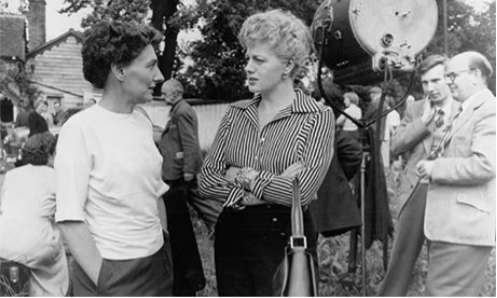
Simon and Laura (1955)
Eyewitness (1956)
The Passionate Stranger (1957)
The Truth About Women (1957)
This Other Eden (1959)
Subway in the Sky (1959)
Young to Love (1960)
The Piper’s Tune (1962) – Children’s Film Foundation featurette
Rattle of a Simple Man (1964) – her final film
Other Work in Film
Before becoming a feature-film director, Muriel worked in a variety of behind-the-scenes roles, learning practically every stage of film production. She worked as a continuity clerk on Anthony Asquith’s Tell England (1931) and later worked at British International Pictures at Elstree, including on Alfred Hitchcock’s Number Seventeen (1932).
She also worked in the scenario department, read and assessed unsolicited screenplays, developed dialogue and story-writing skills, worked as a dialogue director and occasionally re-shot scenes during post-production.
Her wartime work with Verity Films gave her valuable directing experience, while her extensive work on The Lost People (1949), concerning European refugees, resulted in her receiving a co-directing credit alongside Bernard Knowles.
Selected Films of Particular Importance
The Seventh Veil (1945)
The film that brought Muriel and Sydney Box their greatest success. Their screenplay won the Academy Award for Best Original Screenplay, making Muriel the first woman to win the award in this category.
The Lost People (1949)
A drama about European refugees and Muriel’s first co-directing credit on a full-length feature.
The Happy Family (1952)
Muriel’s first solo feature as director. She was 47 when she finally achieved the directorial career she had dreamed of since childhood.
Street Corner (1953)
A semi-documentary-style drama centred on women police officers. It was one of Muriel’s most important attempts to place women’s experiences at the centre of a mainstream British film.
The Beachcomber (1954)
An adaptation of Somerset Maugham’s Vessel of Wrath, filmed partly in Ceylon and featuring Glynis Johns, Donald Sinden and Robert Newton.
Simon and Laura (1955)
An acerbic satire of early television soap operas, starring Kay Kendall and Peter Finch.
Eyewitness (1956)
A crime drama which also pays tribute to the work and dedication of nurses.
The Passionate Stranger (1957)
One of Muriel’s most inventive films, blending reality, fiction, fantasy, black-and-white photography and colour. It has subsequently been reassessed by critics as one of her most accomplished works.
The Truth About Women (1957)
The film Muriel considered personally significant above all her others. A comedy with serious undertones examining the changing status of women and gender equality.
This Other Eden (1959)
A controversial drama dealing with Irish politics, memory, commemoration, hypocrisy and illegitimacy.
Too Young to Love (1960)
A controversial film addressing teenage sexuality, abortion and syphilis. Its subject matter resulted in bans by several local authorities.
Rattle of a Simple Man (1964)
Muriel’s final feature film, concerning the unlikely relationship between a football supporter and a sex worker. Following its disappointing reception, her directing career came to an end.
Beyond Cinema.
Muriel did not stop working when she left film-making.
In 1965, she co-founded Femina Books, a pioneering British feminist publishing company, eight years before Virago Press was established.
She continued writing novels and published her memoir Odd Woman Out in 1974, followed by Rebel Advocate, her biography of her second husband Gerald Gardiner, in 1983.
Her career therefore extended far beyond the cinema screen. She was a screenwriter, director, playwright, author, publisher and feminist campaigner, a woman who repeatedly created opportunities for herself in industries that were rarely prepared to make room for her.
Sources: Wikipedia, Encyclopedia.com, BFI ScreenOnline, The Times Literary Supplement, The Guardian online, and Kids. Kiddle online. Plus my own family history research.
The Baker, Doney and Box Families.
The family behind Violette Muriel Baker.
When I acquired the photograph of Violette Muriel Baker as a fourteen-month-old baby, I knew that there was a fascinating story waiting to be uncovered behind the little girl looking out from the photograph.
My previous story told the story of Violette Muriel herself and the remarkable life she would go on to lead. But photographs like this rarely tell us the whole story. Behind every child is a family, and by following Violette’s family backwards through the generations, a picture emerges of the Baker, Doney and Box families, their homes, occupations, marriages, children and movements through Surrey, Middlesex, Buckinghamshire, London and eventually Australia.
This is the story of the family surrounding that little Victorian and Edwardian photograph.
Stephen Baker, the beginning of the Baker family.
Stephen Baker was born in October 1843 at Brentford, Middlesex, the son of Charles Baker, aged 25, and Harriet Sanders, aged 28.
He was baptised on 5 November 1843 at Holy Trinity, The Green, Twickenham, Middlesex.
Stephen grew up in the Hampton and Twickenham area. His younger brother James Baker was born in 1849 at Twickenham, when Stephen was six, followed by another brother, Henry, born in 1851 at Hampton, and William, born in 1854, also at Hampton.
The 1851 Census found Stephen, aged eight, living at Hampton, Middlesex, as the son of the household. Ten years later, in 1861, he was still living in Hampton. By then he was aged 18 and working as a gardener-journeyman.
Gardening would remain an important part of Stephen’s working life.
Marriage and a growing family.
Stephen married Louisa Cowen, who was born in 1837. Together they would have seven children, one son and six daughters, between 1867 and 1881.
Their first child was Edith Louisa Baker, born on 5 April 1867 at Kingston, Surrey.
Two years later, on 8 November 1869, their only son, Charles Stephen Baker, was born at Surbiton, Surrey. Charles would become particularly important to the story because he was the father of little Violette Muriel Baker.
The family was living in Surrey by 1871. The Census describes Stephen as the head of the household and gives his occupation as gardener-servant.
Another daughter, Emily Elsia Baker, was born in 1871 at Kingston, Surrey, followed by Catherine Harriet Baker, born on 7 June 1872 at Kingston.
Then, in September 1875, the family suffered a devastating loss.
On 5 September 1875, twin daughters Violet Baker and Daisy Baker were born at Surbiton, Surrey. Tragically, both little girls died just two days later, on 7 September 1875, in Surbiton.
They had lived for less than a week.
Stephen and Louisa later had another daughter, Clarice Mabel Baker, born on 5 January 1881 at Kingston, Surrey.
Their seven children were therefore:
Edith Louisa Baker, 5 April 1867 – 16 April 1909
Charles Stephen Baker, 8 November 1869 – 12 March 1945
Emily Elsia Baker, 1871 – 28 April 1943
Catherine Harriet Baker, 7 June 1872 – 1948
Violet Baker, 5 September 1875 – 7 September 1875
Daisy Baker, 5 September 1875 – 7 September 1875
Clarice Mabel Baker, 5 January 1881 – 1969
The loss of the two baby girls, Violet and Daisy, is particularly poignant when we later encounter another little girl in this family who was given the name Violet, Violette Muriel Baker, born in 1905.
Stephen Baker, gardener and family man.
By 1881, Stephen and Louisa were living at Kingston upon Thames, Surrey. Stephen was the head of the household and his occupation was recorded as Gent’s Gardener.
In 1891, the family was living at Paragon Place, Christchurch, Kingston, and Stephen was described as a Gardener & Servant.
By 1901, Stephen was living in Surbiton, Surrey, again as head of the household.
After more than forty years of marriage and family life, tragedy came in 1908 when Louisa died.
Louisa Cowen died on 2 January 1908 at Surbiton, Surrey, aged 71.
The following year Stephen suffered another loss when his eldest daughter, Edith Louisa, died on 16 April 1909 at Surbiton, aged only 42.
The 1911 Census shows Stephen, now a widower aged 68, living in Surbiton. He was still working, his occupation recorded as Gardener Domestic.
He would live for another twelve years.
His brother Charles Baker died on 19 January 1916, aged 72, in Kingston upon Thames.
By 1921, Stephen was living in Kingston upon Thames as a boarder.
Stephen Baker died on 17 October 1923 at Kingston upon Thames, Surrey, aged 80.
He was buried on 21 October 1923 at Kingston upon Thames.
Interestingly, probate was not granted until 20 April 1936, in London.
Stephen had lived through an extraordinary period of change – from his birth in 1843, through the Victorian era and into the twentieth century. His working life as a gardener had taken him through Hampton, Kingston, Surbiton and the surrounding Surrey area, while his children established families of their own.
And it was his son Charles who would take the Baker story forward to the next generation.
Charles Stephen Baker.
Charles Stephen Baker was born on 8 November 1869 at Surbiton, Surrey, the only son of Stephen Baker and Louisa Cowen.
He was just two years old when his sister Emily Elsia was born in 1871, and two when Catherine Harriet arrived in June 1872.
At the age of five he witnessed the heartbreaking loss of his twin sisters Violet and Daisy, who were born and died within two days in September 1875.
His youngest sister, Clarice Mabel, was born on 5 January 1881, when Charles was eleven.
The 1881 Census records Charles, aged 12, living at Kingston upon Thames with his family and described simply as a scholar.
Ten years later, in 1891, Charles was aged 22 and working as a railway clerk.
The railway was to become the defining feature of his working life.
Charles and Caroline.
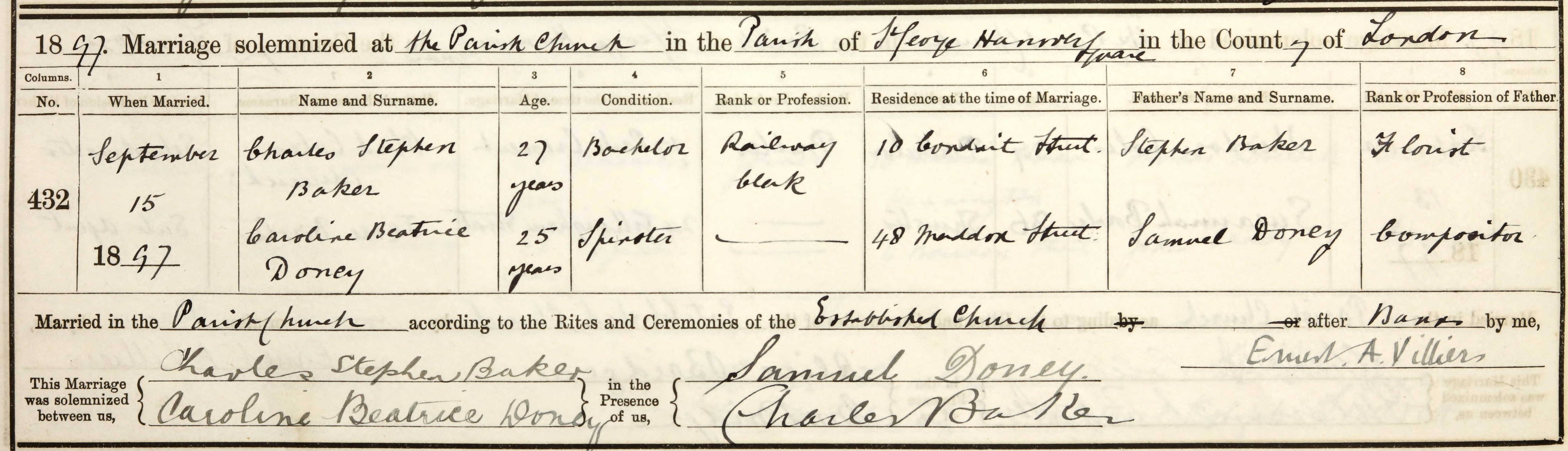
In 1897, Charles married Caroline Beatrice Doney.
The marriage was registered in the July quarter of 1897 at St George Hanover Square, London, while a further record gives the specific date as 15 September 1897, at St George, Hanover Square, Westminster.
Charles was 27 and Caroline was 25.
Caroline came from an interesting family herself.
She was born on 12 May 1872 at Colnbrook, Buckinghamshire, the daughter of Samuel Doney and Caroline Tyler.
Her younger sister, Nellie Maud Doney, was born on 3 August 1873 at Colnbrook.
Caroline’s childhood had been spent partly in the world of public houses, because her father Samuel was a licensed victualler.
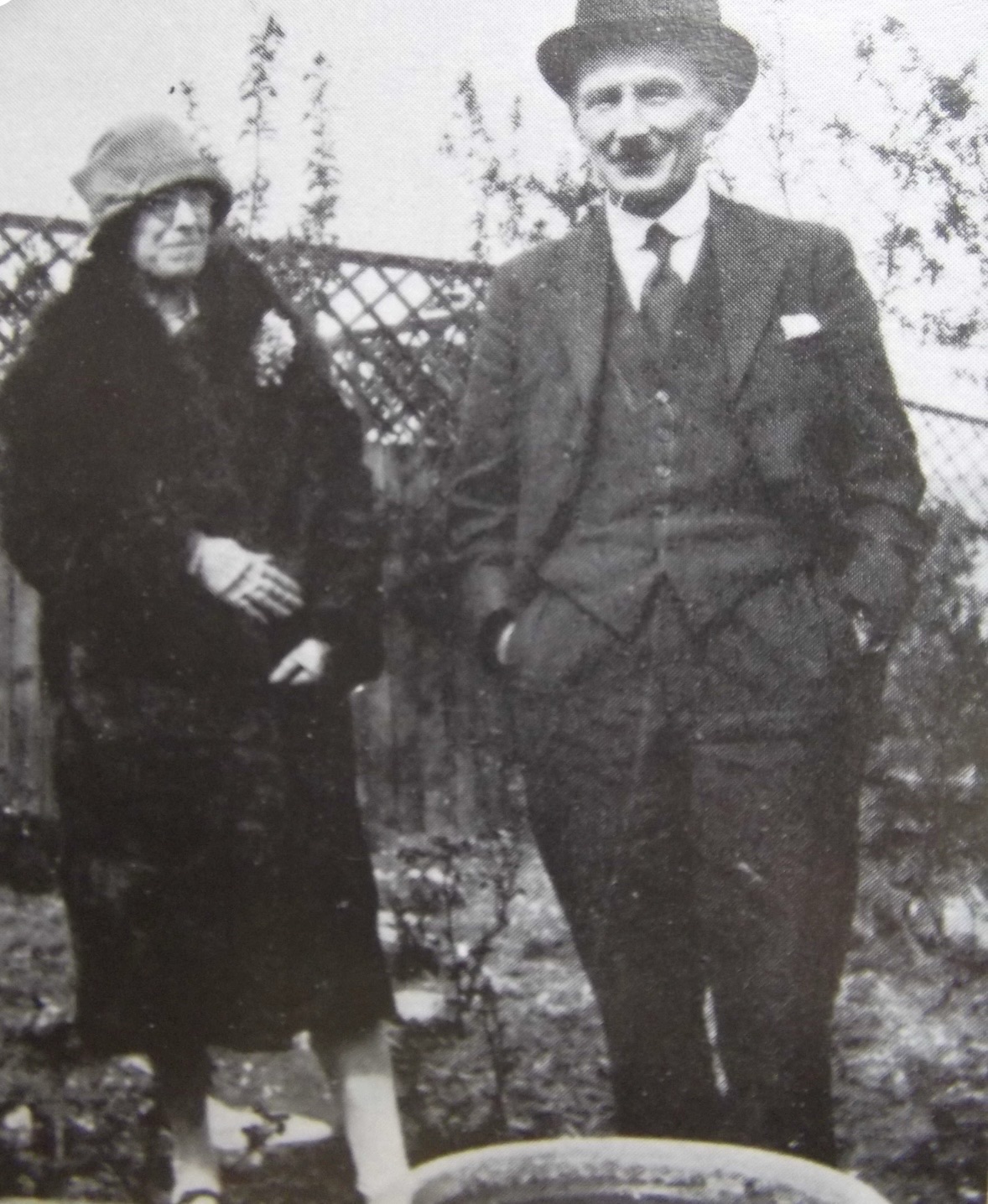
Charles and Caroline began their married life in Surrey and would have three children:
Constance Vera Baker, born 16 July 1898
Vivian Charles Baker, born 6 September 1900
Violette Muriel Baker, born 22 September 1905
And it is with Violette Muriel that my original photograph story begins.
Caroline Beatrice Doney and the Doney family.
To understand Caroline’s story, it is worth going back another generation.
Her father, Samuel Doney, was born in 1847 at Little Marlow, Buckinghamshire, the son of Samuel Doney, aged 48, and Ann, aged 41.
The 1851 Census found Samuel, aged four, living at Little Marlow as the son of the household. In 1861, aged 14, he was still in Little Marlow, in the Oxford area.
Samuel married Caroline Tyler at Staines, Middlesex, when he was 23. The records gives their marriage as 10 February 1870.
Later in that same year, Samuel’s life took an interesting turn.
On 5 October 1870, the licence of the George Inn at Colnbrook was transferred from Francis Dunn to Samuel.
Just seven weeks later, on 24 November 1870, his first daughter, Florence Minnie Frances Doney, was born at Colnbrook.
The 1871 Census shows Samuel, aged 24, as the head of the household at Colnbrook St Thomas, working as an Innkeeper/Publican at the George Inn.
The George Inn was at what is now recorded as 146 High Street, Colnbrook, Slough.
However, Samuel’s time there was relatively short. On 10 May 1871, the licence was transferred from Samuel to Cornelius Denyer.
Samuel and Caroline’s second daughter, Caroline Beatrice, was born on 12 May 1872 at Colnbrook, followed by their third daughter, Nellie Maud, on 3 August 1873.
Samuel subsequently became associated with another public house, the Swan at Egham.
On 4 September 1875, he was given permission to keep the Swan open until 11 pm, and a newspaper report dated 27 April 1878 mentions Samuel at the Swan Hotel, Egham.
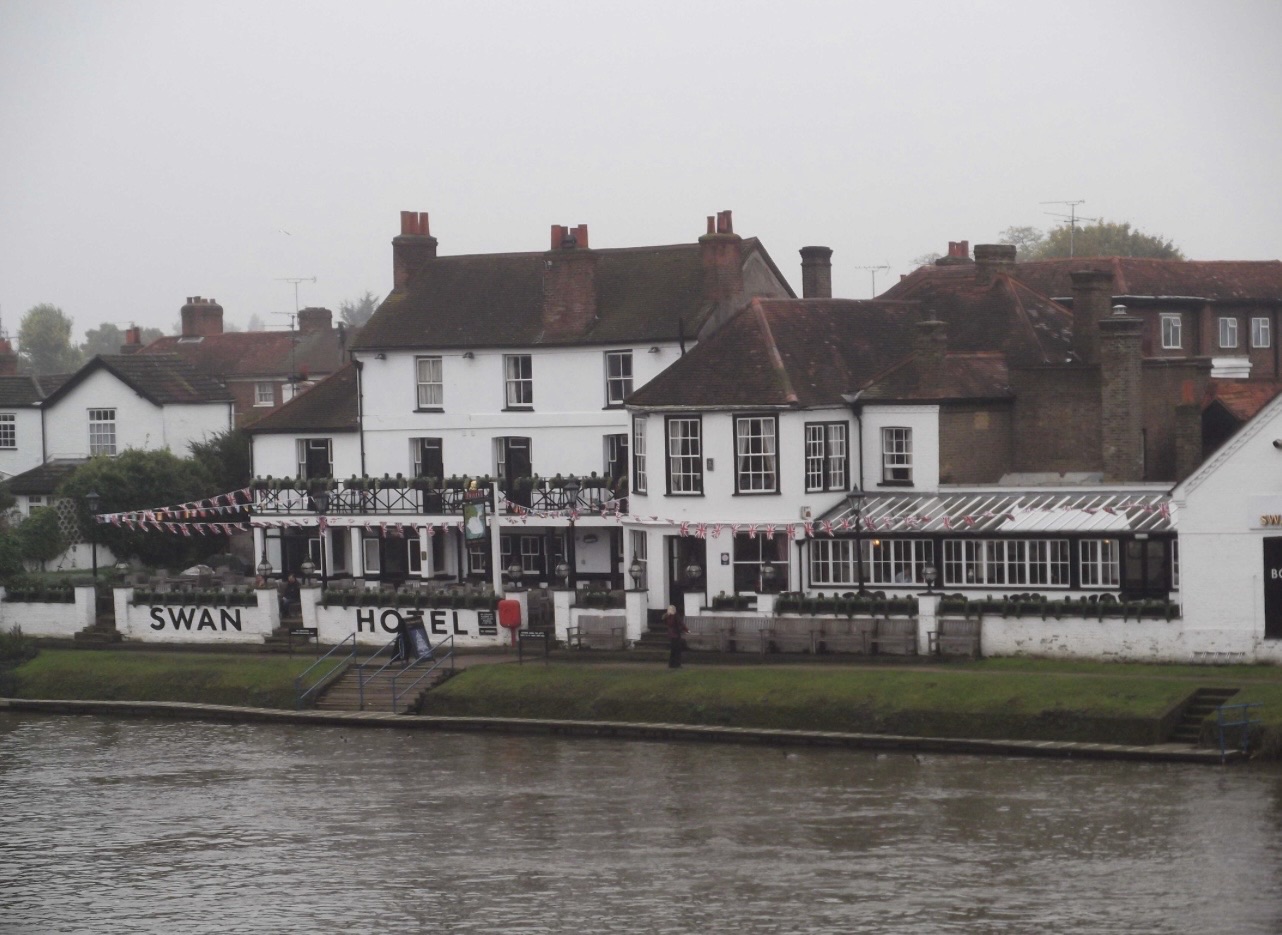
By 1881, Samuel was living in Egham, Surrey, where he was described as a Licensed Victualler, in charge of the Swan at Egham, a substantial property beside the River Thames, now known as the Swan Hotel.
But by 1891 something had changed.
Samuel was living at St John’s, Lambeth, London, and his occupation was now recorded as Compositor/Printer, with the address described as a Refreshment Shop.
It is an intriguing change from publican to printer, and one which would certainly be worth further investigation.
Samuel died on 1 December 1906 in Middlesex, aged 59, and was buried in Surrey on 6 December 1906.
His probate was granted on 16 January 1907 in London.
Caroline Beatrice Doney, from Colnbrook to the Baker family.
Caroline Beatrice Doney was therefore born into this Doney family on 12 May 1872 at Colnbrook.
She was just one year old when her sister Nellie Maud was born in August 1873.
In 1881, nine-year-old Caroline was living in Egham, Surrey, with her family and was recorded as a scholar.
At the age of 25 she married Charles Stephen Baker in 1897.
The marriage brought together the Baker family, whose roots lay around Brentford, Twickenham, Hampton and Surrey, and the Doney family, whose story included Little Marlow, Colnbrook, Egham and the public houses beside the River Thames.
Their first child, Constance Vera Baker, was born on 16 July 1898 at Sunbury, Middlesex.
Their son Vivian Charles Baker followed on 6 September 1900 at New Malden, Surrey.
Then, on 22 September 1905, came their third child:
Violette Muriel Baker.
She was born in Malden, Surrey, with her father Charles aged 35 and her mother Caroline aged 33.
This is the little girl whose photograph I have in my collection.
The childhood of Violette Muriel Baker.
The 1911 Census found six-year-old Violette Muriel Baker living with her family at Tolworth, Surrey, where she was recorded as a daughter and as being of school age.
Her father Charles was by then established in his railway career. In 1901 he had been a Railway Clerk in New Malden, and by 1911 he was still working as a railway clerk in Tolworth.
The family remained in Tolworth into the following decade.
The 1921 Census records Charles as an Engineering Clerk, employed by the London & South Western Railway, with his place of work given as Waterloo Station.
Violette was therefore growing up in a family connected not only with Surrey but also with the great railway network of London.
The Baker family in the twentieth century.
The family experienced a number of losses as the years passed.
Violette’s grandmother Louisa Cowen died on 2 January 1908, aged 71.
Violette’s aunt Edith Louisa Baker died on 16 April 1909, aged 42.
Her great-uncle Charles Baker, brother of her grandfather Stephen, died on 19 January 1916.
Then, on 17 October 1923, Violette’s grandfather Stephen Baker died at Kingston upon Thames, aged 80.
Violette was eighteen at the time.
Her father Charles lived on for another 22 years. In 1939, he and Caroline were living in Surrey, and Charles was recorded as a retired Railway Clerk.
Charles Stephen Baker died on 12 March 1945 in Surrey, aged 75.
His probate was granted on 16 October 1945 at Llandudno, Caernarvonshire, Wales.
Violette’s mother Caroline outlived her husband by sixteen years.
She died on 18 November 1961 at Ewell Road, Surbiton, Surrey, aged 89.
Her probate was granted on 5 January 1962 in London.
The marriage of Violette Muriel Baker.
On 22 September 1935, Violette Muriel would have celebrated her thirtieth birthday. But earlier that year, in April 1935, her life had changed dramatically.
She married Frank Sydney Box in Holborn, London.
The marriage connected the Baker family with the Box family, and would eventually lead to Australia and to another fascinating branch of the family.
Frank Sydney Box was born on 29 April 1907 at Beckenham, Kent, the son of Frank Edward Box, aged 25, and Eva Annie Box, aged 23.
He had several siblings:
Norman Edward Box, born about 1909 at Brighton, Sussex.
John Alexander Box, born 1914 at Beckenham, Kent.
Betty Evelyn Box, born 1915 at Beckenham, Kent.
Kitty Yvonne Box, born 1915 at Beckenham, Kent.
The 1911 Census found Frank, aged four, living with his family, with his father working as a nurseryman.
By 1921 Frank was living in Beckenham as the son of the household.
Frank and Violette were married in April 1935 at Holborn, London.
Their only child was born on 5 November 1936.
She was named Leonora Box.
By 1939, Frank and Violette were living in Hampshire, and Frank was recorded as a journalist.
Frank’s father, Frank Edward Box, died on 8 April 1940 at 44 Foxholes Road, Southbourne, Hampshire, aged 58.
In 1970, Muriel married Gerald Austin Gardiner after being divorced from Frank in 1969. Gerald was a British Labour politician, who served as Lord High Chancellor of Great Britain from 1964 to 1970.
In that position he embarked on a programme of reform, most importantly setting up the Law Commission in 1965. He died on 7 January 1989. You can find more about Baron Gerald Austin Gardiner online at Wikipedia.
Violette survived him by two years.
Frank Sydney Box would eventually spent his later life in Australia. He died on 25 May 1983 at Perth, Western Australia, aged 76.
Leonora Box.
The only child of Violette Muriel Baker and Frank Sydney Box, Leonora Box, was born on 5 November 1936 at Paddington, London.
In 1950, at the age of 13, Leonora travelled abroad with her parents. Her father a Film Producer and her mother a writer.
Records show a departure from Southampton on 6 September 1950, followed by her arrival at New York on 12 September 1950.
She later departed from New York in December 1950, returning to Southampton on 10 January 1951, again with her parents.
Leonora married Donald Humphrey Dossett in January 1965 at Hendon, Greater London, when she was 28.
The couple definitely had two maybe three children.
Leonora lived in London for many years. Records place her there in 1993, and again from 2007–2010 and 2016–2018.
She died on 29 December 2023 at Bristol, Gloucestershire, aged 87.
Donald Humphrey Dossett, another fascinating connection.
Leonora’s husband, Donald H. Dossett, was born in October 1934 at Fulham, London, the son of Mr Dossett and Ms Humphrey.
In 1963, he was living at School House, Campden Hill, London W.8, in Kensington and Chelsea.
He married Leonora in January 1965 at Hendon.
Donald was living at 47 Florence Road, West Ham, in 1969, and a 1982 directory places Don Dossett at Lyndhurst Hall, Lyndhurst Road, Hampstead, London NW3.
Donald Dossett is also known professionally as Don Dossett, and his career took him into the film industry as an art director.
His credits include major film and television productions such as Superman (1978), Never Say Never Again (1983), Judge Dredd (1995), Hamlet (1996), Eyes Wide Shut (1999) and Band of Brothers (2001). He was also nominated for a Primetime Emmy Award for his television art direction work.
The connection is quite remarkable when we think back to the photograph of Violette Muriel Baker, a little girl born in Surrey in 1905 whose family story would eventually lead to the world of British cinema.
The later years of Violette Muriel Baker.
Violette herself lived to the age of 85.
Her brother Vivian Charles Baker died on 9 February 1984 at Kingston upon Thames, aged 83.
Her sister Constance Vera Baker died in April 1980 at Kingston upon Thames.
Violette’s mother Caroline had died in 1961, and her father Charles had died in 1945.
Finally, on 19 May 1991, Violette Muriel Baker died at Hendon, Greater London, aged 85.
She was buried in London.
Her probate was granted on 1 July 1991 in London.
Here’s the direct link to the public family tree I have compiled on Ancestry: Baker Violette Muriel Family Tree
From one photograph to four generations of family history.
Looking at the photograph of Violette Muriel Baker at fourteen months old, it is easy to see only a beautiful little Edwardian child.
But behind that photograph is an entire family history.
Her grandfather Stephen Baker, born in Brentford in 1843, spent his working life as a gardener around Hampton, Kingston and Surbiton. He and Louisa Cowen raised their family through the second half of the nineteenth century, while suffering the heartbreaking loss of their twin daughters Violet and Daisy in 1875.
Their son Charles Stephen Baker became a railway clerk and eventually an engineering clerk working for the London & South Western Railway at Waterloo Station.
Charles married Caroline Beatrice Doney, whose own family story took us from Little Marlow to Colnbrook, the George Inn, the Swan at Egham and eventually Surrey.
Charles and Caroline’s daughter Violette Muriel Baker was born in 1905.
She grew up in Surrey, married journalist Frank Sydney Box in 1935, and became the mother of Leonora Box.
Leonora’s marriage to Donald Humphrey Dossett brought yet another fascinating branch into the family, and through Donald’s career, the descendants of the little girl in my photograph eventually became connected with some of the most recognisable names in British and international film production.
It is one of the things I love most about old photographs.
A old image, perhaps forgotten for decades, can open a door into an entire family.
And in this case, one photograph of Violette Muriel Baker at fourteen months old has led from a Victorian gardener in Surrey, through railway clerks, publicans, journalists and travellers, to a family whose story eventually reached the world of film.
A photograph may capture just one moment in a person’s life, but family history can bring the generations around that moment back to life.

You can contact me either by commenting here or via email at lynnswaffles@gmail.com
Till next time then……..

