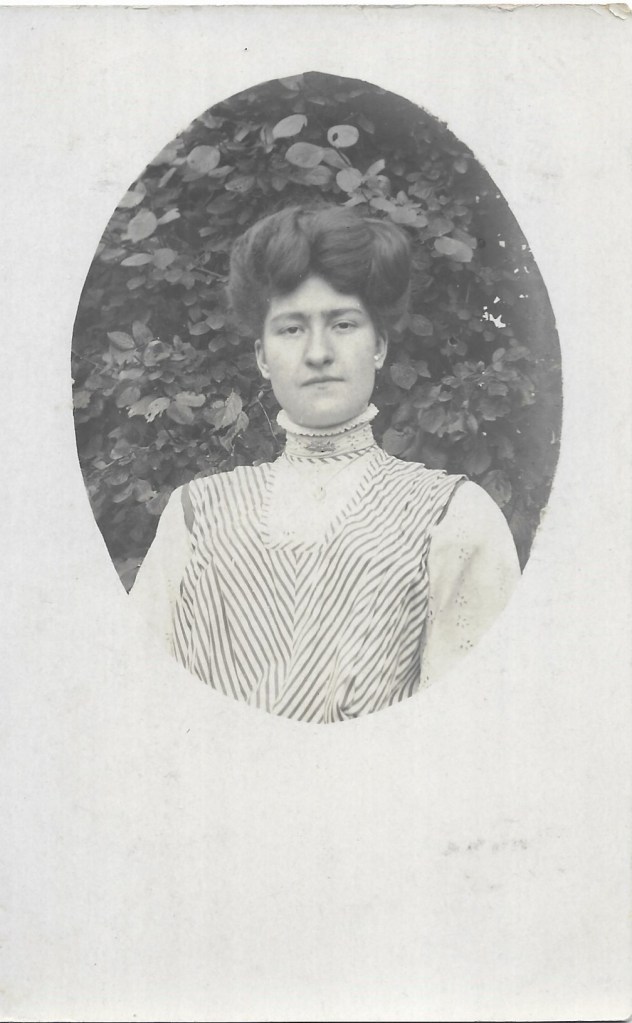
I bought this lovely old postcard at the North Petherton Festival of Cards back in March. It had some interesting information on the back.
This postcard was owned by a friend of Cordelia’s who worked at the Laundry with her, unfortunately we don’t know who she was.
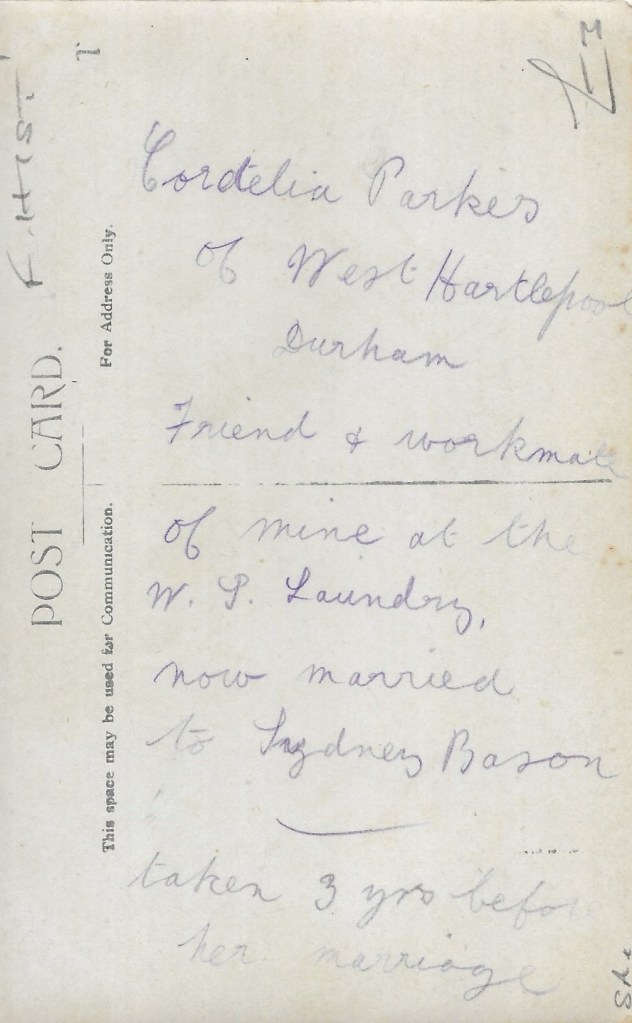
Cordelia Parkes of West Hartlepool, Durham
Friend and workmate of mine at the W.S.Laundry, now married
to Sydney Bason.
Taken 3 years before her marriage.
Cordelia had moved from Hartlepool to Witney before 1910.
After doing some research of the area I believe W.S.Laundry stands for Witney Steam Laundry, Witney town’s largest commercial laundry, employing many women and girls.
It served the blanket industry, local households and Oxford colleges.
Cordelia Parkes‘ story is one of quiet strength. She was the child who bridged two centuries, born into a bustling Victorian household in County Durham and living long enough to witness the modern world taking shape.
Around her, the fortunes of the Parkes family rose and fell with the heavy industries of Hartlepool, and by the time she reached adulthood she had already experienced more family loss than many endure in a lifetime.
Her story begins long before her own birth.
Her mother, Sarah Hannah Foxall, was born in 1847 in Glasgow, Lanarkshire, the daughter of Joseph Foxall, he was a Hammerman, aged 32, and Hannah Manlove, aged 33. By about 1850, Sarah welcomed a younger sister, Elizabeth Foxall, also born in Govan, Lanarkshire.
The family was living in Fireworks Village, Govan, when the 1851 census was taken, but opportunities eventually drew Sarah south into England.
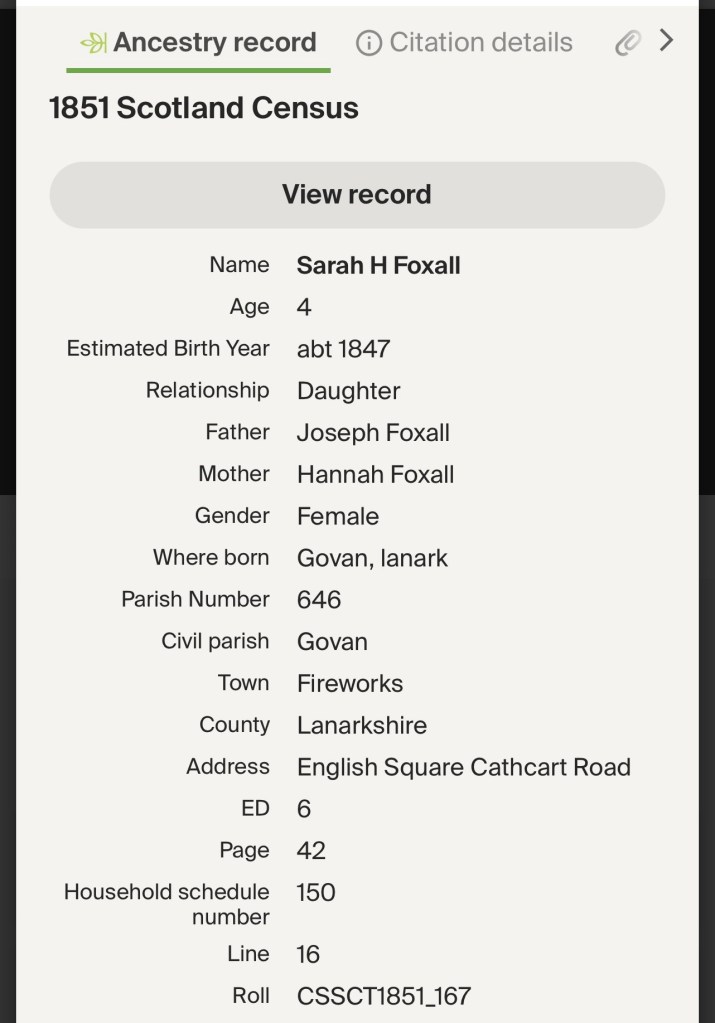
I was curious about ‘Fireworks’ as I couldn’t see the original, just the transcription, I wondered if it was correct. It was!
History of Fireworks Village.
Who built it: The Dixon family established the village as company housing for coal miners and iron workers. They worked at the nearby Govan Colliery and Dixon’s Blazes ironworks.
Where it was: It sat just outside the old Glasgow city boundaries in the “Lands of Little Govan” along Cathcart Road (between modern-day Allison Street and Calder Street).
The Name: Early maps from 1822 recorded parts of it as “Houses of Fire Work”, which locals shortened to “The Fireworks”.
In the 1851 Census: It was officially listed as an enumeration district and locality within Govan parish, featuring specific miner rows and squares like Garden Square and Engine Row.
Later evolution: As the area grew and the mines closed, the settlement was absorbed into Glasgow and evolved into the neighborhood of Govanhill. No physical trace of the original 19th-century village remains today.

By 1861, at only fourteen years of age, she was working as a servant in Wicker, Brightside Bierlow, Yorkshire, showing the independence that many young Victorian women needed to survive.
Cordelia’s father, John Parkes, was born in 1844 at Gorland Wood, Dudley, Staffordshire, the son of James Parkes, aged 30, and Mary Parkes, aged 23. His childhood was spent around Wolverhampton, where the family appeared in the 1851 census. As the years passed his family grew with the births of brothers James (about 1849), William (1852), Jonas (1855) and Thomas (1855). By 1861, seventeen-year-old John was still living in St John, Wolverhampton.
The paths of Sarah and John crossed in Sheffield. They married on 22 July 1866 at St Thomas Church, Brightside, Sheffield, beginning a marriage that would last forty-two years. During those decades they would welcome nine children and create a large family whose descendants spread across England.
Their first child, Zepheniah Parkes, was born in 1868 in Sheffield. Soon afterwards the family moved north to the rapidly expanding port of West Hartlepool, where John found work. By 1871, Sarah was recorded there as John’s wife, while John worked towards supporting his growing household.
Their second son, Aaron Parkes, was born on 25 February 1873 in West Hartlepool.
Four years later came Florence Parkes, born on 19 July 1877, followed by Caroline Parkes in 1879.
The 1881 census finds the family in Stranton, Durham, with John employed as an Iron Worker, an occupation typical of industrial Hartlepool.
The household included thirteen-year-old Zepheniah and eight-year-old Aaron, both scholars, together with Florence and little Caroline.
Another son, Joseph Parkes, arrived on 9 November 1881, followed by Minnie Parkes on 20 June 1884, who was baptised on 29 July 1884 at Burbank Street United Methodist Church in West Hartlepool.
Then came Daisy Parkes, born on 8 August 1886 and baptised on 7 September 1886.
Finally, on 18 October 1888, Cordelia Parkes was born in West Hartlepool, County Durham. Sarah was forty-one years old and John was forty-four. She entered a busy home already filled with older brothers and sisters who ranged from young adults to toddlers.
The youngest child, Lily Parkes, followed in 1891, completing the family.
By the time of the 1891 census, the Parkes family had settled in Seaton Carew, a pleasant seaside district just outside Hartlepool. Three-year-old Cordelia was growing up close to the coast, surrounded by brothers and sisters whose lives would shape her own childhood.
Her eldest brother, Zepheniah, had already begun his own family. He married Mary Ann Parker and between 1889 and 1898 they had five children:
Zephaniah (1889)
Ann Alder (1890)
Sarah Hannah (about 1893)
Caroline (about 1896)
John Cornelias (about p)
By 1901, Zepheniah was heading his own household in West Hartlepool.
Brother Aaron married Ann Lawson on 25 May 1896 in Hartlepool, after their marriage was registered in April. Together they eventually had nine children between 1898 and 1913: Jane A., John William, Florence, Evelyn, Henry, Esther, Ethel, Stanley and Frieda. Aaron remained in Hartlepool throughout his life.
Sister Florence married Thomas William Bunn in January 1900. They later had four children: John William, Henry, Harold, and Mary.
Sister Caroline married Edwin Osborne in January 1902. They raised five children: Gladys, Jessie, Cordelia, Caroline, and Matilda.
Brother Joseph also married in January 1902, taking Amy Maria Welch as his wife. Their six children were John Thomas, Joseph, William Earnest, Victor, Alfred, and Sidney.
Meanwhile, Cordelia herself remained at home. The 1901 census still places her in Seaton Carew, aged thirteen.
Then tragedy struck.
In September 1902, thirteen-year-old Cordelia lost her younger sister Daisy, who died aged only sixteen.
Even greater sorrow followed five years later. In March 1907, eldest brother Zepheniah died in Durham aged just 39, leaving behind his wife and five children.
Only a few months afterwards, in June 1907, sixteen-year-old Lily, the youngest of the Parkes children, also died.
Within three months, the family had buried both their eldest son and their youngest daughter.
In December 1908, another blow came when John Parkes died in Staffordshire, aged 64, after forty-two years of marriage.
By the 1911 census, Sarah Hannah was living in Seaton Carew as a widowed head of household, while Cordelia had begun a new chapter in her own life.
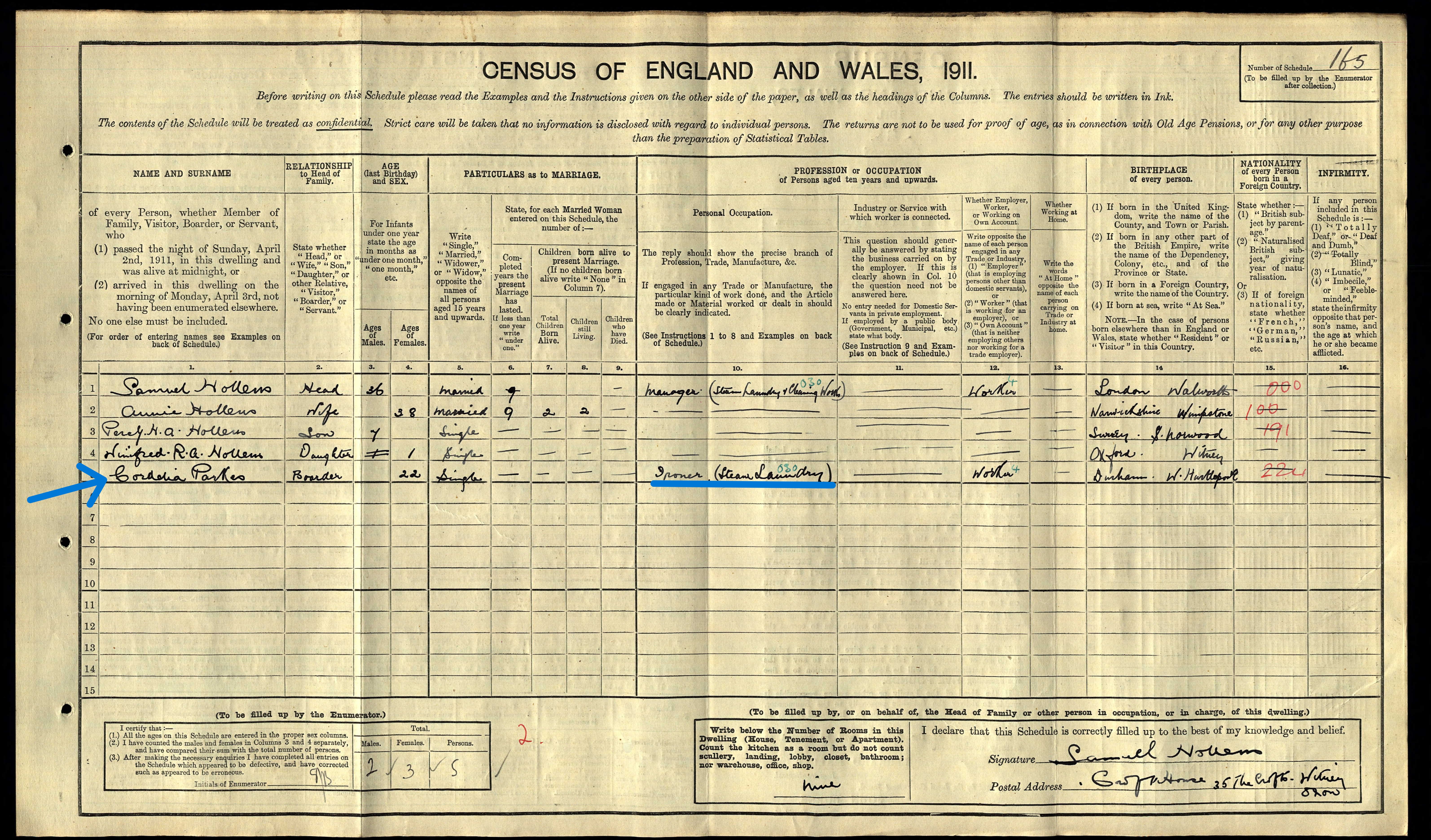
At twenty-three, she had travelled to Witney, Oxfordshire, where she worked as an Ironer in a steam laundry while lodging as a boarder. Like many young women of the Edwardian period, she had left home in search of employment.
Only months later came another loss.
In December 1911, her mother Sarah Hannah Foxall Parkes died in Durham aged 64, bringing to an end the lives of the parents who had raised such a large family.
Despite these hardships, happier times soon followed.
In July 1913, twenty-four-year-old Cordelia married Harry Sidney Basson in Witney.
Harry had been born in April 1887 in Witney, the son of Henry Basson and Elizabeth Weaver, and was baptised at Holy Trinity Church on 22 May 1887.
He had grown up in Witney and by 1911 worked as a stationary engine driver.
Together they established their home in Oxfordshire.
Their first daughter, Freda Elizabeth Basson (later Gorin), was born on 16 August 1914 in Witney.
But before the year ended, another family sorrow reached Cordelia from Durham.
Her sister Caroline Osborne died in December 1914, only 35 years old, leaving five young children.
The First World War years brought yet more grief.
On 14 June 1918, Cordelia’s brother Aaron Parkes died in Hartlepool aged 45. Aaron left behind his wife and nine children.
Only five months later, on 17 November 1918, Cordelia welcomed her second daughter, Joan Parkes Basson, born in Witney.
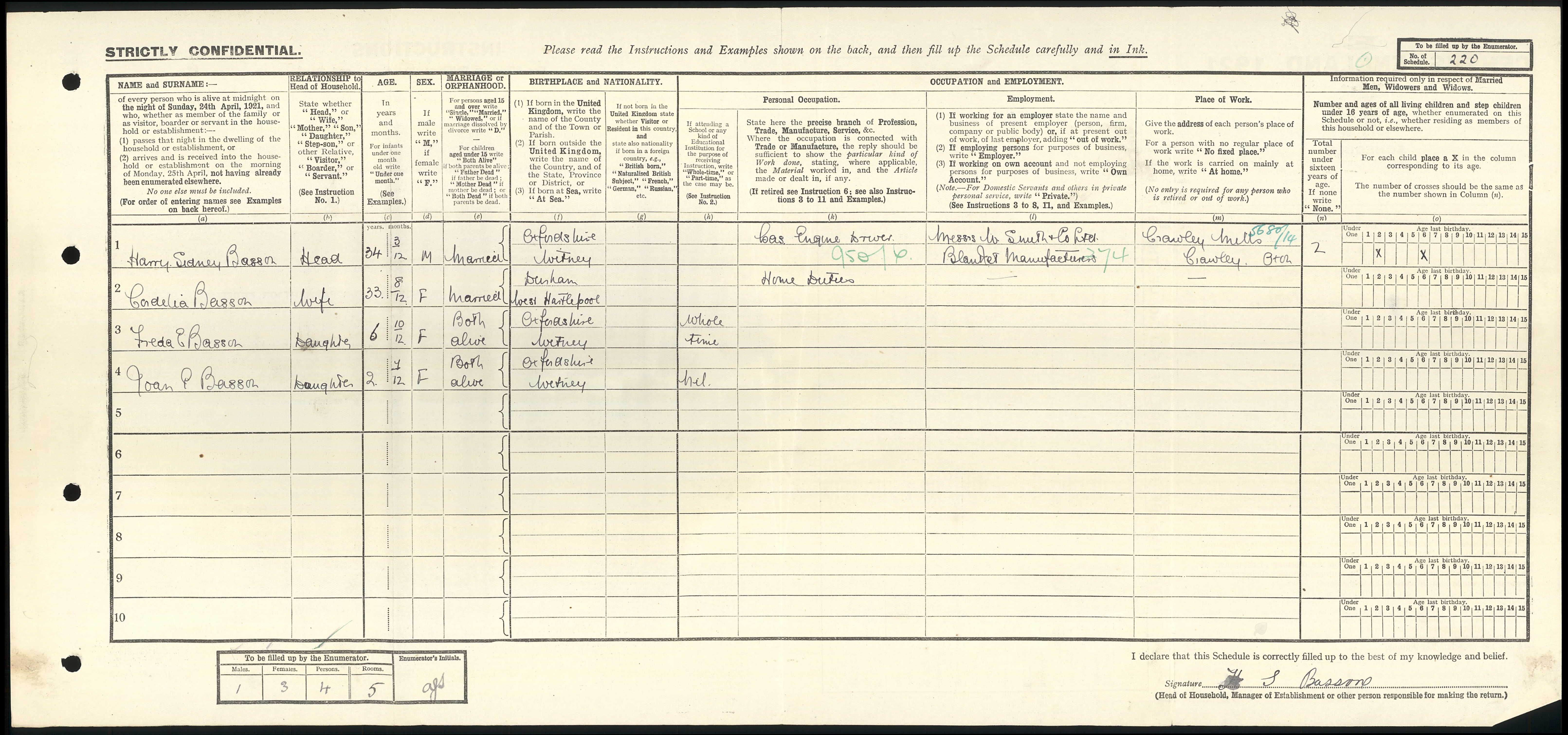
The 1921 census records Cordelia in Witney as a married woman occupied with home duties, while Harry worked as a Gas Engine Driver. Freda and Joan were both at home with their parents.
Then disaster struck once more.
In January 1921, brother Joseph Parkes died in Hartlepool aged only 39, leaving Amy Maria and their six children. Amy remarried in 1925 to Richard White, who was two years older than her. Richard died in 1942, and Amy died in 1964.
Six years later, in October 1927, Cordelia herself became a widow when Harry Sidney Basson died in Headington, Oxfordshire, aged just 40. Their marriage had lasted only fourteen years.
Widowed with two daughters aged thirteen and eight, Cordelia faced the difficult task of raising her girls alone.
By the time of the 1939 Register, she was still living in Oxfordshire, recorded as a widow; under her occupation, it simply says V.A.O.
On the 1939 Register for England and Wales, V.A.O. (or more commonly V.A.D.) stands for Voluntary Aid Detachment, a volunteer organisation providing nursing and medical services.
Her daughters had built lives of their own by now.
Freda Elizabeth trained as a Staff Nurse, living in a London nurses’ home in 1939 before returning to Witney in 1940.
She married Walter Gorin in July 1946. The couple had one son and two daughters.
In July 1953, Freda left England with her children for Malaya, arriving in Singapore on 27 August 1953.
She later departed Hong Kong with her children, in August 1955, returning to Britain through Liverpool on 24 September 1955, intending to settle in Scotland.
I’m assuming her husband worked abroad, but I cannot be certain, and I am unable to find his travel records.
Freda died in January 1998, aged 83.
Joan Parkes Basson married Norman Douglas Haley in October 1938 at Witney.
She appeared in the 1939 Register as a married woman carrying out unpaid domestic duties.
Norman died on 12 June 1998, after fifty-nine years of marriage, and Joan herself died on 3 March 2000, aged 81.
Meanwhile, news from her siblings continued through the years.
Florence Bunn remained in Hartlepool for many years before dying in October 1946 in Newcastle upon Tyne, aged 69.
Minnie Thomas, who had worked as a servant in Lancashire before marrying Harry Thomas on 24 November 1914, raised four children, Norman, Stanley, Joyce and another child, and was still living in Lancashire in 1939.
She outlived Cordelia and was still alive when her sister died.
After a lifetime marked by both happiness and heartbreak, Cordelia Parkes Basson died on 1 September 1957 in Oxford, Oxfordshire, aged 68. Probate was granted on 3 December 1959 at Ipswich, Suffolk.
Here’s the link to the small public family tree I have compiled on Ancestry: Cordelia Parkes Family Tree
Looking back across three generations, the Parkes family tells the story of Victorian and Edwardian Britain itself.
Sarah Hannah Foxall journeyed from Glasgow to Yorkshire as a young servant before raising a large family with John Parkes, an iron worker from the Black Country.
Their children spread from the industrial streets of Hartlepool to Manchester, Newcastle and Oxfordshire.
Some became steelworkers, engine drivers and homemakers; others trained as nurses or travelled halfway around the world.
Yet the family also endured heartbreaking losses, Daisy and Lily dying in childhood, Zepheniah, Caroline, Aaron and Joseph all dying comparatively young, and Cordelia herself widowed while still in her thirties.
At the centre of this story stands Cordelia.
Born into the noise and energy of Victorian West Hartlepool on 18 October 1888, she built a new life in Oxfordshire, raised two daughters through widowhood, and quietly carried the memory of the large family from which she came.
Through Freda and Joan, and through the many descendants of her brothers and sisters, the legacy begun by John Parkes and Sarah Hannah Foxall in 1866 continued well into the twentieth century and beyond.
You can contact me either by commenting here or via email at lynnswaffles@gmail.com
Till next time then………

