Last week, I put on the blog all about the Howes and Leithead families. At the time, I hadn’t realised the connection with this other group photo, that I also found at the Festival of Cards, North Petherton in March.
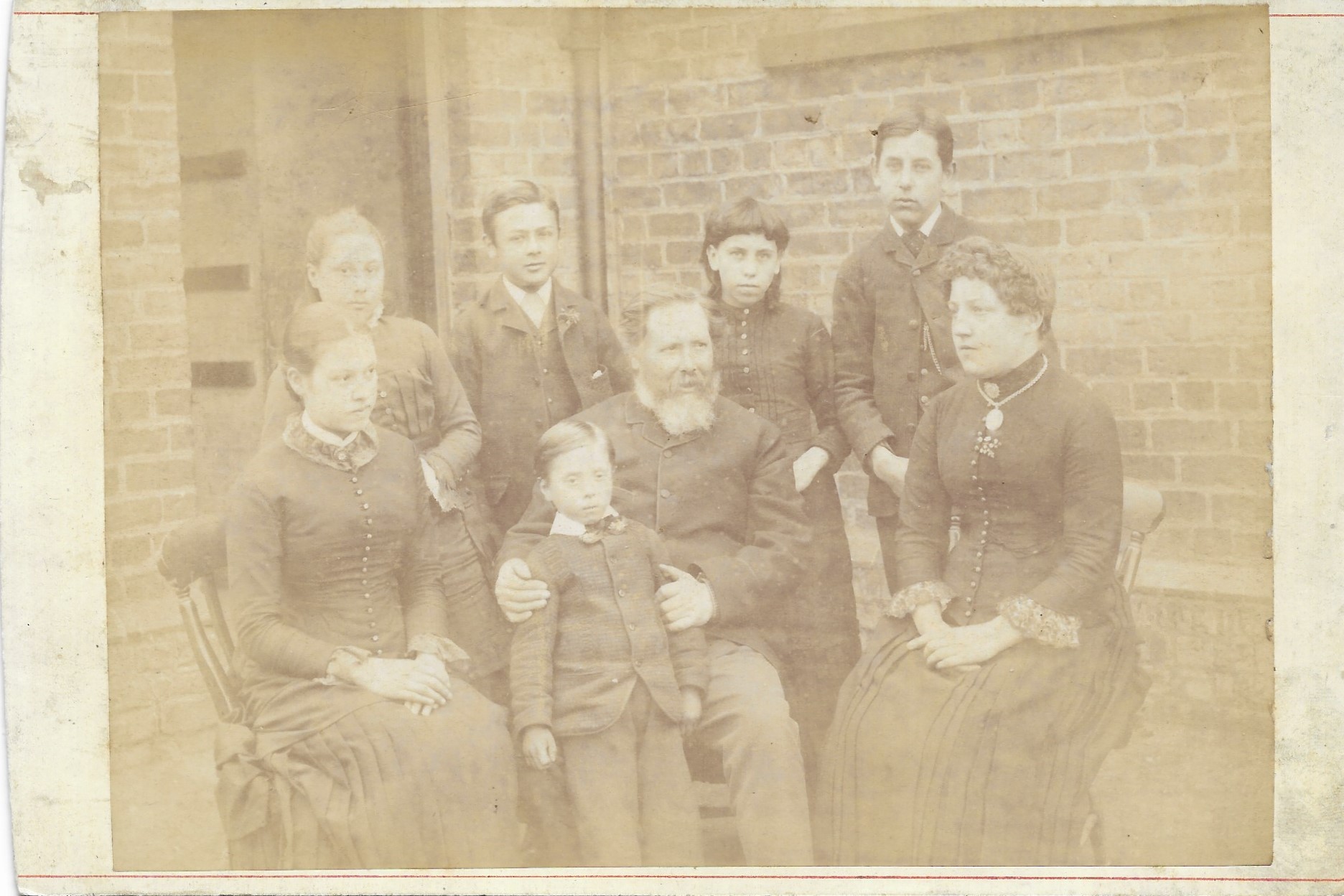
As you can see, it says on the back “Amos Family Holme School”
A few weeks ago I started to search for Holme School, I found several options for the 1880s.
Not knowing what part of the country Holme School was located, made it difficult for me to find the right Amos family.
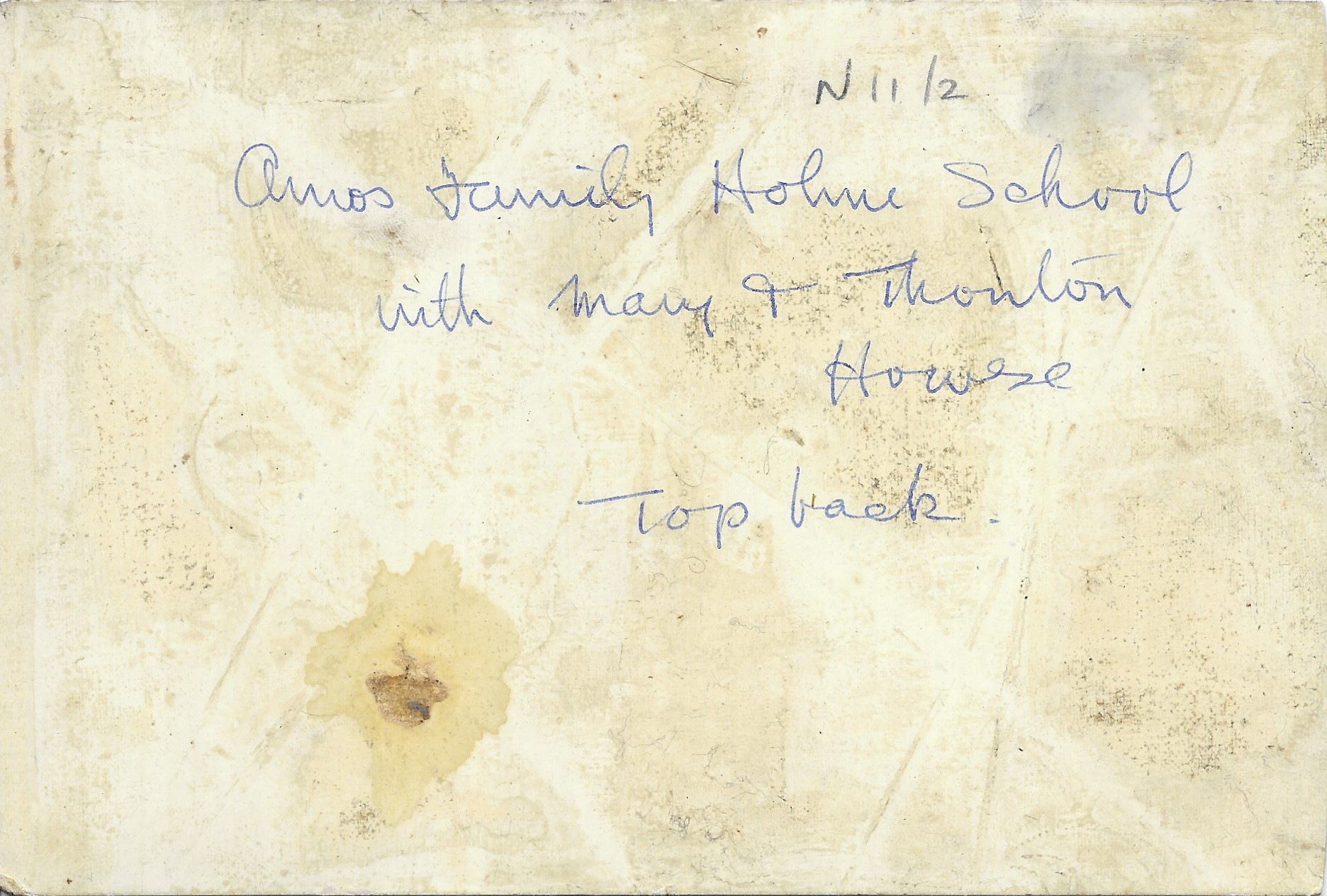
I thought the next line might have said this:
“With Mary T/& Thornton Howse“? Then “Top back” Or could it be Howes??
Going back to this photo a few days ago as I added it to a draft blog, bells rang! Of course! Thornton! From the Howes Family blog!
Now I realise that it is definitely two people, Mary & Thornton Howes not Howse, only because I’ve researched the family of Howes, I now know that Mary (Mary Elizabeth Howes) & Thornton (Charles Thornton Howes) lived in Holme upon Spalding and that they were both teachers from a young age.
So it says “Mary & Thornton Howes” “Top back” they look very young. Blue arrows on the following photo.
Ha, I was so close before! But would probably never have identified them without the help of the other photo information.
With my date of about 1885, Thornton is about 15, and Mary is about 13 (Blue arrows).
They were apprentices under the tuition of Thomas Amos, centre seated, purple arrow, to be school teachers.
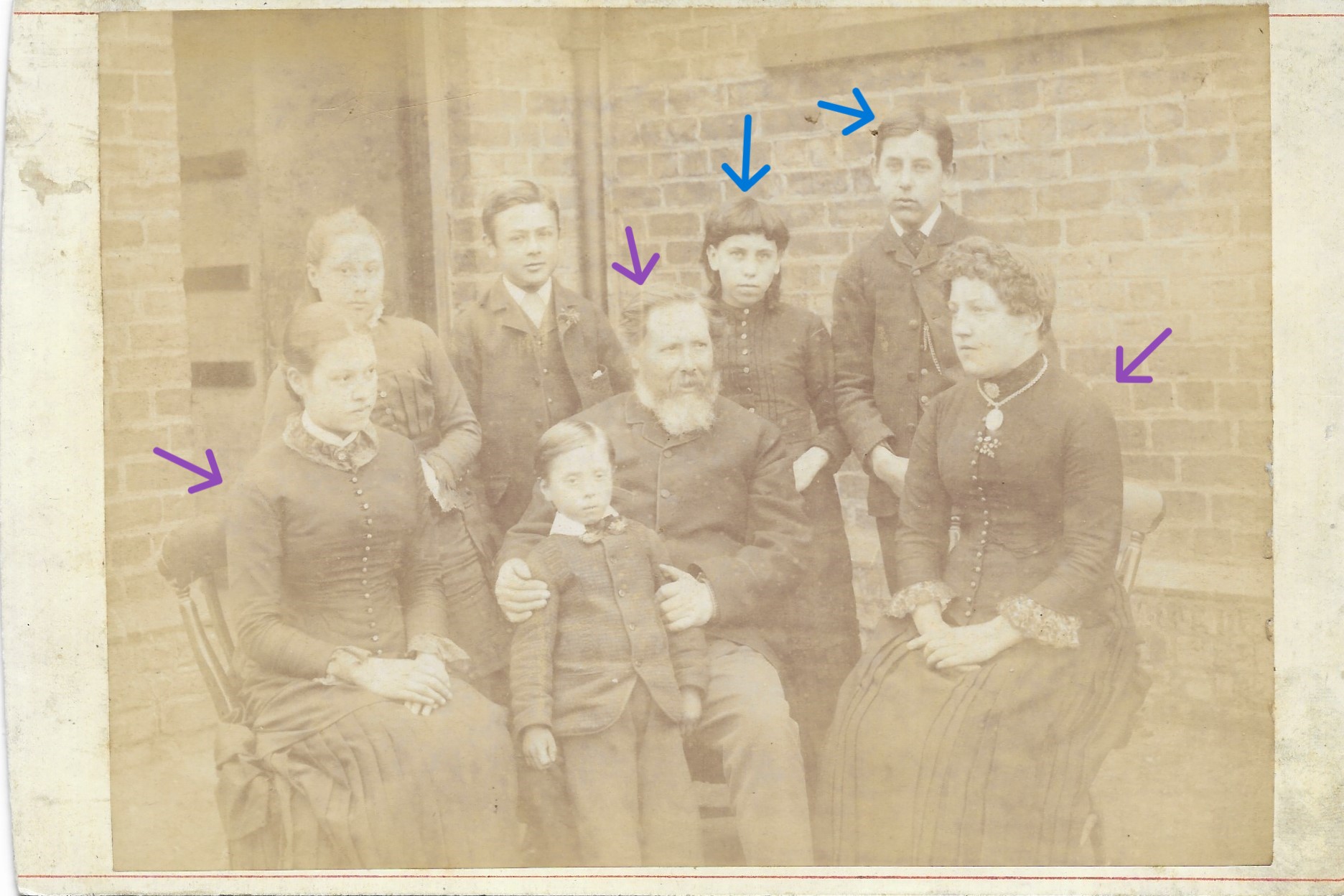
Purple arrows: Thomas Amos centre. I think Henrietta Sarah Amos is on the right & Hilda Amos on the left.
Here’s a little more about siblings Mary Elizabeth and Charles Thornton Howes.
Charles Thornton Howes. (1869-1946).
Beginning as a village schoolmaster’s apprentice under Thomas Amos at Holme-upon-Spalding-Moor National School, he went on to become the head of one of Cumberland’s largest industrial schools, an amazing journey for the son of a Yorkshire shopkeeper and small farmer.
Charles and his wife Florence took over the running of the Cumberland County Industrial School at Cockermouth on 14 July 1902, succeeding Alfred Arthur Williams and his wife as Superintendent and Matron.
They remained there for many years, with Charles recorded as Superintendent in both the 1911 and 1921 censuses. More here about the Cockermouth School: Children’s Homes
Charles Thornton Howes was born on 4 June 1869 in the East Riding village of Holme-upon-Spalding-Moor, the eldest son of Charles Howes, a shopkeeper and farmer, and his wife Hannah Poole. Growing up in a bustling household that eventually included ten younger brothers and sisters, education clearly became his calling from an early age.
As a young man, known simply as Thornton within the family, he trained as a pupil teacher under the respected village schoolmaster Thomas Amos at Holme National School. It was an apprenticeship that laid the foundations for a lifetime devoted to teaching.
By the time of the 1891 census, the twenty-two-year-old Thornton was already described simply as a Schoolmaster, beginning a career that would take him far beyond his Yorkshire village.
The Holme National School, where he trained, had been educating local children since 1824, and records survive documenting Thomas Amos’s appointment and the school’s long history.
116. Agreement to act as schoolmaster, Almondbury
National School 1850 (Thomas Amos – later
master at Holme) from this source: (University of York)
In 1897 Thornton married Florence Alice Peall in London, and together they built both a family and a profession.
Their first son, Charles, was born while Thornton was serving as Head Schoolmaster at Portishead in Somerset.
His abilities as an educator and administrator soon brought further promotion, and in July 1902 Charles and Florence were appointed Superintendent and Matron of the Cumberland County Industrial School at Cockermouth.
“This School was a purpose-built facility on Strawberry How Road in Cockermouth, which opened in 1881 to house, educate, and teach trades to up to 150 boys. The site closed in 1921 and was later used as a secondary school and grammar school before being converted into housing and offices“. Info from Children’s Home Website.
There they accepted responsibility not only for the education of the boys in their care, but also for their welfare and daily lives.
By the 1911 and 1921 censuses, Thornton was firmly established as Superintendent of the institution, leading it through the challenges of the Edwardian years and the First World War. ( Information from Children’s Homes website)
Thornton and his wife retired when it closed in 1921.
From a small Yorkshire village school to one of Cumberland’s leading educational institutions, Charles Thornton Howes devoted his life to teaching and the care of young people.
His journey, beginning as an apprentice under Thomas Amos and culminating as head of the Cockermouth Industrial School, is a testament to the opportunities that education itself could provide.
Mary Elizabeth Howes (1871–1958)
Born on 14 June 1871 at Holme-upon-Spalding-Moor, Mary Elizabeth Howes was the second child of Charles and Hannah Howes. She grew up in a lively household with three brothers and seven sisters, where education was clearly valued.
Like her older brother, Charles Thornton “Thornton” Howes, Mary followed the path of teaching, serving her apprenticeship under the respected schoolmaster Thomas Amos at Holme National School. It was an excellent grounding for a profession that would shape the rest of her life.
As a schoolgirl she would have attended the very same village school where she later trained, learning from Thomas Amos before becoming one of his pupil teachers.
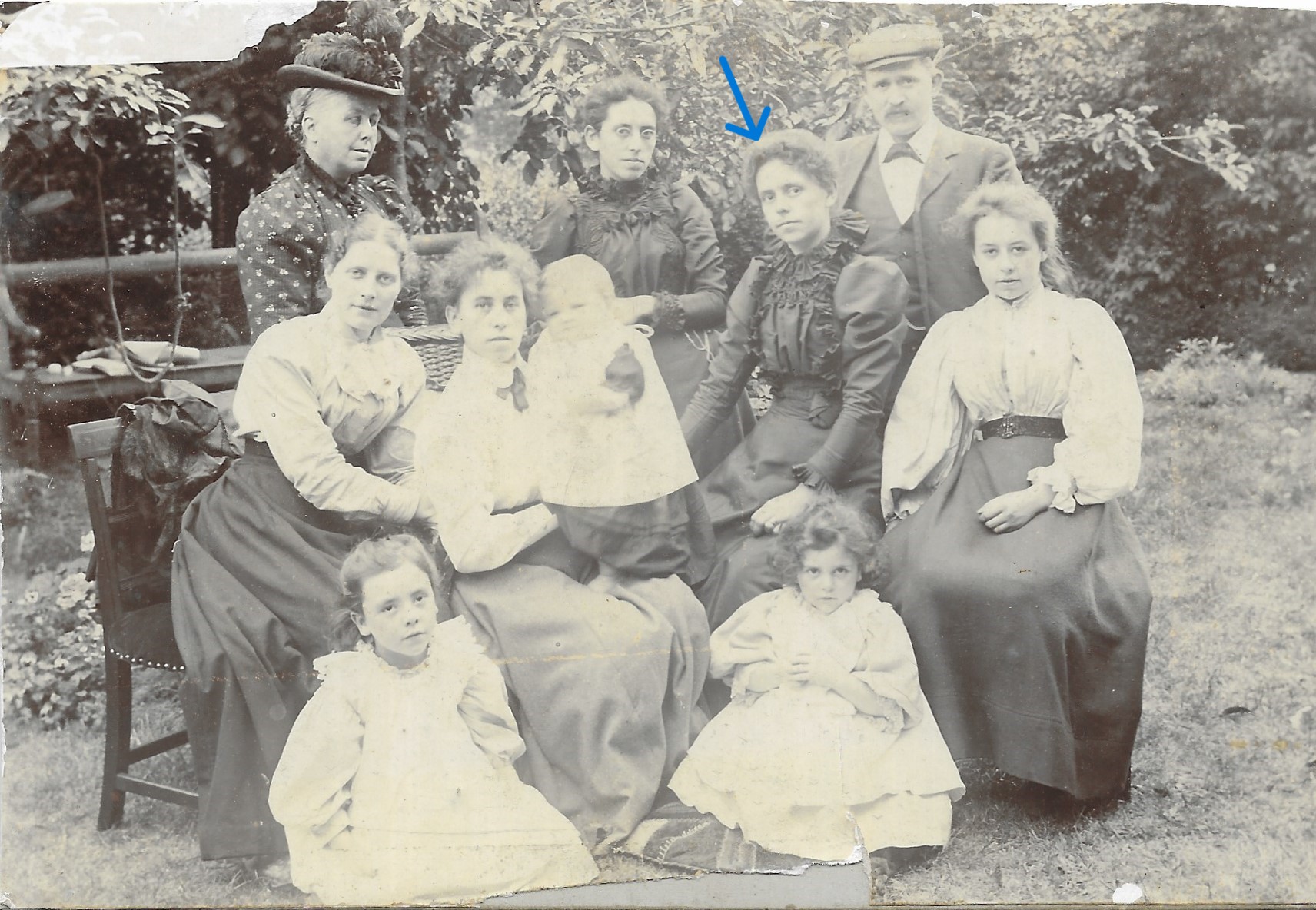
By the early twentieth century she had moved to Harrogate, where she was living with her sister Caroline and brother-in-law Thomas Harris Leithead. She was described as a “Certificated Schoolmistress. Board School“ interestingly Thomas Harris Leithead’s sister Bertha was also living at the same address and described as an “Assistant School Teacher. Board School “
The 1911 census records Mary as an Infant School Teacher, a role perfectly suited to her patient and caring nature, helping countless young children take their first steps in education.
Unlike several of her siblings, Mary never married and had no children of her own, but she remained closely connected to her family throughout her long life.
She witnessed many changes over the years, from the loss of her youngest sister Hannah in childhood to the passing of her parents and, eventually, most of her brothers and sisters.
Despite these family sorrows, Mary continued her quiet life of service, dedicating herself to the education of the youngest pupils entrusted to her care.
Mary lived to the remarkable age of eighty-six, passing away in York on 21 February 1958. She was laid to rest three days later at Hemingbrough, Yorkshire.
Although she left no direct descendants, her legacy lives on through the many children she taught and through the story of a family in which education became a shared vocation.
Together with her brother Thornton, Mary stands as another example of the lasting influence of Thomas Amos, whose guidance inspired two members of the Howes family to spend their lives in the classroom.
Two other sisters of Mary and Thornton also
How the Pupil-Teacher System Worked.
Before the mid-twentieth century, there weren’t widespread teacher training colleges for everyone. Instead, the National School operated a rigorous, hands-on apprenticeship system.
At around age 13 or 14, instead of leaving school to work the land, help with the family millinery business, or go into domestic service, a promising student would be selected by the Headmaster and the parish vicar.
They would spend their days teaching the younger children (often massive classes of 40+ infants) and their evenings or early mornings receiving advanced instruction from the Headmaster himself.
They would progress from “Monitors” to “Pupil-Teachers,” and eventually sit exams to become uncertificated or certificated “Assistant Mistresses.”
Because Thomas Amos was firmly entrenched at the Holme National School throughout the 1870s and 1880s, he wouldn’t just have been the Howes boys and girls’ childhood teacher; he was later their employer and professional mentor.
He would have been the one grading their lesson plans, teaching them classroom management, and signing the logbooks required by the government inspectors.
It paints a wonderful picture of the village schoolhouse: Thomas Amos running the show, while the young Howes grew from students sitting at the wooden benches into his trusted assistants managing the younger classes.
Holme upon Spalding Schools History.
16th Century: Early visitation records from the York archives note the presence of schoolmasters in Holme upon Spalding Moor as early as 1563.
Early 19th Century: Records from 1823 show a National school operating in the village. A Roman Catholic school was also established, which later operated from a premises at Moor End until the mid-19th century.
The 1874/1876 Board School: A seven-member School Board was formed in December 1874 for the combined districts of Holme, Foggathorpe, and Harswell. In 1876, new school premises were built, replacing the older 1824 National school building. So this would have been the building in the background of my old photo.
The Modern Era: Today, the Holme upon Spalding primary school operates on High Street as a large community school. Since 1989, it has also maintained an active international twinning program with a primary school in Lemgo, Germany.
Thomas Amos. The Schoolmaster who shaped Generations.
There are some people whose influence reaches far beyond their own family. Thomas Amos was one of those people. For almost forty years he was at the heart of village life in Holme upon Spalding Moor, not only as the National School’s schoolmaster but also as its organist, educating generations of children while quietly raising a remarkable family of his own.
Thomas was born in Almondsbury, Gloucestershire, in 1835, the son of William Amos and Martha Hughes. His mother was forty when he was born, and from an early age Thomas showed the promise that would define his future.
By the age of sixteen, the 1851 census records him as a Pupil Teacher, already learning the profession that would become his life’s work.
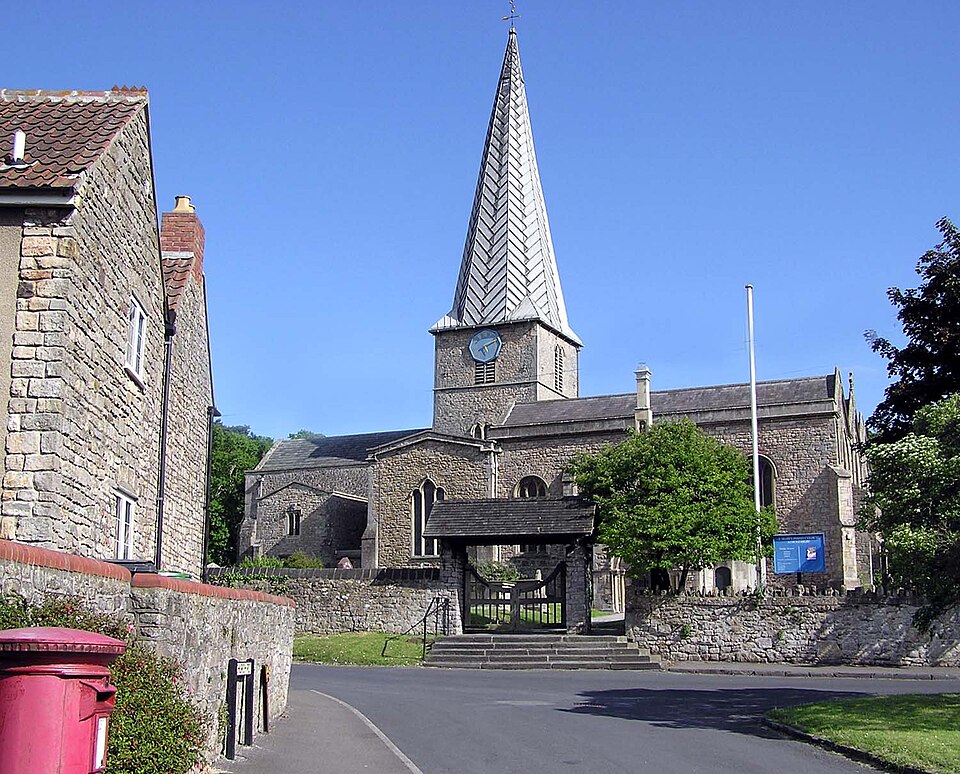
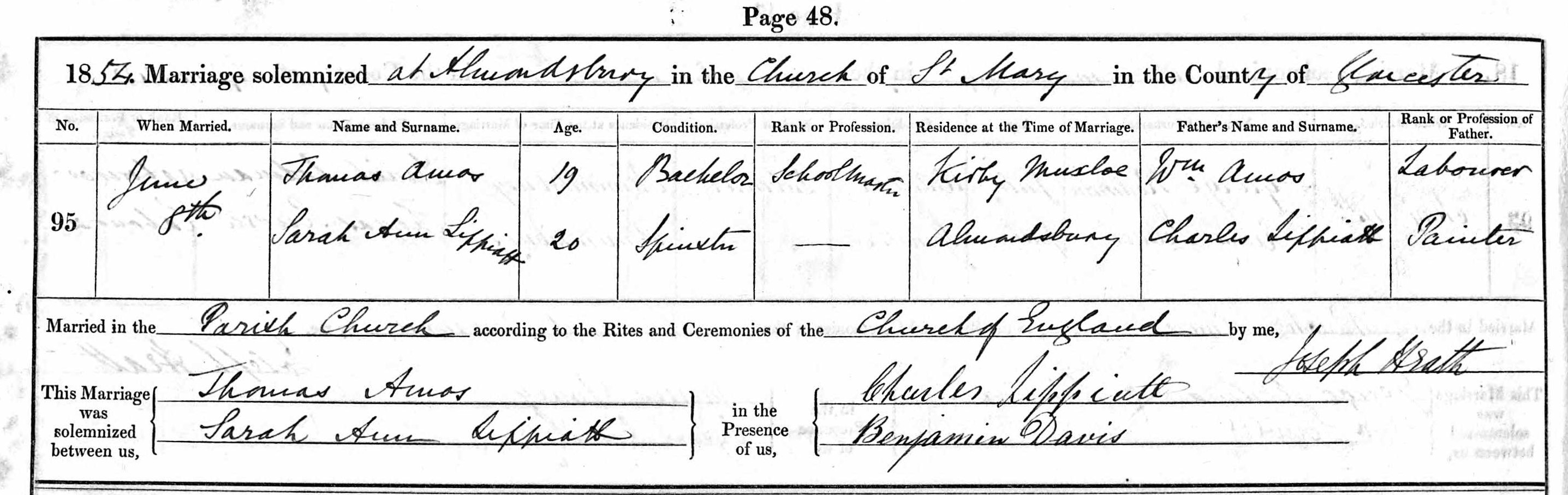
Only three years later, on 8 June 1854, Thomas married Sarah Ann Lippiatt at St Mary’s Church in Almondsbury. Sarah had grown up in the same village, the daughter of Charles Lippiatt and Eliza Morgan, and together they embarked upon a journey that would take them far from the Gloucestershire countryside.
Their first appointment appears to have been at Kirby Muxloe in Leicestershire, where their first three children were born: Eliza Anne in 1855, Amos Frank in 1857 and Charles Morgan in 1858.
Thomas was already an established schoolmaster, his occupation proudly recorded on his marriage certificate, and opportunities for capable teachers often meant moving wherever new schools needed them.
Around 1858, Thomas accepted what would become the defining appointment of his life: Schoolmaster of the National School at Holme upon Spalding Moor in Yorkshire. It was a move that changed the course of the Amos family forever.
By the time of the 1861 census, Thomas was head of his household in Holme, listed simply as School Master. His responsibilities extended well beyond teaching reading, writing and arithmetic.
By 1871 he was also serving as the village Organist, placing him at the centre of both the educational and spiritual life of the community.
For Victorian villages, the schoolmaster occupied one of the most respected positions, expected to be educated, disciplined and morally upright.
Thomas appears to have fulfilled that role for nearly four decades.
While Thomas taught the village’s children, Sarah managed an ever-growing household. Between 1855 and 1877 they welcomed ten children:
Eliza Anne (1855), Amos Frank (1857), Charles Morgan (1858), William (1860), Henrietta Sarah (1862), Ellen (1863), Hilda (1865), Martha Alice (1867), Harriet (1871) and Joseph (1877).
Their greatest sorrow came early. Little William, born in 1860 after the family’s move to Yorkshire, died before reaching his second birthday in December 1861.
Despite that loss, the Amos household remained lively and full of purpose. The older children would have grown up watching their father teach in the village school, hearing the organ played during church services and witnessing the respect he commanded throughout Holme upon Spalding Moor.
Education became something of a family inheritance.
Their eldest son, Amos Frank Amos, followed a musical rather than purely academic path, becoming a Teacher of Music. After marrying Clara Smith in Holme in 1878, he eventually settled in Surrey, where he raised four children before his death in Carshalton in 1913.
The second son, Charles Morgan Amos, continued most directly in his father’s footsteps. He became an Elementary School Schoolmaster, later rising to become a Headmaster in Norwich.
Thomas’s daughter Henrietta Sarah Amos also devoted her life to education. Beginning as a pupil teacher in Rotherham, she eventually became a School Mistress, remaining unmarried and serving schools for decades before retiring.
Census records from 1911, 1921 and even the 1939 Register still describe her by that profession. She had carried her father’s vocation well into the twentieth century.
Another daughter, Hilda, also remained closely connected with education, serving as a School Matron, while several of the other children established lives across England.
Ellen entered domestic service, becoming a lady’s maid, before marrying a coachman, Frederick John Alderman, in 1902.
Martha Alice married Charles Robert Clark and had a daughter, Alice Marie.
Harriet married Ernest Edward Loundes only two days before her father’s death in December 1896 and later raised two daughters in Lancashire and Cheshire.
The youngest son, Joseph, belonged to a new generation. After working as an asylum clerk in Norfolk, he married Florence Gertrude Mary Burns in 1904.
During the First World War, he served as a Sergeant in the Royal Army Medical Corps, but tragedy struck when he died at home in June 1916 from acute yellow atrophy of the liver. He was buried back in Holme upon Spalding Moor, returning to the village where he had grown up.
Here’s the small Amos family tree I have created to go with this blog on Ancestry: Amos Thomas Family Tree
Through the decades, they all remained connected by the education and values instilled in the Amos household.
The family’s greatest personal loss came in February 1887 when Sarah Ann died at only fifty-four years of age.
For thirty-two years, she had stood beside Thomas while raising ten children and supporting the demanding life of a village schoolmaster. She was buried in Holme upon Spalding Moor, the community that had become their home.
Thomas carried on for another nine years. Even after Sarah’s death, the census of 1891 still finds him heading the household in Holme, where he had become one of the village’s longest-serving and most familiar figures.
On 16 December 1896, Thomas Amos died at the age of sixty-one. He was buried beside Sarah three days later in Holme upon Spalding Moor, and probate was granted in January 1897.
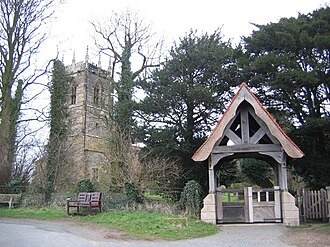
Although Thomas never became famous, his legacy can still be traced through both the village and his descendants. Thousands of village children almost certainly passed through his classroom during nearly forty years as schoolmaster.
He helped shape minds, encouraged literacy and provided stability during a period when education was transforming Victorian society.
Today, when researching the history of Holme upon Spalding Moor, the name Thomas Amos appears repeatedly in school records, census returns and parish registers.
Behind those brief entries stands the story of a Gloucestershire boy who became the trusted schoolmaster of a Yorkshire village, whose work touched countless lives, and whose greatest lesson may have been the example he set for his own children.
His classroom has long since fallen silent, but the education he gave and the family he nurtured remain lasting parts of his legacy.
His story is about far more than one man. It is the story of Victorian education itself.
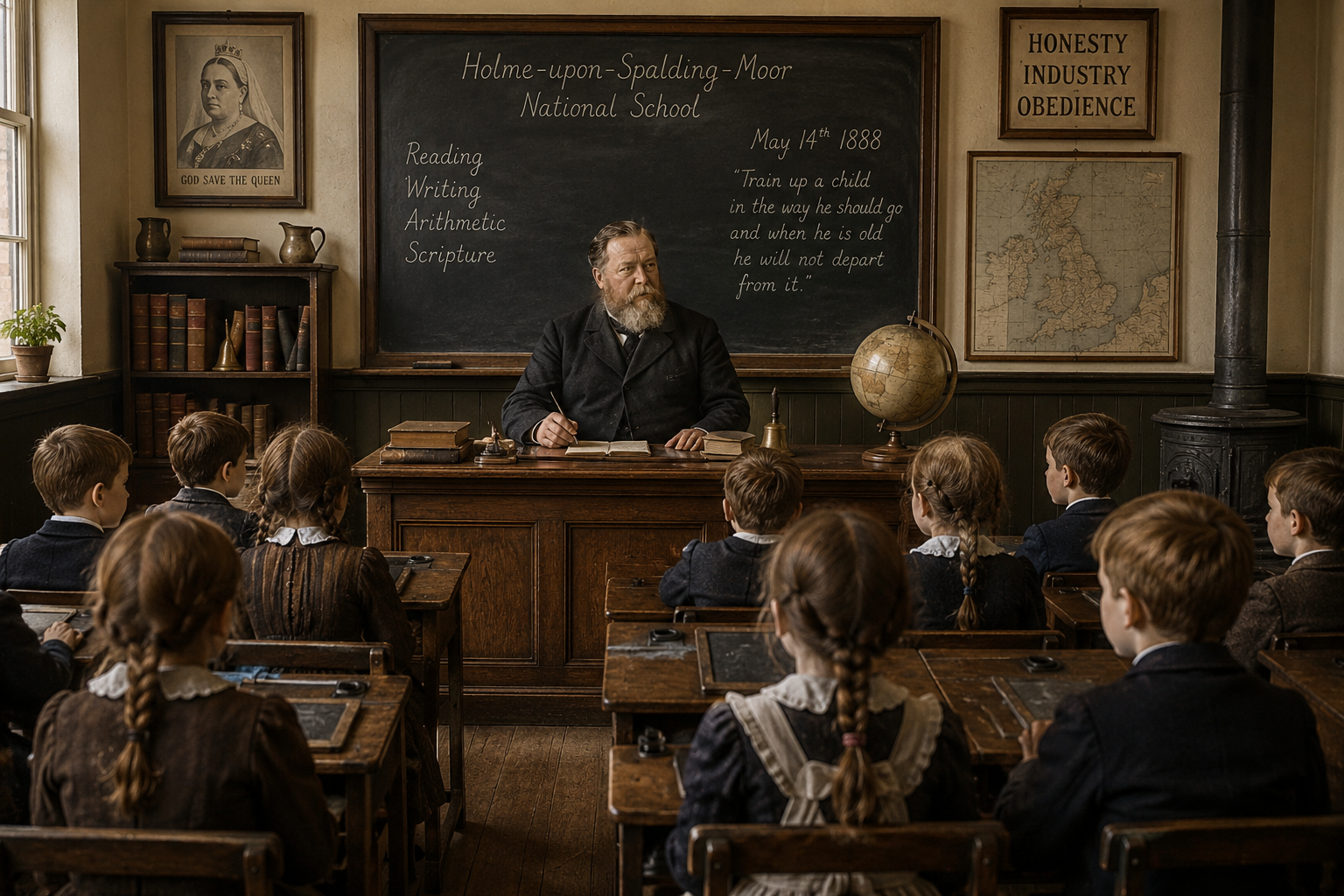
You can contact me either by commenting here or via email at lynnswaffles@gmail.com
Till next time then………

