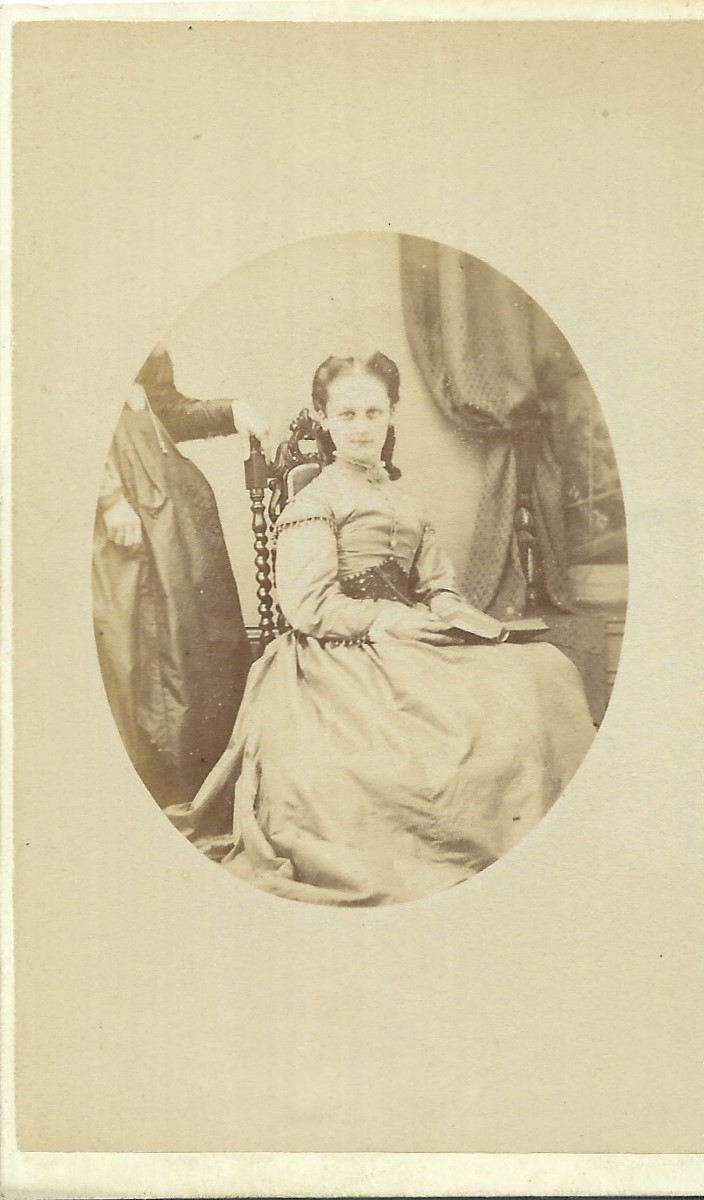
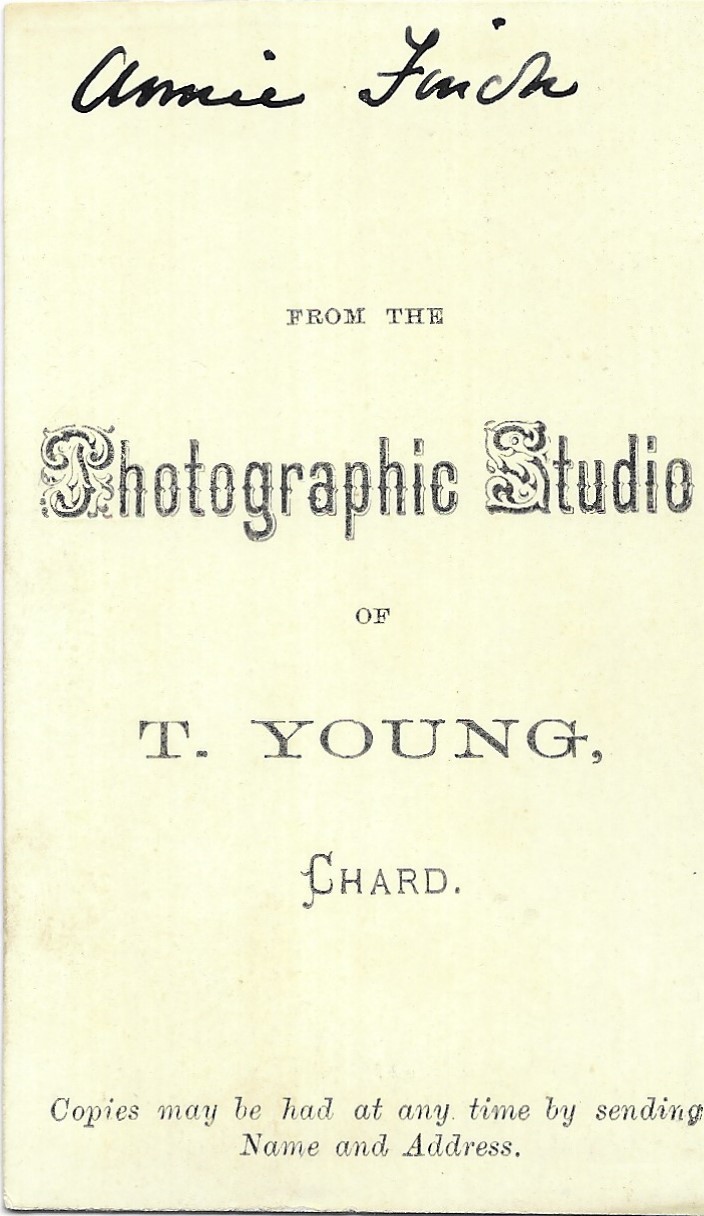
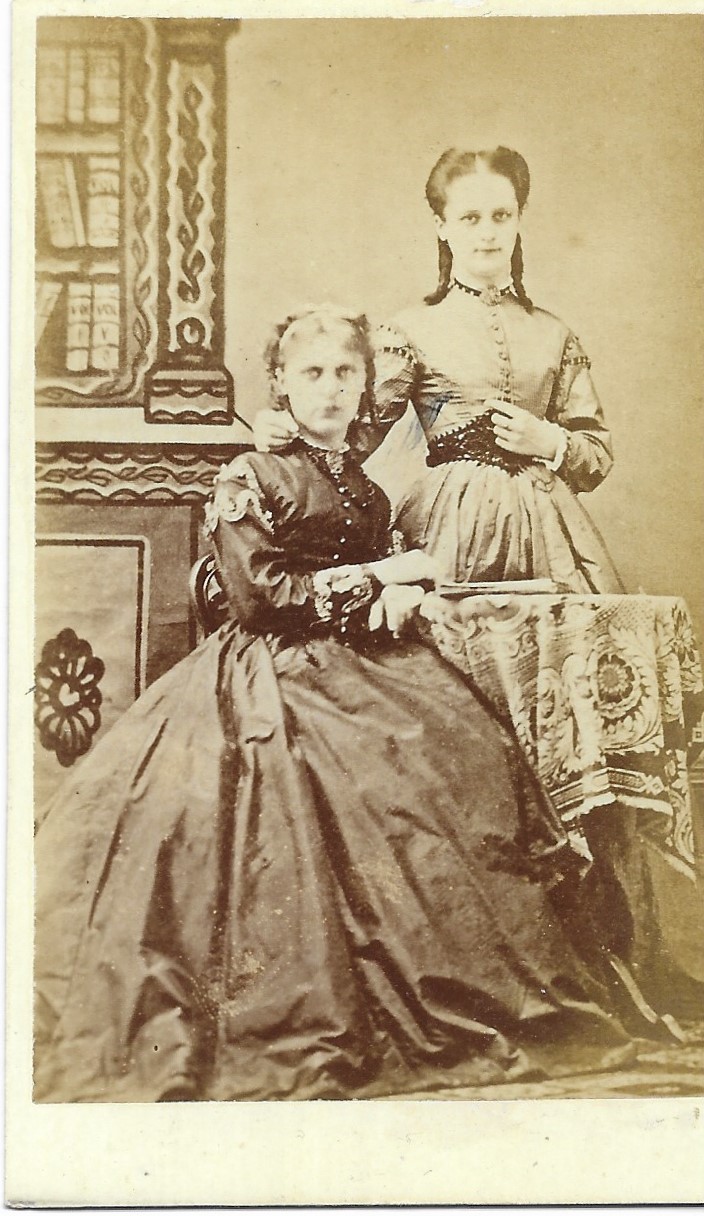
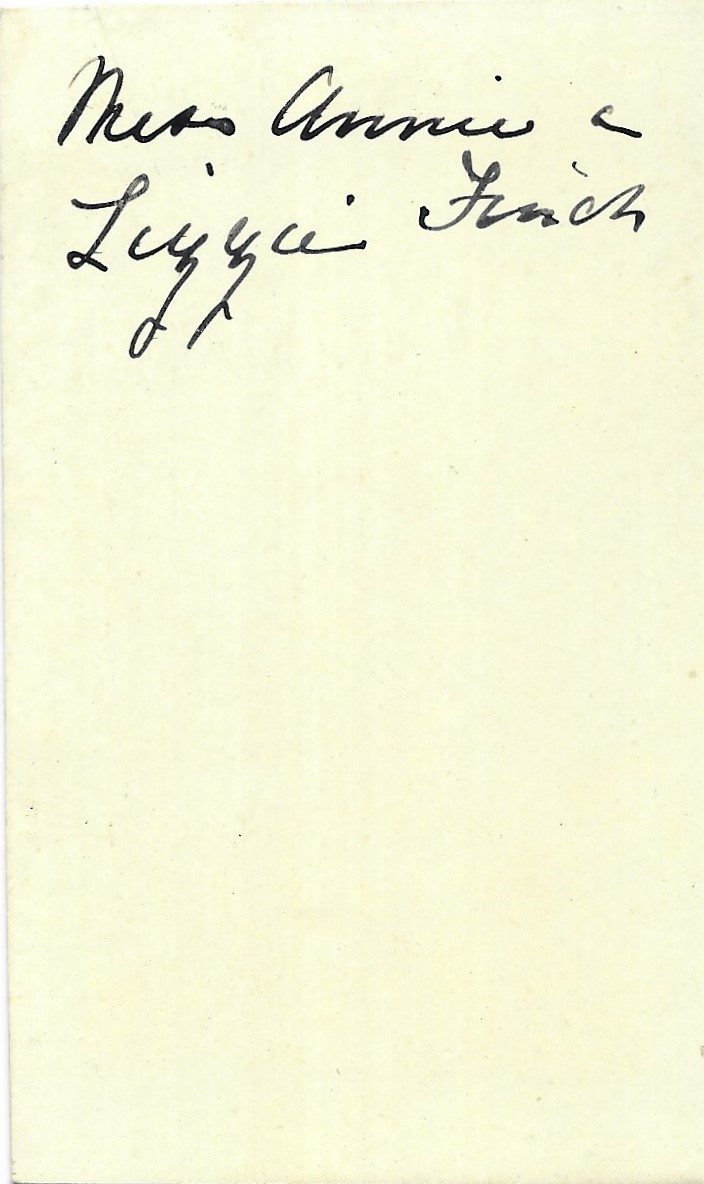
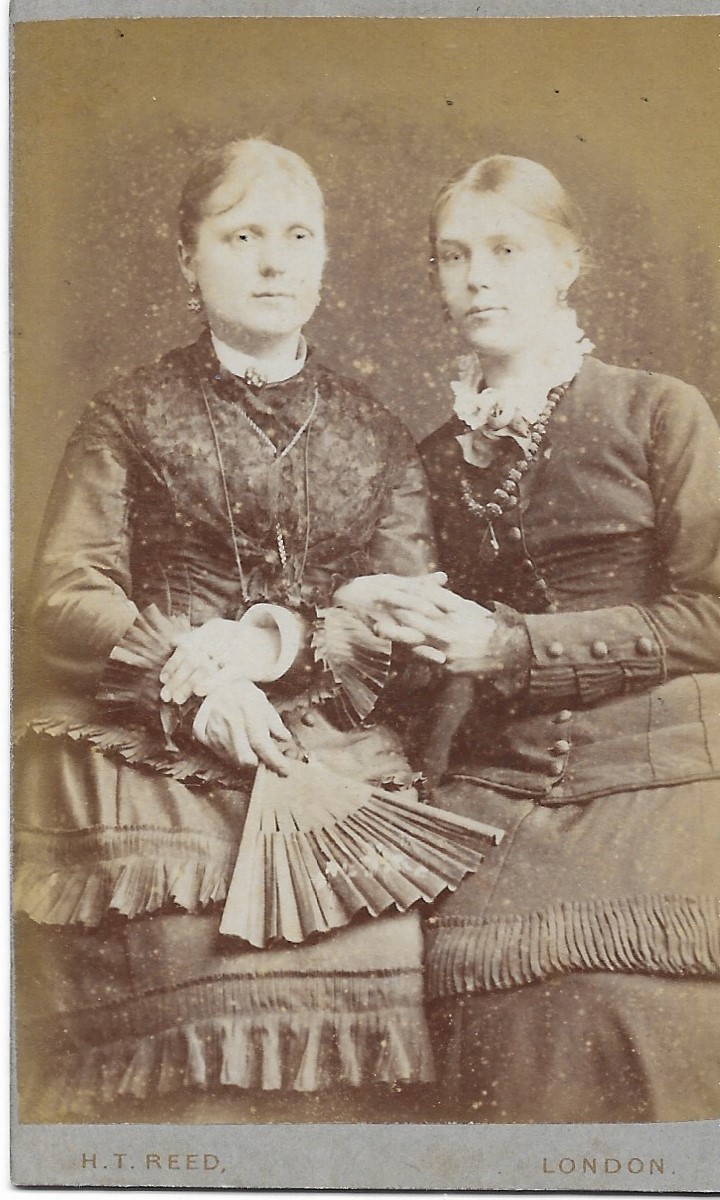
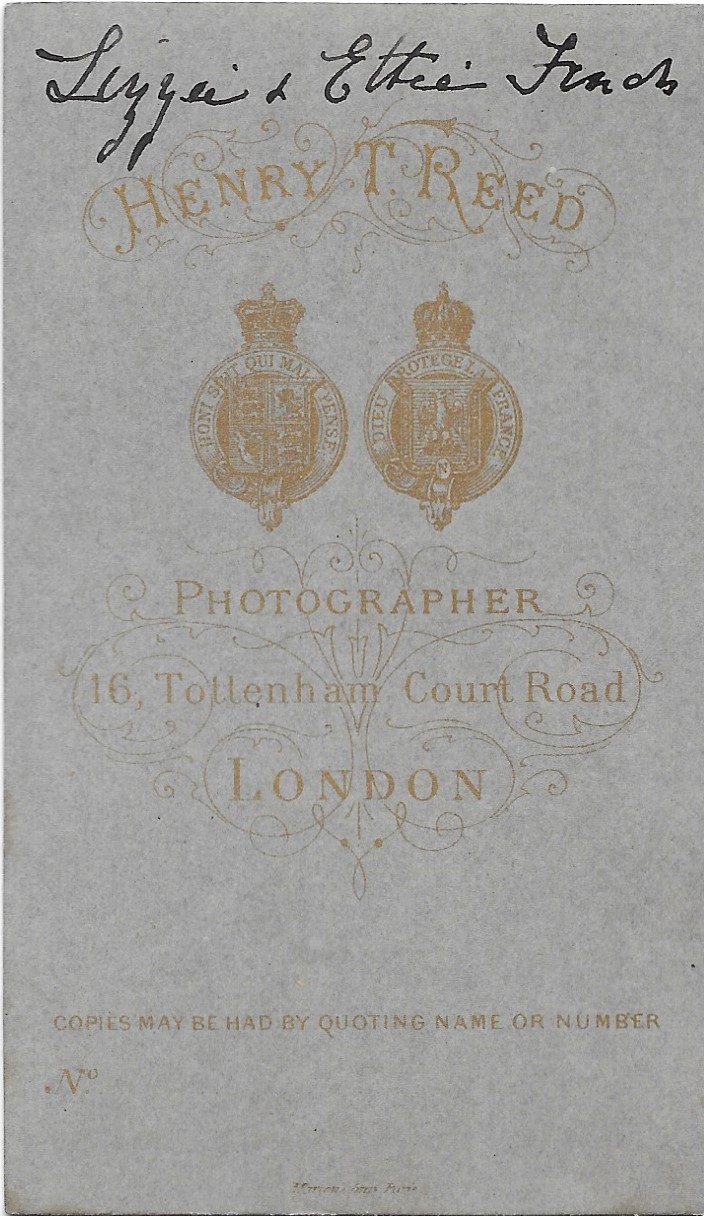
I bought these super CDVs of the Finch family back last December. As they all had names written on, I thought they were very likely to be sisters, and to be able to find them in the records fairly quickly. How wrong I was!
For a start Annie could be the actual name or Ann or even the middle name.
Lizzie could be Eliza, Elizabeth or again maybe a middle name.
Ettie could be Esther, Harriet or Henrietta or even a middle name or a pet name something quite different.
Julia might be Julie, so that was definitely the simplest one to target, although I hadn’t ruled out that the girls could be cousins, even just one of them.
So with all these variations and quite a lot of trawling through records and building up no less than seven trees for different Finch families and also one possible family that my friend Linda found. I eventually came across the best possible family match.
As I was gradually adding family members to this family it just felt more right than any of the others in the other trees.
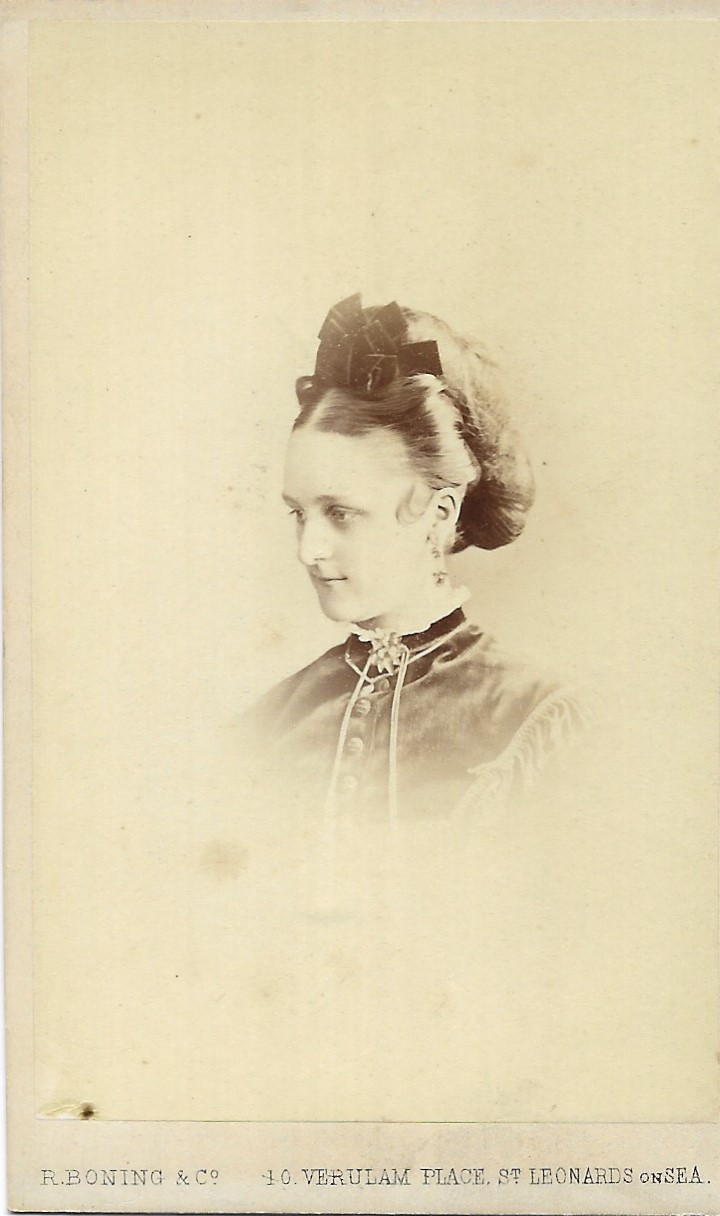
During the Victorian period, St Leonards-on-Sea and neighbouring Hastings were well-known health resorts. Doctors frequently recommended the South Coast.
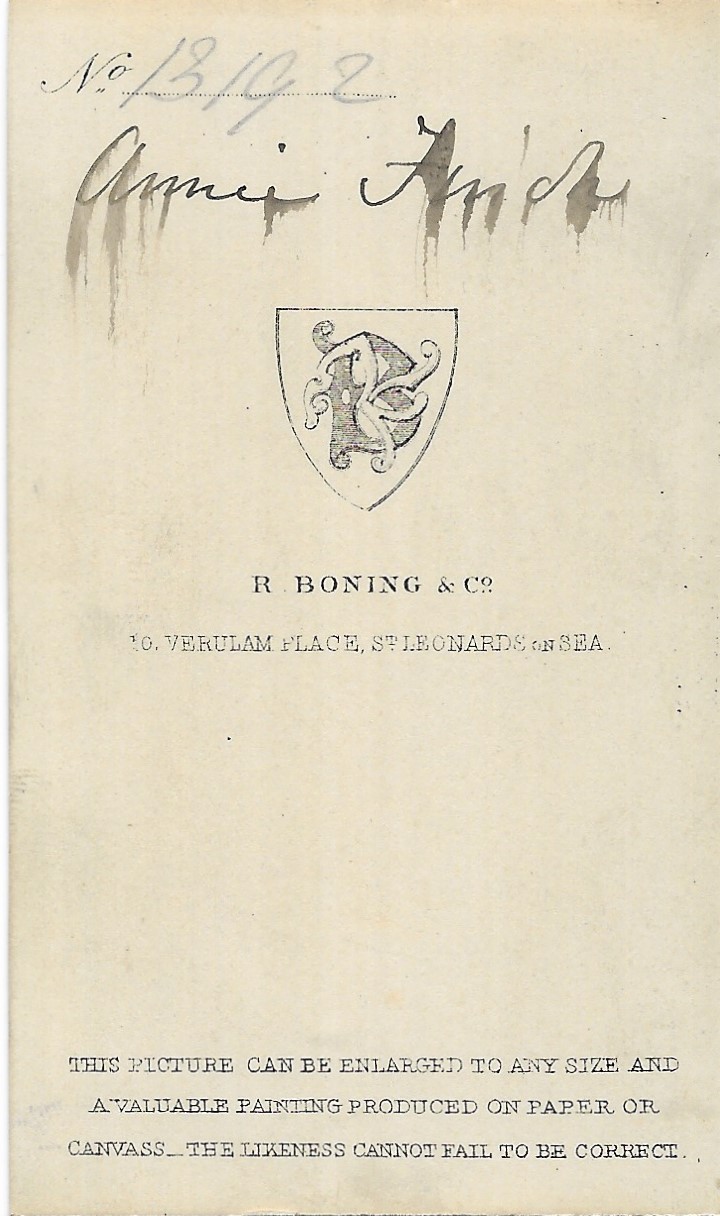
It was while searching the records for possible Julia Finches that I discovered this particular family. This is them all together on the 1861 census, living in the Kensington area.
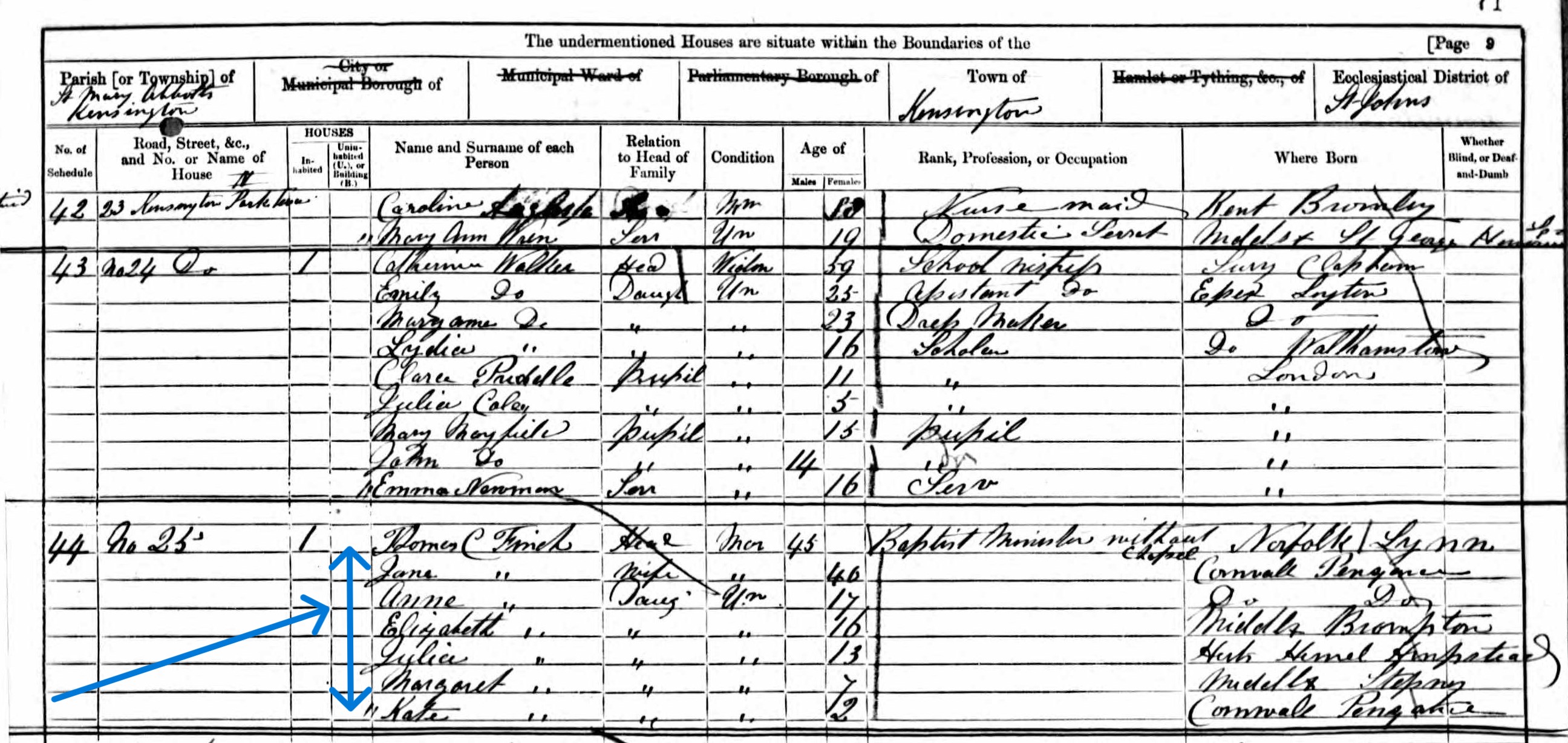
At this point, my only slight concern was the name ‘Ettie’ on one CDV, and that would likely be Margaret, who was 7 years old on this census. I have in the past come across other pet names that were totally unlike the birth names of some people.
A household consisting of Thomas, his wife, and five daughters in Kensington but without a servant suggests that the family was living on a relatively limited income. The eldest daughters, being 17 and 16, were still at home and not employed, which suggests the family retained middle-class aspirations and respectability, even if money was tight.
Thomas was a lower-middle-class Baptist Minister; ‘without Chapel’ suggests he was living on modest means while not attached to a congregation.
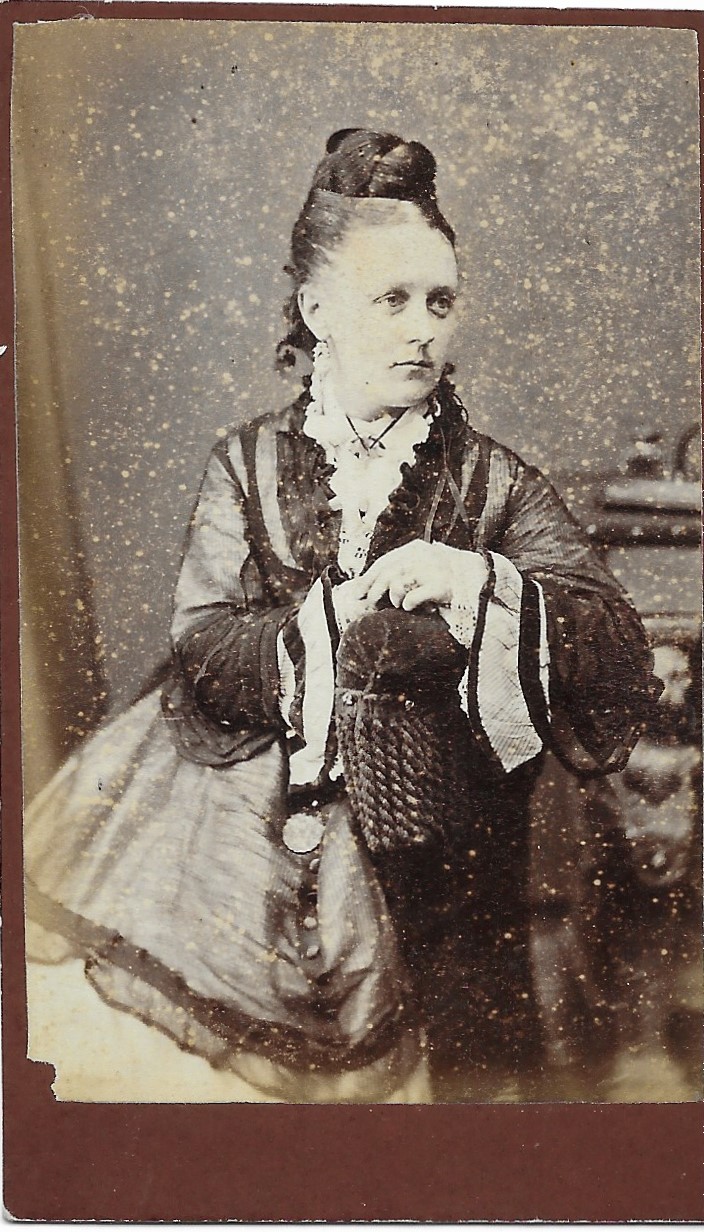
As I built up the five girls’ family history, I was amazed to learn that, after her marriage, Julia lived in Bisley, a small village just outside Stroud, where this CDV photo of her was taken.
Because the family may have also gone to various Baptist meetings outside their father’s area, this was also a plus as far as this family matching the various photos.
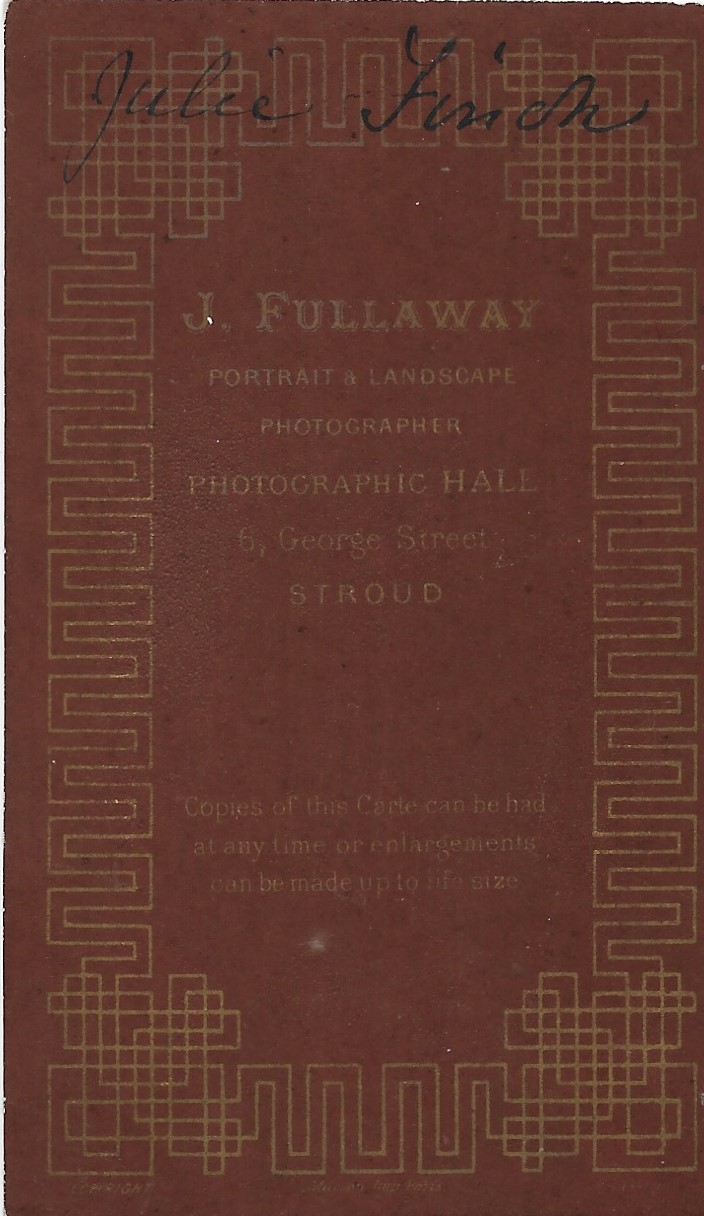

Julia Marshall Finch.
In October 1874, at the age of 27, Julia married John Edward Brett in Bath, Somerset. Like her father, John was a Baptist minister, and together they shared a life centred on faith and service. Their marriage was blessed with four children: Marguerite Annie, 1879-1932; Melanethon Edward, born 1882; Amelia Emmeline, 1884-1970; and Geraldine Ethel, 1886-1923.
The Brett family settled in the picturesque Gloucestershire village of Bisley and later Eastcombe, where Julia devoted herself to raising her growing family.
By 1891, Julia and her family were living in Tewkesbury, Gloucestershire. Tragically, only a few months after being recorded there in the census, Julia died in June 1891 at the age of just 43. Though her life was cut short, she left behind a loving husband and four children who carried her legacy into the next generation.

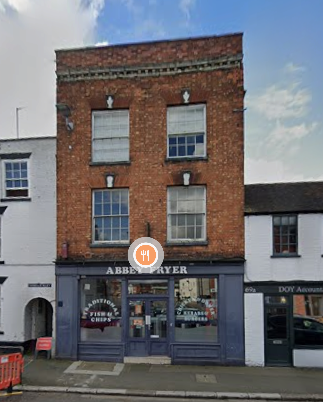
The Finch Family: A Life of Faith, Family and Service
Thomas Clarkson Finch was born on 10 July 1815 in King’s Lynn, Norfolk, the son of the Reverend Thomas Darke Finch and Anne Whiting. He grew up in a large family with 8 siblings, whose movements reflected his father’s ministry, living in Norfolk, Essex and elsewhere as new children arrived and family fortunes changed.
His childhood was marked by both joy and sorrow. He welcomed siblings Louisa, Emily, Ebenezer, Charlotte and Cornelius, but also experienced the loss of brothers and sisters at a young age, including William, Christopher Whiting and Sarah Maria.
Following in his father’s footsteps, Thomas devoted his life to the Baptist ministry. By 1841, aged twenty-six, he was living in Madron, Cornwall, where he was recorded as an unmarried Baptist minister sharing accommodation with another minister. It was there that he met Jane Hamilton, the daughter of local builder John Hamilton and his wife Ann Marshall.
Jane had been born in Madron in 1821 and spent her childhood in the shadow of St Michael’s Mount and the Cornish coast. On 9 March 1842, Thomas and Jane married in Madron, beginning a partnership that would last forty-two years.
The life of a nineteenth-century Baptist minister often involved frequent moves, and the Finch family journeyed across southern England as Thomas pursued his calling. Their first daughter, Ann Whiting Finch, was born in Madron in April 1843 and was named in honour of Thomas’s mother.
A second daughter, Elizabeth Hamilton Finch, followed in 1844, and by 1847 the family had moved to Hertfordshire, where Julia Marshall Finch was born, carrying her maternal grandmother’s surname.
The family’s travels continued. By 1849 Thomas was living in Stepney Green in London, serving as a Baptist minister among the growing population of the East End. In the 1851 census he was described as a “Dissenting Minister,” while Jane managed a busy household with three young daughters. Their fourth daughter, Margaret, was born in Stepney on 7 August 1853.
The 1850s brought both happiness and loss. Jane’s mother died in Cornwall in 1846, while Thomas lost his mother Anne in 1851. In 1859, after what appears to have been a return to Cornwall, their youngest daughter, Kate Hamilton Finch, was born in Madron.
The following year both Thomas and Jane lost their fathers within months of one another, bringing to a close the generation that had shaped their early lives.
By 1861 the family had settled in Kensington. The census described Thomas as a “Baptist Minister without Chapel,” suggesting he may have been preaching independently or between pastorates. Despite living in a respectable part of London, the household had no servants, indicating that while educated and respectable, the family was probably living modestly on the income from Thomas’s ministry.
The next decade saw another move, this time to Bothenhampton near Bridport in Dorset, where Thomas continued his work as a Baptist minister.
Their daughters were reaching adulthood and beginning lives of their own. Elizabeth married Dr Franklin Epps in Bridport in 1870 and later emigrated to the United States, where she raised five children.
Julia married John Edward Brett in Bath in 1874 and established a family in Gloucestershire.
Tragedy struck the family at the beginning of 1875 when their eldest daughter, Ann Whiting Finch, died in London at just thirty-one years of age. Unmarried and working as a companion at that time, she was buried in London on 12 January 1875. Her death must have cast a long shadow over the family.

Cause of Death 1875, was ‘Mitral Obstruction (Autopsy) 10 years Effusion into Pleural-3 days.’
Mitral Obstruction: This refers to mitral stenosis, a narrowing of the mitral valve in the heart. This forces the heart to work much harder to pump blood and often results from childhood infections like rheumatic fever.
Pleural Effusion: This is the buildup of fluid in the pleural space between the lungs and the chest wall. In this context, it is commonly known as “dropsy of the chest,” occurring because the failing heart struggles to pump blood efficiently, causing fluid to back up into the lungs and surrounding tissues.
10 Years: The duration indicates that the person suffered from this progressive heart disease for a decade before it ultimately became fatal. Nowadays, it could have been treated.
By 1881 Thomas and Jane were living in Westbury, Wiltshire, where Thomas, now in his mid-sixties, was still serving as a Baptist minister. Two daughters remained at home.
Margaret and Kate never married and devoted much of their lives to caring for their parents and maintaining the family home.
An intriguing event occurred in 1883 when Margaret, aged thirty, chose to be baptised in the Church of England at St George’s, Bloomsbury, perhaps indicating a personal spiritual journey that differed from her father’s Baptist tradition.
On 22 January 1885, after a lifetime spent in Christian ministry, Thomas Clarkson Finch died at Dilton Marsh near Westbury, aged sixty-nine. Probate was granted at Salisbury two months later. He had spent more than four decades as a Baptist minister, serving congregations and communities across England from Cornwall to London, Dorset and Wiltshire.
Jane survived her husband by eleven years. During that time she endured further family losses, including the death of her daughter Julia in Gloucestershire in 1891. Yet she remained at Dilton Marsh, surrounded by the familiar support of Margaret and Kate. Jane died on 20 May 1896 at the age of seventy-five.
The story of the Finch daughters reflects the different paths available to Victorian women. Elizabeth carried the family story across the Atlantic to South Dakota, where she died later in 1896.
Ann’s life ended before she had the chance to marry or have children.
Margaret and Kate, however, remained steadfastly at Dilton Marsh. Both lived on “private means,” sharing the family home long after their parents’ deaths.
Census records show them together in 1901, 1911 and 1921, two sisters maintaining an independent household. Margaret died in Westbury in 1931 at the age of seventy-seven. Kate survived her by six years, dying on 28 July 1937, aged seventy-eight, and was buried in Dilton Marsh.
With Kate’s death, a chapter that had begun with Thomas Clarkson Finch’s birth in Norfolk in 1815 finally came to a close. Across more than a century, the Finch family’s story encompassed ministry, migration, devotion, family loss, and remarkable resilience—leaving descendants in England and America and a legacy rooted in faith and service.
T.C. Finch and Penknap Providence Church. 1877-1884.
‘Mr Thomas Clarkson Finch came next and commenced his labours in March 1877. These few years were trying, as the cloth factories had been closed in the district, and many had to leave the neighbourhood.
This thinned the congregation. Nothing of great importance occurred during Mr Finch’s pastorate. He resigned his charge in June 1884. He had a very painful affliction, which terminated in his death on January 22nd, 1885.
We lay him to rest in the same vault where lie the remains of Mr. Phillips, the first pastor of the church and his devoted wife, on the left hand close to the entrance of the chapel.
Many gathered around his grave; I was present; he was highly esteemed. The solemn service was conducted by Mr Hazzard of Leigh, and Mr I. Birt of Devizes. It is a noteworthy fact that every former pastor of this Church, since its formation, has passed away to his endless rest; Phillips, Evans, Hurlstone, Jeffery, Finch; with the last three, I have been more or less acquainted. Found on the Dilton-Marsh Website online.
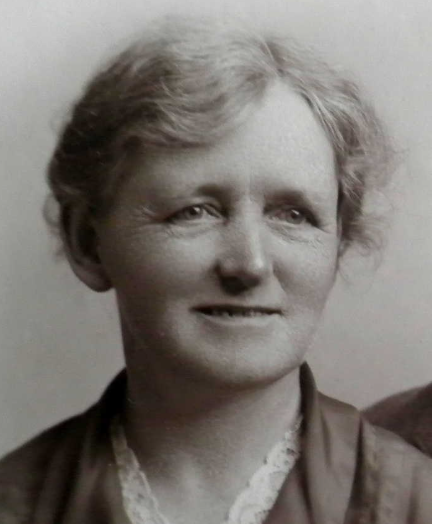
The only family photo I found of any woman in the family while researching was this one, one of Julia’s daughters on a public tree on Ancestry.
Here’s the family tree I compiled on Ancestry: Finch Family Tree
I’m hoping my next family will be much easier to find!
You can contact me either by commenting here or via email at lynnswaffles@gmail.com
Till next time then………

