I bought this lovely Cabinet Card back in the summer of 2025 from eBay.
At the beginning of my research, I realised that this photo is very likely one of the couple’s wedding photos.
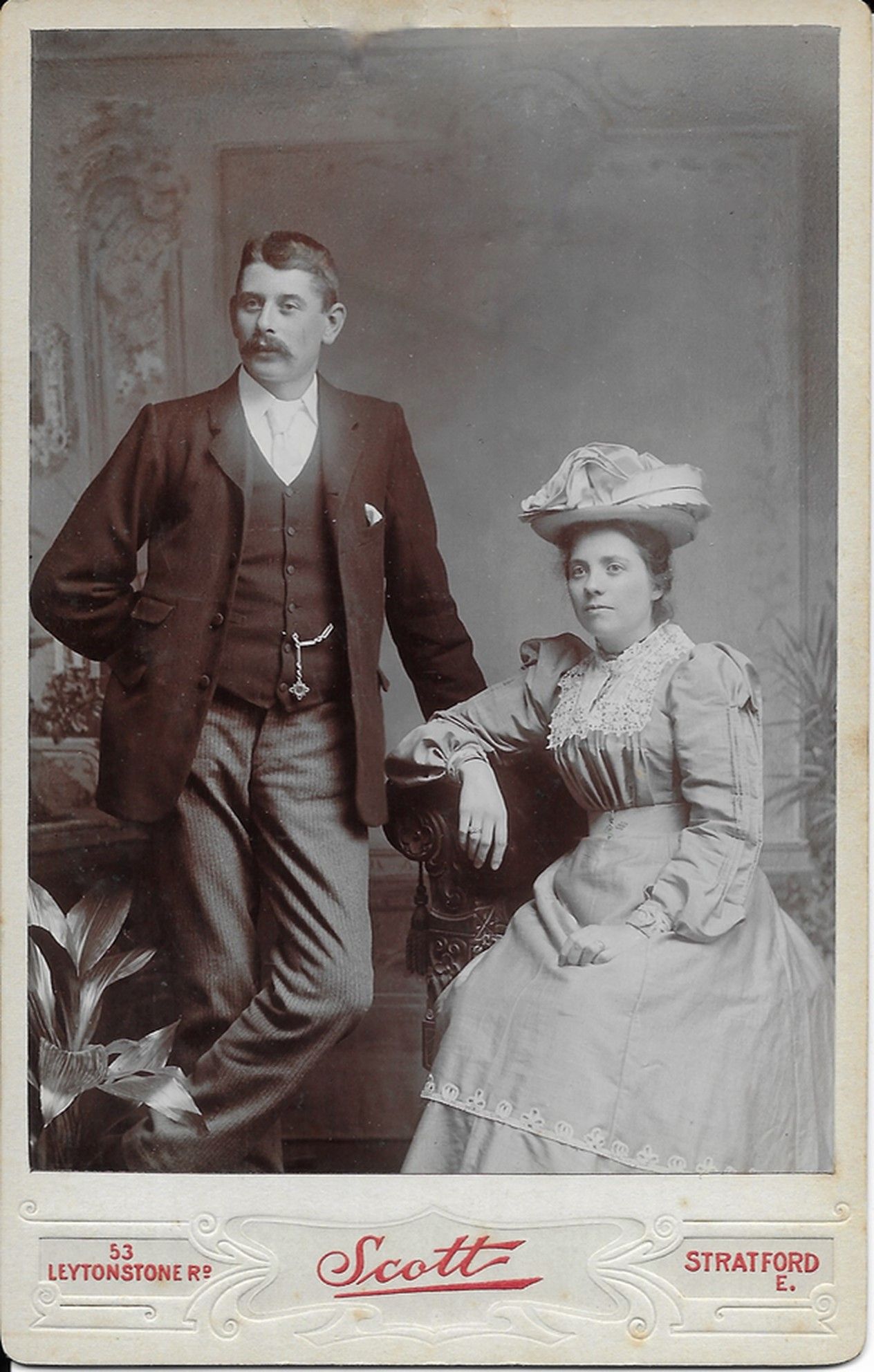
Pencilled on the back was: ‘Charles and Annie Dennison, probably children of Isaac and Martha‘. In fact, it was Charles and his wife, Annie.
Charles and Annie: A Story of Family, Loss, and New Beginnings
Charles Henry Dennison and Annie Mary Amis came from very different corners of England, yet their lives would become closely intertwined at the dawn of the twentieth century.
Charles was born on 6 September 1872 in Stratford, Essex, the son of Isaac Dennison and Martha Ann Amis. His father, Isaac, had been born in Roxwell, Essex, in 1840 and worked as an engine driver for the Great Eastern Railway. Charles grew up in a bustling railway family alongside his brothers and sister.
The family moved from Stratford to Enfield, where young Charles attended school. By 1891, he was living in West Ham and following in his father’s industrial footsteps as an engine fitter’s apprentice. Over the years, he developed his skills and by 1901 was working as a steam engine fitter.
Annie Mary Amis was born in March 1875 in Erpingham, Norfolk, the youngest child of William Amis and Susan Walpole. Her father, William, had been born in Cromer in 1826 and spent much of his life as an innkeeper on the Norfolk coast. Annie’s parents had married in 1864 and raised seven children.
However, Annie’s childhood was marked by loss. Her mother, Susan, died around 1886 when Annie was only eleven years old. Fifteen years later, in January 1901, her father, William, died in Cromer at the age of seventy-five.
Just a few months after losing her father, Annie’s life took a happier turn. In July 1901, she married Charles Henry Dennison in West Ham, Essex. Charles was twenty-eight and Annie twenty-six.
They began married life in the rapidly growing communities east of London, where industry, railways and river trade offered employment and opportunities for young families.
Their first child, Kathleen Dennison, was born in Erith, Kent, on 2 March 1902. A son, Hector Amis Dennison, followed on 17 September 1903.
During these years, Charles was building a career as a skilled engineer, while Annie devoted herself to raising their young family.
The couple also faced family sorrows. Charles’s father, Isaac, died in West Ham in January 1905 at the age of sixty-five. Annie lost two of her brothers within a short period: Richard in 1905 and Horace Walpole Amis in 1907.
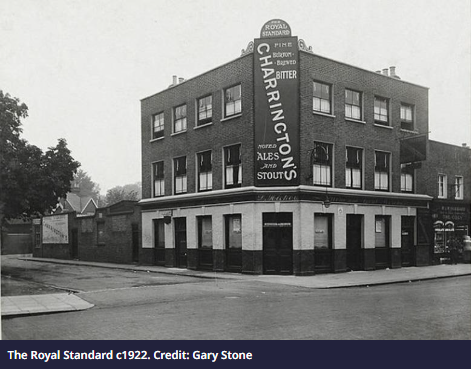
By 1907, Charles and Annie had moved to Loughton, Essex, where their third child, Alfred Dennison, was born on 5 June. Their future must have seemed full of promise as Charles was now running the Royal Standard pub.
Yet tragedy struck unexpectedly.
On 3 February 1909, Charles died at the Royal Standard in Loughton. He was only thirty-six years old. Probate was granted later that month in London.

As you can see, Charles was a Licensed Victualler. He was the landlord of the Royal Standard.
At the time of Charles’s death, Annie was heavily pregnant with their fourth child. Just over a month later, on 11 March 1909, she gave birth to Charlie William Dennison. The baby would grow up never knowing the father whose name he carried.
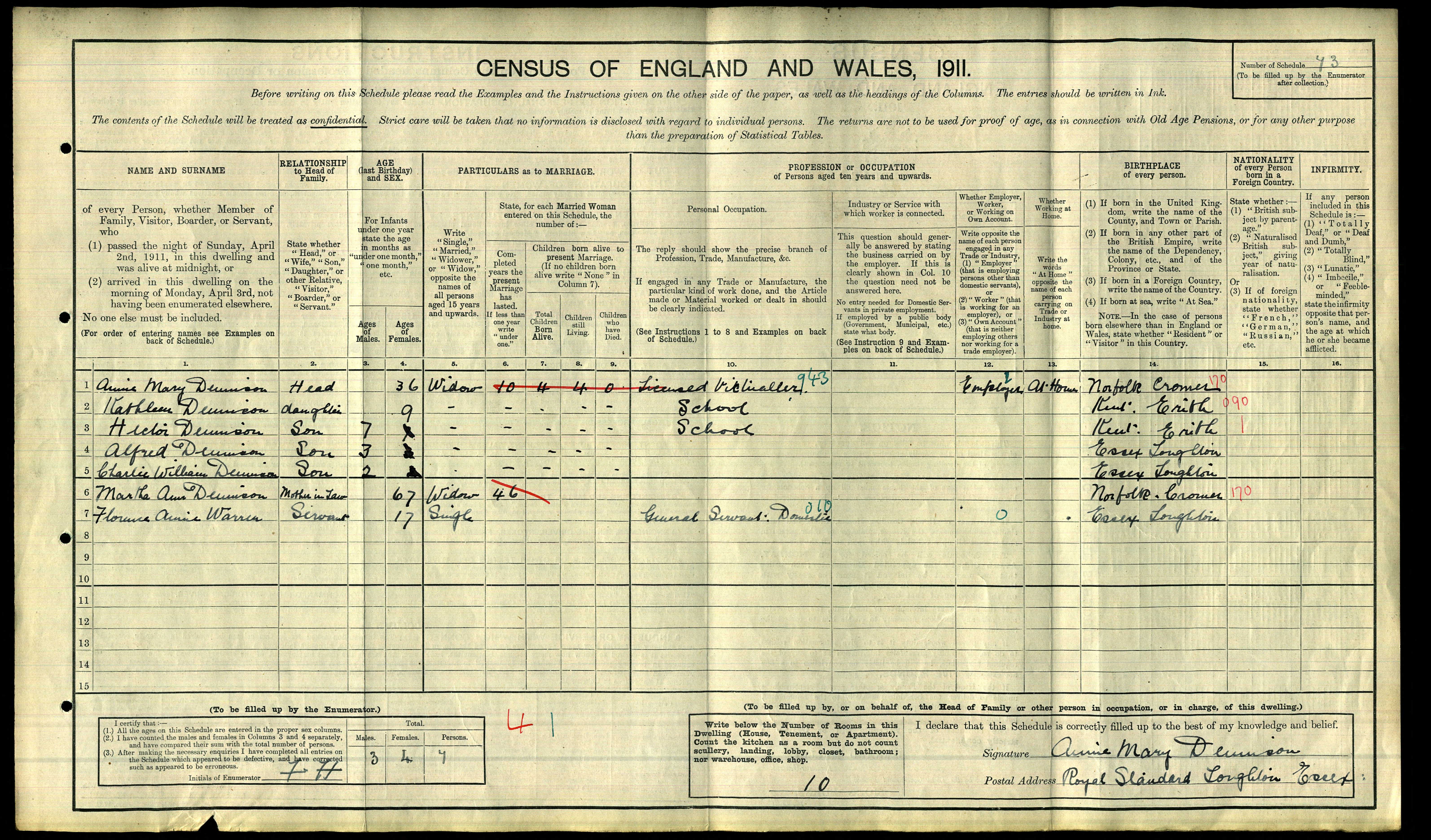
The 1911 census reveals Annie’s remarkable resilience. Widowed with four young children, she remained at the Royal Standard in Loughton and was listed as the head of her household and a licensed victualler.
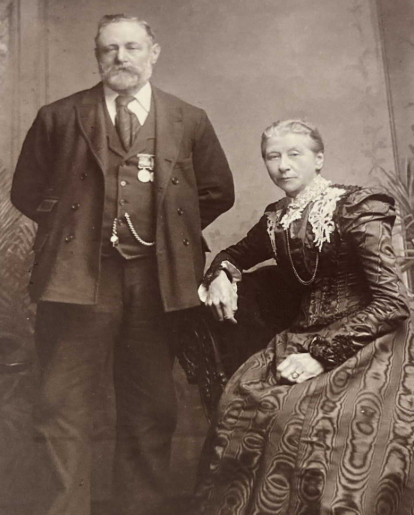
Supporting a family alone was no easy task; she had her mother-in-law, Martha, living with her to help with the children and a general domestic servant. She managed to provide for Kathleen, Hector, Alfred and baby Charlie.
Life brought another chapter when Annie formed a relationship with Thomas William Gordon, a London-born baker and confectioner. Their daughter, Norma Mary Gordon, was born in Loughton on 21 February 1913.
By 1921, the family had moved over a hundred miles away and settled in Loddon, Norfolk, where Thomas worked as a baker and confectioner. Annie was recorded as his wife, while her Dennison children appeared in the household as stepchildren.
After years spent in Essex and Kent, Annie had returned to her Norfolk roots.
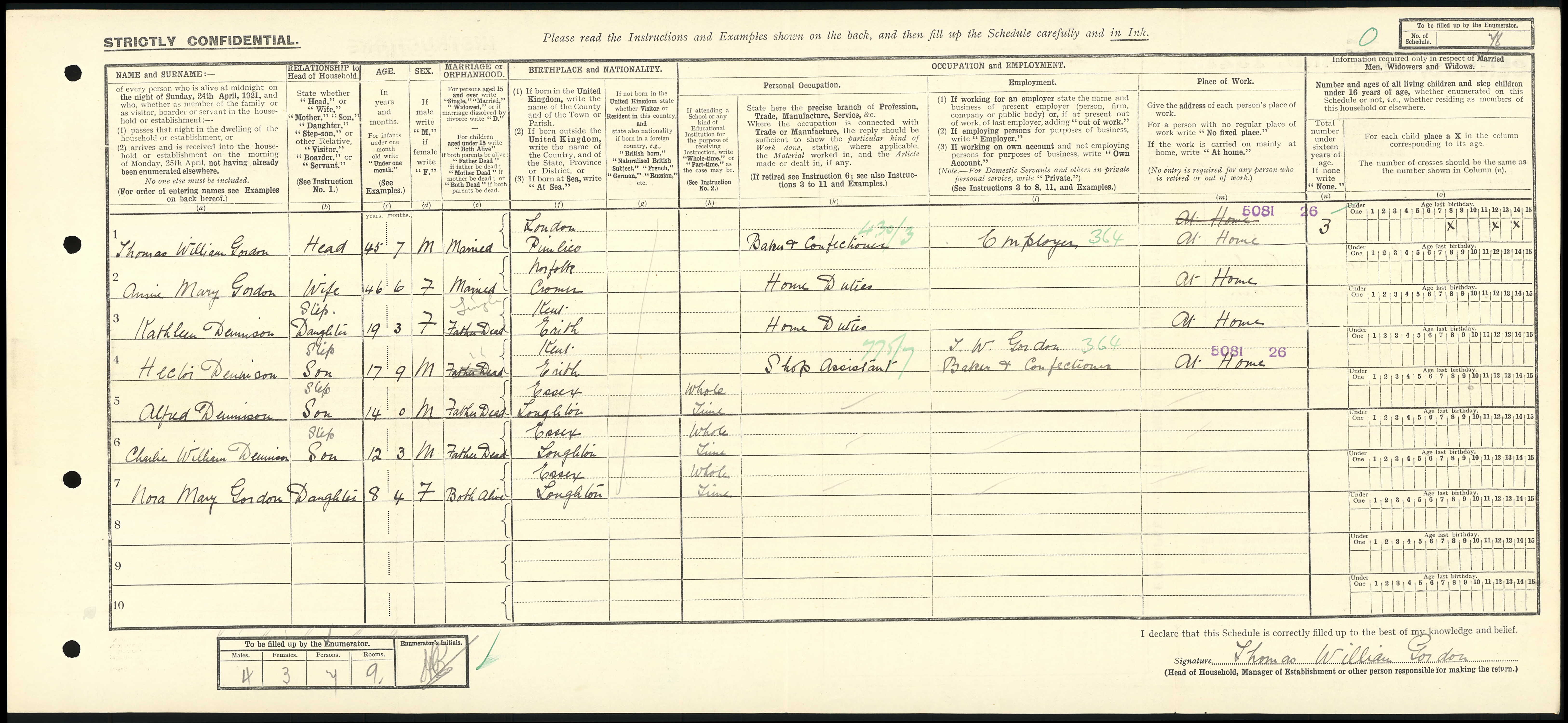
The children grew into adulthood in Norfolk. Kathleen worked as a shop assistant before marrying Reginald Horace Edward Dennison in Norwich in 1941.
Hector became a baker, following the trade of his stepfather, and married Molly Low in the same year.
Alfred worked as a journeyman baker and married Ethel V. Cox in 1936.
Charlie William chose a different path, becoming a farm worker and later a farmer in Suffolk. He married Olive May Steggles in 1939.
Norma Mary married Arthur Frederick Cooper in Norwich later that same year.
Annie lived long enough to see all of her children established in adult life. She died on 20 April 1939 in Norwich at the age of sixty-four and was buried in Loddon. Less than a year later, Thomas Gordon followed her, dying in March 1940.
Although Charles’s life was brief, his legacy endured through the family he and Annie created. Their four children lived long lives stretching well into the late twentieth century. Kathleen died in Norwich in 1981, aged seventy-nine. Hector died in Beccles in 1975, aged seventy-two. Alfred died in Norwich in 1982, aged seventy-five. Charlie William, the son born after his father’s death, lived until 1996, reaching the age of eighty-seven.
Norma, Annie’s daughter with Thomas Gordon, remained part of the wider family story until she died in 1969.
The story of Charles and Annie is one of ordinary people facing extraordinary challenges. It spans the railway age of Victorian Essex, the coastal inns of Norfolk, the growing industrial communities of East London, and the market towns of Norfolk and Suffolk.
Charles’s life was cut tragically short, but Annie’s determination ensured that their children grew up, built families of their own, and carried the Dennison and Gordon names into future generations.
There are also some lovely family threads running through the generations:
Charles inherited an engineering background from his father Isaac, an engine driver with the Great Eastern Railway.
While researching the Royal Standard, I came across this extra information: it was originally called the Wellington.
Annie came from a long-established Norfolk family headed by her father, William Amis, an innkeeper/licensed victualler for 42 years at the Wellington Pub in Cromer.
This pub became the Norfolk Hotel and was run by the executors of William’s will for several years after he died in 1901, namely Horace and Charles, William’s sons.
So that’s how come Charles Dennison became a licensed victualler, and later his wife Annie, William’s daughter. It ran in the family.
Licencees of the premises, this following list from the online Norfolk Pubs History:
‘JOHN WHITTING & dealer & Chapman to 1817
THOMAS BRAWN 1822
ROBERT SUNMAN 1830 – 1831
Robert Miles (NORFOLK HOTEL) 1833
THOMAS HARRISON 1836
TABITHA RANSOM, age 38 in 1851
( This property is identified as the NORFOLK HOTEL 1841) 1839 – 1854
WILLIAM COOPER from 01.1856
WILLIAM WALPOLE AMIS & horse & fly letter 10.1858
CHARLES AMIS 18.02.1901
SYDNEY JAMES LIMMER 29.03.1926
ALFRED M NEAL 30.03.1936
KENNETH HEARD 23.11.1936
STANLEY BULLOCK 01.05.1944
JOHN PHILIP BULLOCK 19.09.1955
H. W. HOWE 23.11.1961′
Although it was rebuilt after a fire in the 1890s, it still stands. It’s had a couple of name changes but is now back to The Wellington in Cromer.
The families’ move from Essex back to Norfolk shaped the next generation’s lives.
Several of Annie’s sons entered the baking trade through their connection with Thomas Gordon, while Charlie William found his future in farming.
Despite losing their father so young, all four Dennison children lived long lives, carrying the family into the late twentieth century.

You can contact me either by commenting here or via email at lynnswaffles@gmail.com
Till next time then……


I enjoyed reading this story; such resilience. Poor Charles and double pneumonia. My dad had double pneumonia in Oct 2022, but our local hospital saved him. It came from a bout of Covid. He will be 97 next month. I think health care has improved dramatically! I’m so glad I live now, but I love to read your posts and how life used to be. Thanks! I myself am having fun with my local Vancouver research. I would love to open a WordPress blog but I don’t know how.
LikeLiked by 1 person
Your Dad sounds amazing! Thank you, glad you enjoy reading my blog. The best thing I can suggest is to look up and read up as much as you can about starting a blog from scratch on WordPress. I knew nothing when I started mine & have taught myself how to do stuff along the way. I think it’s not as difficult as you might think. Good luck, I hope you take the plunge! Lynn
LikeLiked by 1 person