This is a family story like no other that I have written.
When any of us research a family history of our own or someone else’s family history, I/we mostly research records of the past generations before we were born.
So we don’t get to know the generations before that, what we have are facts and figures that we can work with and do our best to understand what they were like as people.
But because of this written account of this particular family about ninety years ago by Louise Edith Williams. We get a glimpse of many family members and learn what some of them were actually like.
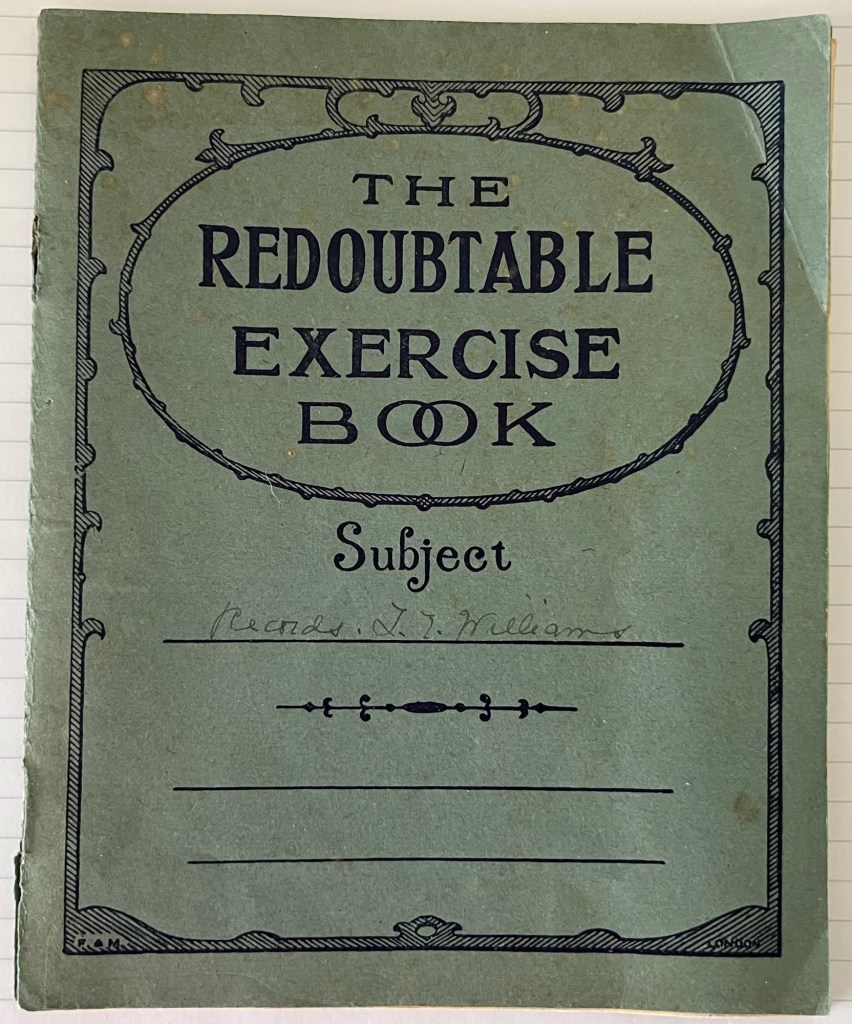
The Redoubtable Exercise Book. Records. L E Williams.
The Exercise Book.
Louise wrote in this exercise book in 1938 when she was aged 65. She wrote this account of the family from her perspective, and her memories were mostly as she says, for her younger sisters’ children in case they were interested and curious about their heritage.
There are also letters, parts of their family tree written on separate bits of paper and a few certificates and a couple of newspaper clippings.
My friend Diana found this quite a while ago and sent it to me in the hope that if I researched and wrote about the book and its contents, it might lead to the collection being returned to a branch of the family.
It would be great to return all this information to a descendant of Louise’s sister or another descendant.
Unfortunately, no old photos of the family….yet!
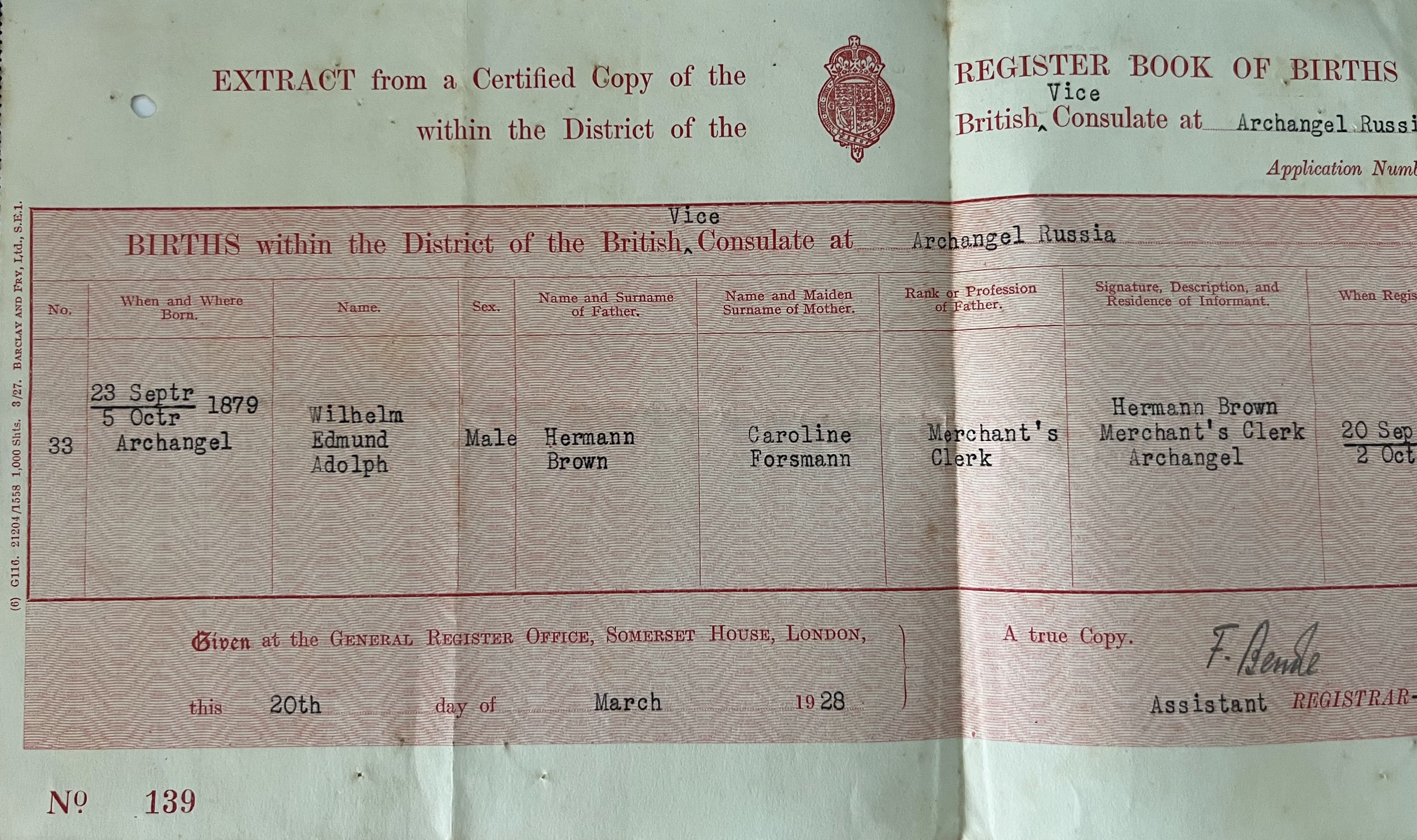
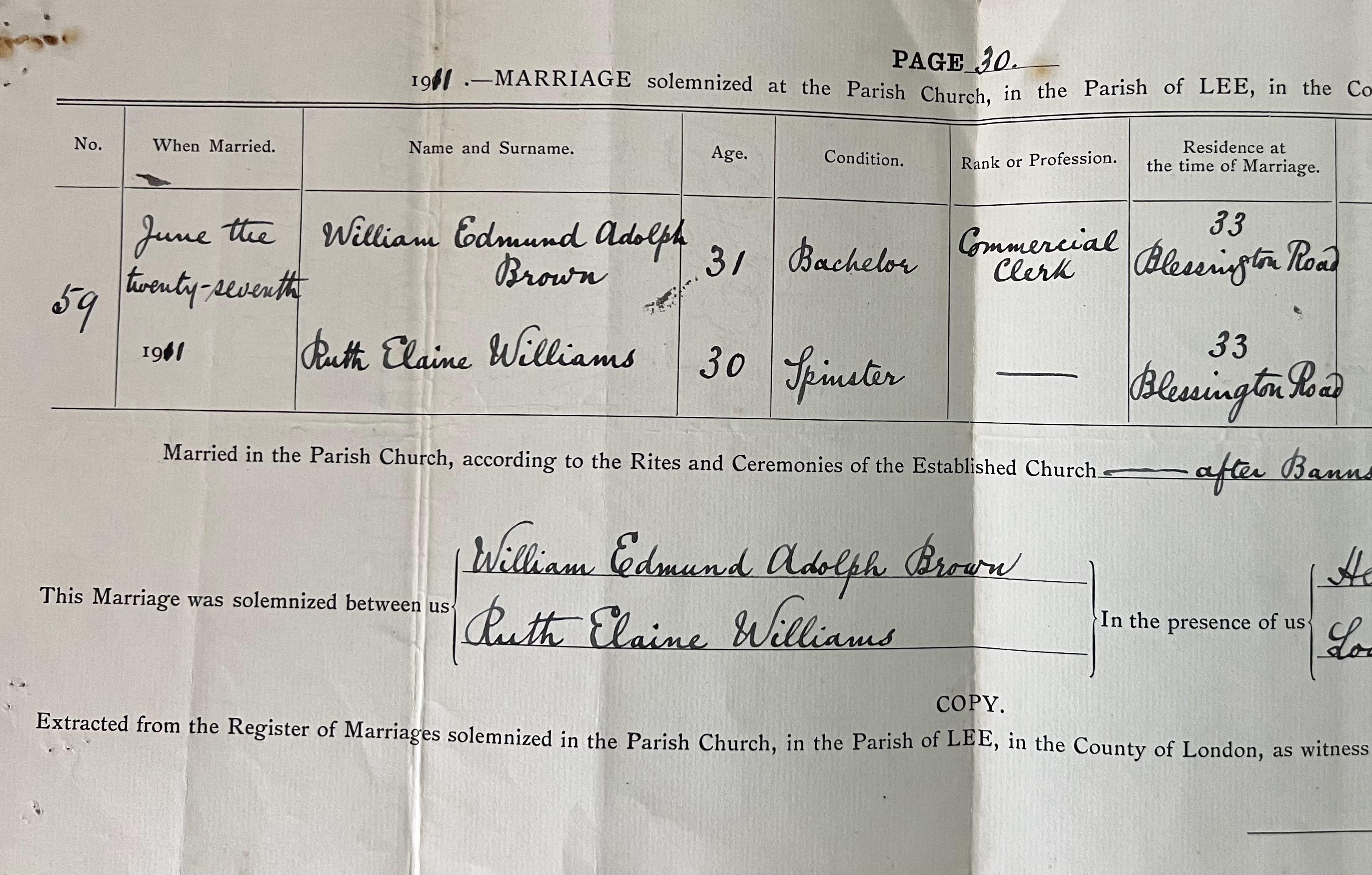
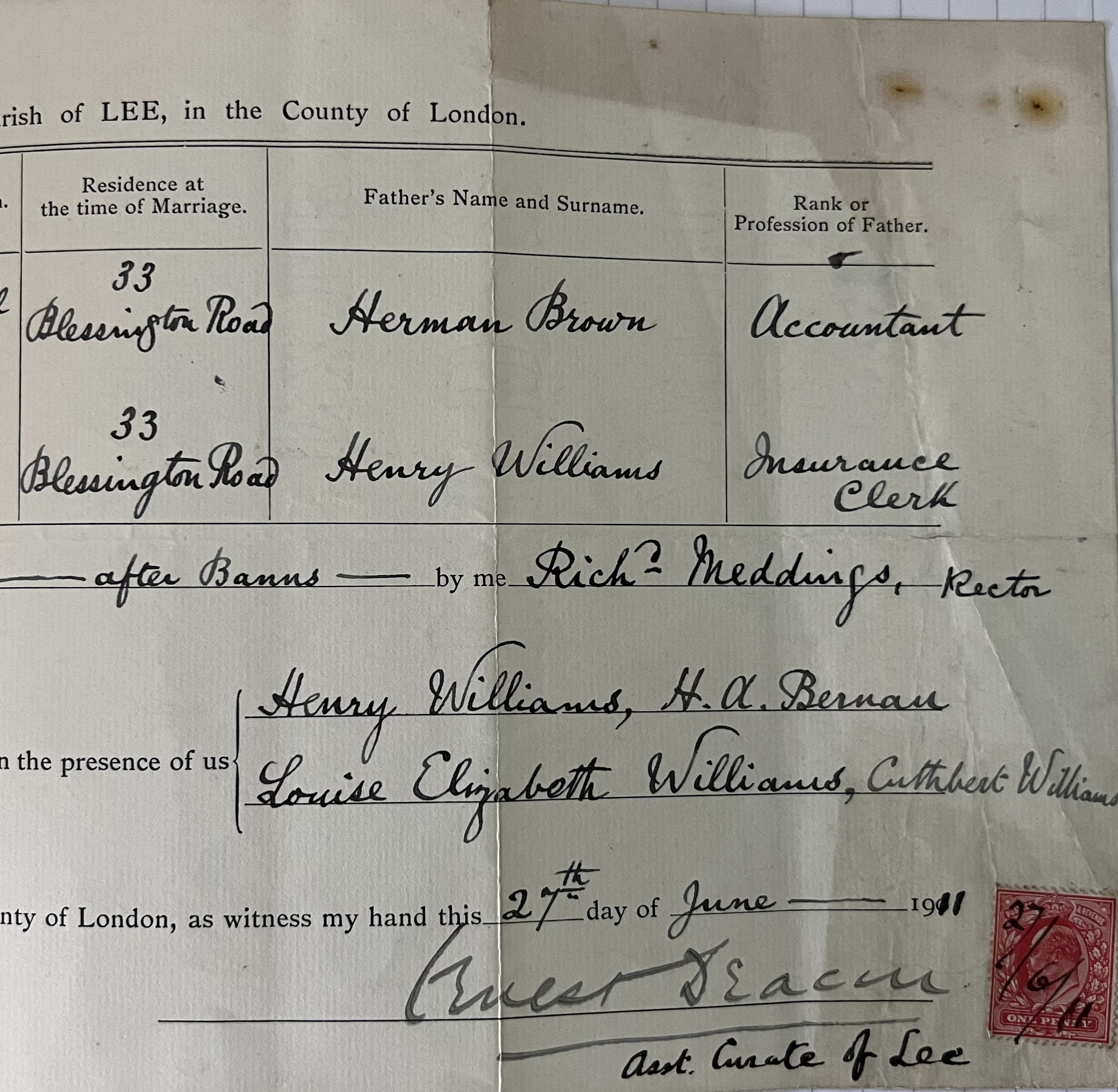
I started the family tree on Ancestry with the facts from the certificates of the couple. They gave me a base to work from. They are also in the newspaper clippings. The couple are Ruth and Willhelm, the title of this blog. They were Louise’s younger sister, Ruth Elaine Williams and her husband.
Birth certificate for Willhelm
Marriage certificate part 1, Willhelm used the name William.
Marriage certificate part 2 for Willhelm & Ruth.
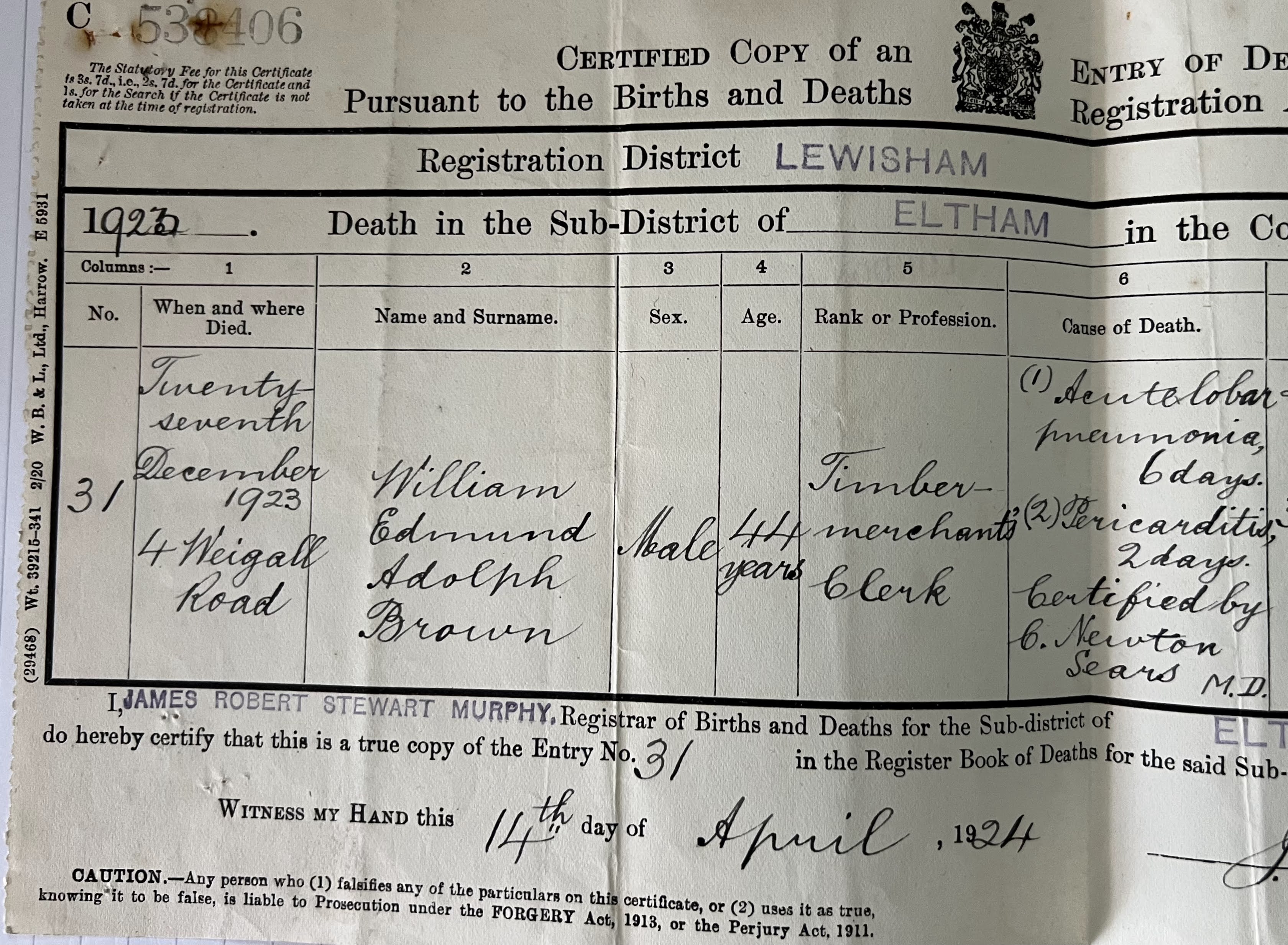
Willhelm/William death certificate part 1
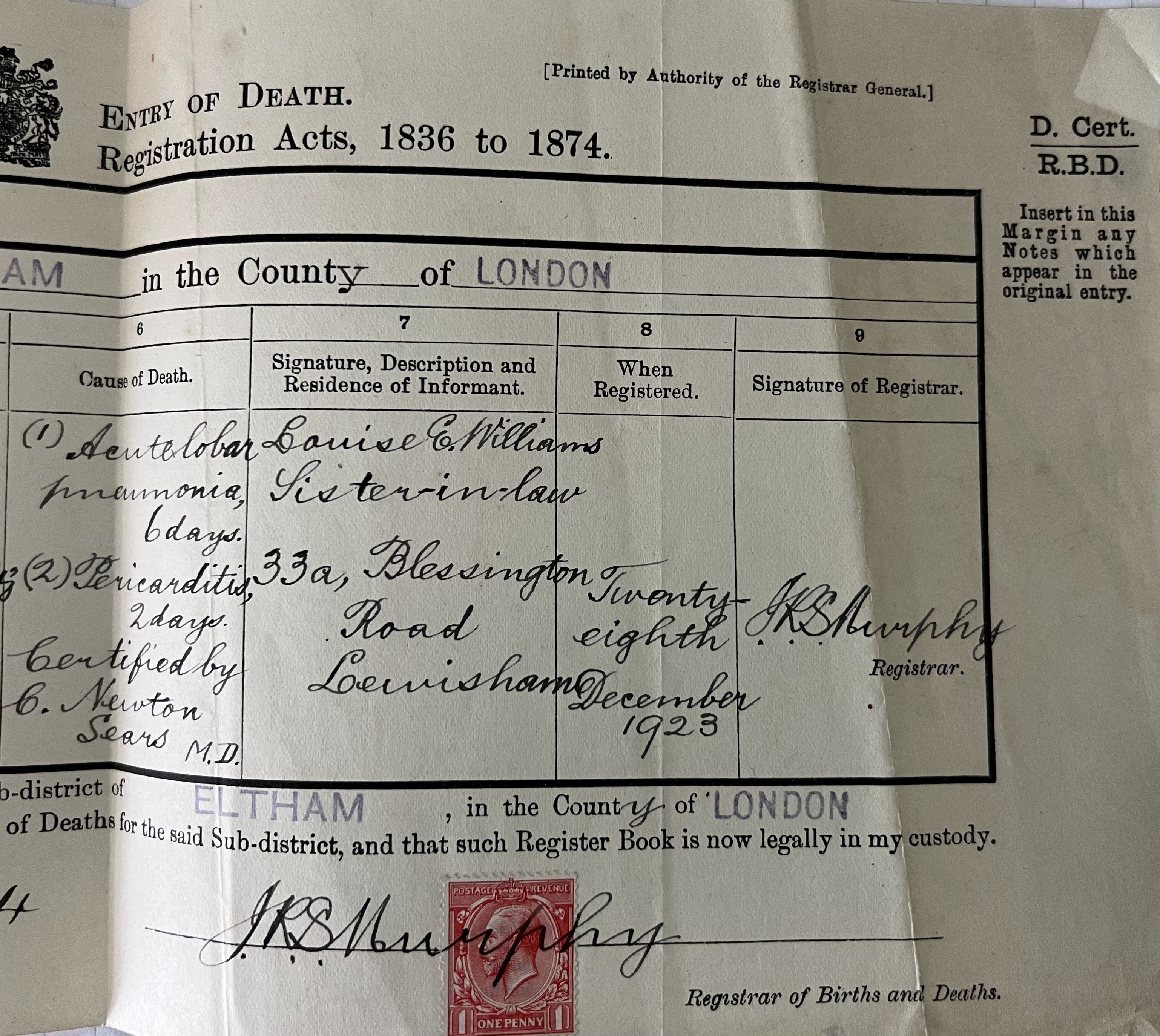
Part 2 of Death certificate. Note Louise E Williams registered her brother in law’s death.
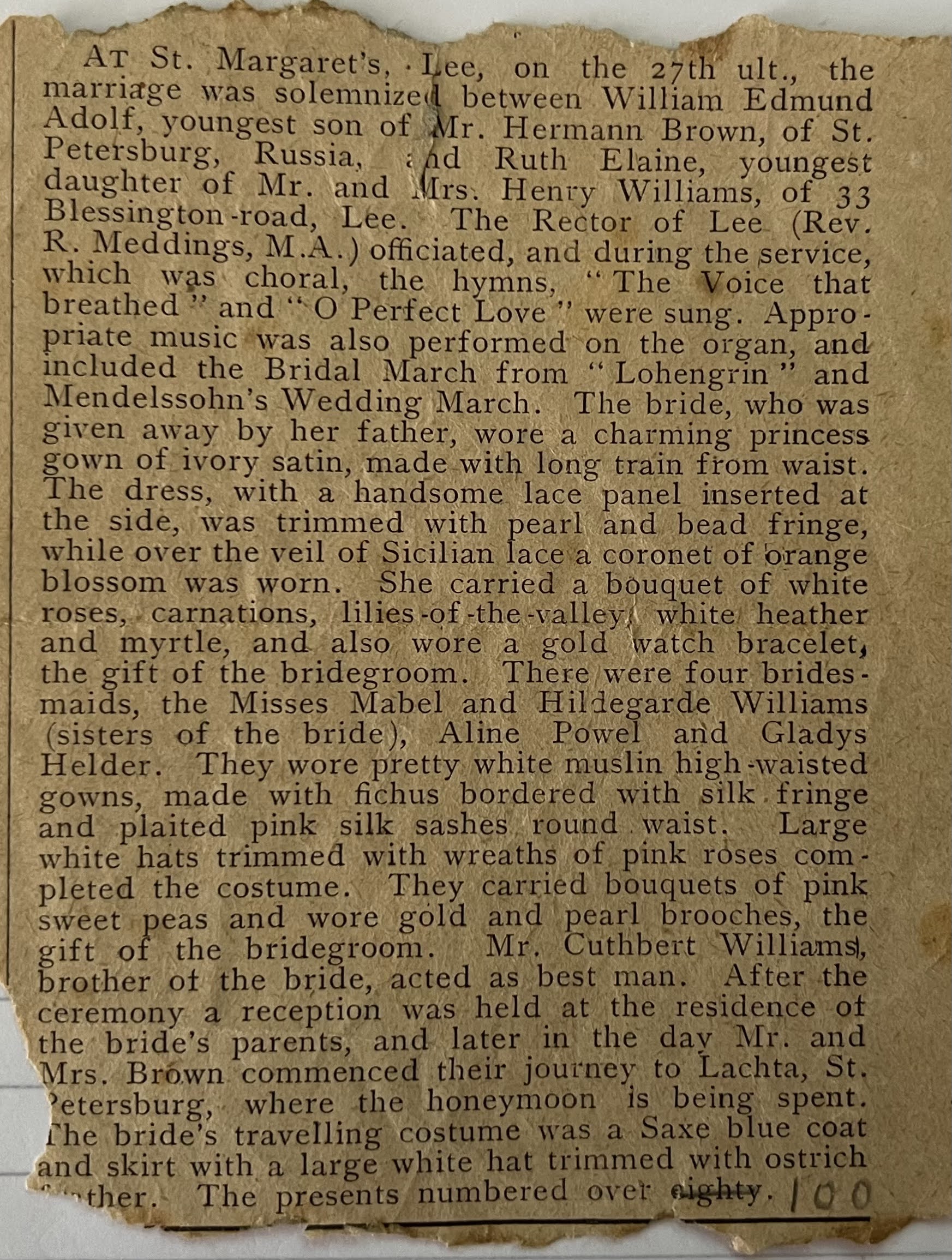
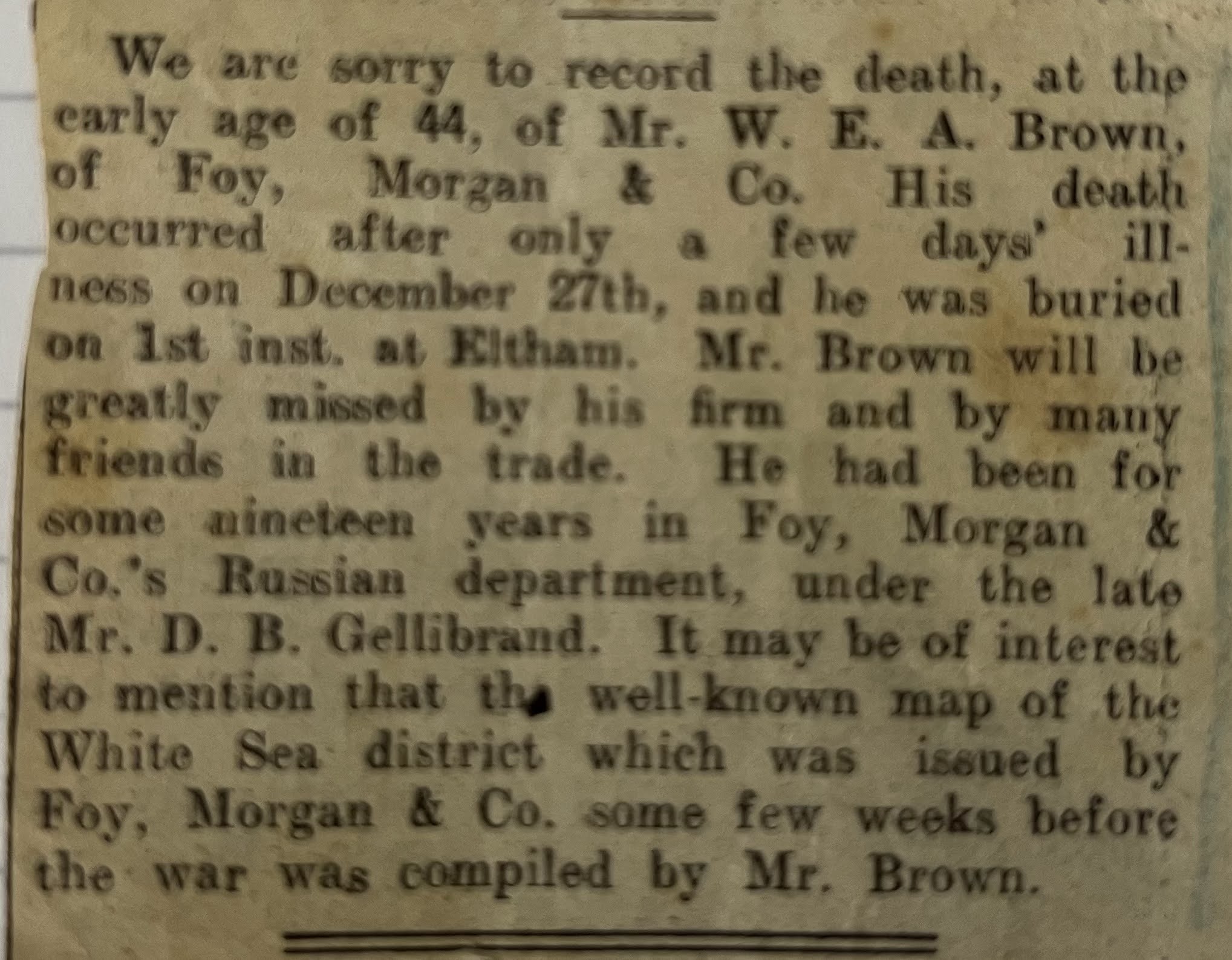
One of the two newspaper clippings from the exercise book.
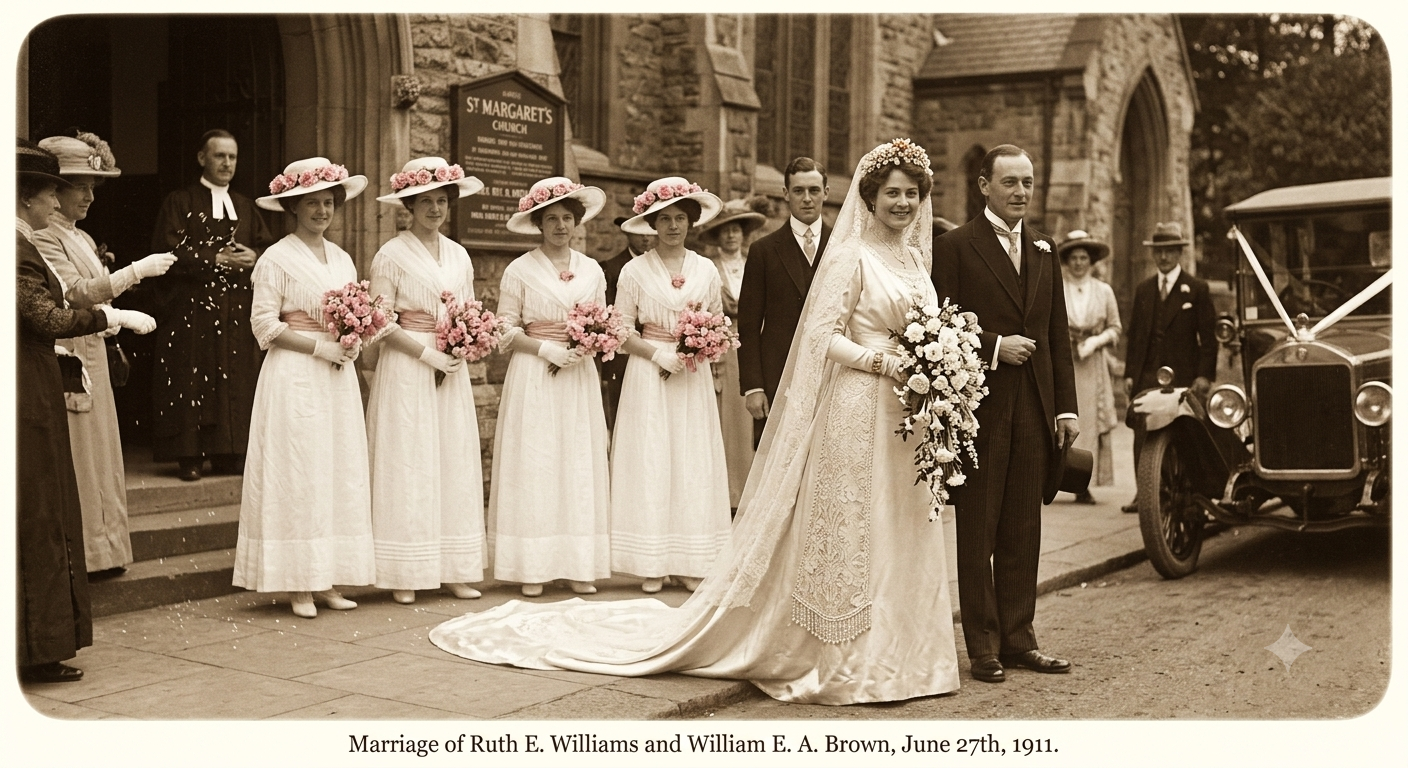
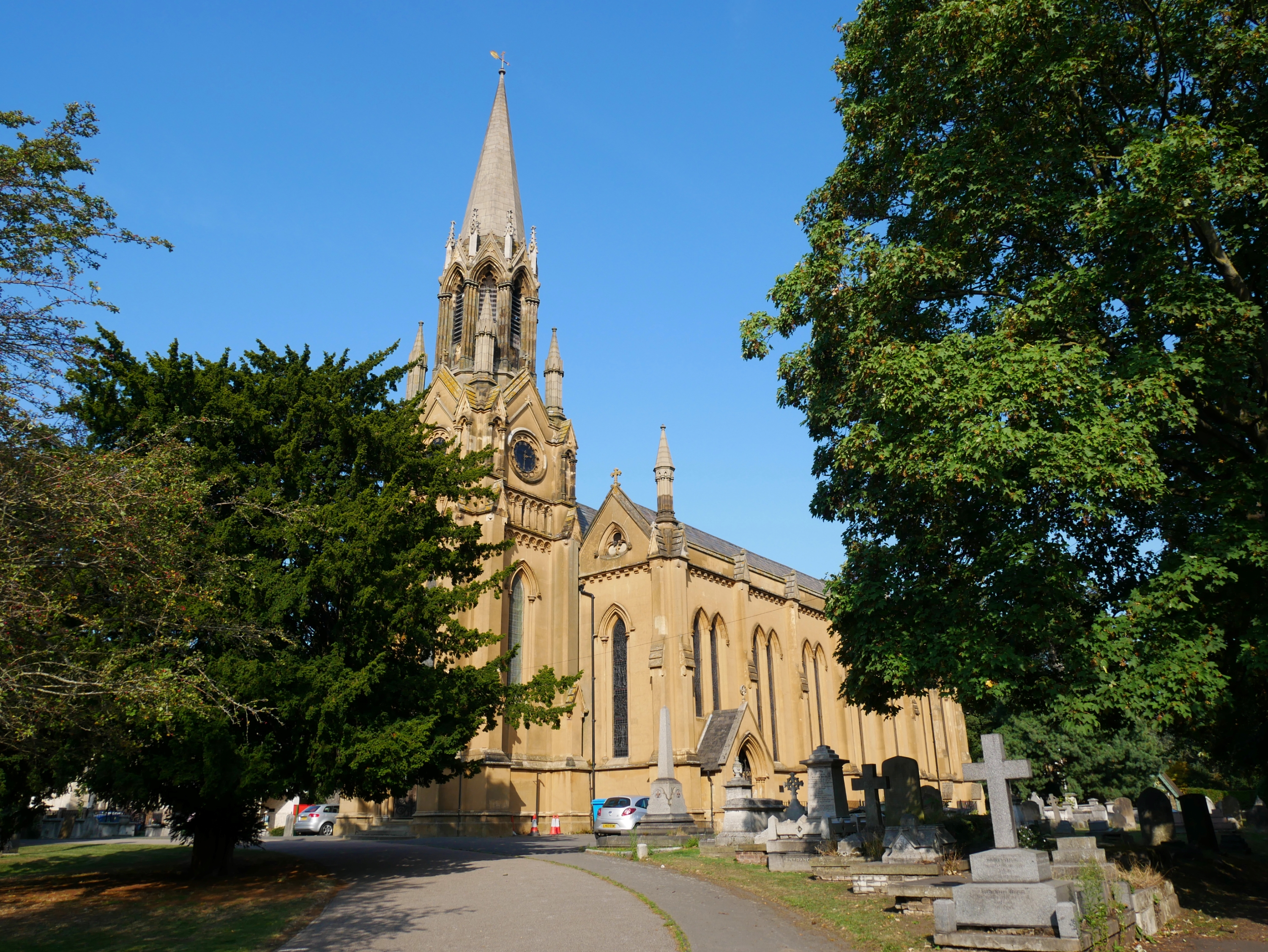
I couldn’t resist attempting to recreate this wedding using the newspaper report above. So this is Google Gemini’s recreation. Not bad, as we don’t know what the couple looked like, but we do know the date and that it was held at St Margaret’s Church, Lee, Lewisham.
Image created by Google Gemini.
The second newspaper clipping
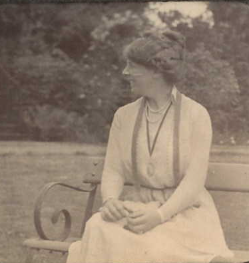
As I added more to the tree, I came across a definite match for L E Williams, and it was this lady. Louise Edith Williams, she was born on 8 August 1873 in Deptford, Kent. Parents Henry Williams and Louise Elizabeth Turner. Louise was their firstborn child. Her parents had married only eleven months earlier, on 7 September 1872 at St Paul’s Church, Deptford, beginning what would become a marriage lasting almost half a century.
She had two brothers, Henry Frances and Cuthbert Victor, and three sisters Hildagarde Maude, Mabel Florence and Ruth Elaine.
Louise never married, and she died on 25 January 1963 at Ranyard Memorial Nursing Home, Blessington Rd, Lewisham, London, at the age of 89.
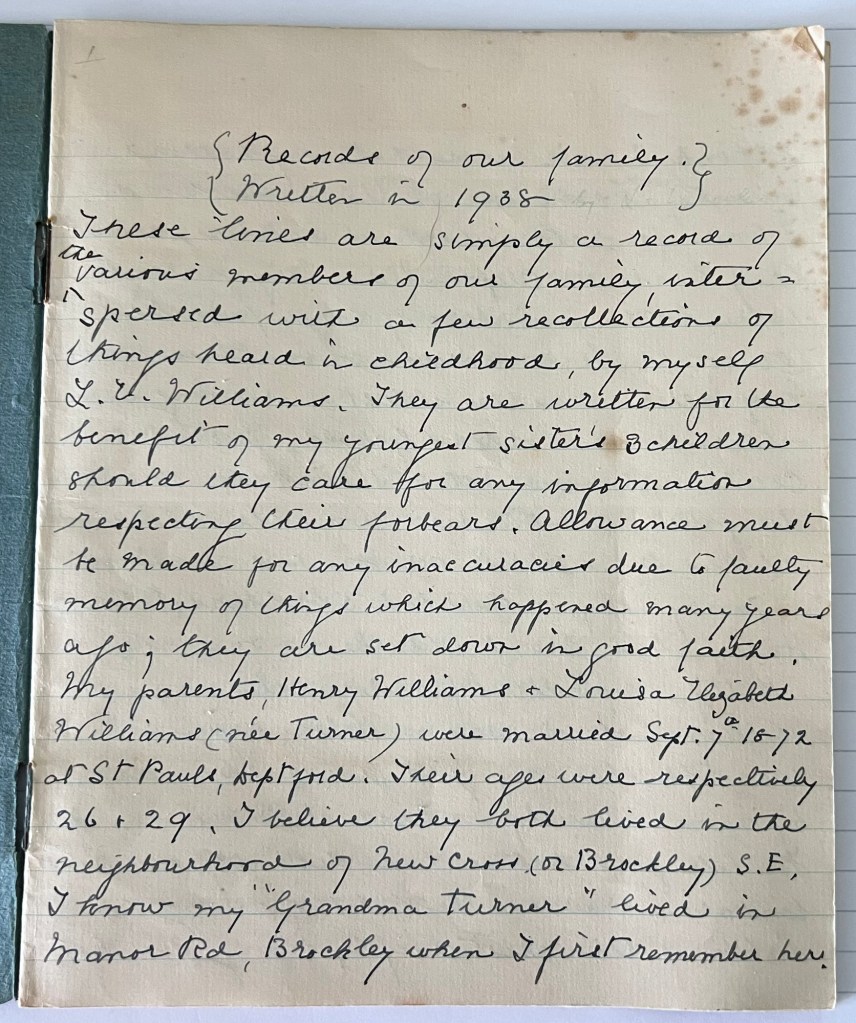
The first page.
Transcription of The Exercise Book.
This is my transcription of the many pages of Louise’s Exercise Book. As Louise didn’t have any children herself, she wrote and kept all these memories for her younger sister Ruth’s descendants.
Records of our family, written in 1938.
These lines are simply a record of the various members of our family, interspersed with a few recollections of things heard in childhood, by myself, L. V. Williams.
They are written for the benefit of my youngest sister’s children, should they care for any information respecting their forebears.
Allowance must be made for any inaccuracies due to faulty memory of things which happened many years ago. They are set down in good faith.
My parents, Henry Williams and Louisa Elizabeth Williams, née Turner, were married on September 7th, 1872, at St. Paul’s, Deptford. Their ages were respectively 26 and 29.
I believe they both lived in the neighbourhood of New Cross or Brockley, South East London. I know my Grandma Turner lived in Manor Road, Brockley, when I first remember her.
I think I have heard that my father’s parents lived at some time in the same road. I know for certain that at another period they lived in Clifton Road.
My parents were both members of large families, or would be considered so in their days.
My father was the eldest surviving son, and there were three others, Gerald, Justin, and Cecil, nicknamed Tet. I think the one daughter, Aunt Edie, was the eldest child, but I believe one son had died in infancy.
My mother had five brothers, Peter, Harry, Gus, Frank, and Charlie, and one sister, Kitty.
My father’s family, as the name of Williams shows, was of Welsh origin, and I was told that my great-grandfather was by name Llewellyn, and lived at Llanrwst, North Wales.
The tale grew that he had distinctly sporadic tendencies, and was in the habit of showing his dislike of the aristocracy by fixing his hat more firmly on his head if a lord passed by. Possibly in those days it might have been customary to doff one’s hat to a tilted personage, I think it says, or something similar. Otherwise, why the anecdote?
Grandpa Williams was a Londoner in his adult years, but I do not know when he was born. Perhaps at Llanrwst.
His son, my father, was, I think, born in Clerkenwell, London. Grandpa Williams seemed a pleasant, friendly man to my young eyes.
He had a great liking for scientific work, and made a collection of specimens and all kinds of interesting objects, which were all put together in a room kept for the purpose, and called the Museum.
This museum used to be a veritable chamber of delight to me. There was a clock ticking loudly in it. I recall that sound even now with the atmosphere of the room. The sight of the fossils and a certain little Chinese figure which put out its tongue when touched and nodded its head.
I have been told that my grandfather used to lecture at times. I expect he was quite an amateur but talented and well-read.
His occupation was that of a clerk in Glyn’s Bank, and I suppose he had just a moderate income and sufficient to bring up his family in ordinary comfort.
I do not know where my father was educated. It was probably a boarding school, and not an expensive one.
For one thing he used to tell me the food was scanty, and that he used to subterfuge to obtain the largest portion of bread and butter. Though this fact may only prove the existence of a healthy schoolboy appetite.
He was put into business when I first remember him. He had a position in the London and Manchester Plate Glass Company.
I imagine about that time that foreign competition began to make its mark on British business, and the plate glass business had keen competition in Belgium.
Certainly most of my recollections concerning money and business were those of scarcity and uncertainty. There seemed to be frequently hopes that the breadwinner would sometimes procure a good appointment, but their hopes were never realised.
There is doubt that the plate glass industry was badly hit, but I also think now that my father, though a most industrious and painstaking man, was not one to shine in business. Probably he lacked initiative and push. He was a most likeable and popular person, but not a moneymaker.
Of his brothers, Justin did well in the Westminster Bank. He became a manager at the Lombard Street head office, finally retiring with a pension. And when he died he kept his widow comfortably off.
There were four children. The eldest is a daughter, Claire, who married Mr Fell Clark and has a family of four. The second daughter, Grace, married Mr Pritchard and has no children.
The youngest daughter, Connie, did not marry. She died of cancer before she was 40.
The only son, Harold, married and had a son and daughter. He went to the war, 1914–18, and was killed. After his death, his widow lost the boy at the age of 11. The girl, Suzanne, survived and has recently married.
Gerald, the next son, was unfortunate in his life. I do not know in what business he started, but the latest recollections I have of him were as a stockbroker, and he did not do well.
His marriage turned out badly, as his wife took to drink. They had two daughters. The elder, Maud, married a doctor, had a family, and died in middle age. Her married name was Gibbons, and her family consisted of one daughter and two sons.
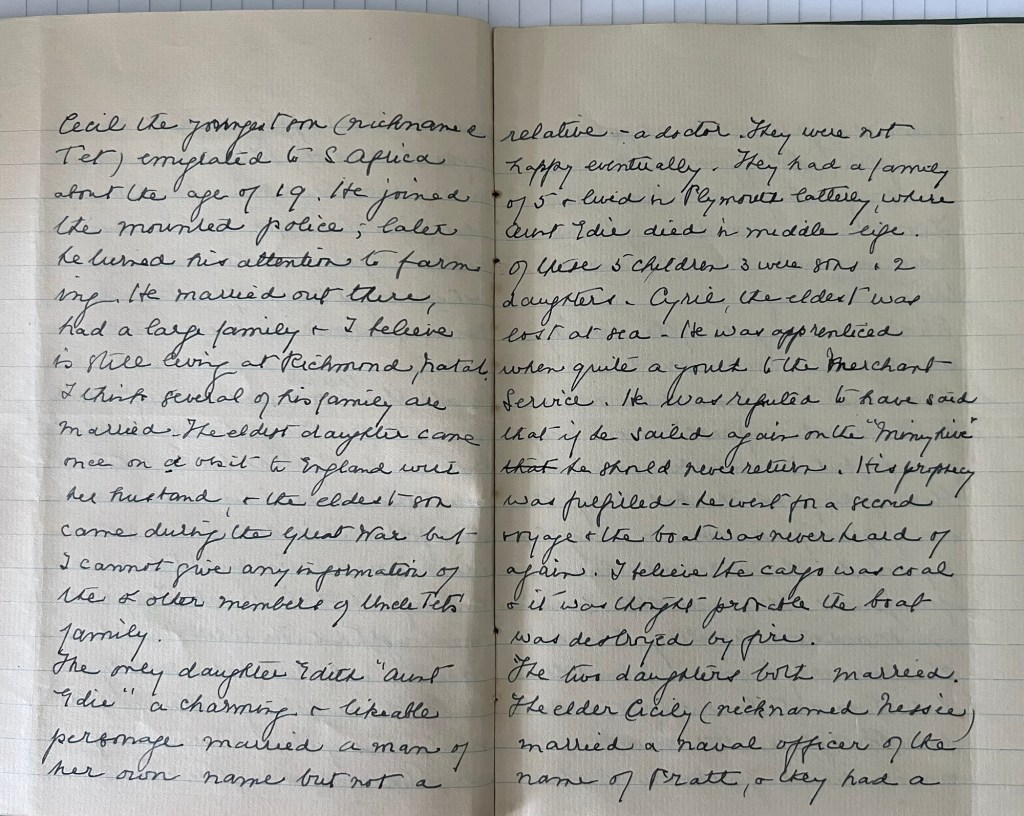
Cecil the youngest son (nickname Tet)
Cecil, the youngest son, (nicknamed Tet), emigrated to South Africa about the age of 19. He joined the Mounted Police.
Later, he turned his attention to farming. He married out there, and had a large family, and I believe is still living at Richmond, Natal.
I think several of his family are married. The eldest daughter came once on a visit to England with her husband, and the eldest son came during the Great War. But I cannot give any information of the other members of Uncle Tet’s family.
The only daughter, Edith, Aunt Edie, a charming and likable personage, married a man of her own name, Williams, but not a relative. He was a doctor.
They were not happy, eventually. They had a family of five, and lived in Plymouth latterly, where Aunt Edie died in middle life.
Of these five children, three were sons and two daughters. Cyril, the eldest, was lost at sea. He was apprenticed when quite a youth to the Merchant Service. He was reputed to have said that if he sailed again on the Minnie Hive, he should never return. His prophecy was fulfilled.
He went for a second voyage, and the boat was never heard of again. I believe the cargo was coal, and it was thought probable the boat was destroyed by fire.
The two daughters both married. The elder, Cecily, nicknamed Nessie, married a naval officer of the name of Pratt, and they had a son and daughter.
Dorothy, the younger, known as Dolly, married a Mr. Kaye, and they have two sons.
Lionel, the second son of Aunt Edie, married, but I know nothing of his life. Radley, the youngest of the family, died young and unmarried.
Grandma Williams did not make much impression on my mind, but I remember her as a blue-eyed, pink-cheeked lady. She and my grandfather were a very happy couple. She survived him a few years. They were both buried in Maidstone Cemetery.
I believe she formerly lived in Maidstone, but I do not know if it was her birthplace. Her maiden name was Jackson, and she came from a family which traced its descent from the Standishes, the family to which belonged the famous Miles Standish, Captain of Plymouth, and whose family seat was Duxbury Hall in Lancashire.
And now I would turn my attention to my grandparents on the maternal side.
Of Grandpapa Turner we know nothing except that he was a doctor, practising in Woolwich, and that he was twice married.
There was a son and daughter of the first marriage. The son, Richard, was, I believe, in the Merchant Service. He married a Miss Kate Harmer, whom I remember having seen on various occasions. They had one daughter, Lizzie, who for many years had a job as matron of Charterhouse School. She died unmarried.
The daughter of my grandfather by this first marriage was named Mary, and she went to Australia, but I know nothing further and never heard her mentioned until quite recently, when a cousin told me that she had existed.
Grandpa Turner died when my mother was a child. Naturally, I have no recollection of him, but my mother used to tell me that he never had any illness till he contracted the fatal one that carried him off in middle life.
She said he was a most kind-hearted person, often treating his poorer patients for nothing. Indeed, he was supposed to have caught the chill from which he died from doing a kindness to someone and disregarding his own health.
His second wife, my grandmother, always seemed a very dominating personality and loomed large in my childhood years.
She was extremely fond of me, and I used to stay with her frequently. She had been very good-looking in her youth and was quite personable in her later years.
She had good features and was blue-eyed and olive-skinned, which was noticeable. She had had a rough time, as her husband died leaving her with a young family of seven.
The two stepchildren may have been on their own when this happened.
Her unmarried brother, Thomas Sutton, gave her keep, I believe, and he made his home with her, apparently.
I remember being taken to see him when he was in bed with his last illness. I was too young to realize much, but I heard that he had cancer of the stomach, that he had no pain, but died of starvation as no food could be taken.
He was buried in Brockley Cemetery. I remember that he had expressed a wish that wallflowers should be planted on his grave.
This happened when my grandma’s family had all grown up and were on their own in the world. There must have been many years of struggle to bring up the family.
My mother took posts as resident governess in various families. She was very musical and I suppose well educated for those days.
She had been sent to a boarding school in Cambridge, which was kept by an Aunt Mary. I have an idea she was a Miss Sutton, but I’m not sure.
One of the posts my mother took was as resident governess to the daughter of Reverend Chamberlain in Wiltshire.
She made lifelong friends of this family, and even now we hear from them on occasions.
In another post there was some connection with the famous Isambard Brunel, engineer, but whether he was her pupil or only a relative I am not clear.
But I remember her talking of him. A certain Lady Haynes, who may have been his aunt.
My mother must have been nearly thirty when she married my father.
Grandma Turner, when I began to remember her at Manor Road, Brockley, was a strict, bigoted Dissenter, much given to reading and hearing sermons.
She was rather intolerant and not slow in airing her views.
She was highly skilled in plain sewing and wrote in wonderfully neat handwriting, almost up to her death at the age of ninety.
I think she was a rather uncontrolled nature, passionate and nervous. She and my mother used occasionally to come across each other, but on the whole remained on friendly terms.
Her last days were spent with our family at 47 Burnt Ash Hill, Lee. The last house which she kept up herself was in Morton Road, Forest Hill.
During her later years, a good deal of time was spent at Hastings in the winter months, and I used to go with her at times and walk on the front there by the side of her bath chair.
The eldest son, Peter, emigrated to America, and he used to write to his people from California, where I think he practised dentistry.
We heard that he married and they had one daughter. Shortly after the birth of the child, all correspondence ceased, and my mother was of the opinion that Uncle Peter might have lost his life in the earthquake in San Francisco.
Another son, Gus, also went out to America, to Vancouver, and he married a Miss Kate Harmer. This lady must have some connection with my grandpa’s first wife, as the name is the same, whom he had known in England, who joined him in America.
They had a family of four, two sons and two daughters.
The youngest son came once to England as a volunteer in the Great War. He came to visit us at Blessington Road, with his wife and two children.
He had married a girl from Hythe. He had some small pension as his health had suffered in the war.
Not being able to make any headway in this country, the little family returned to Vancouver. We heard of their arrival, but the correspondence did not continue.
The eldest daughter of the family, Lily, married but died of consumption.
The other sister, May, I believe, also married, and the eldest son practised law. It seems unlikely we shall hear of this branch of the family again.
There was a strain of lung weakness in the Turner family, for Uncle Gus had trouble, though I do not know if it caused his death, and the youngest daughter, Kitty, of whom more recently, died young in consumption.
But neither of our grandparents seemed to have had no such weakness.
The third son, Frank, married a Miss Fanny Shackle, and they had one son and two daughters.
They lived near us at one time at Forest Hill. Later on, Uncle Frank had some job which took the family to Dublin. There they have remained until this day.
Uncle Frank died first. I think he was a Freemason. He left his widow and family in poor circumstances, and I believe they had keep from his lodge.
The two girls, Edie and Lena, run a boarding house in County Wicklow, and supported themselves and their mother while she lived. They are still at the same place.
The son, Frank, married a Devonshire girl. They have a family and live, I think, in County Kilkenny, where he has his job.
Though latterly on good terms with Uncle Frank, I know there were quarrels between him and my mother when I was a child.
Quarrels relating to money, and I hear there were even legal proceedings concerning some fines, some bonds. I do not know the rights of the case, but I do know my mother said she had lost a great deal of money.
She was naturally sore on the subject, and relations were strained. But, as before remarked, the feud was healed in later years.
Uncle Harry was the one of my uncles whom I used to know best. He came and went to and from our house at certain intervals, and I suppose was a wanderer, trying one occupation after another. I imagine he never had much money.
He was good-looking and a great favourite with us children, with whom he used to romp and play, sometimes exciting us to a perfect frenzy.
I think he must have had a curious digestion, for he frequently tried diets, at one time eating nothing but nuts and drinking huge quantities of water.
I think he was a very likable person, with a great sense of fun, and he used to talk and laugh profusely.
He died in Hamburg, I think in a hospital, and my father went once to see about the funeral. I imagine he left practically no money at all, or died as he had lived, a sort of wanderer.
The youngest son, Charlie, from all accounts, was the black sheep of the family. I don’t know what his offences were, but the story goes that he was obliged to get out of the country.
His mother sold silver or jewellery, or both, to find money for his passage, and he went to Australia.
It certainly seems as if there was a bit of unscrupulousness about some of the Turner sons.
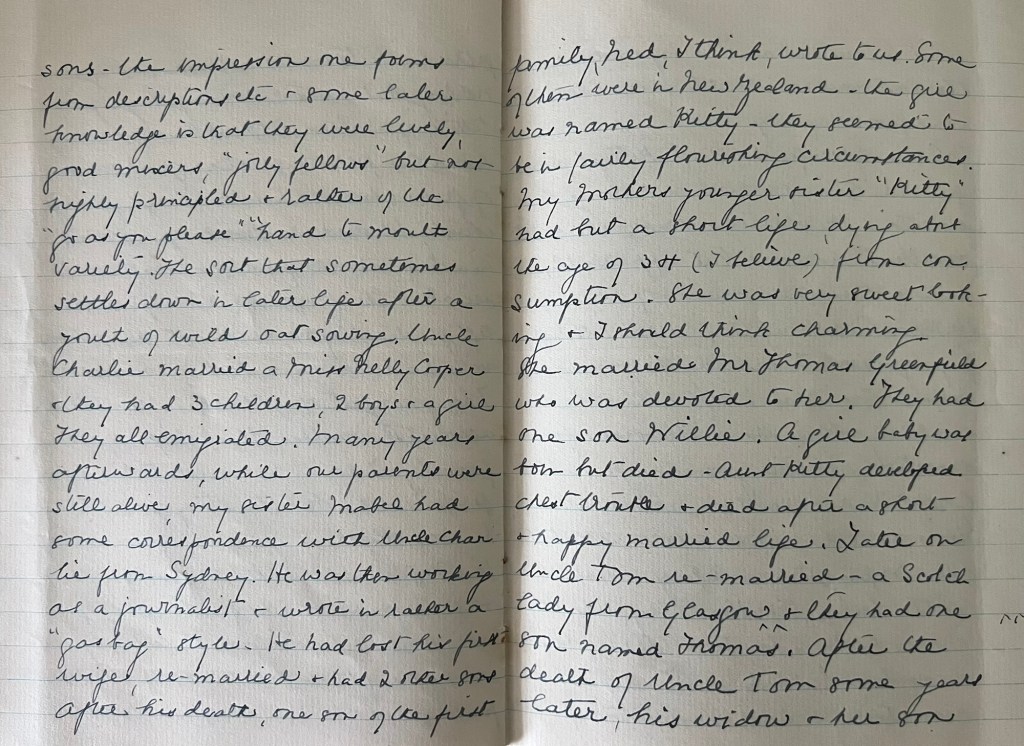
A couple more of the many pages in the exercise book.
The impression one forms from descriptions, etc., and some later knowledge, is that they were lively, good mixers, jolly fellows, but not highly principled, and rather of the go-as-you-please, hand-to-mouth variety.
The sort that sometimes settle down in later life after a due sowing of wild oats.
Uncle Charlie married a Miss Nellie Cooper, and they had three children, two boys and a girl. They all emigrated many years afterwards, while our parents were still alive.
My sister Mabel had some correspondence with Uncle Charlie from Sydney, Australia.
He was then working as a journalist, and wrote in rather a gasbag style. He had lost his first wife, remarried, and had two other sons.
After his death, one son of the first family, Ned, I think, wrote to us.
Some of them were in New Zealand. The girl was named Kitty, and they seemed to be in flourishing circumstances.
My mother’s youngest sister, Kitty, had but a short life, dying at the age of 34, I believe, from consumption. She was very sweet-looking, and I should think charming.
She married Mr. Thomas Greenfield, who was devoted to her. They had one son, Willie. A girl baby was born but died.
Aunt Kitty developed chest trouble and died after a short and happy married life.
Later on, Uncle Tom remarried a Scotch lady from Glasgow, and they had one son named Thomas.
After the death of Uncle Tom, some years later, his widow and her son went to Australia. The boy married, and the last news we heard from them was from Sydney.
Willie Greenfield, Aunt Kitty’s son, proved to be of rather a roving disposition. He started business with excellent chances, but apparently did not make much of them.
He married, but they were not happy together. Eventually, he emigrated to Canada and left her. She eventually obtained a divorce for desertion.
Willie joined up in the Great War, went on active service. His health failed, and he was sent to the Orpington Military Sanatorium with lung trouble. They did not cure him, and he died there.
He was buried in Ladywell Cemetery and had a military funeral.
Having now concluded a record of nearest relatives of uncles, aunts, first cousins, it is time to make mention of remoter cousins, etc.
There are few or none to be noted on the maternal side, the reason being that of the relatives or history of Grandpa Turner we know nothing. As before stated, he was a doctor, married twice, for the second time to my grandmother, who was a Miss Sutton.
And of her family, only three, including herself, lived to grow up.
The brother Thomas remained a bachelor, and the other sister, Amelia, was not on friendly terms with my grandmother.
Indeed, they must have quarrelled bitterly, for I remember Grandma giving express orders that on her death no one was to acquaint her sister of the event.
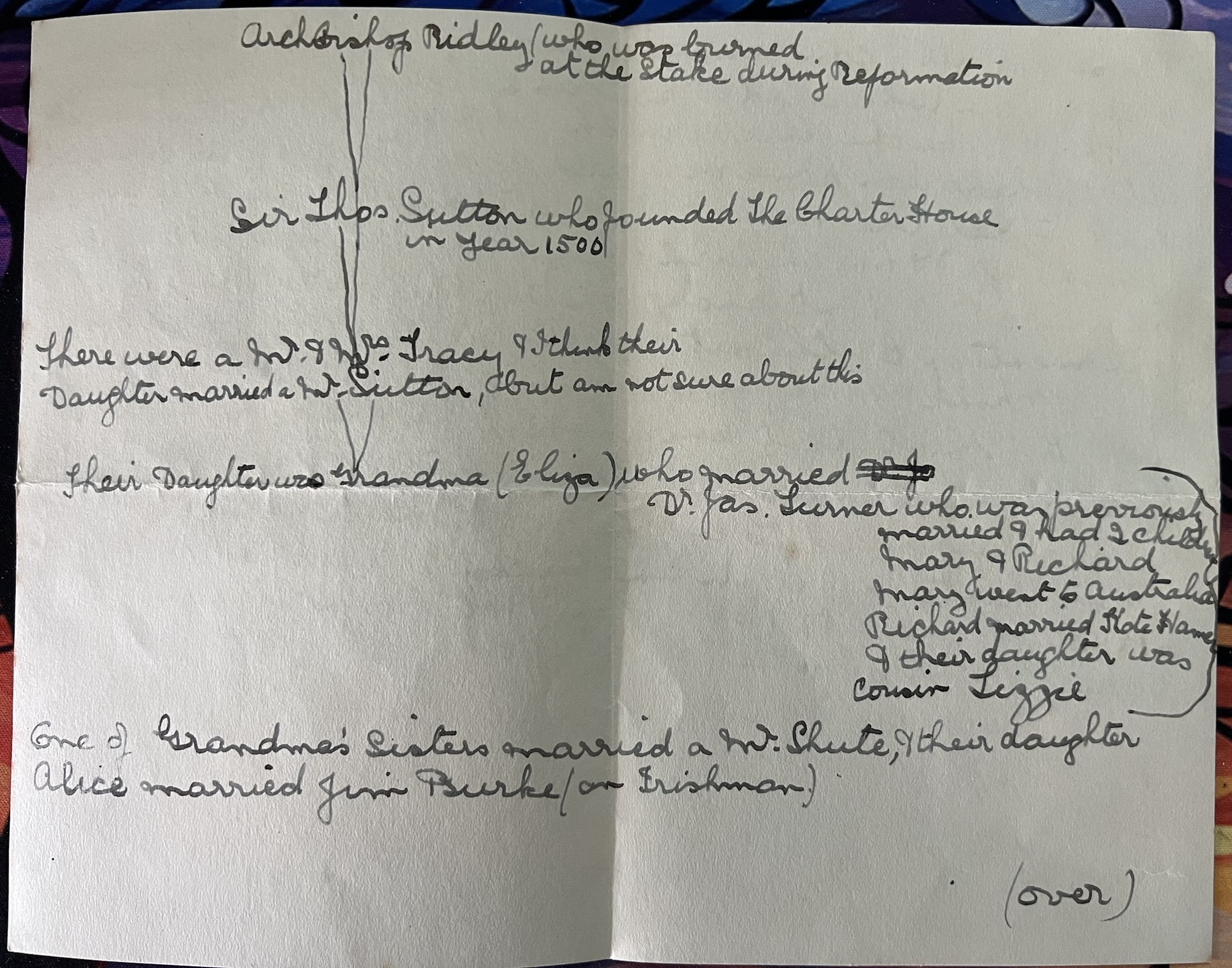
This sister married and became Mrs. Shute. She had a daughter, Alice, who married an Irishman of the name of Burke.
Evidently, the relationship between the two families was not kept up, and I know nothing of any second cousins or whether any existed.
It is a different matter on the paternal side of the family, for the members seemed to be more peace-loving and used to meet and see a great deal of each other.
Grandpa Williams had at least two sisters. I remember my father saying he had an Aunt Maitland, but I do not know whether she was on the paternal or maternal side.
Of course, Maitland was her married name, and I have some notion that her husband was in the army, but that may be wrong.
The two sisters of whom I am certain were Aunt Betsy, who remained single. The story goes that, being poor, her banker, my grandfather, helped her financially.
She managed to live very economically and had more money than she made out, for at her death in 1875 quite a little hoard was found among her belongings.
The second sister I remember enough, but not her Christian name, for she went by the married name and was called Aunt Woollard.
I remember her as a dear old lady who used to live with her married daughter Amelia, who was a Mrs. Walter Hitchcock.
The Hitchcock family were well-to-do, and I remember later being taken to visit them at various different houses. They seemed always changing their homes.
There were two sons and two daughters in that family, Walter, Leonard, Amy, and Elsie.
The youngest, Elsie, was about my own age. I used to stay with her as a child. She did not live to grow up, but died of scarlet fever. Probably about 12 years of age.
Walter was the one who married. Leonard died in middle life and was a brother in some R.C. order.
I have an idea that Grandpa Williams had more than one brother, but have only information concerning one of the name of Owen. I think he was also in a bank. He married a Miss Sarah Shepherd.
Their children were among my quite early recollections. They lived at Lee, and when I remember them, the mother was a widow, whom we not very politely called the “Old Aunt Sarah,” to distinguish her from her eldest daughter, whom we called “Aunt Sarah.”
The relationship was really that of cousin once removed, but we were taught to say “Aunt” in deference to superior age.
There were four other daughters, Mary, Nellie, Patty, and Lily, and two sons. They were most likable and kind, and it was a red-letter day when we were taken to their home to pay a visit.
Of this family only one daughter married, Patty, and she married Captain Willie Kentish, of whom no more need be said now than that he was also a cousin of my father’s, so that this marriage rather complicated relationships, both the parties being cousins to one family, but not to each other.
The two sons, Owen and Walter, both married. Owen, the elder, married Miss Bertha Drake, who died when the first child was born. The child was a daughter, Daisy, who afterwards married Mr. Savage, and has a large family.
The youngest son, Walter, married Miss Geraldine Saunders, and they had one son, Llewellyn.
We now return to the family of Grandma Williams. Her maiden name was Jackson, and I know of no brothers or sisters except a sister of the name of Susan, who married Mr. James Kentish, a very wealthy man.
They had a very large family, eight in number. The names were as follows: Mary, Fanny, Rose, Susie, Emma, Willie, Jim, Horace, and Ernest.
Mary became Mrs. Startups, and had ten or eleven children. Fanny became Mrs. Chater. Rose became Mrs. Herbert. Susie became Mrs. Lovejoy. Emma became Mrs. Moore, who had six children.
Willie Kentish we have formerly mentioned, as he married my father’s other cousin, Patty Williams, niece of Grandpa Williams.
They had six children, Jim, Owen, Violet, Maud, Hubert, and Edgar. Of these, all are married, with the exception of Violet.
Maud married Mr. Wilson, but had no children. Of the sons, all married and had families, and some of them are now grandparents.
The three remaining sons of the Kentish family, Jim, Horace, and Ernest, all married. I think Jim and Horace were in the army.
There are a few details respecting my mother’s family. Grandma Turner was a Miss Sutton. The Sutton family were descended from Thomas Sutton, the founder of Charterhouse School.
I believe Grandma lived at Enfield or Cheshunt, but I don’t know if she was from there. Her mother was a Miss Thompson.
Grandma used to say her parents were an ill-matched couple. At least I imagine she spoke of her father when she related that he was attracted to his future wife when he saw her ankles as she stepped out of a carriage.
He was of a quick temper, and she was very cold and managed to exasperate him.
There is an anecdote that on one occasion they were driving together, quarrelling, and he, to gain his point or to excite remorse, pretended to be dead. But all he got was his wife’s calm remark to the pony, “Come, Jack let’s drive the dead man home.”
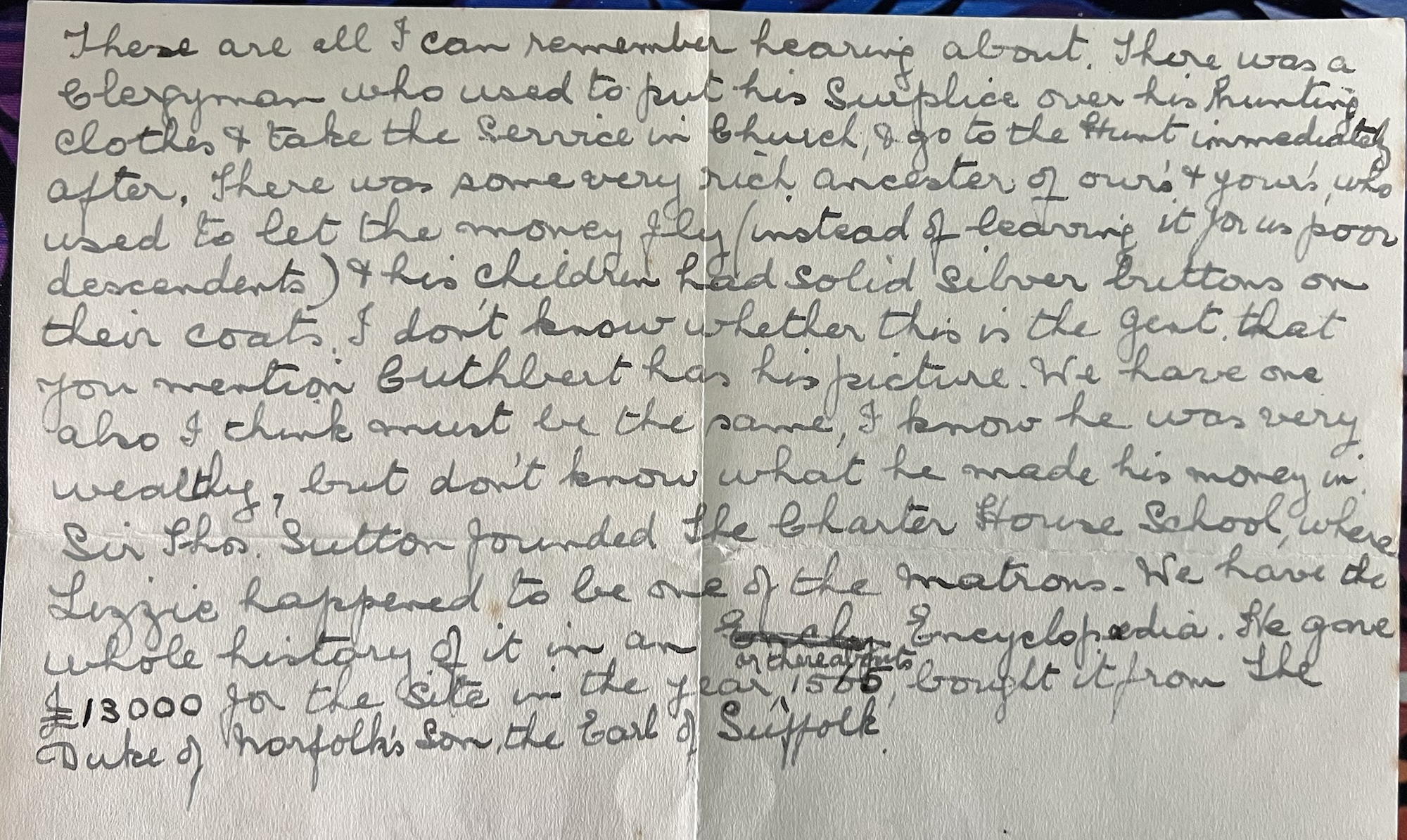
My grandmother used to say there was formerly a lot of money in the family, and I imagine it belonged to her maternal grandfather, by the name of Thompson.
Some say he made money by business as a court tailor. Others say he was a wine merchant, and someone else mentioned coach-building.
However that may be, I believe there was a good deal of money at one time. There are two oil portraits now in possession of my brother, one of Mr. Thompson and the other of my grandmother’s father, Mr. Sutton.
This fact proves that the persons painted were persons of affluent circumstances, as oil portraits are a luxury.
However, all this talk of money did not persist beyond my grandmother’s time, though I believe there was a certain sum my mother had, but I have no idea of the amount, probably only a little.
It was said to have been dissipated extravagantly at some time in ostentatious luxuries. Or it was also said there had been sharp play over money. Anyhow, the fortune, whatever it was, has now disappeared, and I know of no descendants who are even moderately rich.
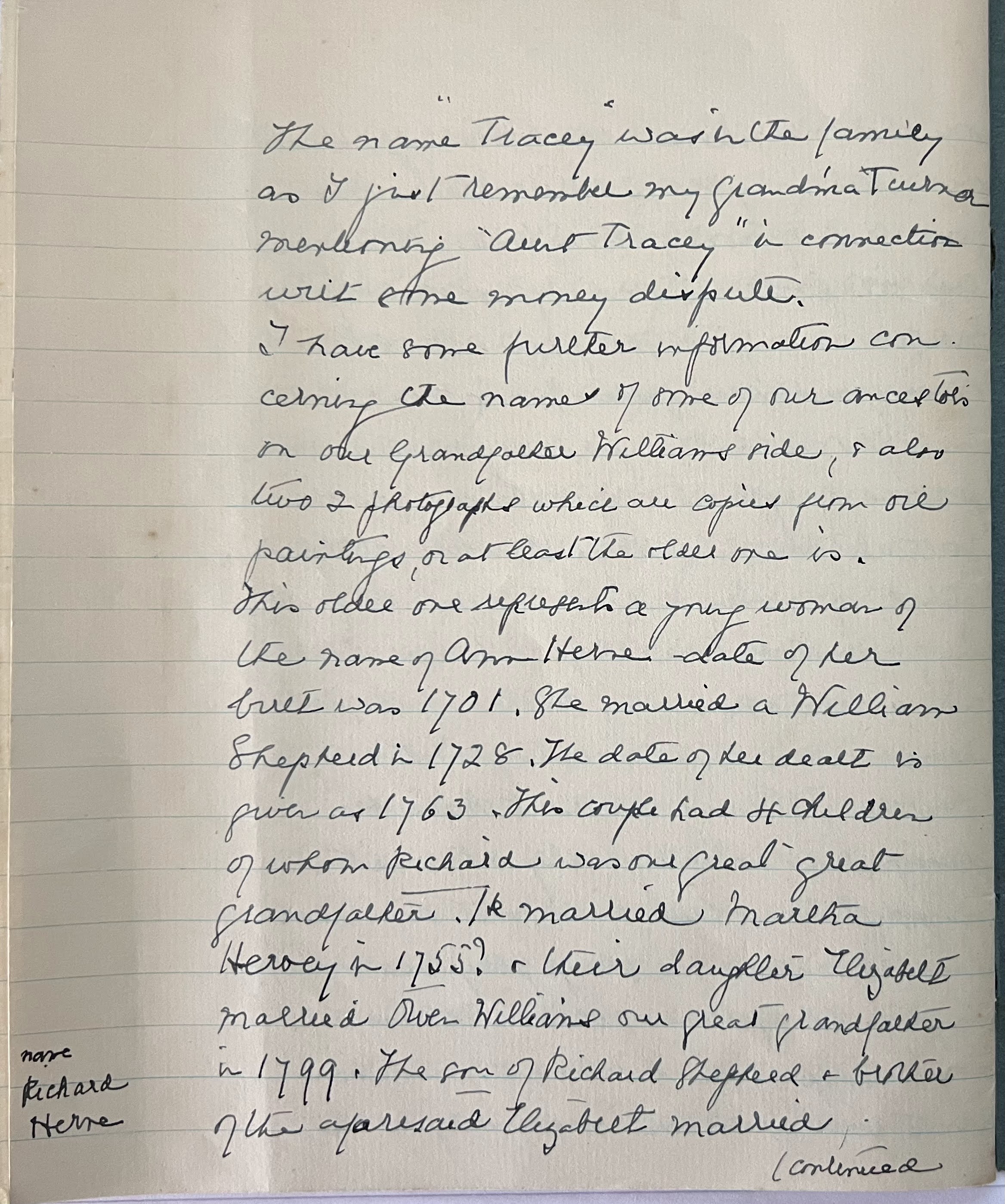
The name Tracy was in the family, and I just remember my Grandma Turner mentioning Aunt Tracy in connection with the money dispute.
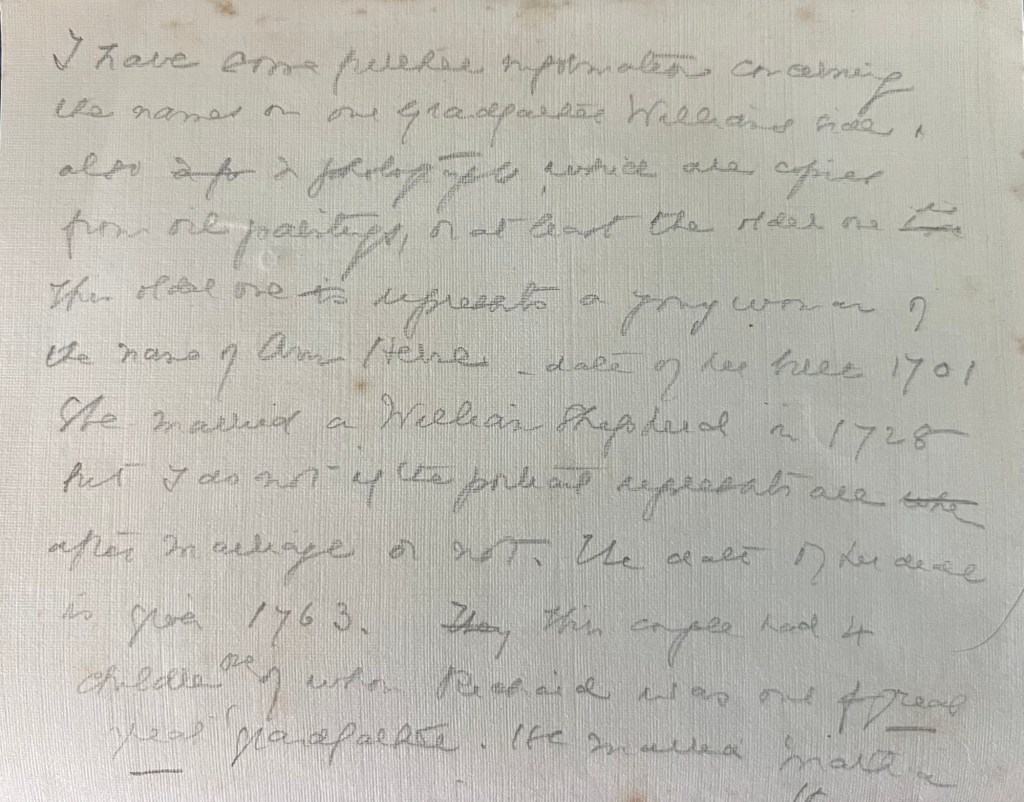
I have some further information concerning the names of more of our ancestors on our Grandfather Williams’s side, and also two photographs which are copied from oil paintings, or at least the older one is.
This older one represents a young woman of the name of Anne Hearse, or Hearn. The date of her birth was 1701. She married William Shepherd in 1728. The date of her death is given as 1763.
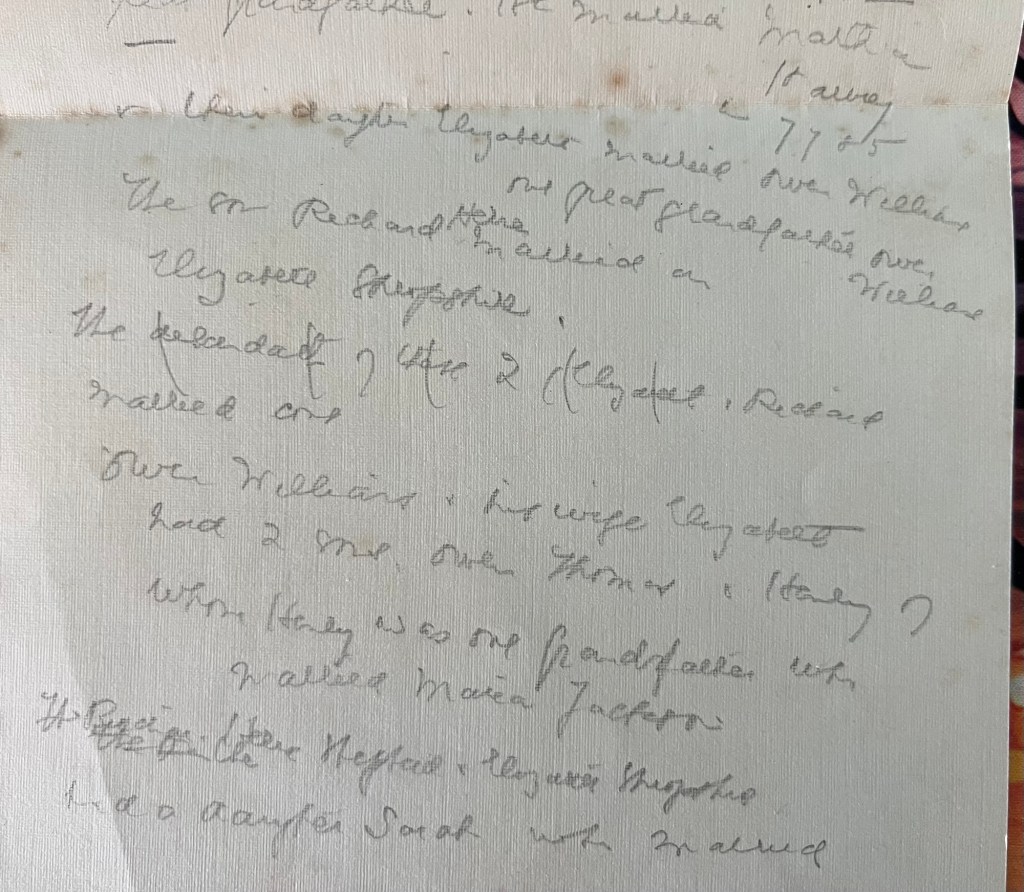
This couple had four children, of whom Richard was one, our great-great-grandfather. He married Martha Hewey in 1755 (?). Their daughter Elizabeth married Owen Williams, our great-grandfather, in 1799.
The son of Richard Shepherd and Martha, the aforesaid Elizabeth, married…
more Richard Hearne
Continued”………
It says continued….. It’s at this point that I’m thinking there may have been another Exercise Book, or more likely, was it just all the following notes on bits of paper, with the parts of family trees on paper, and also the letter from her cousin and the certificates? I do hope so.
Page 1 pictures/Sutton
Page 2 Sutton
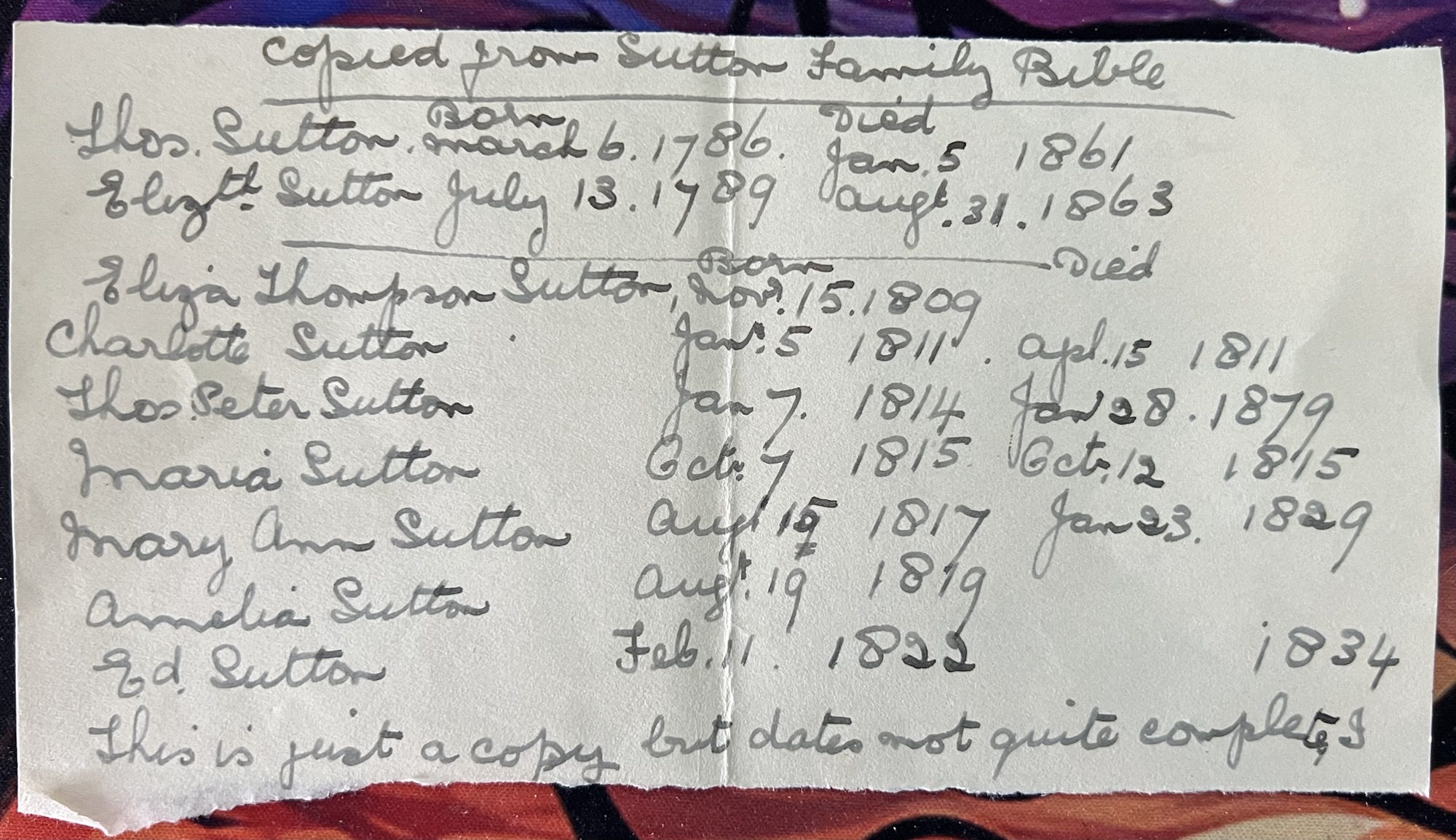
Family Bible Notes.
Bible entries
Reverse of bible entries
Sutton Family. From above copied Bible entries.
Thomas Sutton born 6 March 1786 died 5 January.
1861 Elizabeth Sutton born 13 July 1789 died 31 August 1863.
Children. Dates in image above.
Eliza Thompson Sutton
Charlotte Sutton
Thomas Peter Sutton
Maria Sutton
Mary Ann Sutton
Amelia Sutton
Edward Sutton
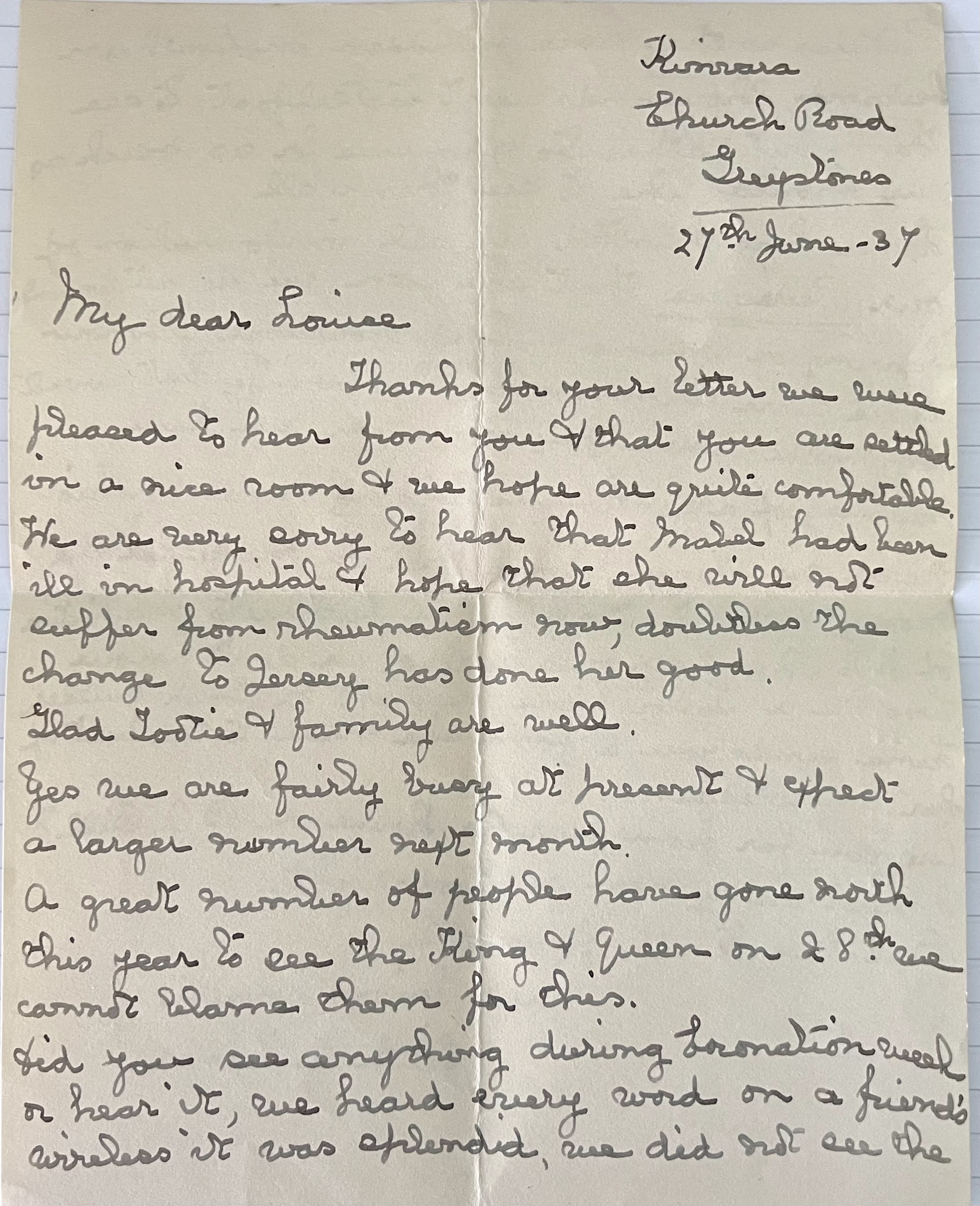
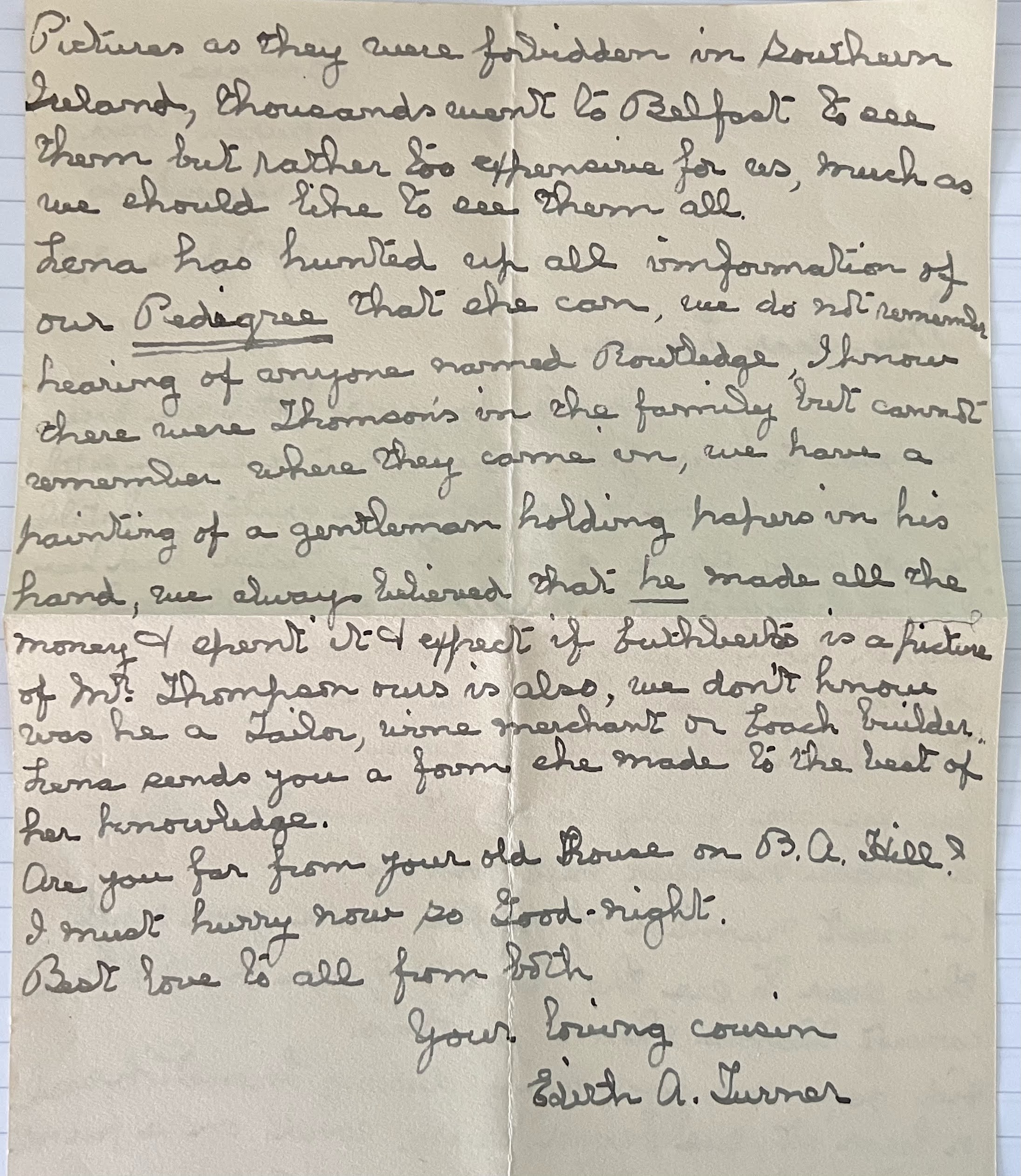
This is a letter from a cousin written on 27 June 1937. She lived in Southern Ireland.
I’ve transcribed the following two pages in order. Questions marks ? on words that I’m not sure of.
Kimrara? Church Road Greystones.
27th June – 37
My dear Louise
Thanks for your letter we were pleased to hear from you & that you are settled in a nice room & we hope are quite comfortable.
We are very sorry to hear that Mabel had been ill in hospital & hope that she will not suffer from rheumatism now, doubtless the change to Jersey has done her good.
Glad Tootie? & family are well.
Yes we are fairly busy at present & expect a larger number next month.
A great number of people have gone north this year to see the King & Queen on 28th we cannot blame them for this.
Did you see anything during Coronation week or hear it, we heard every word on a friend’s wireless it was splendid, we did not see the pictures as they were forbidden in Southern Ireland, thousands went to Belfast to see them but rather too expensive for us, much as we should like to see them all.
Lena has hunted up all information of our Pedigree that she can, we do not remember hearing of anyone named Routledge. I know there were Thomsons in the family but cannot remember where they came in, we have a painting of a gentleman holding papers in his hand, we always believed that he made all the money & spent it & expect if Cuthberts is a picture of Mr. Thompson ours is also, we don’t know was he a tailor, wine merchant or coach builder.
Lena sends you a form she made to the best of her knowledge.
Are you far from your old house on B.A. Hill?
I must hurry now so Good-night.
Best love to all from both
Your loving cousin Edith A. Turner
Family History: Edith Annie Turner was born on 23 February 1873 in London; her parents were Francis and Fanny (Shackle). She had one brother, Francis William James, and one sister, Eveline Fanny Turner. She never married and died on 15 March 1958 in Harold’s Cross, Dublin, at the age of 85, and was buried there.
Lena seems to have been a nickname for Eveline, Edith’s sister.
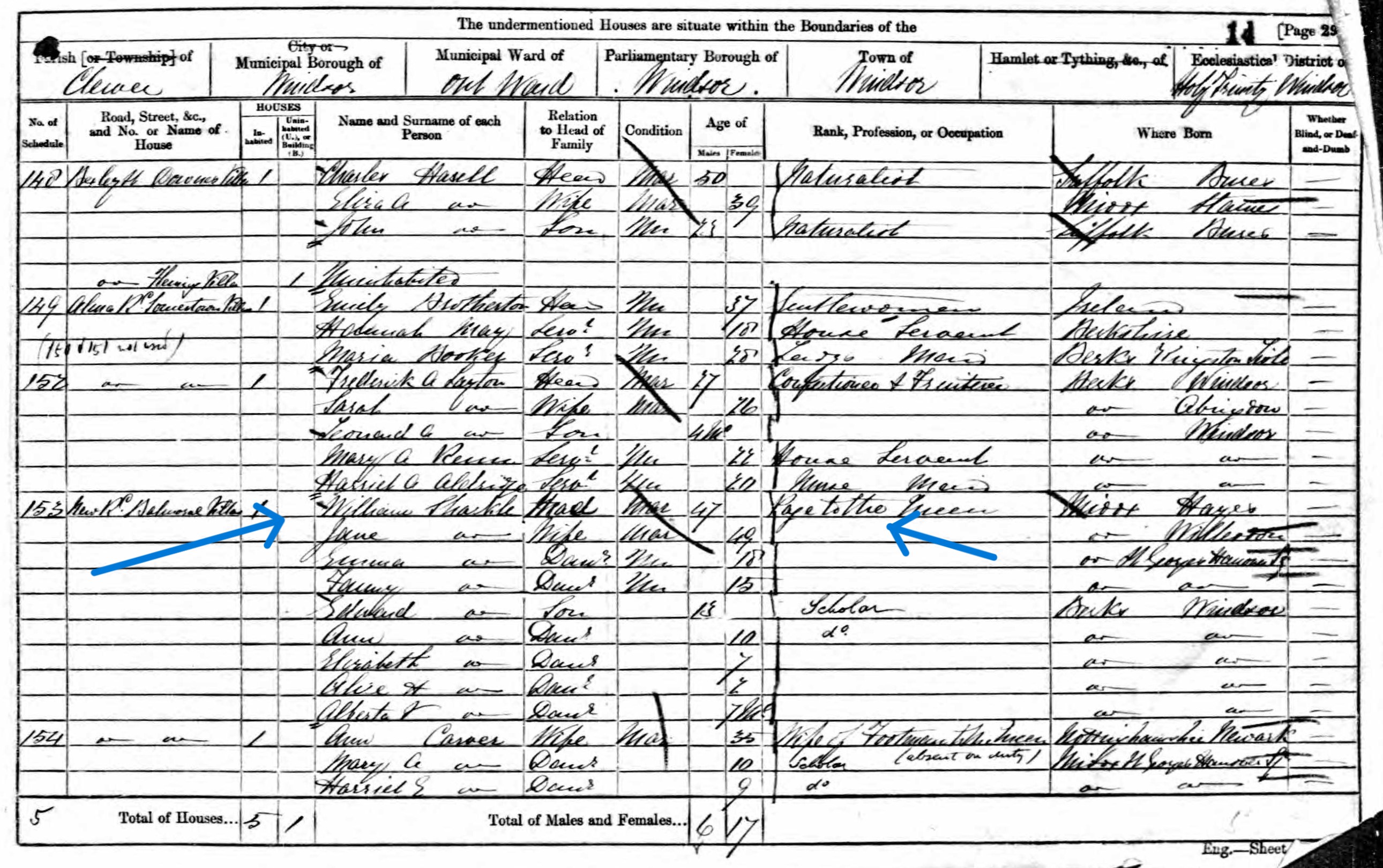
As usual, I diversified, I had a quick look at Fanny Shackle and her family and found that in 1861 they were living at Balmoral Villas, New Road, Clewer, Windsor. Fanny’s father, William Shackle, was a Page for the Queen.
The Shackle family on the 1861 census
The proximity of New Road (later renamed Clarence Road and near Dedworth Road) to Windsor Castle made it an ideal residential pocket for members of the Royal Household.
In the 1861 census, the area included several families in which the head of household was officially listed as “In H.M. Service” (Her Majesty’s Service).
Interestingly, Eveline (Lena) was visiting her Shackle grandparents in Windsor, aged 15.
In the Victorian Royal Household, a “Page” was not a young boy running errands, but a prestigious, formal, lifetime career track for adult gentlemen. Pages handled the Monarch’s immediate, private, and ceremonial needs. Given his residence in Windsor, William Shackle likely served in one of two closely related branches managed by the Lord Chamberlain’s Department. By 1881, he was a ‘retired Queen’s Page’; he died in January 1892, aged 78.
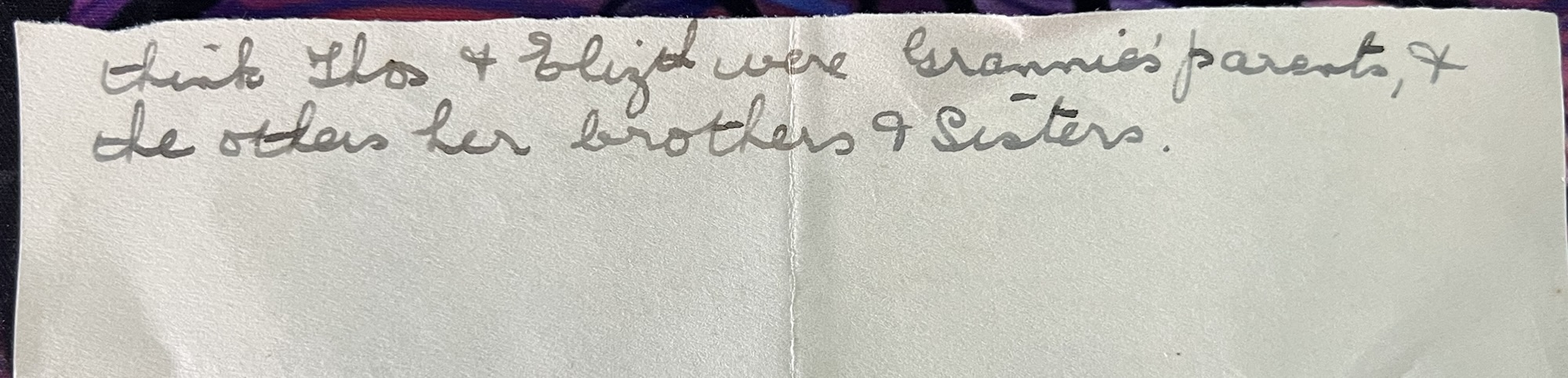
Is this below what Lena wrote?
Easier to understand when you have the tree in front of you!
Transcription of above:
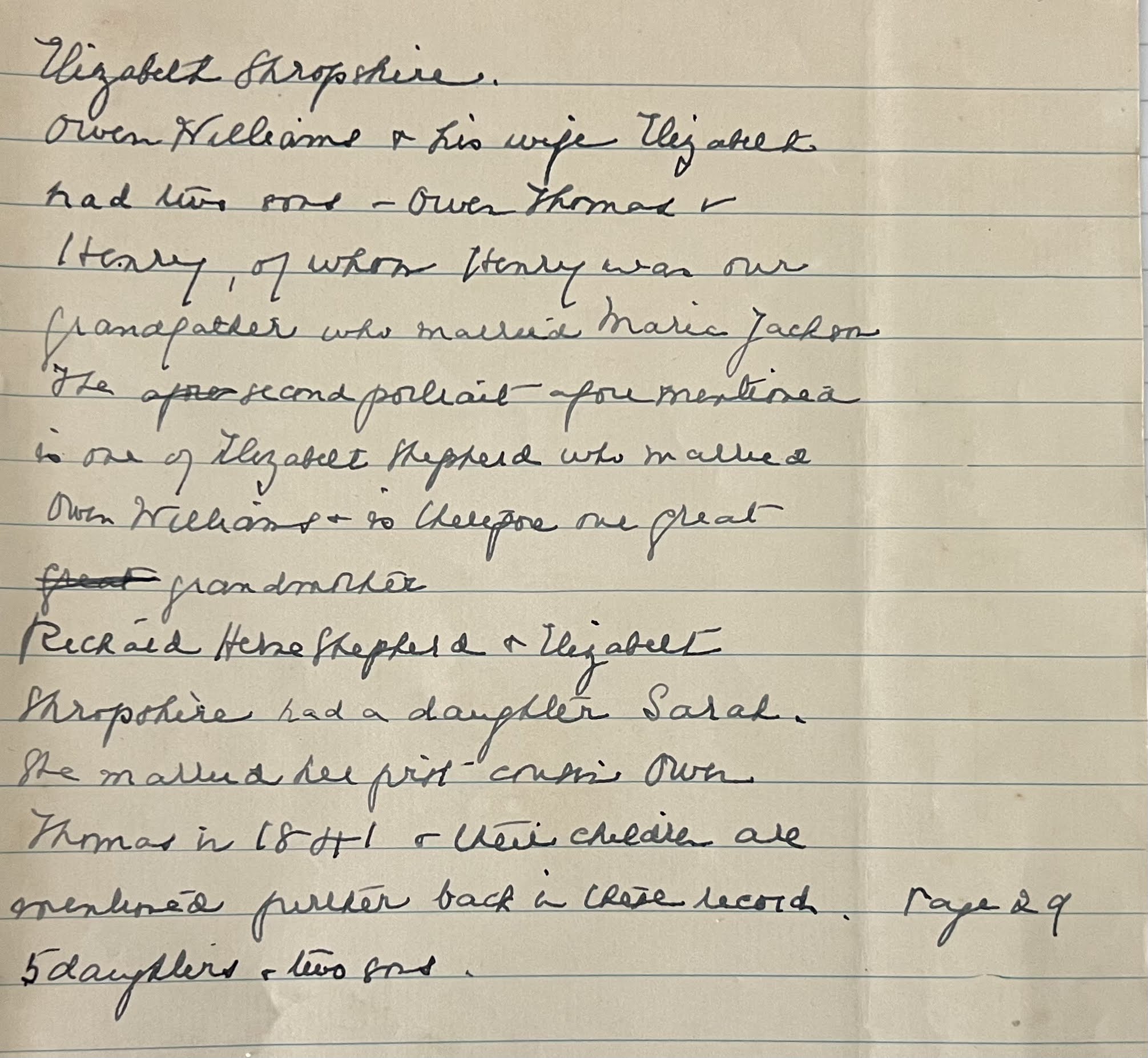
Elizabeth Shropshire.
Owen Williams & his wife Elizabeth had two sons – Owen Thomas & Henry, of whom Henry was our Grandfather who married Maria Jackson.
The second portrait afor mentioned is one of Elizabeth Shepherd who married Owen Williams & is therefore our great grandmother.
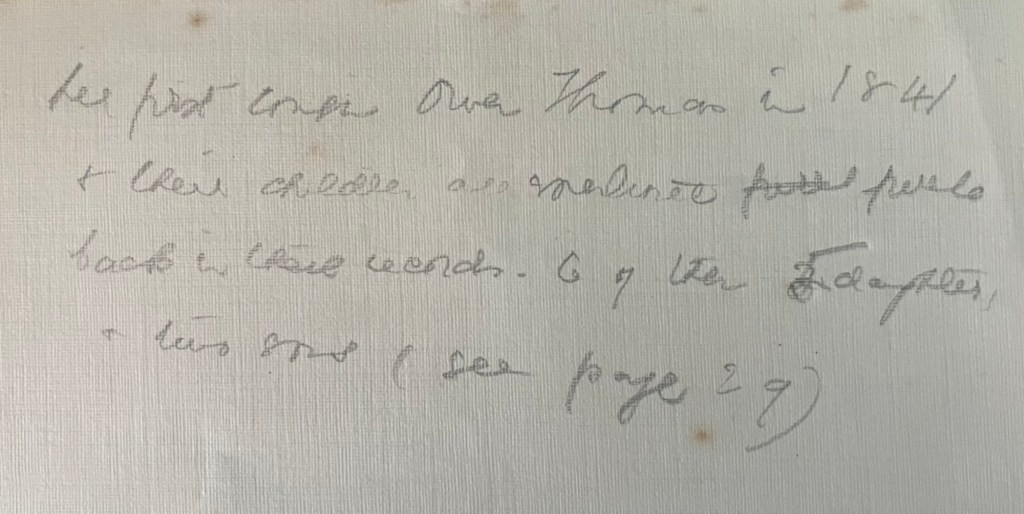
Richard Hope Shepherd & Elizabeth Shropshire had a daughter Sarah. She married her first cousin Owen Thomas in 1841 & their children are mentioned further back in these records. Page 29
5 daughters – two sons
Standish Family.
Another piece of paper, two sides.
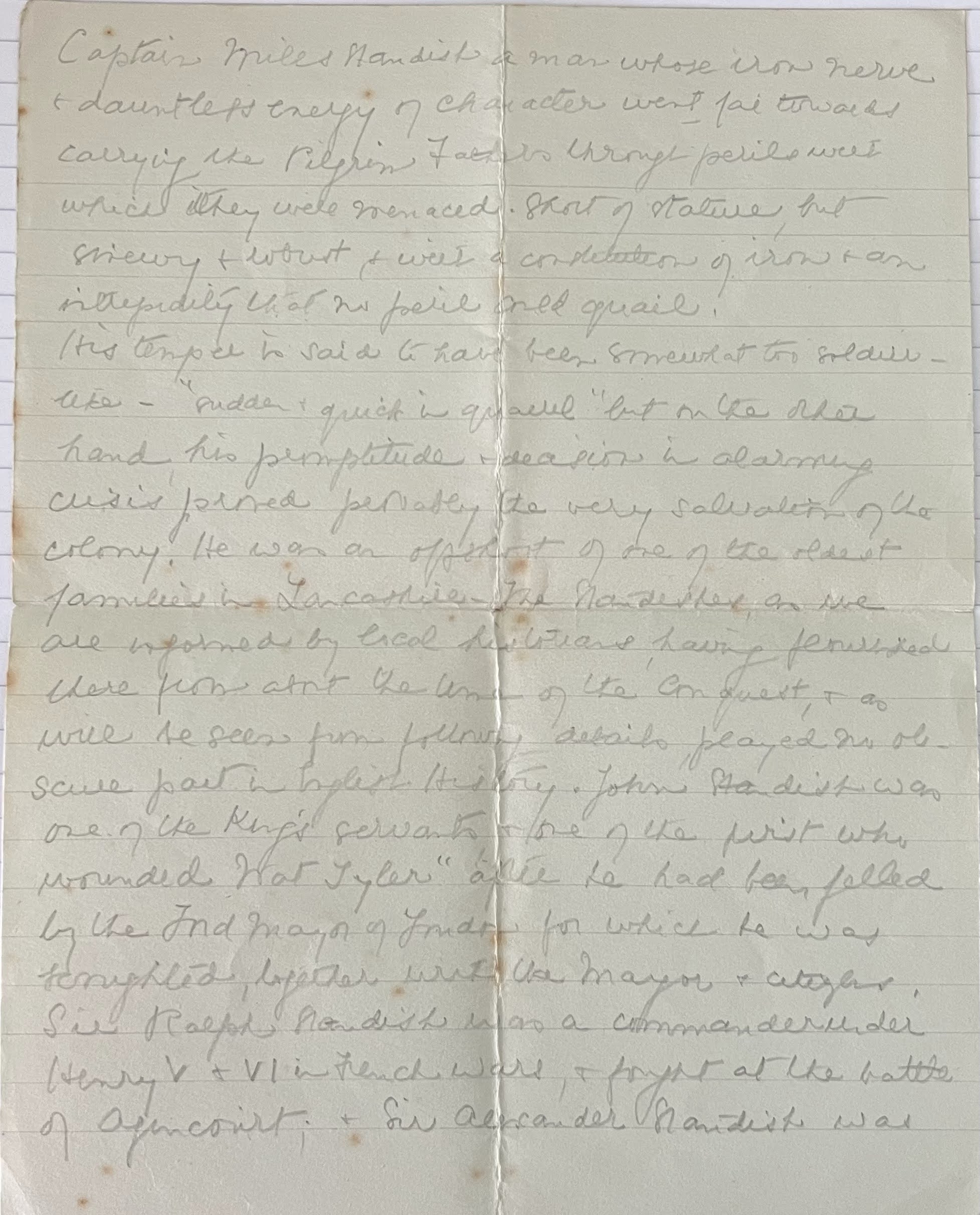
page 1
Transcription:
Captain Miles Standish a man whose iron nerve & dauntless energy of character went far towards carrying the Pilgrim Fathers through perils with which they were menaced.
Short of stature, but sinewy & robust & with a constitution of iron & an intrepidity that no peril could quail.
His temper is said to have been somewhat too soldier-like — “sudden & quick in quarrel” but on the other hand his promptitude & decisions in alarming crisis formed privately the very salvation of the colony.
He was an offshoot of one of the oldest families in Lancashire.
The Standishes, as we are informed by local historians having flourished there from about the time of the Conquest, & as will be seen from following details played no obscure part in English History.
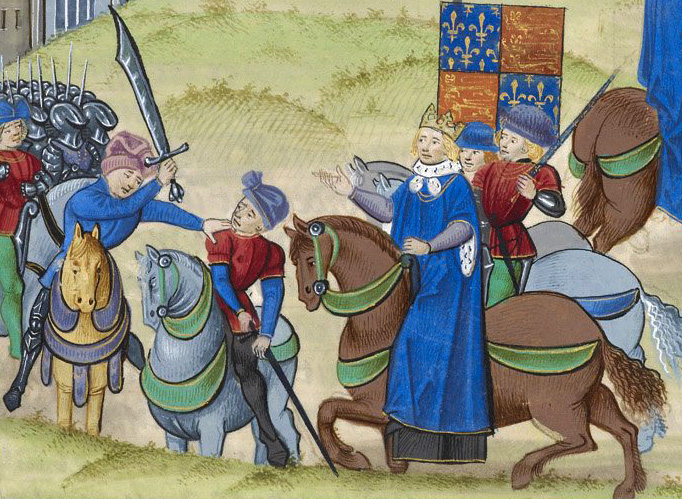
John Standish was one of the King’s servants & one of the first who wounded “Wat Tyler” after he had been felled by the Lrd (Lord) Mayor of London, for which he was knighted, together with the Mayor + others.
My additional notes: John Standish (often recorded in history as Ralph de Standish) was indeed a squire in the service of King Richard II. He is credited with delivering the mortal blow to Wat Tyler during the Peasants’ Revolt in Smithfield on June 15, 1381, right after Tyler had been slashed by the Lord Mayor. After the Lord Mayor of London, William Walworth, struck Tyler with his sword, Standish dismounted his horse and ran his sword through Tyler’s stomach, killing the rebel leader. For this act of bravery, he was knighted directly on the field by the young King. More here:The History Press
The Death of Wat Tyler at the hands of Walworth, Mayor of London, with the young Richard II looking on, King Richard II, and Sir John Cavendish, esquire to the king (bearing decorated sword), dated c. 1385-1400. User Bkwillwm on Wikipedia.
continued…..Sir Ralph Standish was a commander under Henry V & VI in French wars, & fought at the Battle of Agincourt, & Sir Alexander Standish was……
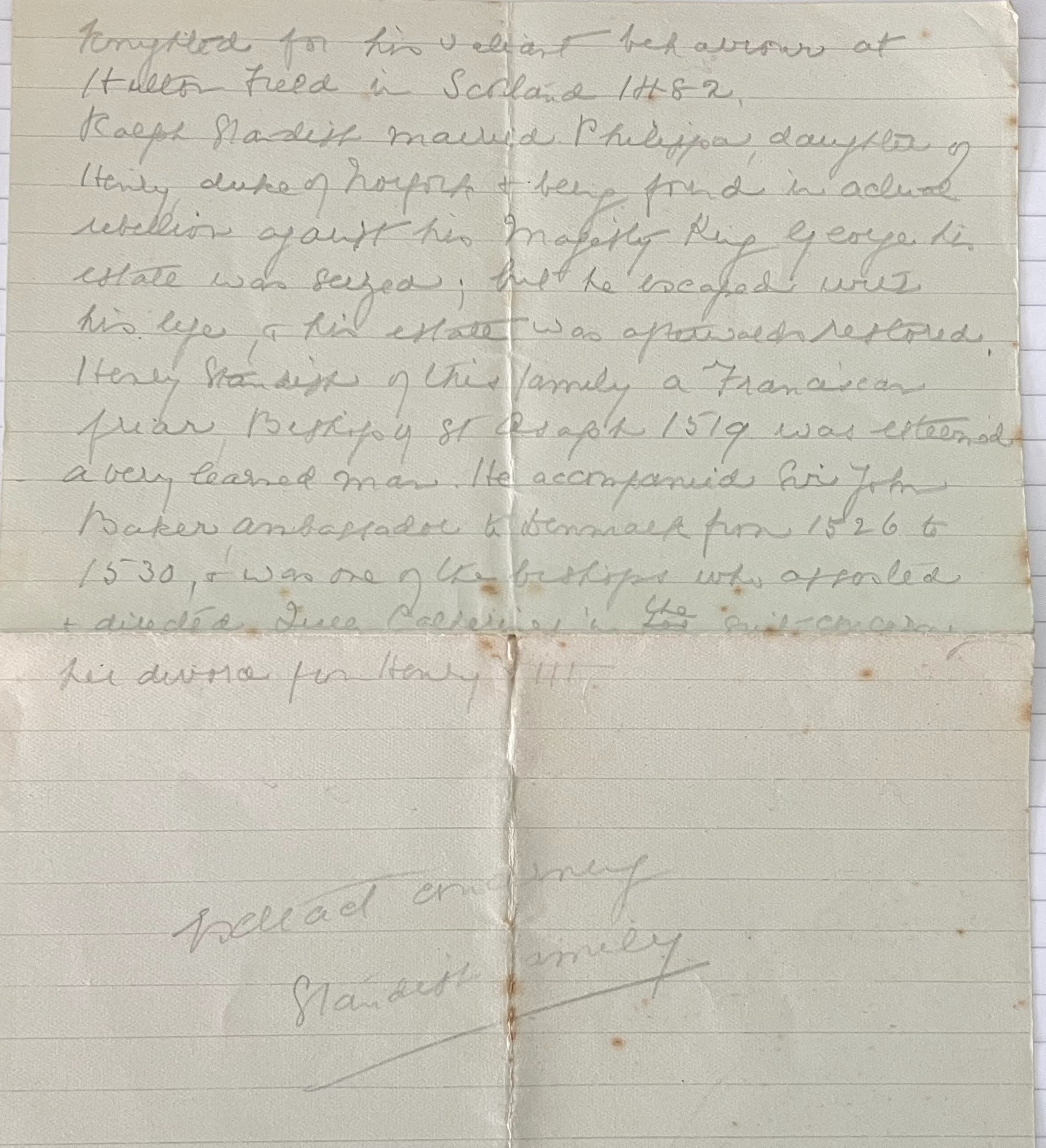
page 2
……..knyghted for his valiant behaviour at Hutton Field in Scotland 1482.
Ralph Standish married Philippa daughter of Henry duke of Norfolk & being found in actual rebellion against his majesty King George his estate was seized; but he escaped with his life, & his estate was afterwards restored.
Henry Standish of this family a Franciscan friar Bishop of St Asaph 1519 was esteemed a very learned man. He accompanied Sir John Baker ambassador to Denmark from 1526 to 1530, & was one of the bishops who assisted? & directed Queen Catherine in the suit concerning her divorce from Henry VIII.
Notes concerning Standish Family
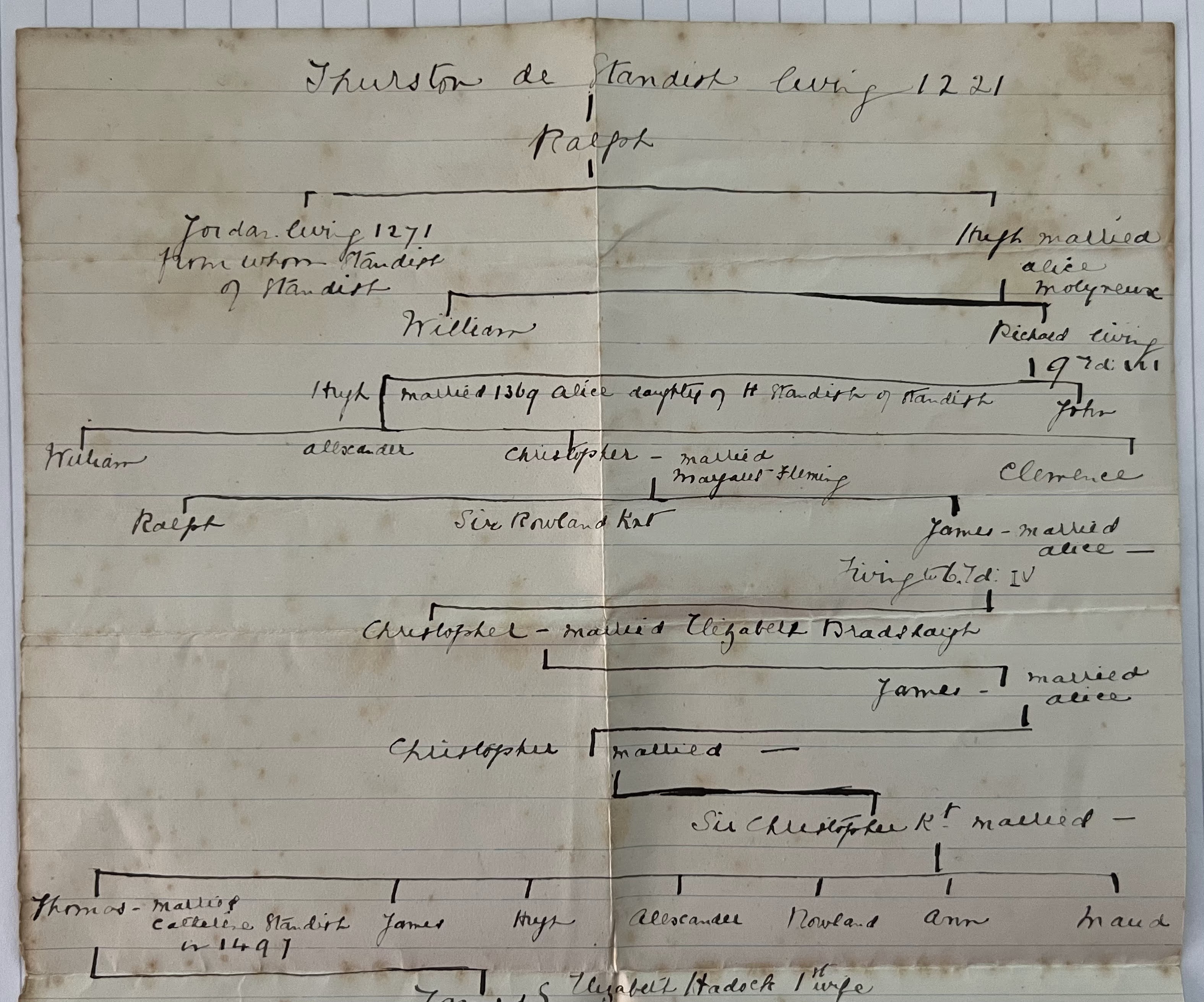
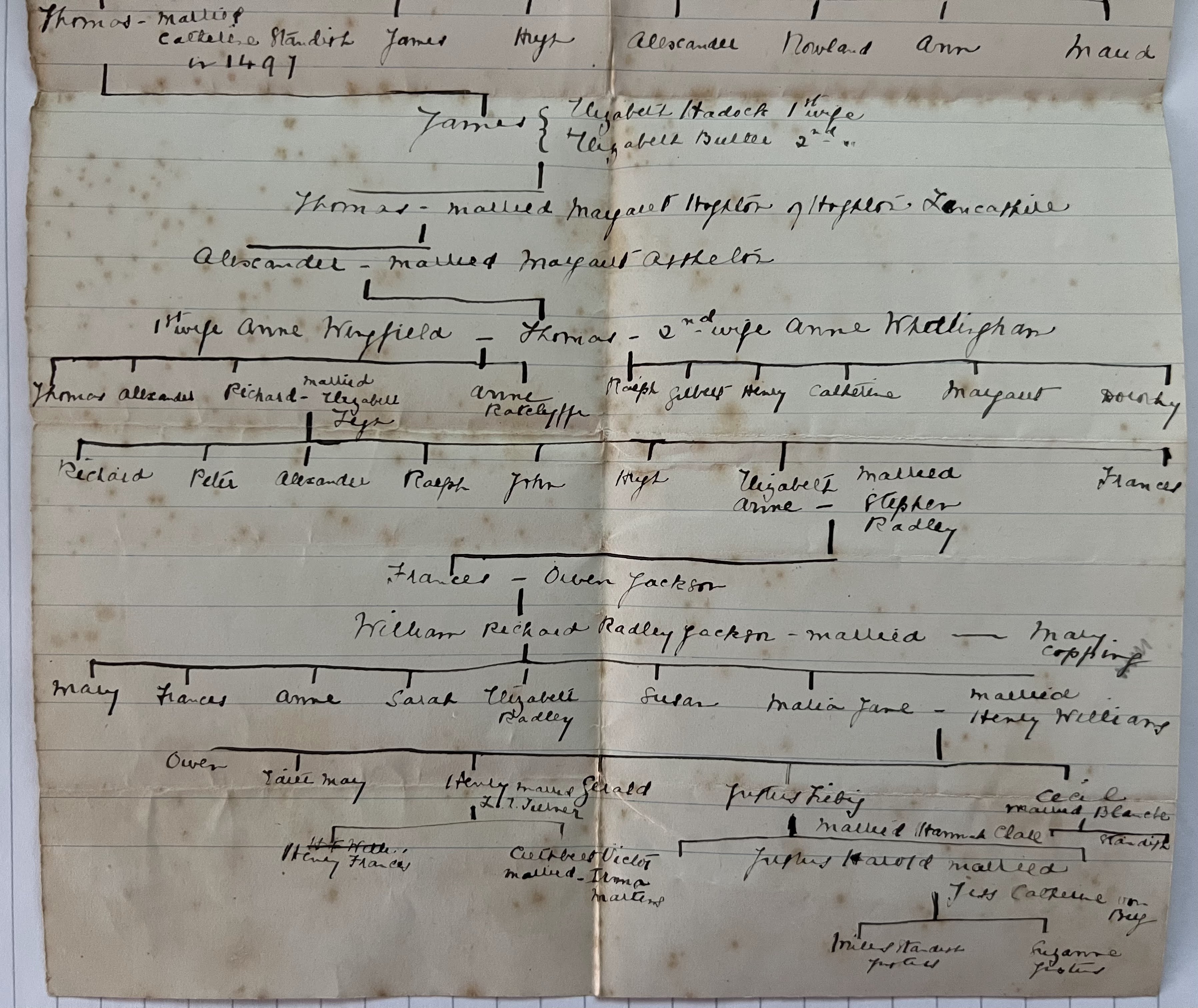
The following generations I have taken from the drawn trees included within this collection, starting with the Standish family.
The Standish Family Tree.
Generation 1
Thurston de Standish, living in 1221.
Children:
Ralph
Generation 2
Ralph
Children:
Jordan, living in 1271, from whom the Standishes of Standish descended.
Hugh married Alice Molyneux.
Generation 3
Children of Hugh and Alice Molyneux
William
Richard (living during Edward III, 1313-1377)
Generation 4
Richard
Children include:
Hugh (married 1369 Alice, daughter of H. Standish)
Alexander
Christopher
John
Clement
Generation 5
Christopher married Margaret Fleming.
Children:
Ralph
Sir Rowland Standish (Knight)
James (married Alice; living Edward IV. 1442–1483)
Generation 6
Christopher married Elizabeth Bradshaigh.
Child:
James (married Alice)
Generation 7
Christopher, wife not named.
Children:
Thomas
James
Hugh
Alexander
Rowland
Anne
Maud
Generation 8
Thomas married Catherine Standish (1492)
Generation 9
James
1st wife: Elizabeth Radclyffe
2nd wife: Elizabeth Butler
Child:
Thomas
Generation 10
Thomas married Margaret Hoghton of Hoghton, Lancashire.
Child:
Alexander
Generation 11
Alexander married Margaret Assheton.
1st wife: Anne Wingfield.
2nd wife: Anne Strickland.
Children include:
Thomas
Alexander
Richard
Anne
Ralph
Gilbert
Henry
Catherine
Margaret
Dorothy
Richard married Elizabeth (possibly Radclyffe)
Children:
Mary
Frances
Anne
Sarah
Elizabeth Radley
Susan
Maria Jane – Henry Williams
Generation 12+
Owen
Edith May
Henry married L E Turner. They had Henry Francis and Cuthbert Victor, Cuthbert married Irma Martens.
Gerald
Justus married Hannah Clare. They had Justus Harold who married Jess Catherine and they had Miles Standish Justus and Susanna Justus
Cecil married Blanche. They had Clare and Standish.
Shepherd & Herne & Williams & Shepherd Family.
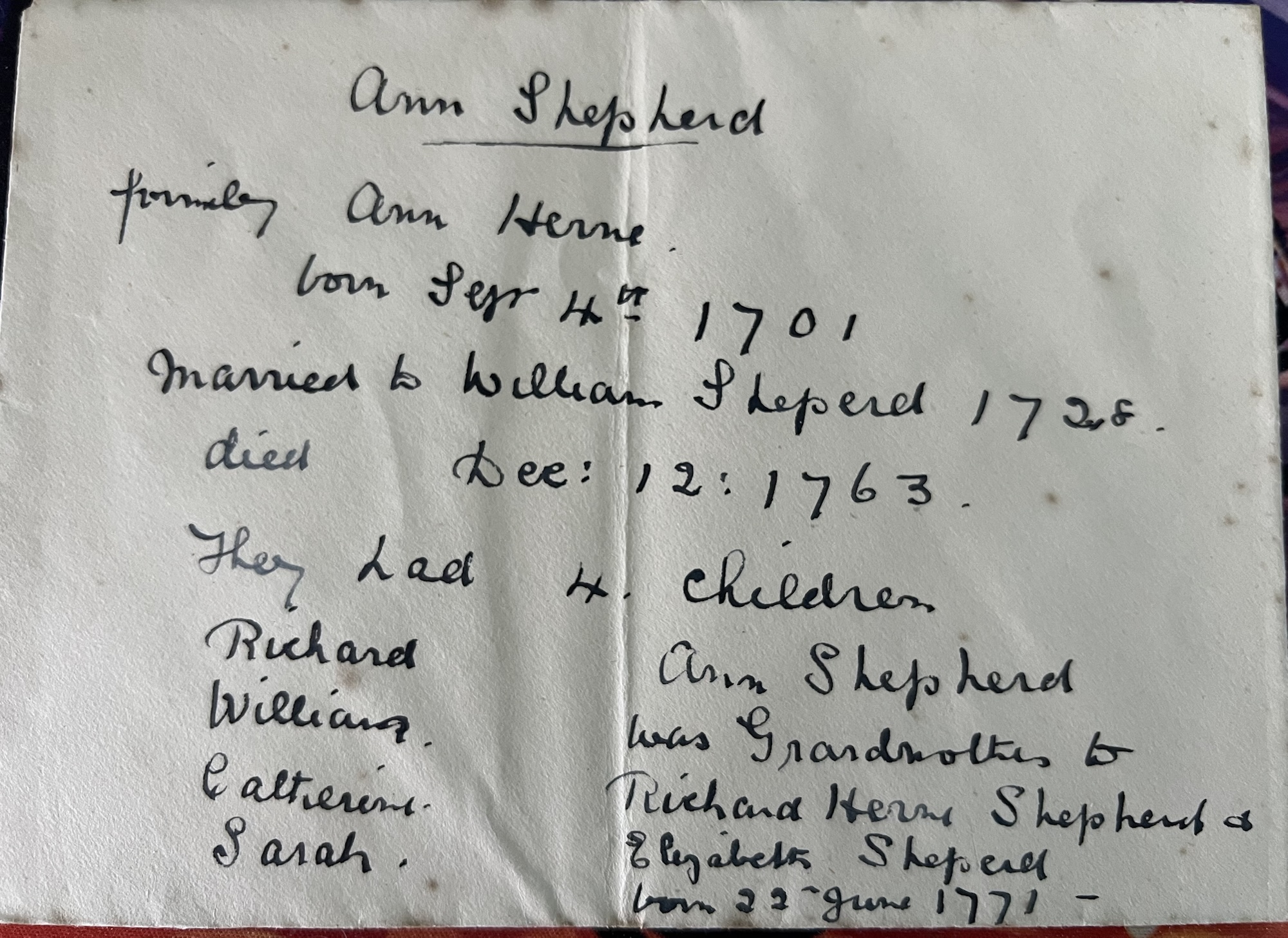
Front of an envelope.
Scrap of paper.
Ann Shepherd nee Herne.
Transcription:
Generation 1
Ann Herne was born on 4 September 1701.
married William Shepherd in 1728.
Ann died on 12 December 1763.
Children:
Richard
William
Catherine
Sarah
Generation 2
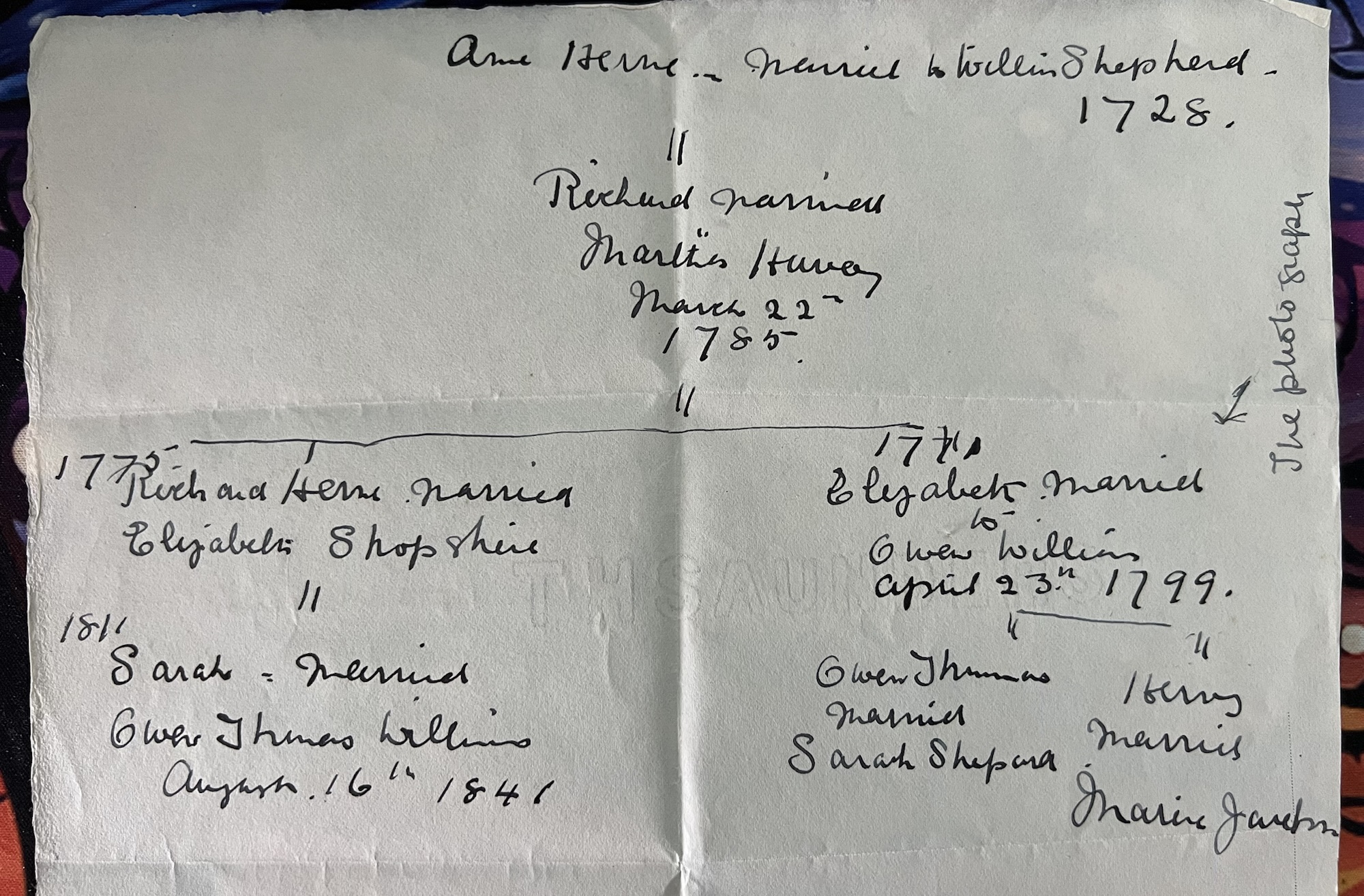
Richard Shepherd married Martha Harvey on
22 March 1785
Generation 3
Richard Herne Shepherd married
Elizabeth Shropshire.
Children include:
Sarah
Elizabeth (possibly)
Generation 4
Sarah Shepherd married Owen Thomas Williams on
16 August 1841
Generation 5
Children of Owen Thomas Williams and Sarah Shepherd
From the notes:
Owen Williams
Henry Williams
Henry married Maria Jackson.
Generation 6
Henry Williams married Maria Jackson
Children not listed in these notes.
More information about the Williams Family.
Part 1
I have some further information concerning the names on our grandfaethers Williams side & also 2 or 3 photographs which are copies from oil paintings, or at least the older one is. This older one is represented a young woman of the name of Ann Hernes — date of her birth 1701. She married a William Shepherd in 1728 but I do not know if the portrait represents her after marriage or not. The date of her decease is given 1763. This then couple had 4 children, one of whom Richard was our great great grandfaether. He married Martha…..
Part 2
He married Martha—
(inserted note: & died away 1775)
& their daughter Elizabeth married Owen Williams
our great grandfather Owen Williams
The son Richard Herne married an
Elizabeth Shropshire.
The descendants of these 2 (Elizabeth & Richard)
married one Owen Williams & his wife Elizabeth
had 2 sons Owen Thomas & Henry?
whom Henry was our grandfather who married Maria Jackson & Richard I have Richard & Elizabeth Shropshire
had a daughter Sarah who married
Part 3
her first cousin Owen Thomas in 1841
& their children are mentioned further
back in these records. 6 of them, 4 daughters,
& two sons (see page 29)
Interesting family snippets.
Captain Miles Standish descended from the Lancashire Standishes.
Sir Alexander Standish was said to have been knighted after Flodden.
Sir Thomas Sutton founded Charterhouse School.
One ancestor was reputedly extremely wealthy and dressed his children with solid silver buttons.
A clergyman relation hunted after taking church services.
Possible connections with the Ridley, Tracy, Turner and Shute families.
The Shepherd/Williams information is especially valuable because it includes some dates and marriages that can be verified in online records.
The Standish information appears to have been copied from an older published family history. But it would all need to be verified. Especially medieval generations, before treating them as proven.
Portraits and Photos.
As for photographs and portraits of people in this family and in these records, there are several possibilities I can share with you all.
The Standish family.
Because the Standishes of Standish Hall, Lancashire, were an old landed family, portraits of various members do survive. They are mostly oil paintings rather than photographs, and many are in museums or private collections. There are also engravings of some members in old county histories and genealogical books. This is one online resource: Project Gutenberg
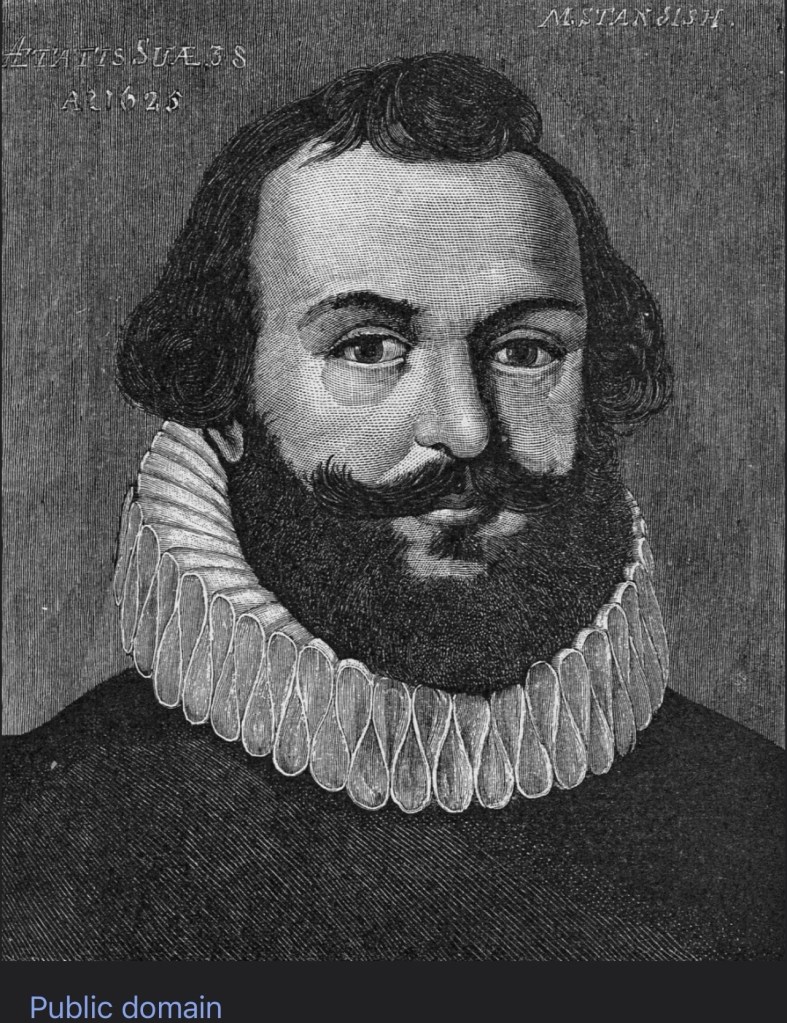
Captain Miles Standish (numerous later artistic portraits based on tradition)
This portrait was first published in 1885 and is alleged to be a 1625 likeness of Standish, although its authenticity has never been proven.
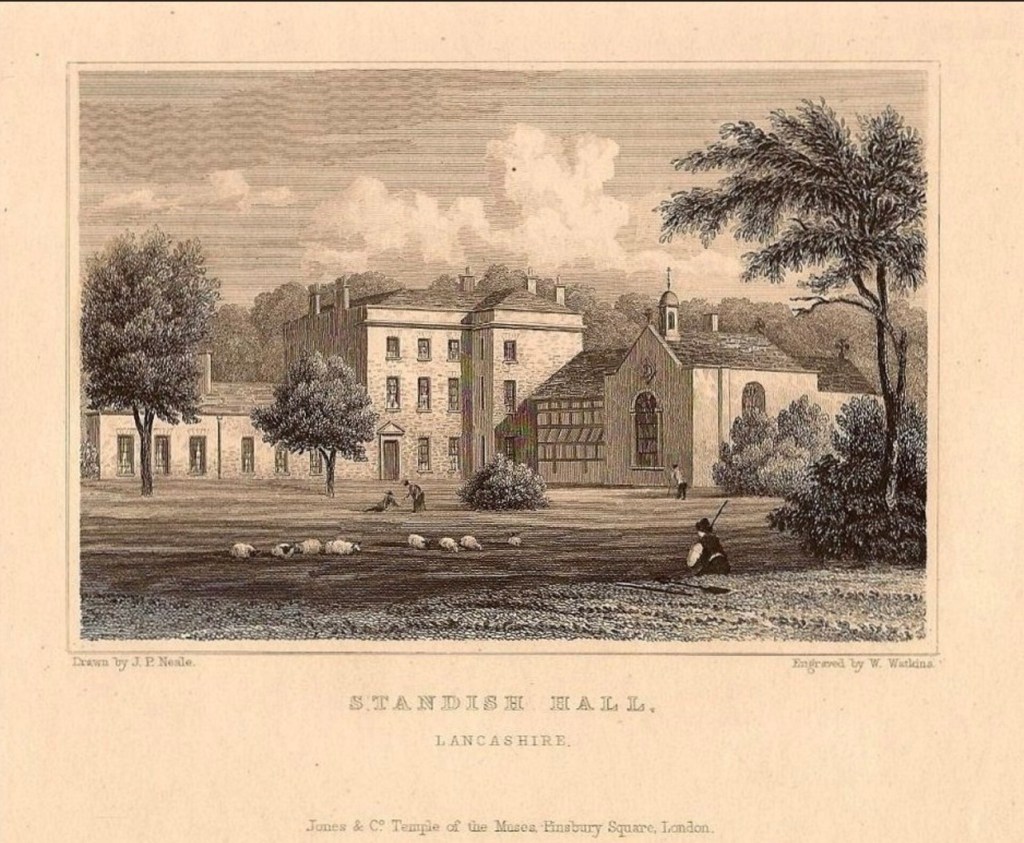
Standish Hall
Drawing of Standish Hall, by John Preston Neale c. 1845
An image of the Standish family coat of arms is available online.
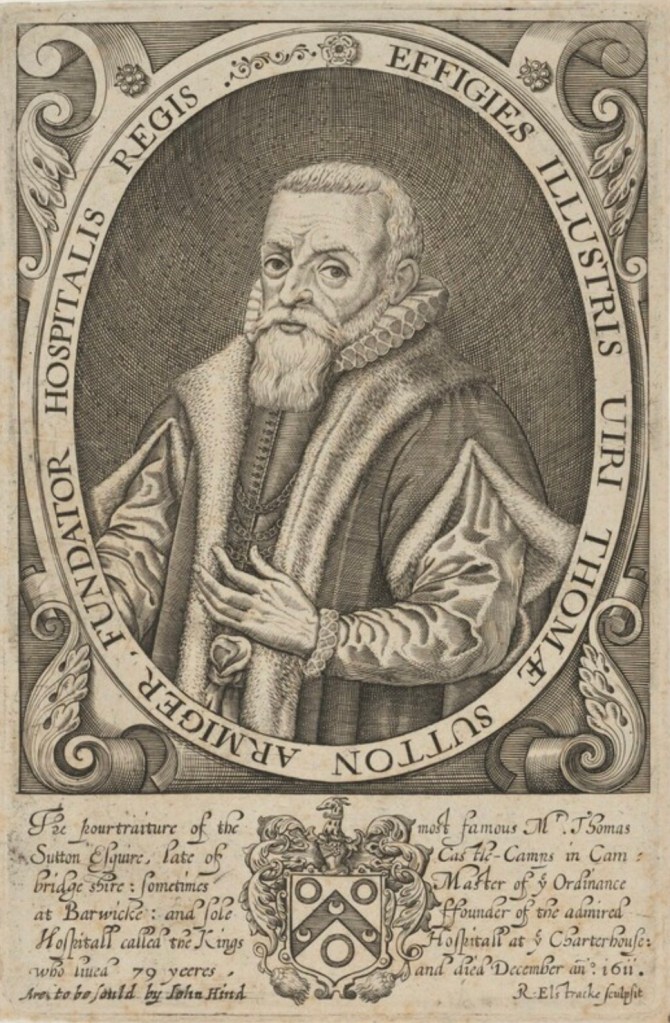
Sir Thomas Sutton
Since the notes mention Sir Thomas Sutton, founder of Charterhouse, there are several authentic portraits of him dating from the early 1600s. These are well-known and reproduced in books and by Charterhouse itself.
By Renold Elstrack (English) 1571 – 1625
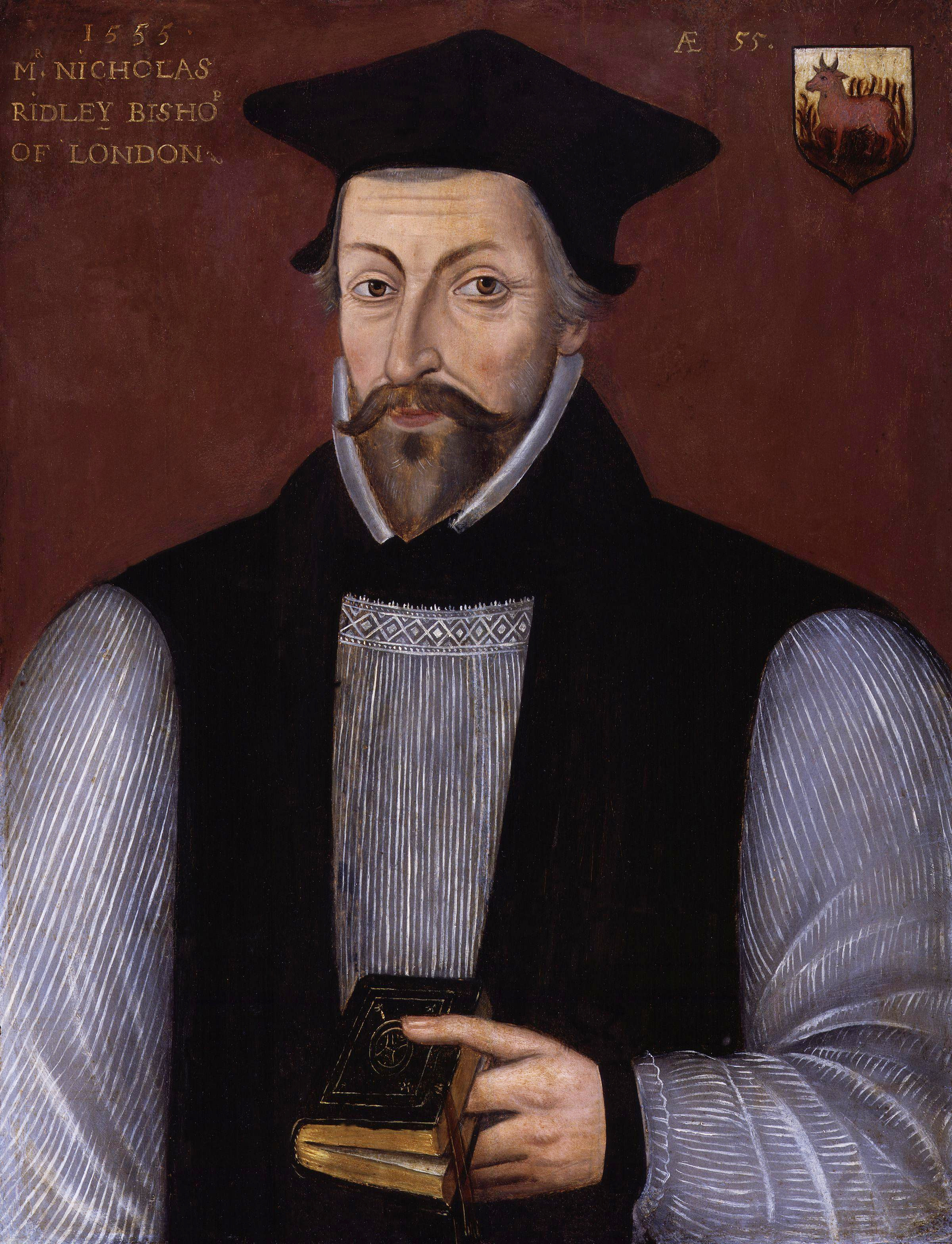
Archbishop Nicholas Ridley.
The notes refer to Archbishop Ridley (more correctly Bishop Nicholas Ridley, c. 1500–1555), one of the Oxford Martyrs. He was an influential English Reformation theologian and Bishop of London. A brilliant Cambridge scholar, he helped draft the first Book of Common Prayer. During the Marian Persecutions, he was burned at the stake in Oxford for his Protestant beliefs.
Nicholas Ridley (1500-1555) Date 16th century. Oil on panel. National Portrait Gallery NPG 296.
The Shepherd / Williams family
These are a bit different.
The pages of memories say the family once owned portraits, but I haven’t found any public images of:
Ann Herne, William Shepherd, Richard Herne Shepherd, Elizabeth Shropshire, Owen Williams or Henry Williams
Unless descendants still own them, those portraits might be lost.
Later Victorian descendants
Once the family reaches the mid-1800s, the Victorian era, there is a much better chance of finding old photos, maybe on public family trees on genealogy websites, or held by descendants. I shall look.
Sometimes descendants have uploaded photographs to family history websites without realising the wider story behind them. I have been lucky enough to find just a few!
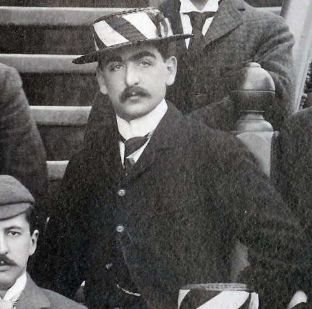
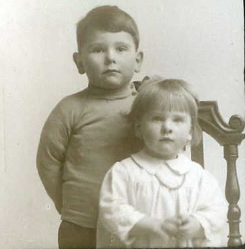
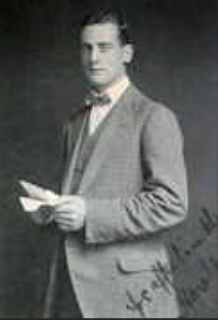
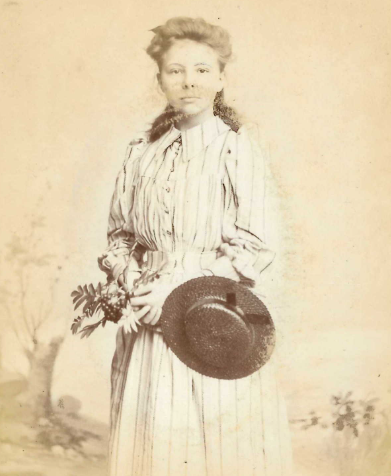
Hannah Clare Williams, one of Louise’s 1st Cousin. From a public tree on Ancestry.Robert Tell Clark, husband of Hannah Clare Williams, from a public tree on Ancestry.Miles Standish Justus Williams & his sister Susanna Justus Williams. From a public tree on Ancestry.Justus Harold Williams. Louise’s 1st cousin. From a public tree on Ancestry.
Above is one of Louise’s first cousins, Justus, and the photo is of his two children with his wife, Jessie Catherine Von Berg.
Jessie Catherine Von Berg as a young lady from a public tree on Ancestry.
All these notes may have originally been kept with actual family photographs or portraits and become separated.
I’ve included all the scans of the notes and my transcriptions; there’s a real possibility that someone from the family will recognise them.
I’ve now assembled enough evidence to tell the story of this family. One thing that stands out, especially when combined with the Exercise Book, is that Louise Edith Williams was not simply recording genealogy. She was preserving the memories of a family that she knew was disappearing.
The Family Behind the Exercise Book
Among the papers that survived in an old family exercise book was the story of one remarkable family. The author of that book was Louise Edith Williams, and without realising it, she became the guardian of her family’s history.
The names, memories and relationships that she carefully recorded will enable later generations to construct not only a pedigree, but the lives of the people she loved.
Her father, Henry, had been born in Clerkenwell in March 1848, the son of Henry Williams and Maria Jane Jackson.
By the time he married, he had established himself in south-east London and, in the 1881 census, was employed as a Plate Glass Traveller, travelling on behalf of a glass merchant and visiting customers across London and beyond. It was a respectable occupation that enabled the family to establish a comfortable middle-class home as London expanded rapidly during the Victorian period.
Louise’s mother, Louise Elizabeth Turner, came from an equally interesting family. Born in Greenwich in December 1842, she was the daughter of Dr James Samuel Turner and Eliza Thompson Sutton.
Her father died when she was only fourteen years old, leaving her mother to raise a large family, an experience that undoubtedly shaped her own determination when she later became a wife and mother herself.
Over the next fourteen years Henry and Louise welcomed six children into the family:
Louise Edith (1873)
Hildagard Maude (1875)
Henry Francis (1876)
Mabel Florence (1878)
Ruth Elaine (1882)
Cuthbert Victor (1887)
The family moved gradually through the growing suburbs of south-east London, Deptford, Brockley, Lewisham, Forest Hill and Lee, following the steady expansion of Victorian London. Census returns show a settled household whose children received good educations.
Education clearly mattered to Henry and Louise. By 1901, three of their daughters, Louise, Hildagard and Mabel, had all become school governesses, a respectable and educated profession for unmarried women of the period.
The sisters remained together in the parental home, suggesting a close-knit family in which mutual support was valued above independence. None of the three sisters ever married or had children.
Louise herself appears to have accepted this role willingly. Intelligent, organised and clearly interested in history, she became the family’s unofficial archivist.
The Exercise Book she compiled demonstrates not simply an interest in names and dates but a genuine affection for her wider family.
She corresponded with relatives, copied family traditions, preserved stories and attempted to untangle complicated branches of the Williams, Turner, Shepherd and related families.
Thanks to her efforts, information that would almost certainly have disappeared has survived.
One of the recurring themes in her notes is the importance of family relationships. My research has confirmed several connections that Louise herself was trying to understand.
St Margaret, Brandram Road, Lee-geograph.org.uk-3158439
The only daughter to marry was Ruth Elaine Williams, who married Wilhelm Edmund Adolf Brown at St Margaret’s Church, Lee, on 27 June 1911. Their marriage brought three children into the family, Margaret Esther, Denys Edmund and Elizabeth Aline, ensuring that this branch of the Williams family continued into future generations.
St Margaret’s Church, Lee by Ethan Doyle 2020.
It is through Ruth’s descendants that many of the later family connections documented in the Exercise Book can still be followed.
The First World War cast a shadow over the family. Although the surviving records reveal little detail, Cuthbert Victor Williams served during the war, while tragedy struck when his brother Henry Francis Williams died in January 1919 at only forty-two years of age.
The years that followed brought one bereavement after another.
Louise Elizabeth, the family matriarch, died in January 1921 after nearly forty-nine years of marriage. Three years later came an especially painful period. In April 1924, Henry Williams lost first one of his daughters, Hildagard Maude, who died aged only forty-nine, and then died himself within the same month at the age of seventy-six. It marked the end of the generation that had built the family home.
By then the surviving unmarried sisters had spent most of their lives together. Louise, Mabel and later Cuthbert remained the principal keepers of the family’s memories.
The 1939 Register shows Louise living in Surrey. Interestingly, the register originally altered her name to “Louisa”, but the official green annotation records ‘ECIA—Earlier Correction Is Annulled’, confirming that the correction itself had been cancelled and that her correct name remained Louise.
It is a small administrative detail, yet one that illustrates how even official records can contain errors requiring careful interpretation by family historians.
Louise lived quietly into old age, witnessing the passing of almost every member of her immediate family. Her sister Ruth died in 1954, followed by Mabel in 1960. Louise herself died in London on 25 January 1963, aged eighty-nine. Probate was granted two months later.
Only her youngest brother, Cuthbert Victor Williams, survived her. After serving in the First World War he married twice, worked as a bank clerk and eventually settled in Sussex, where he died in Crowborough in 1977 at the age of eighty-nine, closing the final chapter of Henry and Louise Williams’s immediate family.
Today, however, the family has not been forgotten.
Much of what is known about them survives because Louise Edith Williams took the time to write. Her Exercise Book was far more than a notebook of names. It was an act of remembrance. She recognised that memories disappear, relationships become confused and family stories are easily lost.
More than sixty years after her death, her work has allowed me to rebuild the Williams family story.
In many ways, Louise Edith Williams achieved exactly what she hoped. Although she never married and left no children of her own, she created something that has endured far longer than she could ever have imagined, the history of her family.
Her Exercise Book remains her legacy. In a sense, she’s become the narrator of her own family’s story, and my research has filled in some of the gaps that she never had the opportunity to discover for herself.
Here’s the public tree that I have created on Ancestry for the family. I haven’t added every detail that was in the notes, but there’s enough there for the family to add to if they want: Louise Edith Williams Family Tree
Well done, Louise! You have left a treasure of memories in your exercise book. It’s a thought for all of us. Some people do have diaries, or contribute to one-name studies or one-name places and leave many memories. Many write blogs about their family history.
Whether you have descendants or not in this digital age, it’s a great idea to put pen to paper and write about your life and the people you met along the way, aunts, uncles, grandparents and even the younger generations in your family.
You never know who will discover it in later years.
You can contact me either by commenting here or via email at lynnswaffles@gmail.com