This was another of my finds at the Festival of Cards back at the end of March. Although I didn’t get much of a chance to read the back properly, I did realise that I could definitely research this lovely Cabinet Card.
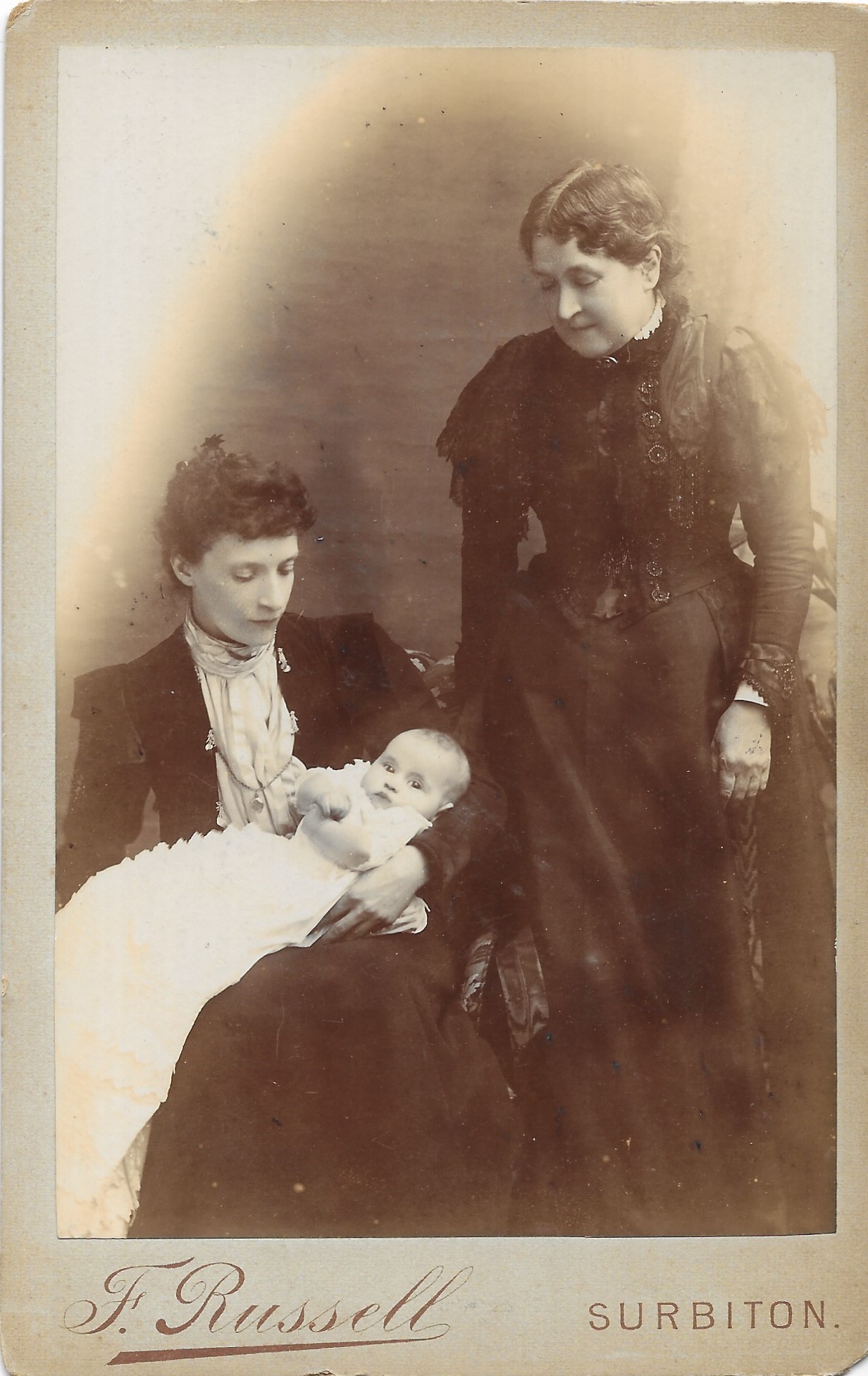
Transcription of the back of this Cabinet Card is:
Miss Margaret Mudie of Victoria Road, Surbiton, SW & her niece Miss Annie Mudie & her great niece Margaret Hilda Mudie, daughter of William & Alice Mudie, nee Ames.
A huge amount of information! If only all old photos were like this.
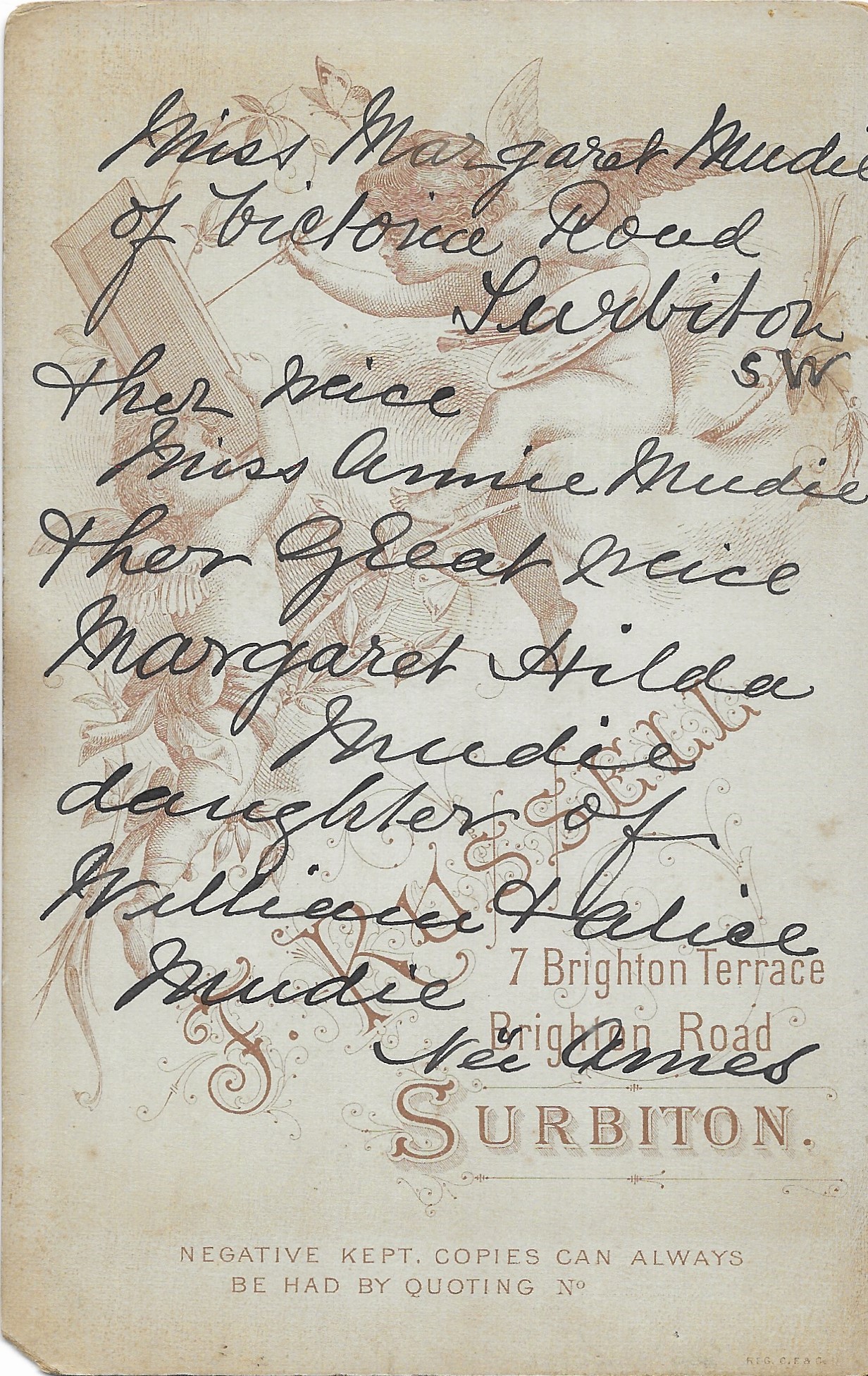
I will start with Margaret Mudie’s Story.
Margaret Mudie was born on 28 January 1839 in St Pancras, then part of Middlesex.
She was born into a modest but established family, the daughter of William Mudie, a Carpenter, and Anne Brand, who had both been born in Scotland. They had moved to London, England, sometime after their marriage, before their first child, James, was born in 1835.
Within weeks, Margaret was baptised at the old parish church of St Pancras, formally welcomed into both family and faith.
Margaret grew up as one of five children, surrounded by the bustle and closeness of siblings. Her brothers, James and George, had been born before her, and in her early childhood she watched her family grow further with the arrival of her younger sisters, Jane in 1842, born in Sussex, and Catherine in 1846, back in St Pancras.
By 1851, at the age of 12, Margaret’s life had shifted to Kingston upon Thames, a town that would remain central to her story. The move marked a transition from her London birthplace to a quieter Surrey setting. As she grew into adulthood, Margaret remained closely tied to her family, still living at home by 1861 in nearby Surbiton and again in 1871 and 1881, always recorded as a daughter within the household.
Tragedy touched Margaret’s life in March 1858, when she was just 19. Her mother, Anne, passed away at the age of 57. The loss must have been deeply felt, especially in a household where Margaret, as one of the older daughters, may have taken on greater responsibilities.
Despite this, she remained rooted in family life, never marrying and having no known children of her own.
Margaret’s later years were marked by both independence and quiet endurance. After her father William’s death in December 1890 at the age of 81.
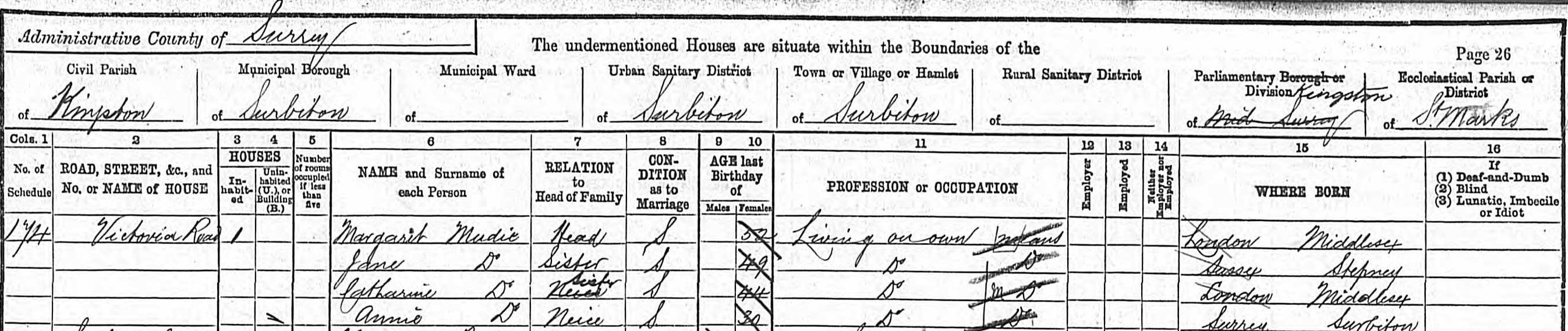
Margaret became the head of her own household. Census records from 1891 onward show her living in Surbiton, described as having “private means,” suggesting a degree of financial stability that allowed her to live without employment.
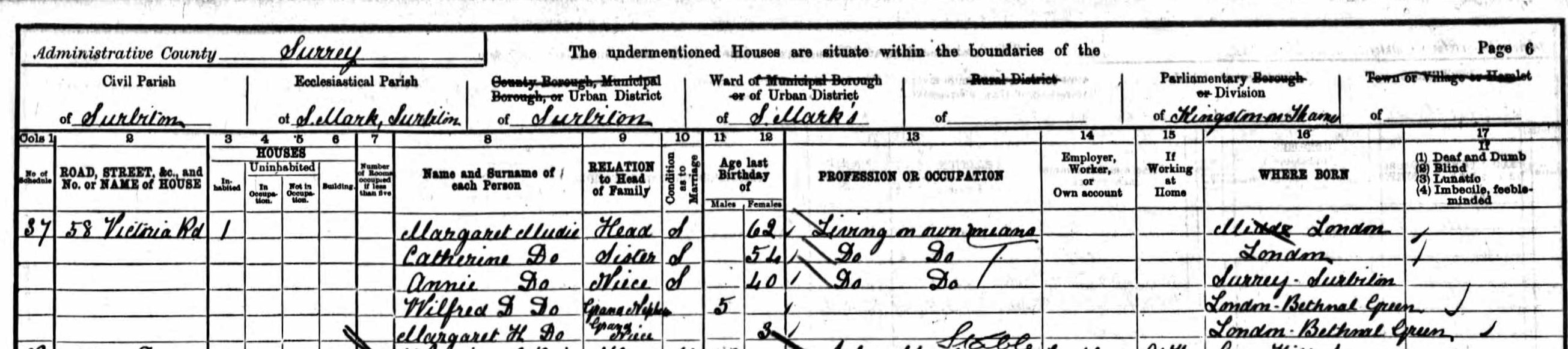
The 1901 census was on the night of 31 March 1901. Five-year-old Wilfred and three-year-old Margaret may have been staying at Margaret’s house to give their mother, Alice, a break, as she had a young baby daughter, nearly four months old at the time, Alice Constance Ivy Mudie, who had been born on 16 December 1900 and baptised on 6 March 1901.
In 1893, her brother George had died, followed by her brother James in 1904. With each passing, the circle of her immediate family grew smaller.
By 1911, at the age of 72, she was still living independently in Surbiton, unmarried and self-sufficient.
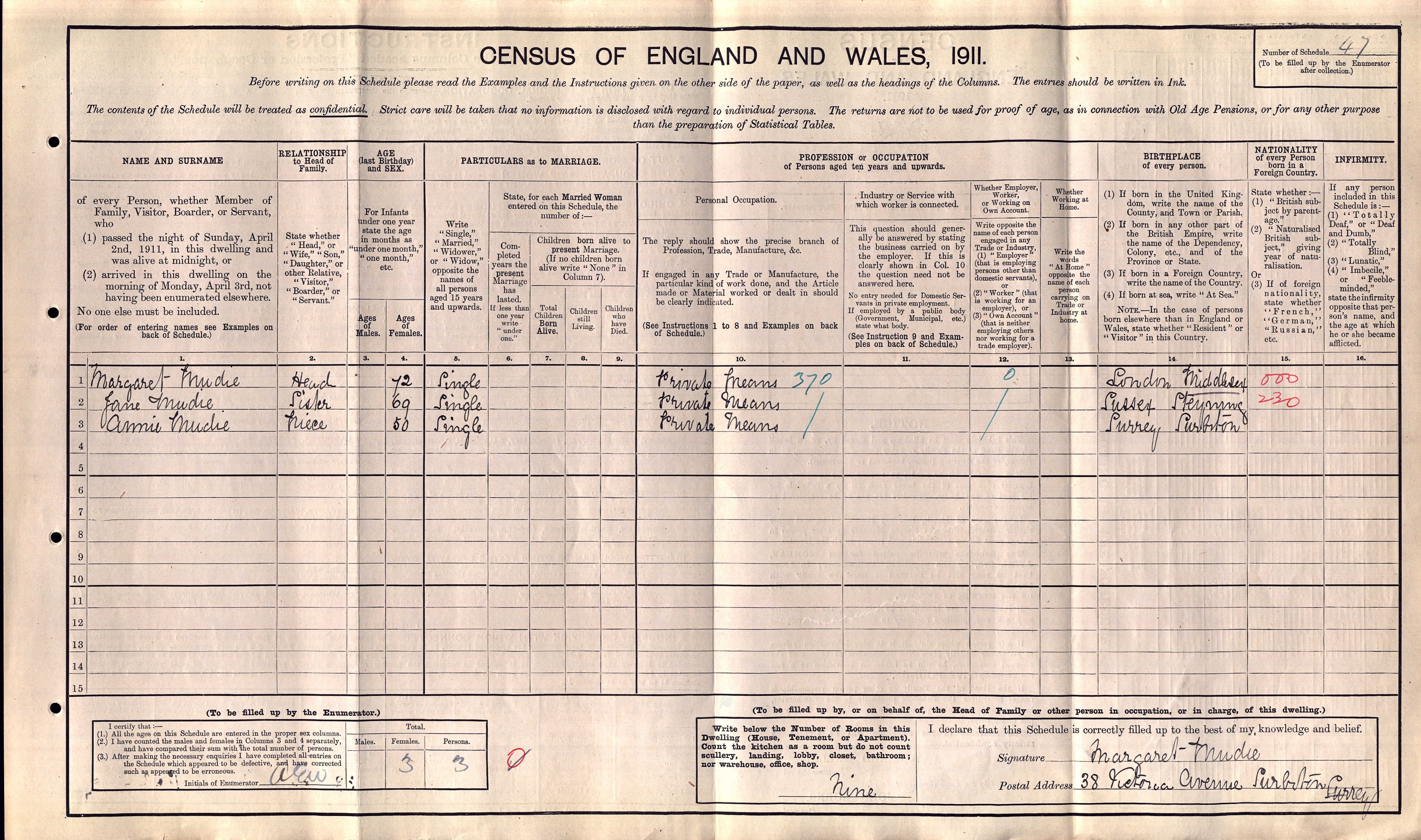
Margaret Mudie died on 24 July 1918 in Kingston upon Thames, at the age of 79. She had lived a long life, spanning nearly eight decades of profound social change.
She left no descendants, but her story endures through the records she left behind, a life shaped by family.
Margaret’s parents were William Mudie, born on 26 October 1809 in Dundee, Angus, Scotland, the son of Margaret and William. He died aged 81 in December 1890 in Kingston Upon Thames, Surrey. Her mother was Anne Brand, 1801-March 1858. This is Margaret with her siblings.
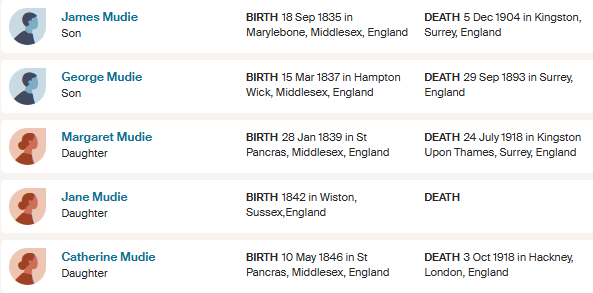
The three in the old photo I have highlighted below so that you can see their relationship to each other.
James married Emma Grey, and they had 4 children, Charles, Edith, Arthur and Walter.
The 3 daughters, Margaret, Jane and Catherine, never married.
George Mudie married Clara Bowrey and had 3 children, William, Annie and John.
Of these 3, only William married, to Alice Ames, and the couple had 4 children, Wilfred Douglas, Margaret Hilda, Alice Constance Ivy and Francis Hubert.

Annie’s Story.
Annie Mudie was born on 20 November 1860 in Kingston, Surrey, the second child of George Mudie and Clara Bowrey, both only twenty-three at the time.
Annie knew her father as a builder in Kingston, a man who shaped wood and brick into homes while holding together his own.
Annie’s older brother William had been born in September 1859 in Surbiton. Then Annie herself. Then her younger brother John in March 1864.
In 1861, she was a baby in Surbiton; by 1871, she was eleven, listed as a granddaughter in a household that seemed to stretch across generations.
At twenty-one, she spent time in Hastings, a visitor by the sea.
She never married. There were chances, perhaps, but Annie remained where she was needed, or where she felt she belonged. By 1891, she was back in Surbiton, recorded as a niece in a household that had shifted and reshaped with time.
That same year, the past began to close in.
In December 1890, her grandfather William Mudie died at eighty-one in Kingston upon Thames.
Then, on 29 September 1893, her father George died at just fifty-six. He was buried days later in Kingston upon Thames, the same place where so much of his life had unfolded. Annie was thirty-two.
Her mother, Clara, lived on until 5 March 1909, passing away in Guildford at the age of seventy-two. Annie, now nearing fifty, remained single, steady, and present, recorded again and again as “niece.”
In 1901, she was still in Surbiton.
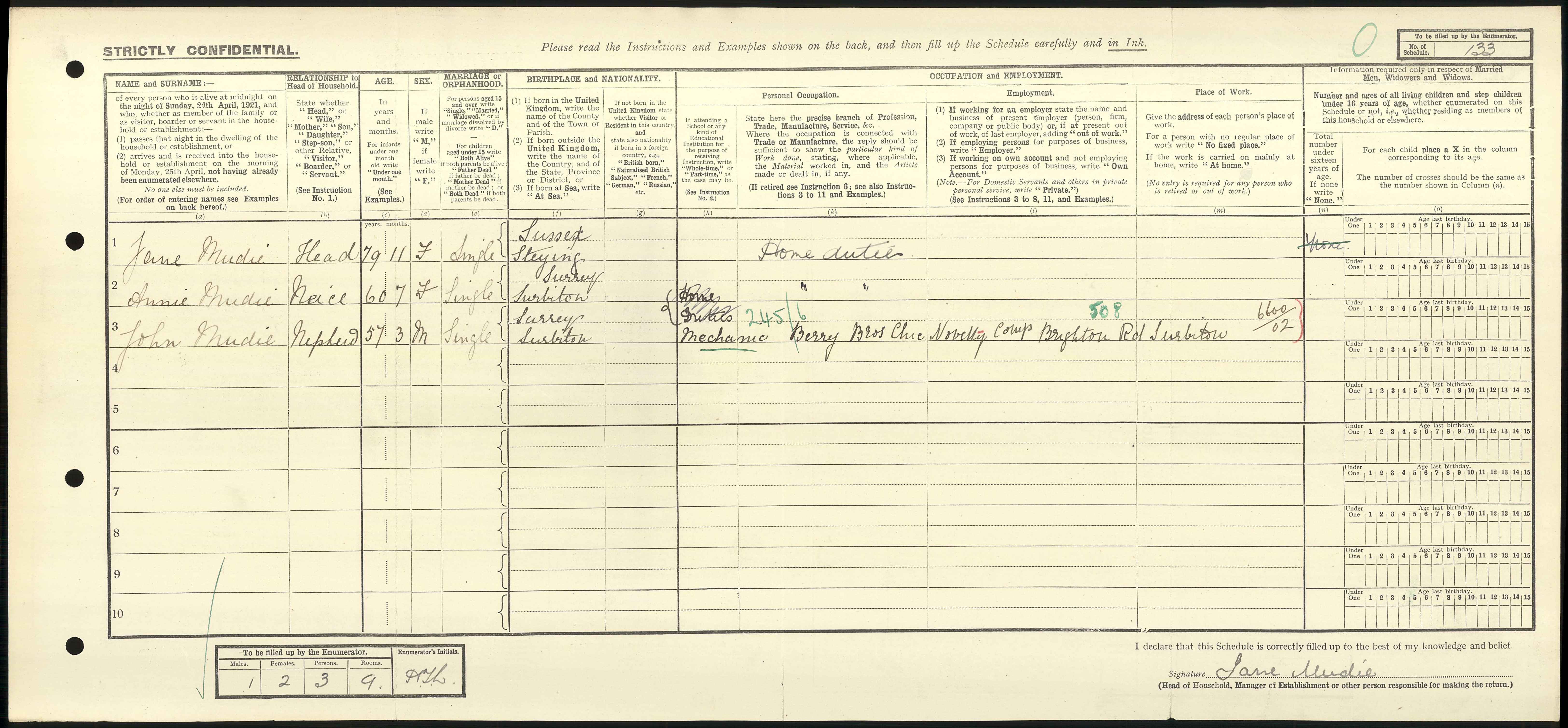
In 1921, too, listed with “home duties,” unmarried at sixty. That same year, her brother William died in Kingston upon Thames.

By 1939, at seventy-nine, Annie was still in Surrey, her occupation described simply as “unpaid domestic duties”, her brother John still living with her.
She had no children, no direct line forward. But she was a very important member of a close family.
In April 1942, Annie Mudie died in Surrey at the age of eighty-one. When her brother John died in 1945, he had still been living at 38 Victoria Road.
Margaret Hilda Mudie’s Story.
Margaret Hilda Mudie was born in November 1897 in Bethnal Green, the daughter of William Mudie and Alice Ames. Her father was already 38 then, a steady man shaped by Surrey roots.
Margaret grew up mostly in Surbiton, where she was baptised as a baby and later went to school. She remembered a busy household: Wilfred, the eldest, leading the way; her sister Alice, born when Margaret was three; and little Francis arriving when she was five. Their father worked hard as a builder and decorator, providing stability even as the family moved between Bethnal Green and Surrey.
Loss came early and quietly. Margaret was just 23 when her father, William, died on 1 June 1921 at 20 Brighton Road, Surbiton. He was 61, and his passing marked the end of the steady presence that had shaped her childhood.
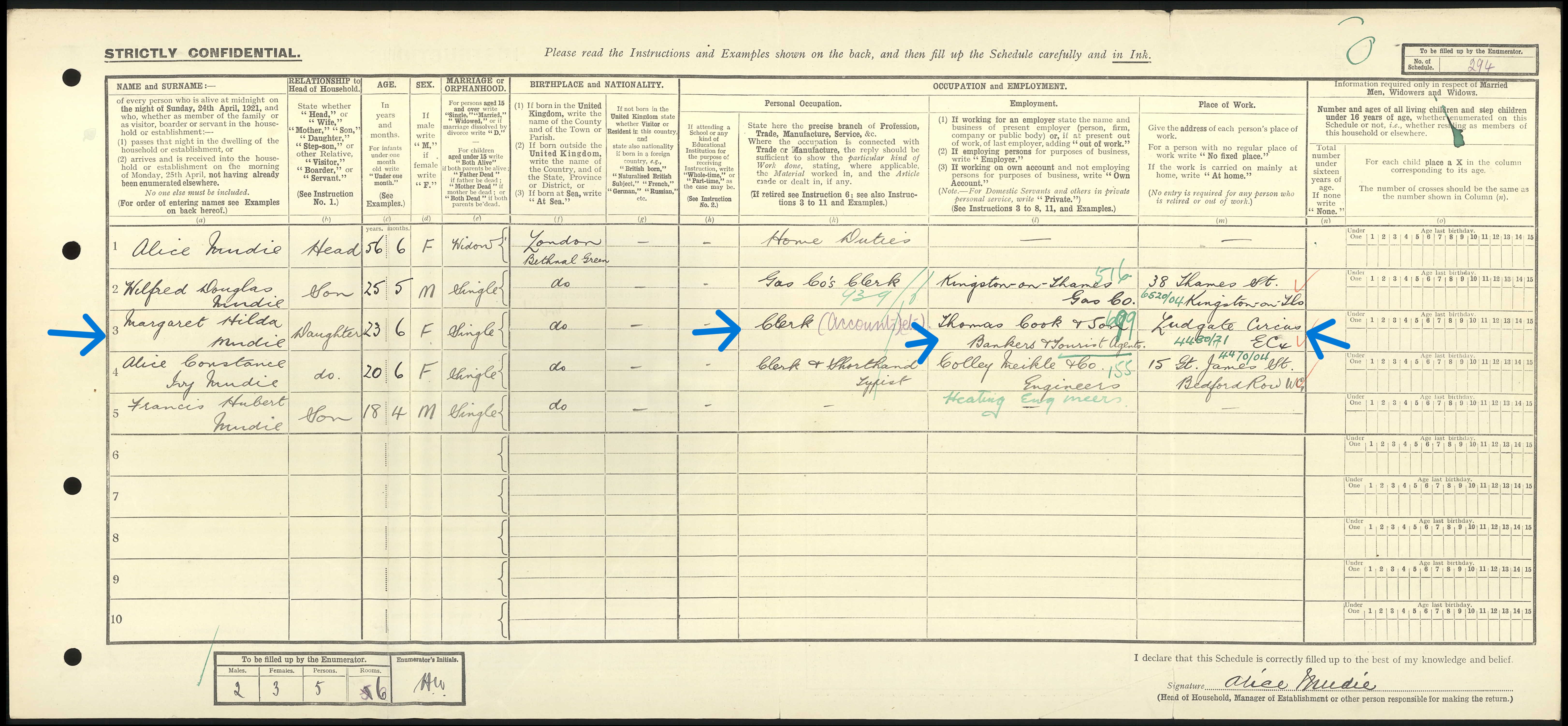
1921. Margaret was living at home, 20 Brighton Road, Surbiton, with her mother Alice, a widow and her unmarried siblings, Wilfred, a Gas company Clerk working for Kingston on Thames Gas Company, Alice, a Clerk and Shorthand typist working at Colley Meikle & Co Engineers, and Francis aged 18.
By then, Margaret was already working, first as a clerk in the accounts department of Thomas Cook & Son Bankers & Tourist Agents, in Ludgate Circus. Then later, as a bank clerk, living a life of independence, unusual for many women of her time.
She never married and had no children, but her life was far from empty.

1939. Margaret was living at 33 Ditton Road, Surbiton, Surrey. With her widowed mother, Alice and her brother Francis, who was a Motor Cycle and Motor Mechanic. Margaret and her brother were both single. Margaret is now a Bank Clerk.
She remained very close to her family, though one by one they were lost to time: her sister Alice in March 1939, her mother in 1943, her brother Francis in 1947, and finally Wilfred in 1965.
Margaret Hilda, on her own, moved to Bacton Grange, Bacton, Suffolk, in her later life, as many well-to-do people did. It was known as a home for retired gentlefolk. The home offered qualified nursing staff and round-the-clock care if needed; it looks beautiful in over six acres of grounds.
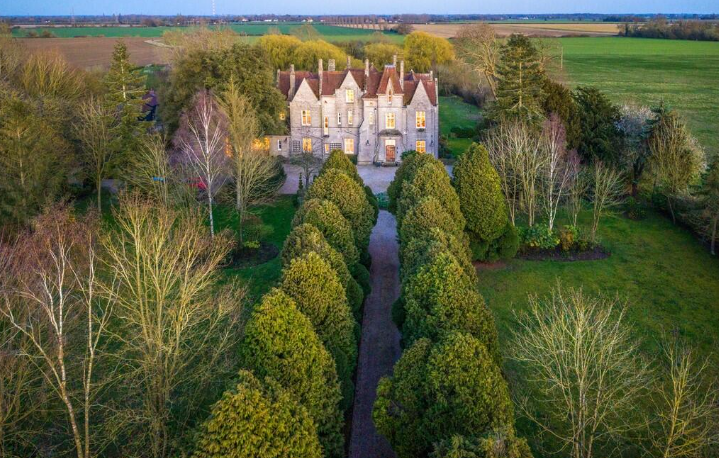
Bacton Grange: Up for sale in March 2026 for £2,300,000.
Lady Bedingfeld of Oxburgh Hall spent the last years of her life there in Bacton, celebrating her 100th Birthday there in 1983 after she had given Oxburgh Hall to the National Trust a few years previously. So Margaret Hilda was in good company!
When she died on 21 November 1987 in Bacton, Suffolk, just days before her 90th birthday, she was laid to rest back in Kingston Cemetery, Kingston upon Thames.
Brighton Road, Ditton Road and Victoria Road, Surbiton, within a mile of one another, and also Kingston Cemetery, Kingston Upon Thames, are all so close to each other. The Mudie family reunited at the end of their lives.
Here’s the public family tree I have compiled on Ancestry for the Mudie family: Mudie Family Tree
In 1921, Margaret was working as a Clerk in the Accounts department of Thomas Cook & Son, Ludgate Circus.
Thomas Cook & Son at Ludgate Circus was one of the most prominent travel and financial service firms in the world in the late 19th and early 20th centuries. By 1921, its London presence, especially around Ludgate Circus, symbolised global mobility in the age of empire.
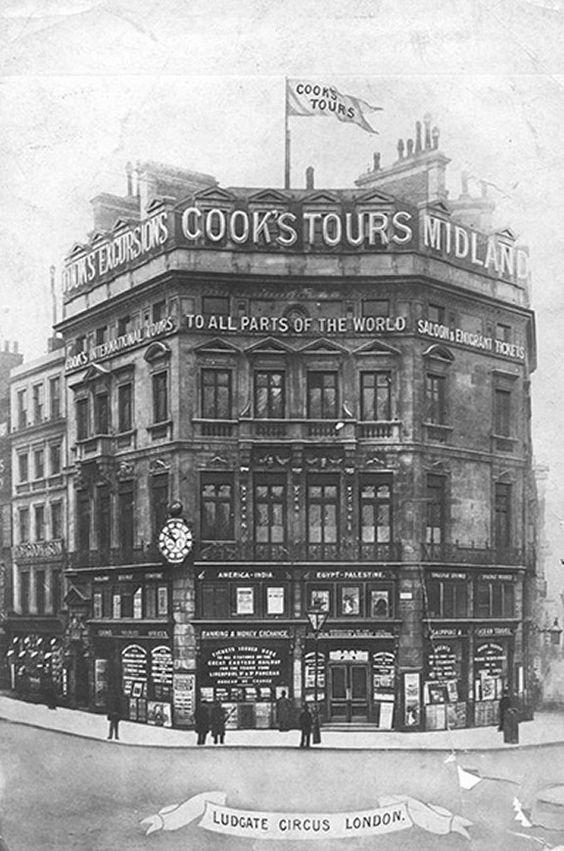
In the years just after the Great War, WW1, when London was learning how to breathe again, Ludgate Circus stood as one of the city’s great crossroads of traffic, of commerce, and of lives moving cautiously back toward normality. Amid the noise of motorcars, omnibuses, and hurried clerks, one name carried a quiet promise of the wider world: Thomas Cook & Son.
Their office there was more than a shopfront. It was, in a sense, a gateway.
The firm had begun modestly, decades earlier in 1841, under the vision of Thomas Cook, who first arranged excursions not for profit alone, but to broaden ordinary lives.
By the late 1800s, his son, John Mason Cook, had expanded that vision into something extraordinary, a global enterprise that could carry a traveller from London to Cairo, from Paris to Bombay, with a confidence that was rare in an uncertain world.
By the time Ludgate Circus became one of its central London bases, Thomas Cook & Son had grown into something far larger than a travel agency. It was described, quite accurately, as “bankers and tourist agents.”
Inside, clerks did not merely sell tickets; they handled money, issued circular notes and travellers’ cheques, arranged routes across continents, and solved the practical puzzles of long-distance travel in an age before such journeys were routine. A person could walk in with ambition and leave with a plan to cross the world.
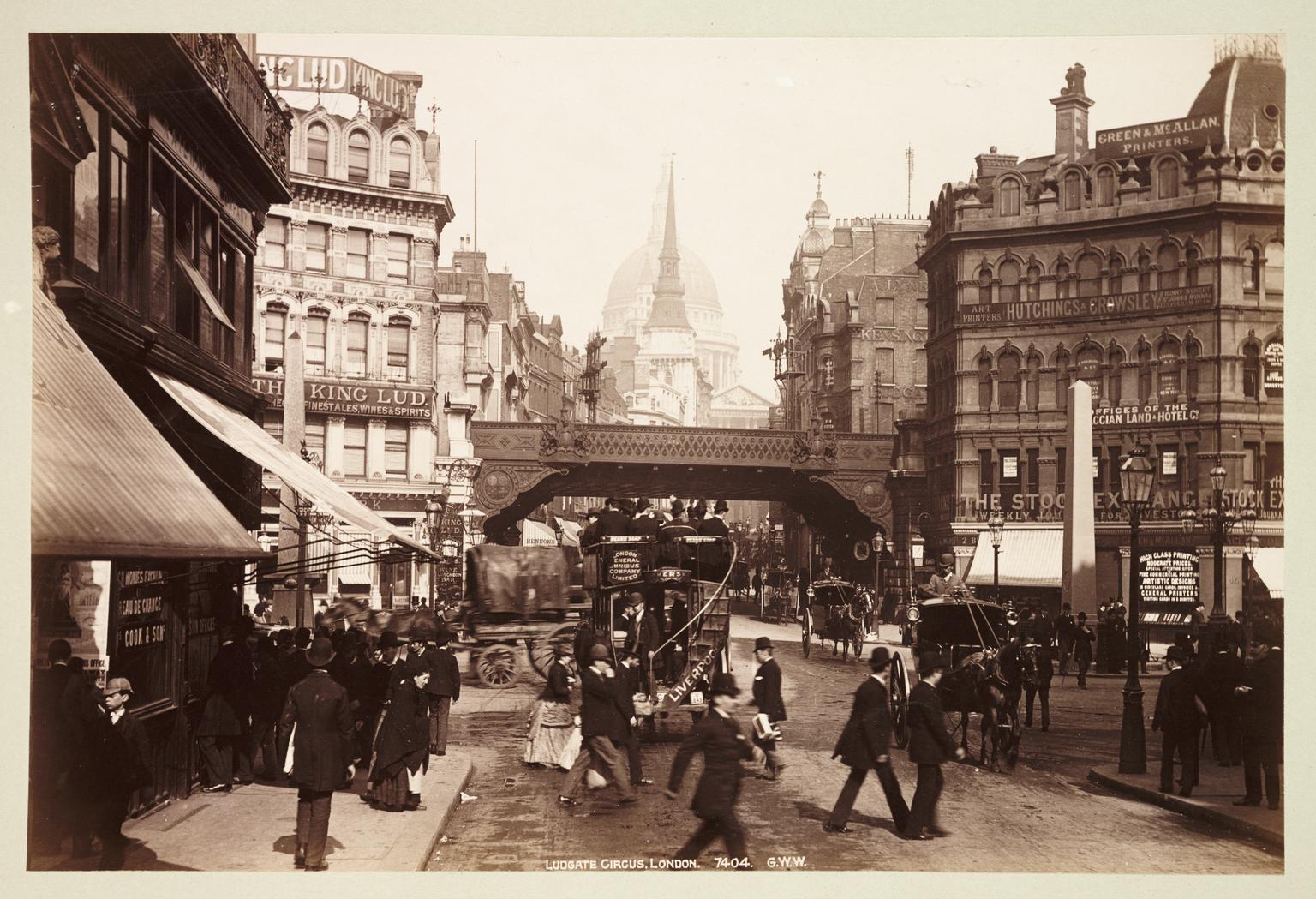
Then came World War I.
For several years, the easy movement of people all but ceased. Railways and steamships were turned to war. Borders hardened. Travel, once adventurous but accessible, became entangled in danger and bureaucracy. Even a company as vast as Thomas Cook & Son could not escape the upheaval.
So when 1921 arrived, the office at Ludgate Circus stood at a turning point. Travel had resumed, but it was no longer the same. Passports, visas, and new regulations had become part of the process. Journeys required more planning, more paperwork, and often more patience. Yet the desire to see the world had not vanished; if anything, it had deepened.
Inside the office, one might have seen a mixture of old confidence and new caution. Clients approached the counters not only with excitement, but with questions shaped by recent history. Clerks, experienced and steady, guided them through unfamiliar requirements, currencies to be exchanged, documents to be prepared, and routes carefully mapped. The world was open again, but it had changed, and Thomas Cook & Son adapted with it.
Behind the scenes, the company itself was changing too. No longer solely in family hands, it had recently, in 1920, passed into new ownership, marking the end of an era that began with Thomas Cook’s original vision. The company had been sold in 1920 to the Belgian company Compagnie Internationale des Wagons-Lits (famous for luxury trains like the Orient Express).
This marked a shift from family-run business to corporate control.
Even so, its purpose endured: to connect people with places far beyond their daily horizons.
In the years that followed, the firm would continue to evolve alongside the modern world through the rise of air travel, the tightening of borders, and the shifting patterns of tourism. But in 1921, at Ludgate Circus, it stood as both a survivor of disruption and a symbol of continuity.

For those who passed through its doors, it offered something simple yet profound: the possibility of going elsewhere, at a time when “elsewhere” had become more meaningful than ever before.

You can contact me either by commenting here or via email at lynnswaffles@gmail.com
Till next time then……….
 lynnswaffles.com
I enjoyed this story so much. You write so well! It’s interesting none of them married. But they all had an interesting life. I love research and genealogy and the stories one can discoverer. It’s a beautiful cabinet card. Do you keep them all in albums?
LikeLiked by 1 person
Thank you. If you had money or the will to work & be independent you didn’t need a husband to keep you back then. I really enjoy the research as I never know where it will take me. I keep all my old photos in storage boxes. Lynn
LikeLike
This is so interesting, Lynn. I expect you know that Surbiton station is on Victoria Road so it was easy for commuting to London. I shared a flat in a Victorian house backing on to Victoria Road in my twenties. I have many fond memories of living there.
LikeLiked by 1 person
Thanks Liz, I can imagine that it was very different from today’s Victoria Road xx
LikeLiked by 1 person