This is the story of another small collection of old photos that I added to my collection last summer.
It was this first photo of the Botterill family that initially caught my eye.
I absolutely love these old Victorian photos of families; some adults look so uncomfortable. Very different from photos of today. This one was especially good because of the names written on the back. It was taken about 1880.
The seller also told me that ‘Father’ was William Botterill, a wealthy farmer (info from original Album) I then added photos of the children that were named and two more Governesses that the seller said were with the family in the Album.
I started a tree for the Botterill Family on Ancestry.
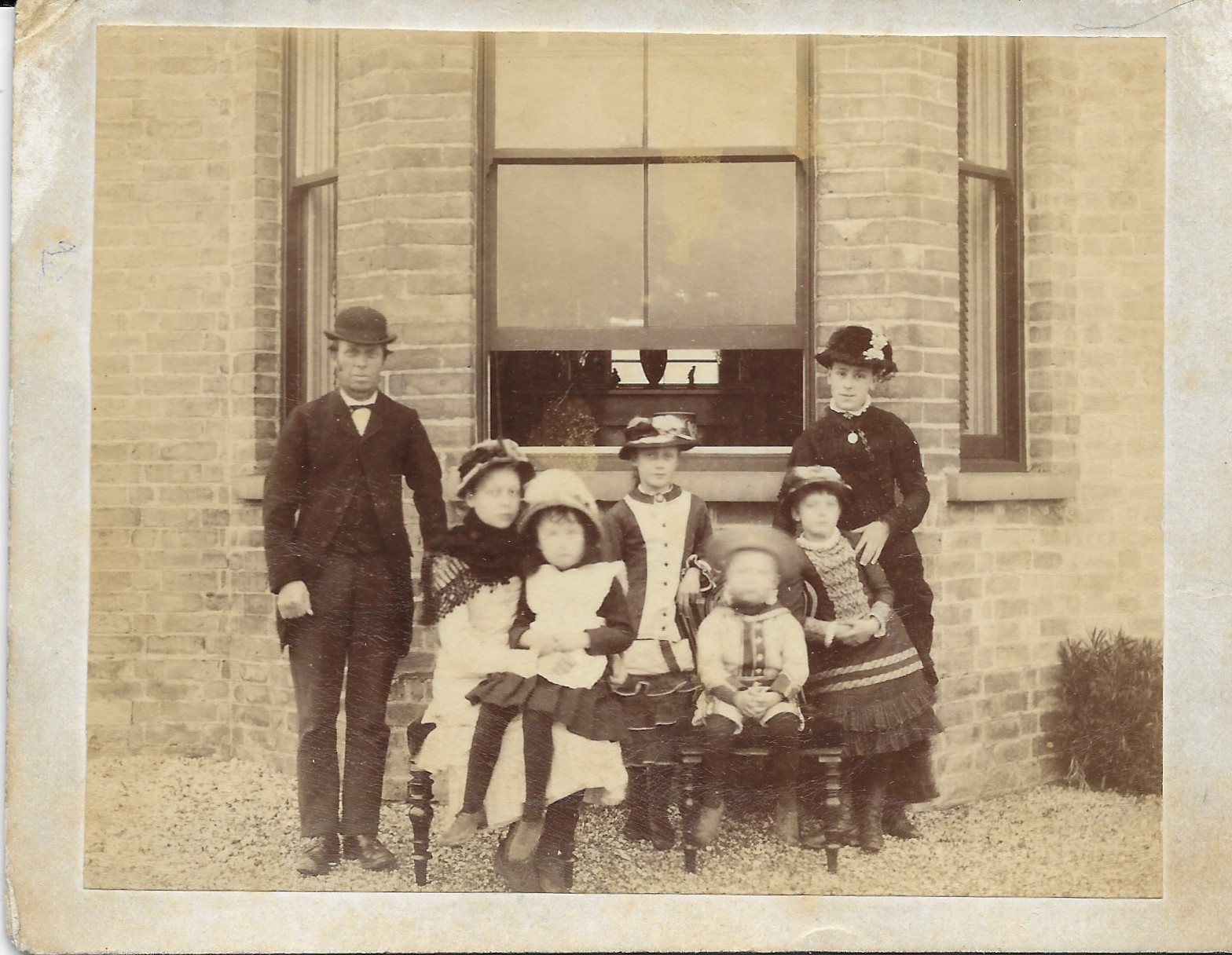
Ethel, the eldest child seated, with Blanche on her lap, then Lucy standing centre, Florence standing next to Miss Fisher and young Arthur in the other chair.
William Botterill.
William Botterill was born in 1835 in Garton, Yorkshire; his parents were Richard Snr and Elizabeth Foster. The family lived at Garton Field, Garton, Yorkshire, and Richard’s father was a Farmer of 560 acres, employing 13 labourers.
William had five brothers and one sister that I have found so far. They were Thomas, Richard Jnr, John, Arthur, Henry and Elizabeth.
William married Harriet Anne Beckitt on 24 September 1870 in Driffield, Yorkshire. They had eight children before William died on 8 October 1884 in Garton, Yorkshire, at the age of 49. They were Ethel, Lucy, Florence, Blanche, Arthur, Gertrude, Constance and Mabel.
Harriet Anne Beckitt was born on 20 July 1847 in Doncaster, Yorkshire. She died on 3 December 1930 in Scarborough, Yorkshire, at the age of 83.
The children’s paternal grandparents were Richard Botterill and Elizabeth Foster; their maternal grandparents were Richard Beckitt and Mary Jane Smith. I’ll come back to the Smith branch of the family later in this blog.
Miss Fisher was the children’s Governess in the photo above, and I was really lucky to find her on the Botterill family census record for 1881.
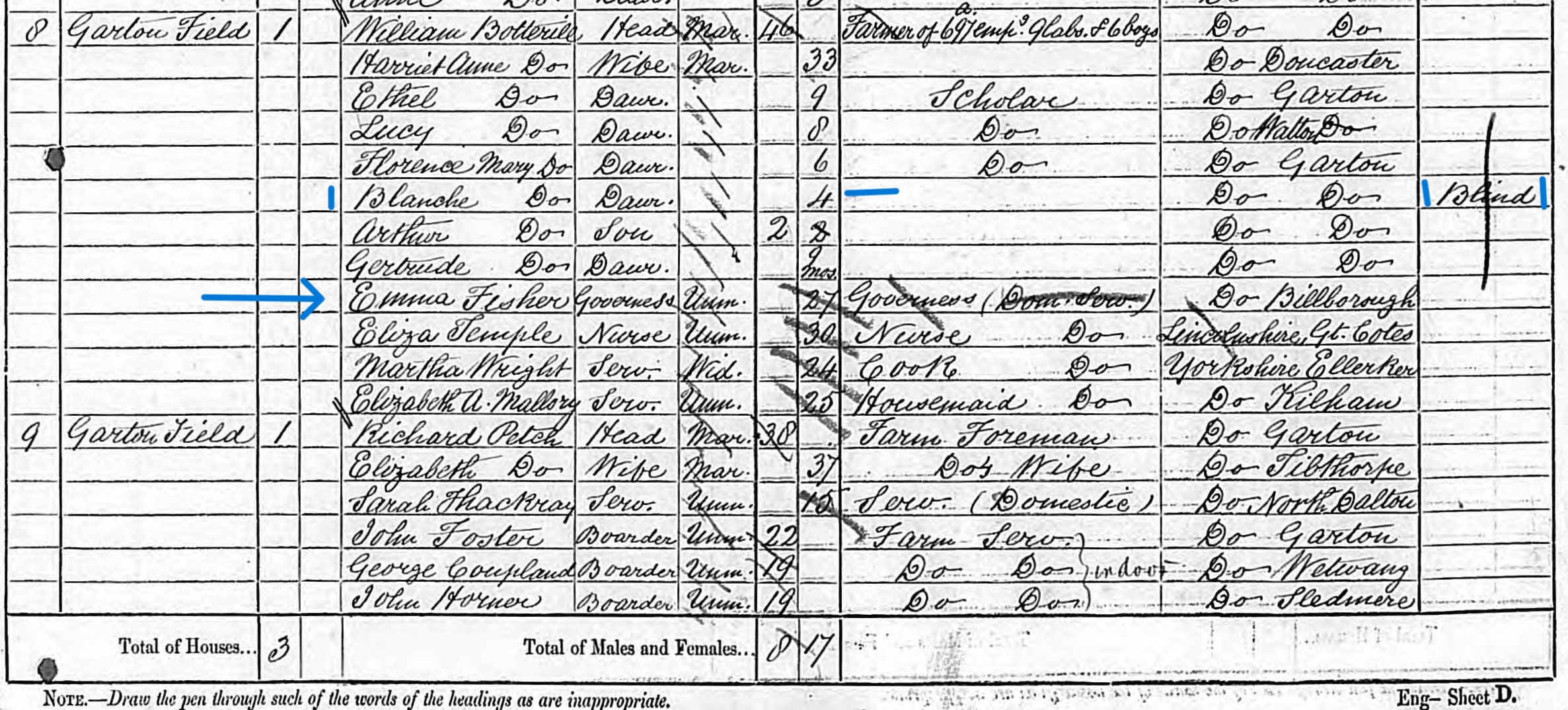
Miss Emma Fisher.
This 1881 census information enabled me to find out more about her. First, this is her birth record:

Emma Fisher was born in Bilborough to John Fisher and Charlotte Marion Jackson. She had eight siblings. Her father was an ‘Attorney at Law, Solicitor and Landed Proprietor’ (1851).
By 1891, Emma had left the Botterill’s family, and was now a Governess for the Branston family’s three children: Emily E Branston, 10, Florence Branston, 9 and George Y Branston, 6. She was living with them in Barnby in the Willows, Nottinghamshire.
I can’t find her in 1901, but in 1911 she was living at the home of one of her sisters, Charlotte and her husband, John Elliot, who was a Law Clerk. Another sister, Caroline, was also living in the same home in Halifax, Yorkshire.
Emma and Caroline were unmarried.
On the 1921 census, I found Emma as a visitor to a family in New Malden, Surrey; they had two sons aged six and ten, so was Emma, at the age of 67 giving them some tuition? She died at the end of December 1938 in Halifax, Yorkshire, so maybe she was still living there with her sister’s family. Emma never married.
Ethel Botterill.
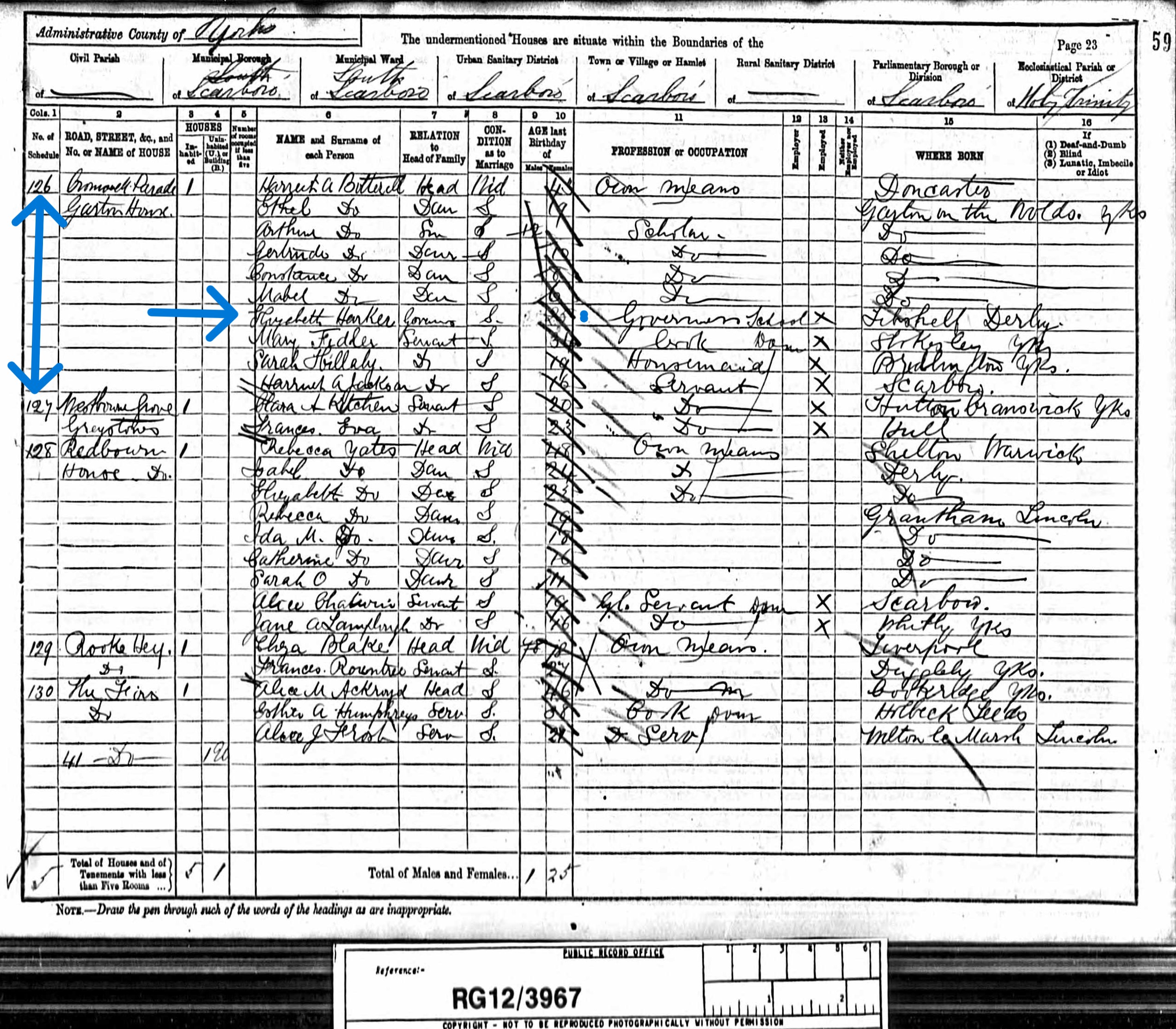
Ethel Botterill, William and Harriet’s eldest child, was born on 3 August 1871 in Garton on the Wolds, Yorkshire. After father William died in 1884, mother Harriett moved with her children to Garton House, Cromwell Parade, Scarborough. She had obviously been well provided for by William. Ethel was now 19, and the youngest child, Mabel, was just six.
You can see them here on the 1891 census; they had a new Governess, Elizabeth Harker, more about her later.
1901. Ethel, Blanche, Gertrude and Constance still lived at Garton House with their mother, Harriett, in 1901. Arthur, the only son, was a Theological student and was living at the home of his uncle, Arthur Botterill, a Farmer in Garton.
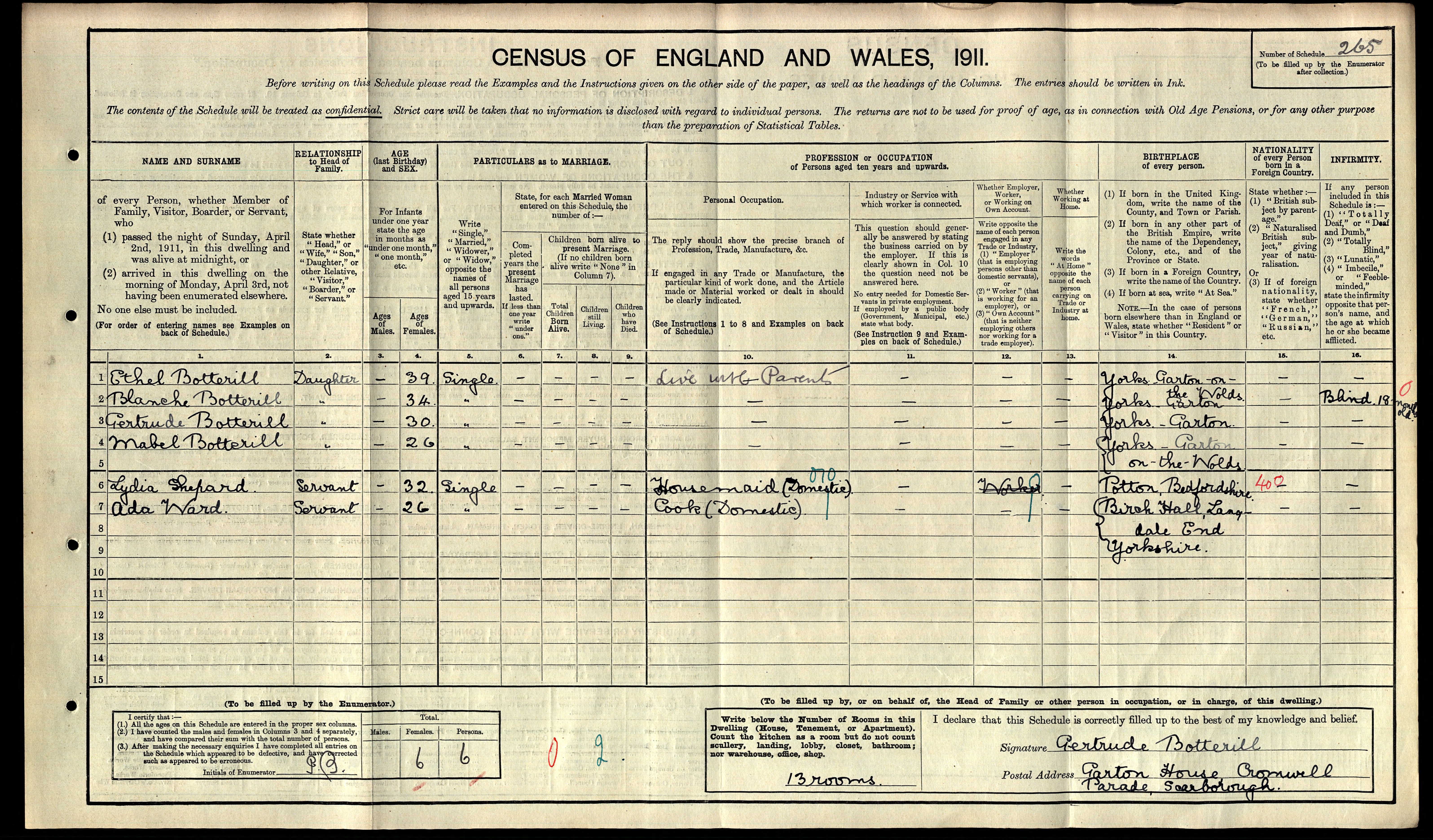
1911. Ethel, Blanche, Gertrude and Mabel at home at Garton House, Scarborough.
Mother Harriett, with her daughter Constance were visiting her son Arthur, who was now a Clergyman in Manchester.
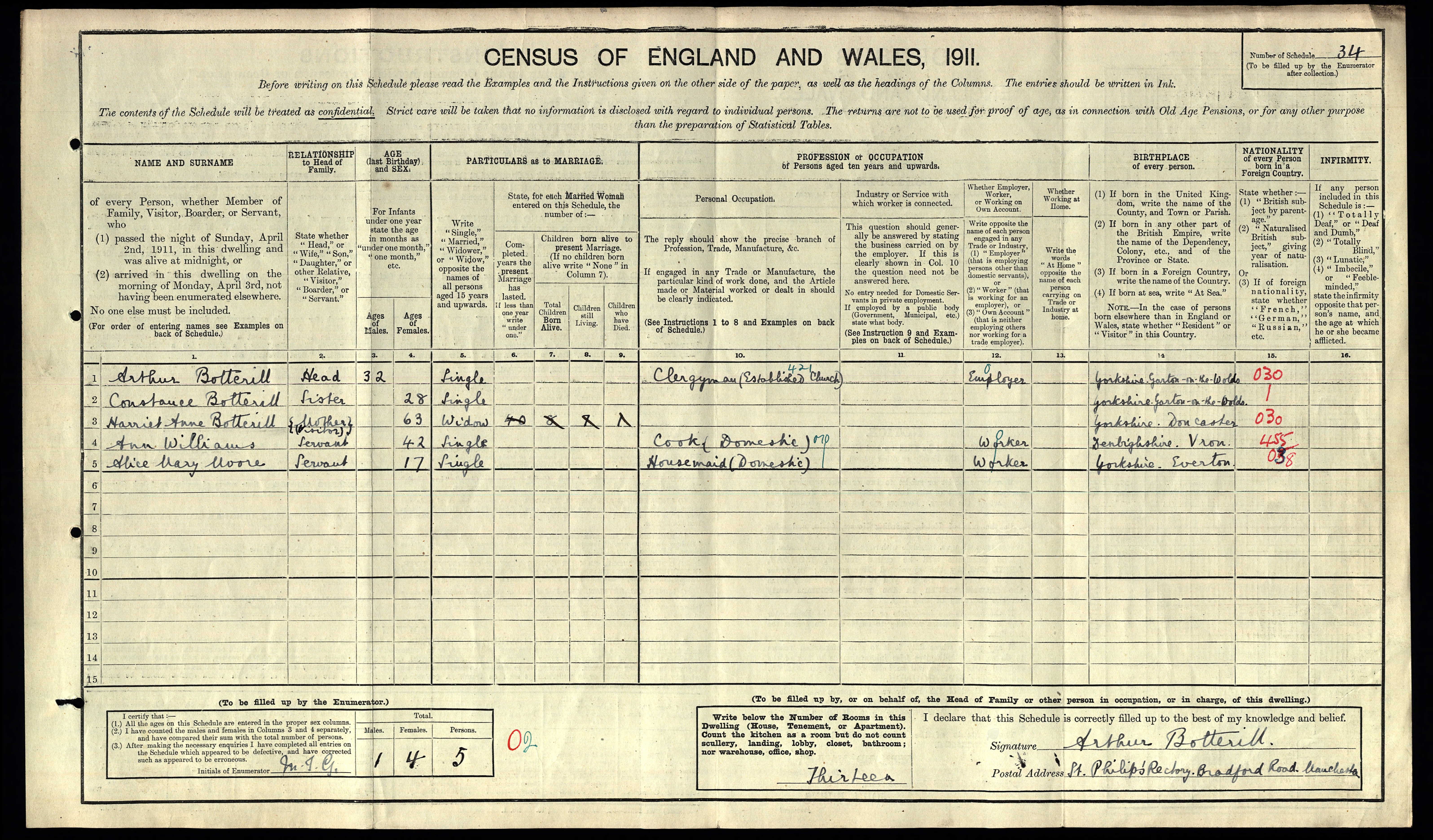
In 1921, Ethel was still living with her mother, Harriett, at Garton House, Cromwell Road, Scarborough. The household was greatly reduced now, and the two ladies had just one servant. Mother Harriett died in 1930.
By 1939, Ethel was living on her own at Garfield Road, Scarborough. She died on 1 August 1952 in Scarborough, Yorkshire, at the age of 80.
Lucy Botterill.
Lucy Botterill was born in January 1873 in Driffield, Yorkshire. She married Charles Lydon, an Educational Publisher, in January 1906 in Scarborough, Yorkshire.
The couple moved to Ealing, Middlesex, and they had one daughter in 1907, Joyce Catherine Lydon. Lucy died on 31 August 1916 at the young age of 43.
Charles then married Lucy’s unmarried sister, Gertrude, on 17 September 1919. Gertrude was 39 when they married. They also had a daughter the following year, Audrey Fitzgerald Lydon, born on 1 June 1920. The couple and the two girls were living in Acton, Middlesex, in 1921. Charles was described as an Artist. By 1939, Charles was a retired Publisher, and the family of four was living in Malvern, Worcestershire.
Lucy’s daughter Joyce married her first cousin Gerald in 1931 in Sussex. Joyce died in 2001, aged 94.
Arthur Botterill.
Arthur Botterill was born in July 1878 in Driffield, Yorkshire. I already mentioned that he was a Clergyman in Manchester, and by 1921, he was still single and now the Vicar of Holy Trinity Church in Darwen, Lancashire. His unmarried sister Constance was living with him at the Vicarage.
I found this great article via the British Newspaper Archives from Find My Past. This actually gives us some idea of what a lovely chap he was. Plus some great family information.
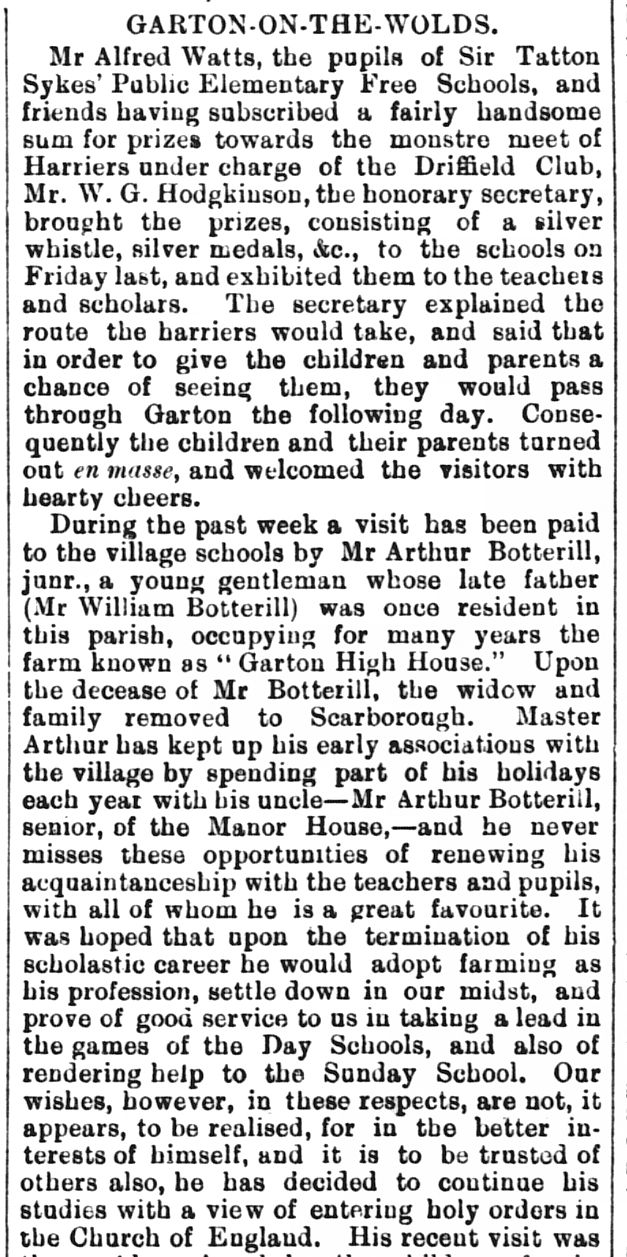
Then, on 12 April 1923, Arthur married Barbara Harman Young in Dorking, Surrey. They had no children. By 1939, he was Vicar of St Hilda’s in Old Trafford, Manchester.
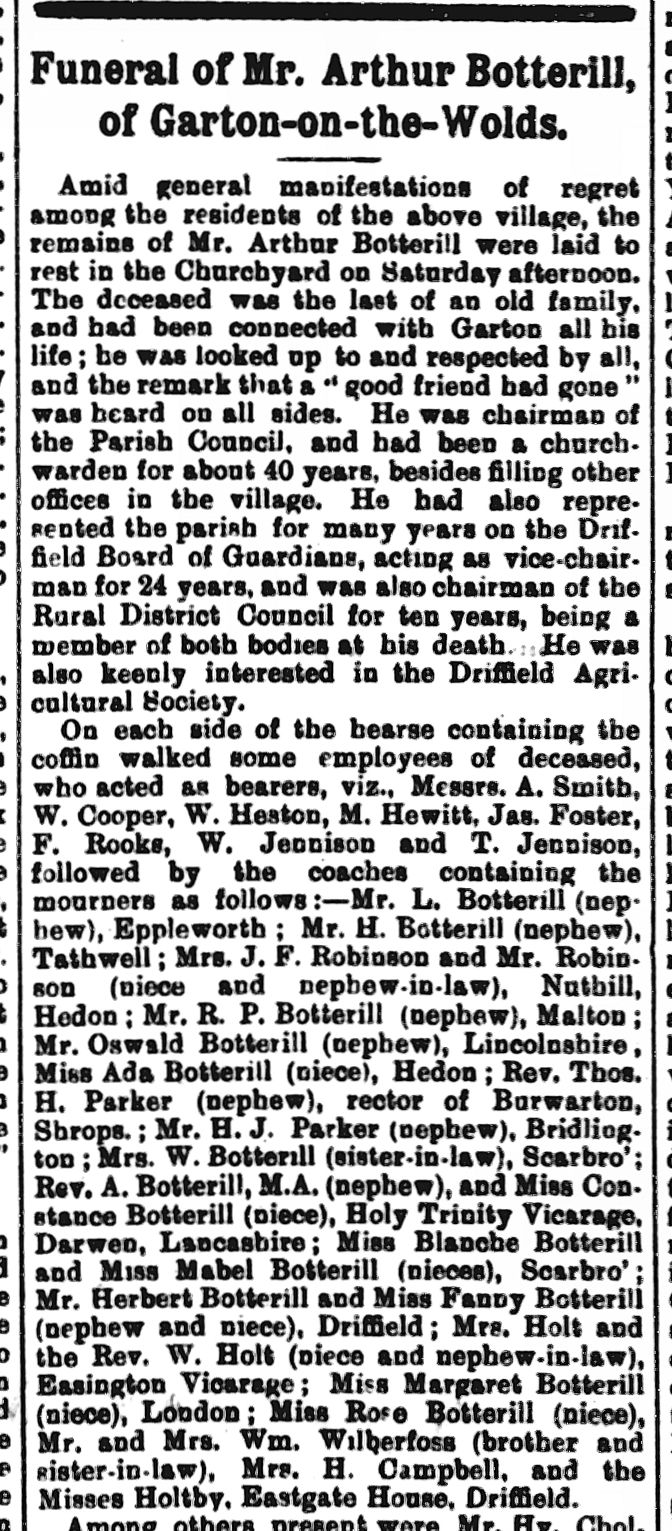
Arthur died on 15 July 1952 at St Feock Vicarage, near Truro, Cornwall, at the age of 74, and was buried in Feock, Cornwall.
The funeral of Arthur Botterill in 1919, who was the uncle of Rev Arthur Botterill and his sisters. So many of the Botterill family attended.
Blanche Botterill.
I realised as soon as I saw this photo that the little girl looked like she was blind and not just blinking when the photo was taken. This was confirmed by the 1881 census of the family.
In 1891, Blanche was attending the Royal Normal College for the Blind at 72 Westow Street, Upper Norwood, Croydon, Surrey, England. It was obviously the best school for her, as she achieved so much. This is just a couple of newspaper reports mentioning her. I believe she played the Piano, the organ and also sang. She was obviously very gifted.
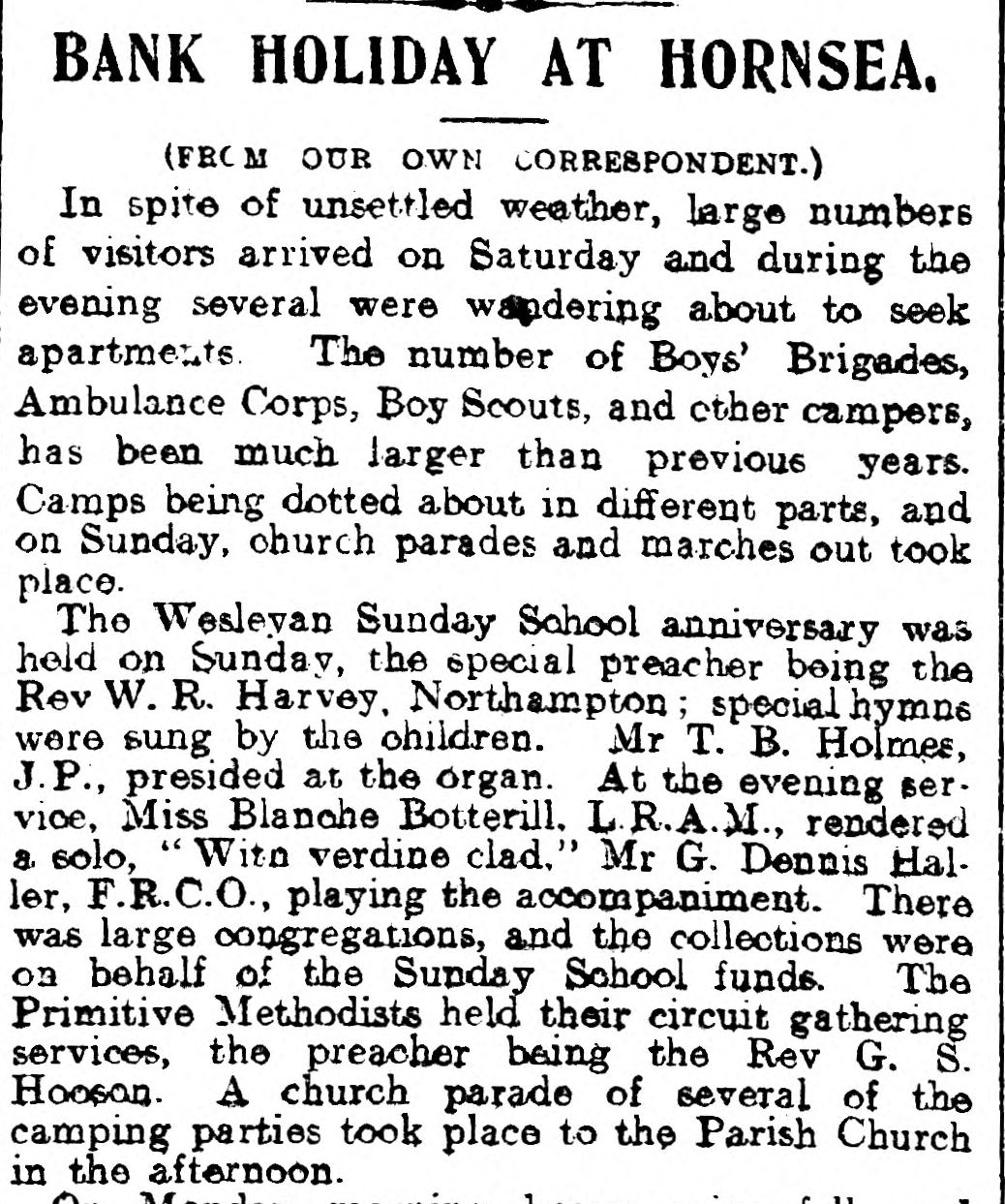
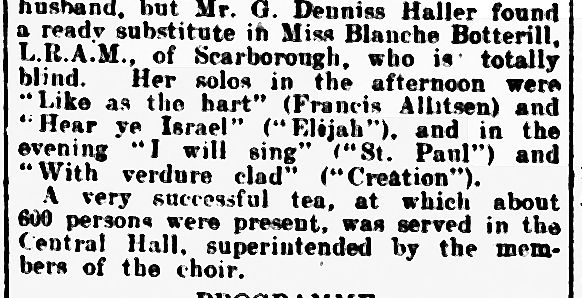
She was a graduate of the Royal Normal College and Academy of Music in London. She acquired the letters LRAM after her name. It stands for Licentiate of the Royal Academy of Music.
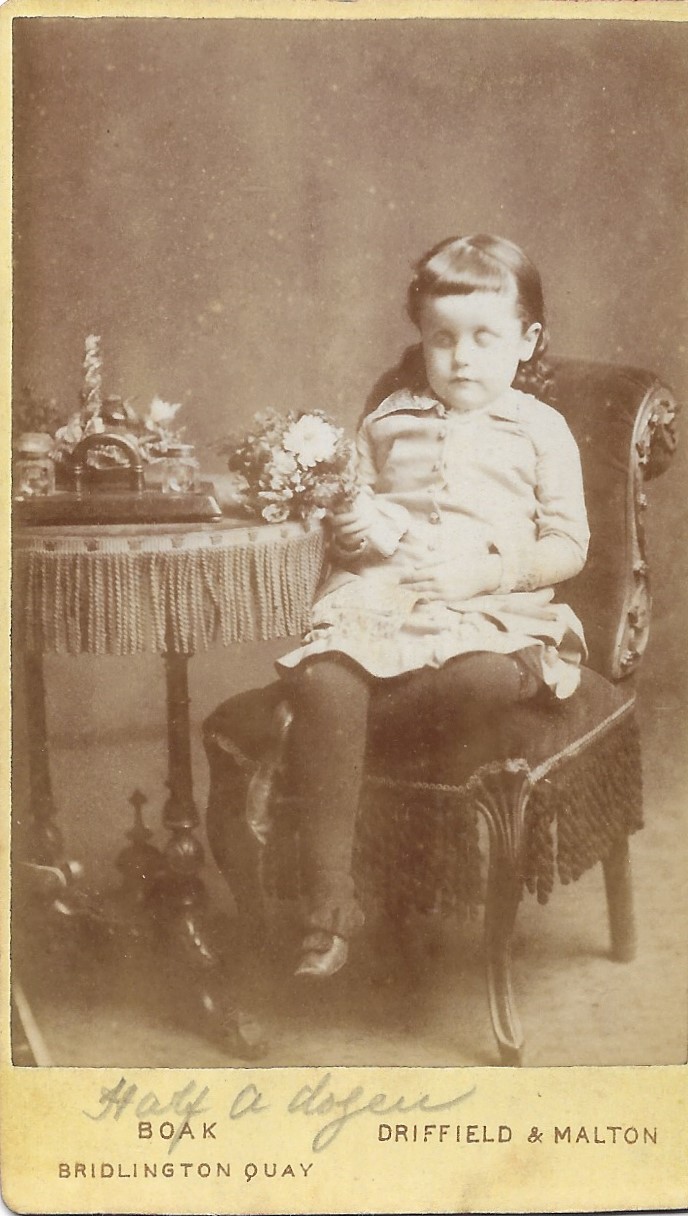
In 1901 and 1911, she was with her family in Cromwell Parade, Scarborough. 1921 finds her visiting friends in Skipton, Yorkshire. Blanche died in Scarborough, Yorkshire, when she was 79 on 2 September 1955.
Florence Botterill.
Florence Mary Botterill was born in April 1875 in Hunslet, Yorkshire. She is with the rest of her family in Garton on the 1881 census.
She died as a child on 10 April 1887 in York, Yorkshire. Her cause of death was double pneumonia; she died at Garton House, Cromwell Parade, Scarborough. Her family must have been heartbroken; they seem to be such a close-knit family.

Anne was Richard Beckitt’s second wife who he married in 1878. So she would have known Florence from her marriage as a two-year-old. His first wife, Mary Jane Smith, died in 1876.
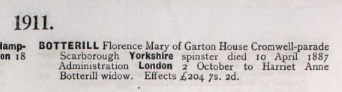
Her mother, Harriett, went to probate in 1911. She had just over £200 in her savings as a child on the probate record.
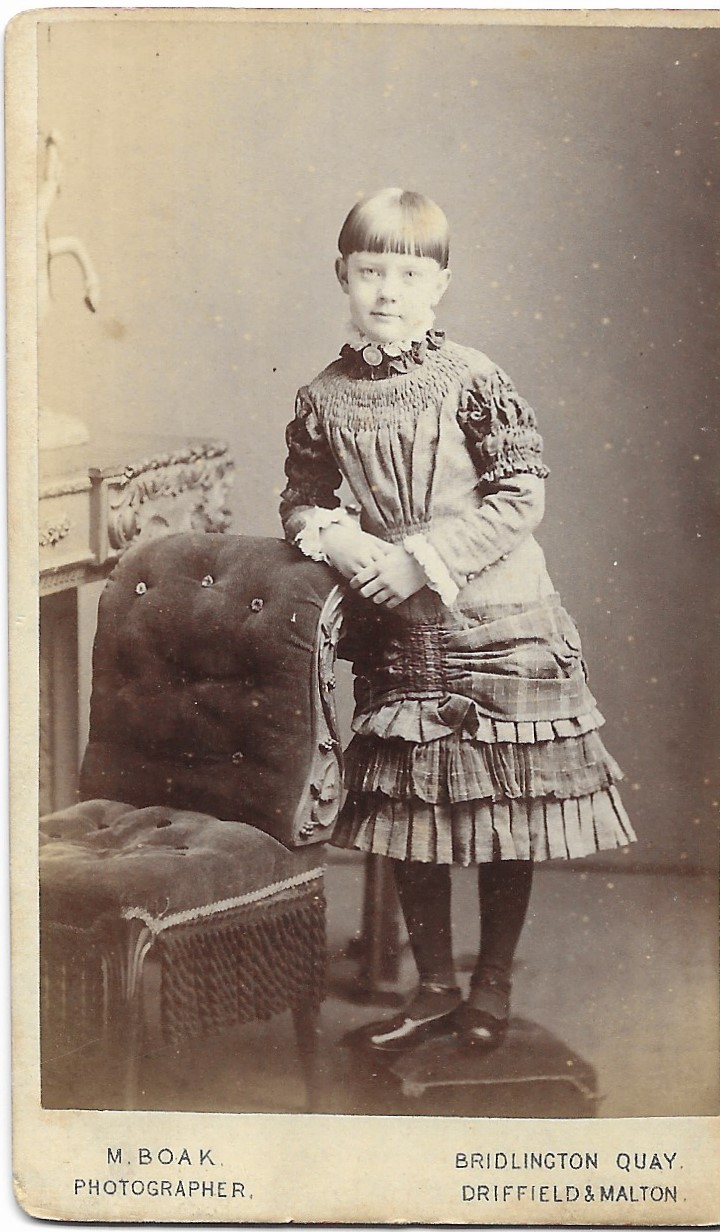
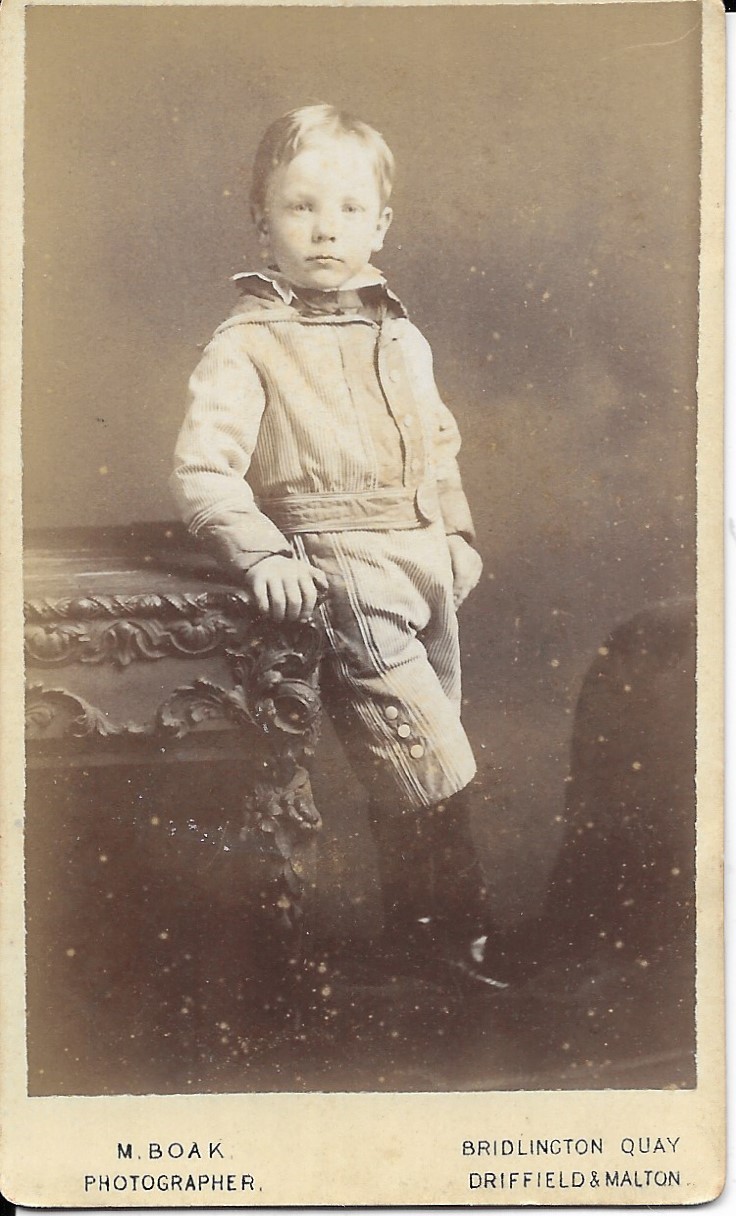
This next photo is also of Florence, but when she was younger. A beautiful photo.
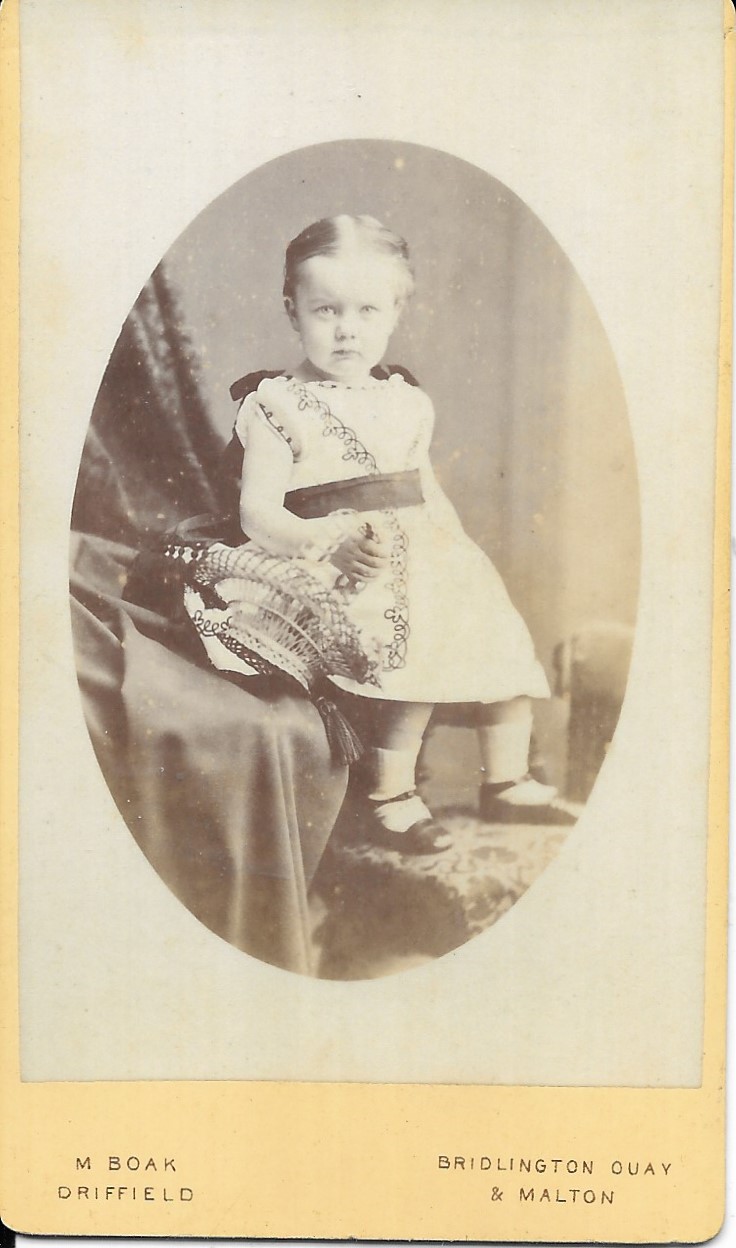
M. Boak. Photographer.
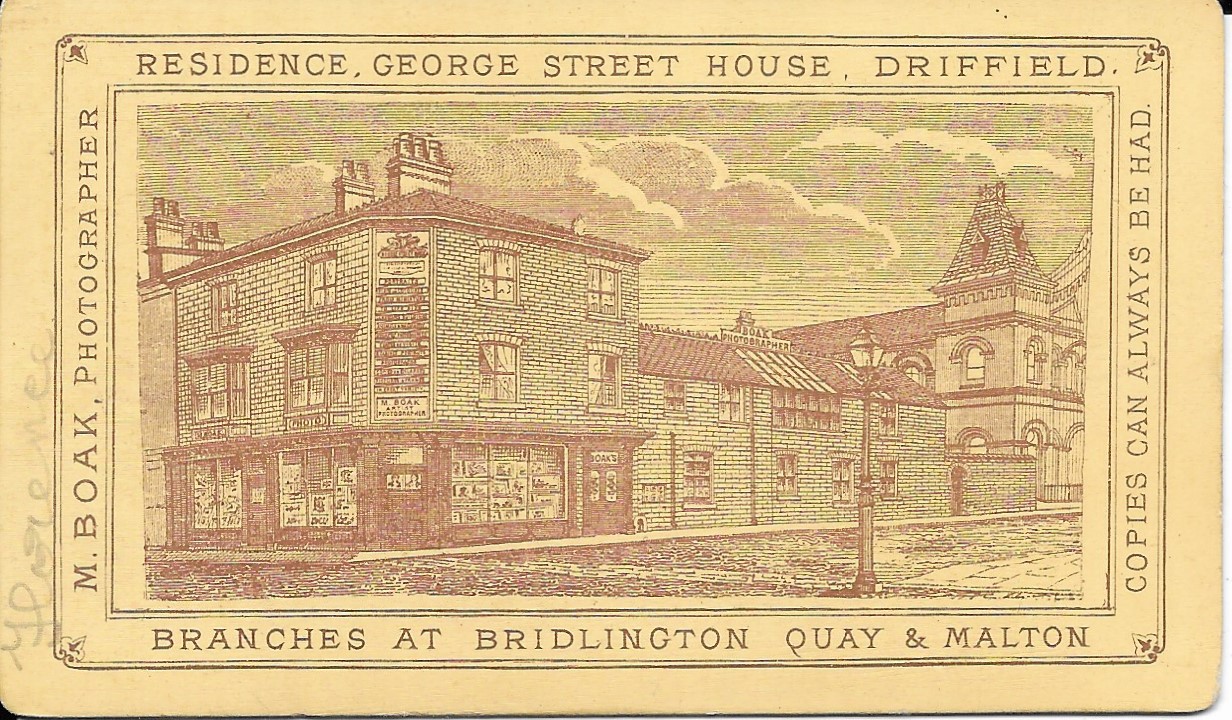
Sometimes you come across wonderful back pictures on photographers’ CDVs or Cabinet cards, and this is one that I wanted to share with you, an artist’s sketch of George Street House and the premises of Matthew Boak.
Matthew Boak took over Michael Tayleure’s photographic business at George Street House in Driffield. Tayleure moved to Pocklington in 1870 and started a new photographic business there. Matthew Boak expanded his Driffield business with additional branches in Bridlington Quay, Malton and Pickering in 1868.
Matthew Boak continued working in photography for many years, and later, his sons and daughter, Mary Jane Boak, became involved in the business, especially at the Bridlington location.
Matthew Boak’s Will.
Matthew Boak died on 13 March 1906. In his will, he left his daughter Mary his share and interest in the photography business at Bridlington, and placed £600 in trust for his son William.
Following his death, the trustees offered for auction a block of freehold property occupying a central position in the marketplace, comprising a photographic shop, showroom and studio, together with a shop occupied by the Balloon Yeast Store; however, the lot was withdrawn.
Matthew had sons William and Johnson, who were also photographers, and Charles, who was an engineer, as well as daughters Mary, Frances and Katherine.
In the 1891 census, Mary is described as an “artist and retoucher”. It appears likely that Johnson took a major role in the Malton studio, as photographs held by the National Archives are credited to “Johnson Boak, Helio House, Malton”, and a contemporary newspaper report states that he was a partner with his father in the Malton business.

Two More Governesses.
Miss Constance Margaret Mumford.
Constance Margaret Mumford was born on 15 September 1878 in Norwich, Norfolk; her parents were George and Louisa. She had two brothers and four sisters.
Constance comes in between Emma Fisher and Elizabeth Harker, so likely was the children’s Governess in the late 1880s/early 1890s.
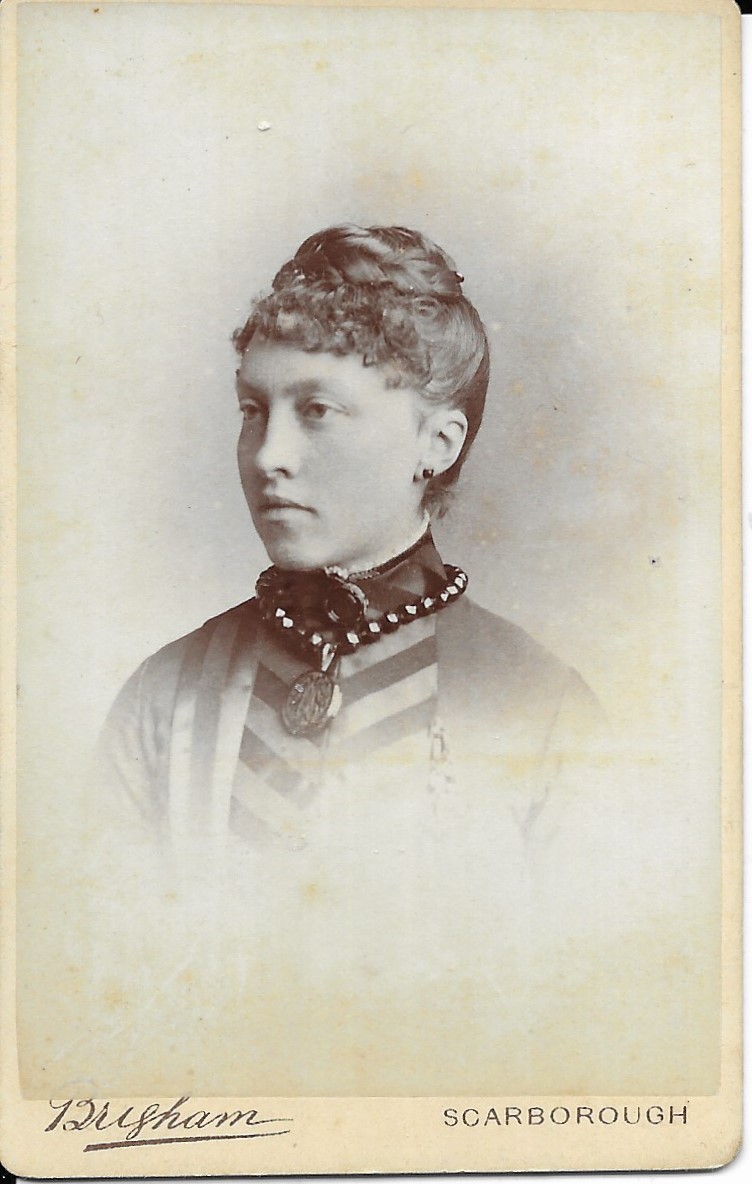
1911 sees Constance living with a family in Scarborough, a Governess, teaching a solicitor’s three sons. In 1939, aged 61 years old, she was living in Croydon, Surrey. Constance was still single but had another family member living with her, aged 25, likely a niece.
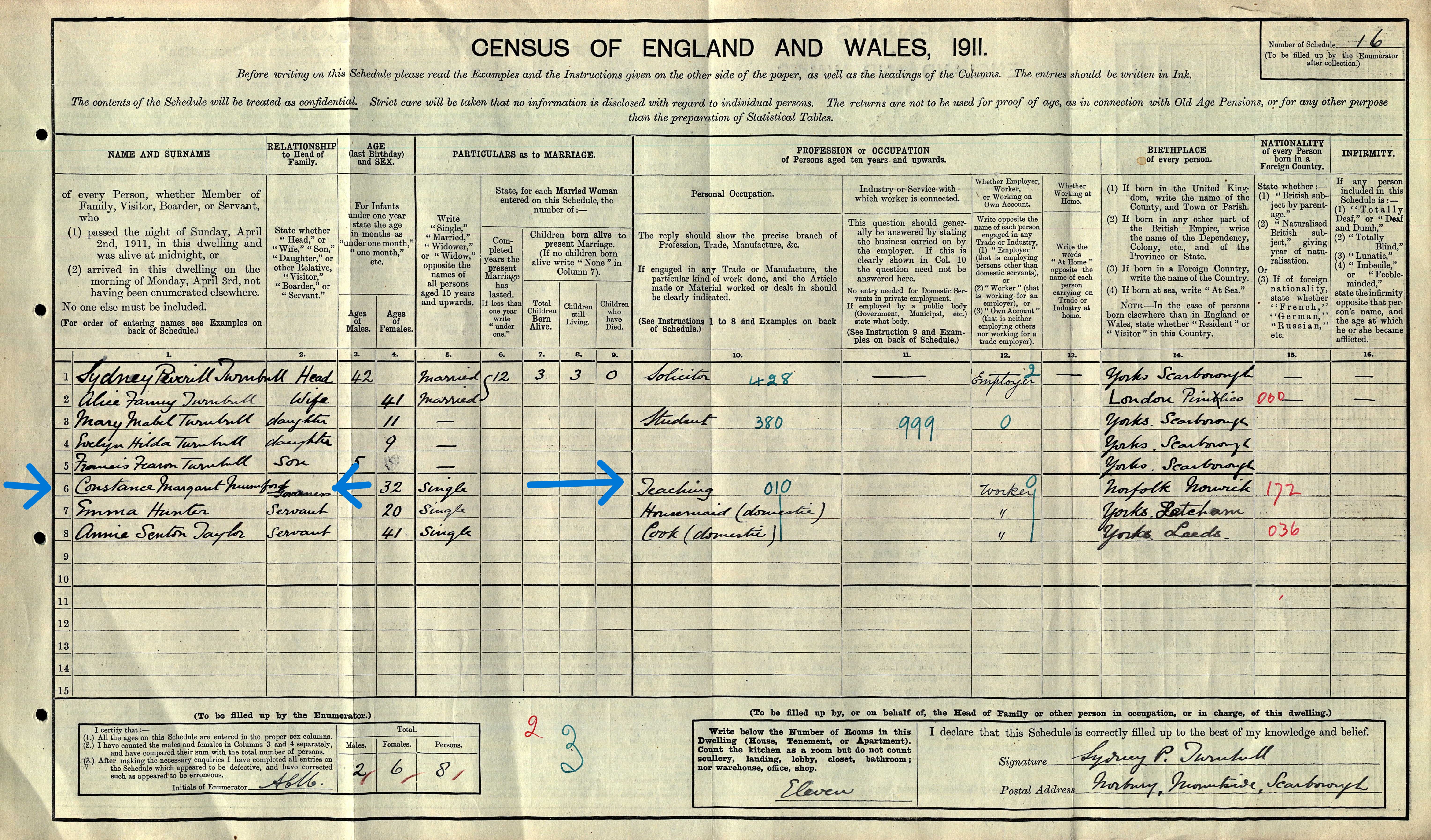
She died on 10 April 1951 at the Croydon General Hospital in Croydon, Surrey, at the age of 72.
Miss Elizabeth Harker.
Elizabeth Harker was born in 1865 in Tibshelf, Derbyshire. Her parents were James, a Farmer, and Ann. She had three brothers and four sisters.
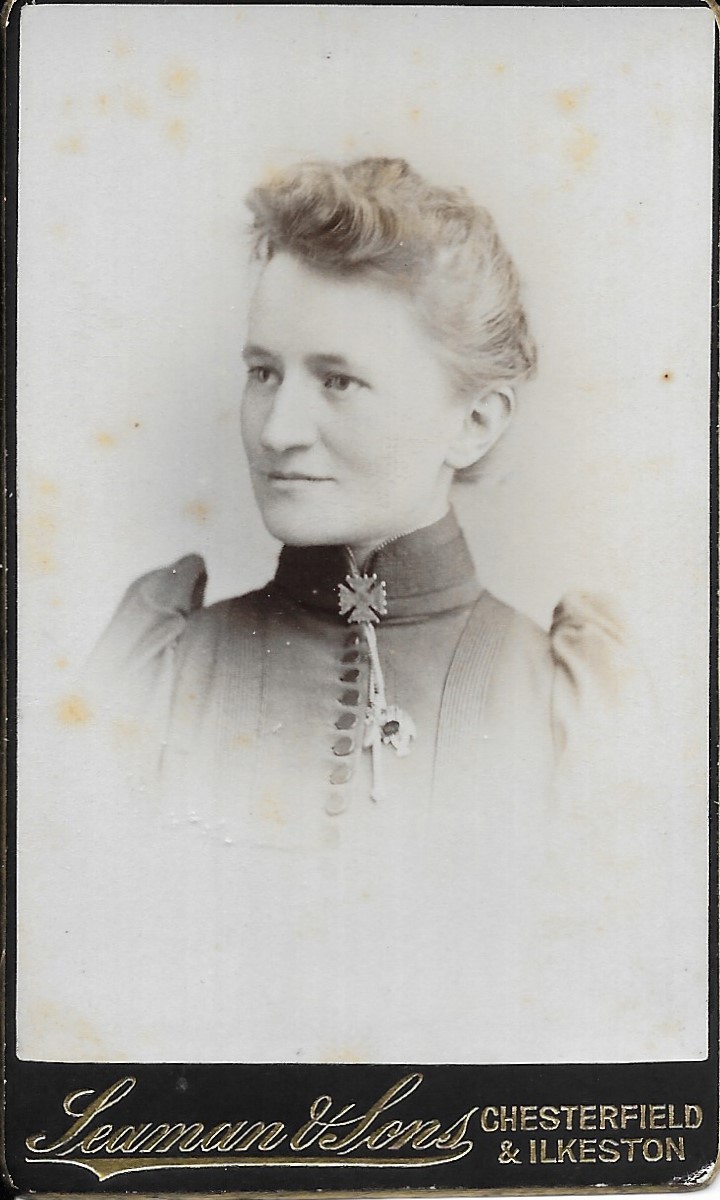
In 1901 Elizabeth was living with her brother Edward who was a Grocer.
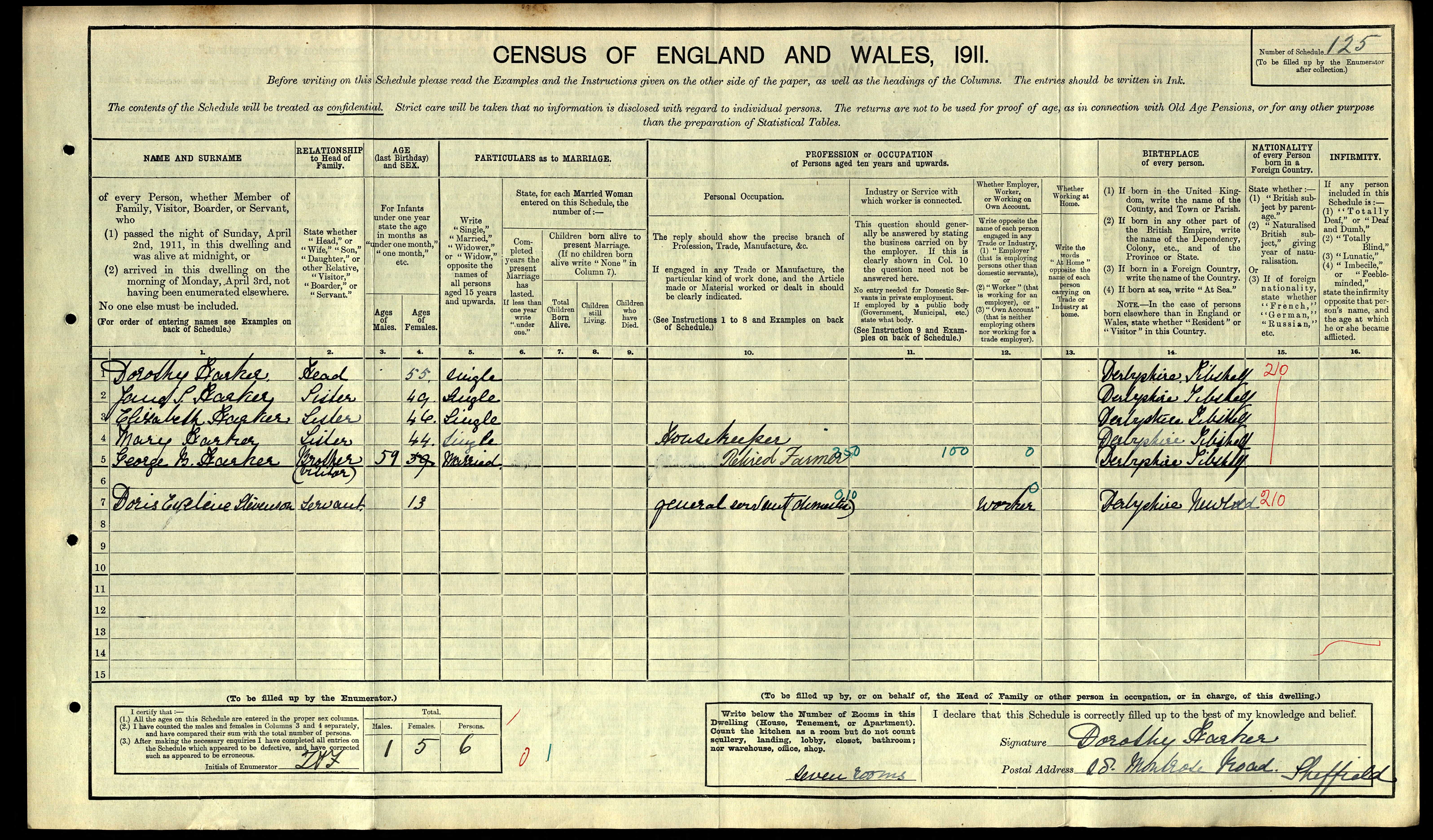
The 1911 census finds Elizabeth aged 46, living at the home of her sibling Dorothy, aged 55, with her were other siblings Jane S, aged 49, Mary, aged 44, and George B aged 59, a retired Farmer.
She died on 3 March 1916 in Ecclesall, Yorkshire, at the age of 51.
Who was Doris?
Also at their home in 1911 was a 13-year-old girl, Doris Eveline Stevenson, who was a general domestic servant.
Of course, ever curious, I had to also find out what happened to young Doris, didn’t I? She was born on 31 August 1897, then married James William Nicholson in the summer of 1915, just before he went off to serve in World War I.
Doris, just 17 years old, was pregnant when they married. Just a few weeks later, on 26 September 1915, James was killed in action. “On 26 September 1915, the 8th (Service) Battalion, Lincolnshire Regiment suffered a ‘“‘bloody baptism of fire” during the Battle of Loos. It was the battalion’s first major engagement after arriving in France just weeks earlier“.
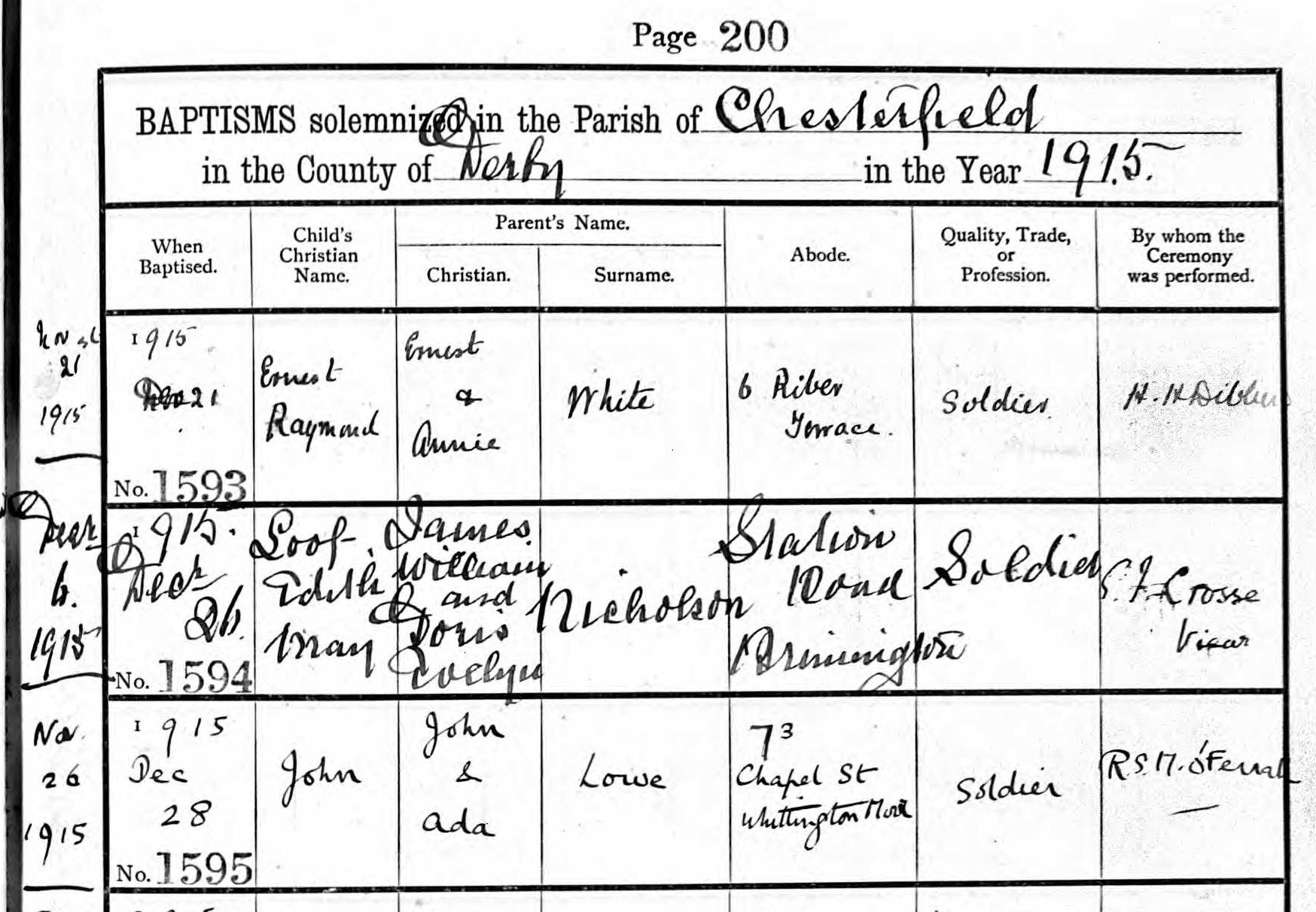
He was commemorated on the Loos memorial. Doris gave birth on 6 December 1915 to a daughter, whom she called Loos Edith Mary Nicholson. Tragedy struck again for Doris at the beginning of 1918, when young Loos died aged two.
Doris found happiness when she married another soldier, Edward Wild, on February 25, 1918. Together, they had several more children. After World War I, Edward worked for Siemens at Stocksbridge, Sheffield. He passed away in 1972, and Doris died on June 15, 1987, at the age of 89.
The Governess.
Governesses were responsible for teaching the children in their care a range of subjects, tailored to their age and abilities. This included the basics like reading, writing, and arithmetic for younger children, and more advanced subjects like literature, history, geography, and languages (often French) for older children.
Governesses also taught young ladies the skills considered necessary for success in the marriage market, including music (piano, singing), drawing, dancing, and deportment (good posture, social graces).
A key part of the governess’s role was to shape the children’s character and instil in them a strong moral compass, including regular Bible reading and prayer.
The following information I found in an article by Felicity Day on the WDYTYA Magazine site:
By the Victorian era, employing a live-in governess had spread from the aristocracy to most wealthy middle-class families, serving both as a marker of social status and a way to prepare daughters for married life in a respectable domestic setting. Once a niche occupation, the profession boomed: by the 1851 census, about 25,000 women worked as governesses.
The role required no formal qualifications. Although Queen’s College in Harley Street, Marylebone, awarded certificates, few parents asked for them, valuing a governess’s family background and genteel upbringing over education or intellect. Knowledge from her own schooling was usually enough, often supplemented by advice manuals such as Sir George Stephen’s 1844 The Guide to Service: The Governess. Positions were typically sought through advertisements or scholastic agencies, with strong demand for those who could teach music or fashionable languages like French and Italian.
Intense competition kept wages low. Governesses in the wealthiest households earned over £100 a year, but £35 to £80 was more typical; Charlotte Brontë earned £20, with £4 deducted for washing, and some posts offered only board and lodging. Accommodation ranged from a private bedroom and, more rarely, a sitting room to sharing with pupils, with only the schoolroom available for solitude in the evenings. As a result, the work was often lonely and depressing.

Henry Botterill’s Family.
This next beautiful photo is also of the Botterill family, although with similar names, they are three of the children of William’s brother, Henry Botterill. Henry and his wife, Sophia (Agars), had nine daughters and one son!
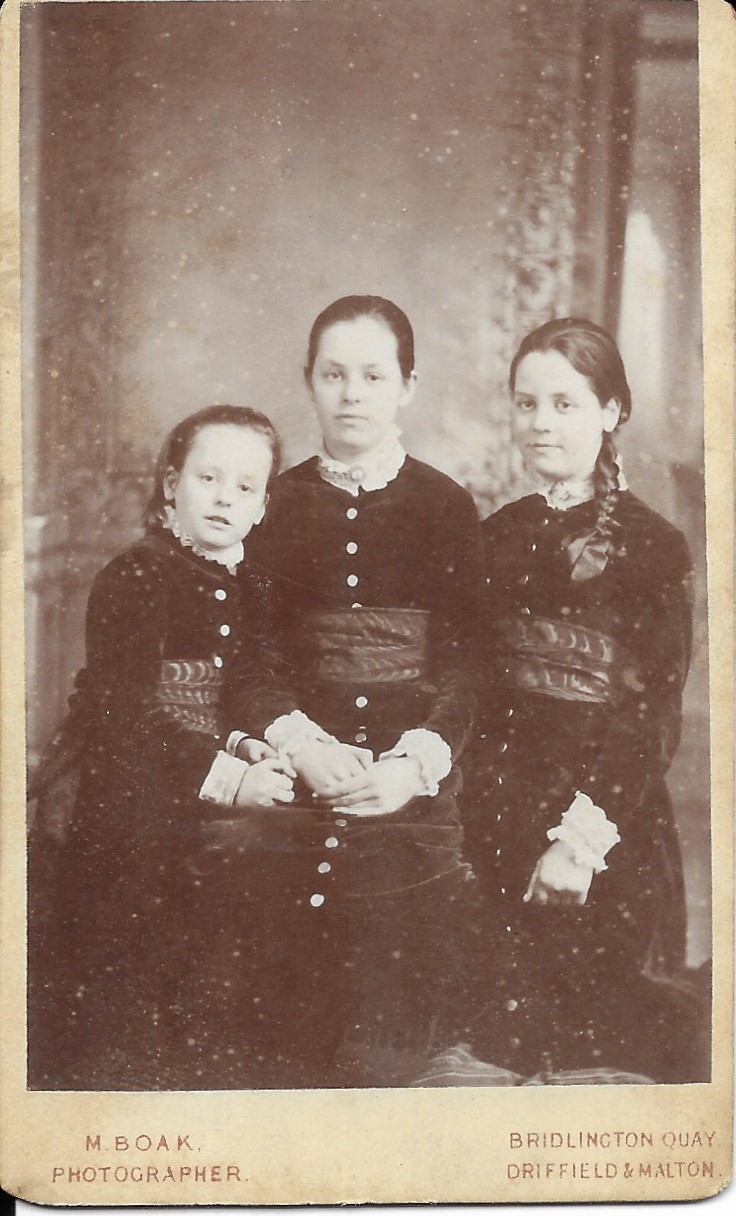
This photo above was taken in the late 1870s, according to the girls’ birth dates and the age they look like. The youngest is Florence (born 1872, on the left, then centre is Edith, the eldest, then on the right is Lizzie (Elizabeth).
Edith Botterill.
Edith Mary Botterill was born in July 1869 in Driffield, Yorkshire, to Henry and Sophia. She had one brother and eight sisters. She died on 25 September 1898 in Yorkshire at the age of 29.
Elizabeth Botterill. (Lizzie)
Elizabeth Botterill was born in 1870 in Great Driffield, Yorkshire. She died on 6 February 1895 in Driffield, Yorkshire, at the age of 25.
Florence Botterill.
Florence Botterill was born in 1872 in Great Driffield, Yorkshire. She died on 21 June 1923 in Yorkshire at the age of 51. None of the three girls pictured here was married.
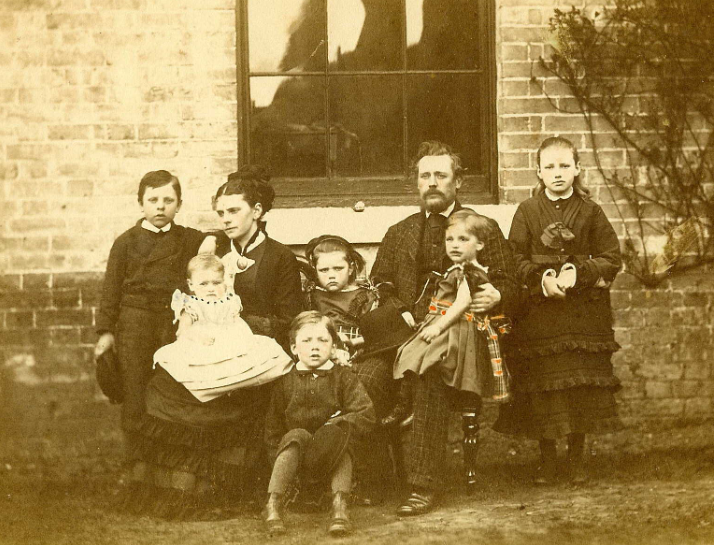
This next photo is not mine but I couldn’t resist sharing it with you all. I spotted it on a public family tree on Ancestry. It is Richard Botterill Jnr, another of William’s brothers, with his wife Fanny (Leonard) and six of his children.

The Smith branch.
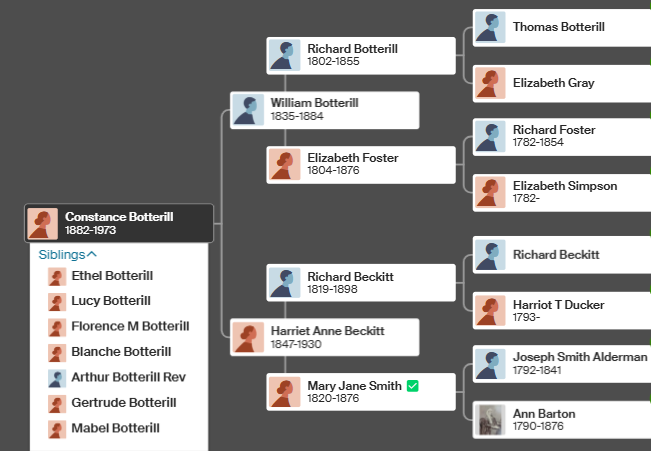
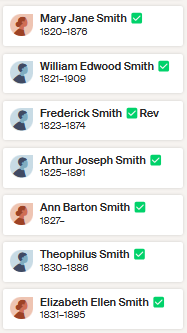
In case you’re wondering about the green ticks. Because of the surname SMITH, I put a tick on each child as I identified it as belonging to this family. There are many families with a Joseph Smith (Mary Jane’s Father) and family, born around the same time in the same area, so it was a bit of a puzzle.
A Doncaster family of Civic Duty.
In the closing years of the 18th century, Joseph Smith (1792-1841) was born into a Yorkshire world poised on the edge of transformation. By the time he reached adulthood, Doncaster was evolving from a traditional market town into a borough shaped by reform, industry, and modern municipal government. Smith became part of the generation that guided that transition.
By the early 19th century, Joseph Smith had established himself as a Burgess and Alderman of Doncaster, placing him among the town’s civic elite. The role of Alderman was not merely honorary: it marked him as a senior figure in borough governance at a time when local councils wielded significant influence over public order, markets, infrastructure, and charitable provision.
Joseph Smith passed away on 6 October 1841; however, the public-spirited values he represented persisted beyond his life. They became a hallmark of the Smith family throughout much of the 19th century.
Sons who shaped the borough.
Among Joseph Smith’s children were men who carried his civic legacy forward with unusual prominence.
One son, Arthur Joseph Smith, would go on to serve three terms as Lord Mayor of Doncaster, an exceptional achievement that reflected both popularity and continuity of influence within the borough corporation.
Another son, William Edwood Smith, became one of the most important municipal figures in mid-Victorian Doncaster. William served twice as Lord Mayor (in 1854 and 1855) and also held the post of Town Clerk, a position central to the legal and administrative functioning of the town. As Town Clerk, he would have overseen official records, advised the council on law and procedure, and ensured the borough’s compliance with the reforms introduced by the Municipal Corporations Act of 1835.
A Family of Law, Politics and the Church.
The next generation of the Smith family expanded its influence beyond Doncaster’s council chamber.
William Edwood Smith’s son, originally named Walter Shirley Smith, pursued a career in law and politics. In 1863, the family adopted the surname Shirley, reflecting either inheritance or lineage considerations common among Victorian professional families. After known as Walter Shirley Shirley, he became a barrister, a Liberal politician, and in 1885, Member of Parliament for Doncaster, bringing the family’s public service from local government to the national stage.
Meanwhile, another branch of the family entered the Church. Joseph Smith’s grandson Lucius Frederick Moses Bottomley Smith (child of Rev Frederick Smith) rose to become Bishop of Knaresborough, demonstrating that the family’s influence extended not only into civic and political life but also into religious leadership.
What emerges from the story of Joseph Smith and his descendants is not simply a list of offices held, but a pattern of sustained public service. From Alderman to Mayor, from Town Clerk to MP and Bishop, the Smith family helped shape Doncaster and beyond for nearly a century.
Through his children and grandchildren, Joseph founded a dynasty of civic responsibility, rooted in Doncaster and reflective of the values of duty, governance, and public life that defined Victorian England.
A few very different family histories, but for a time, their lives were intertwined. Here’s the link to the public family tree on Ancestry for the Botterill’s: Botterill William Family
You can contact me either by commenting here or via email at lynnswaffles@gmail.com.
Till next time then…..
 lynnswaffles.com
Fantastic photos Lynn and super research as always 👍
LikeLiked by 1 person
Thanks Simon x
LikeLiked by 1 person