These are more of my finds from eBay, going back to January 2024. This first photo really caught my eye it just felt a bit different and I loved the little lad George.

Written on the back is Slade Nash. Edith Day and George Nash (Boy), really excellent information.

I wondered, as I always do, if the seller had other photos of the same family, so I carefully scrolled through all her images for sale and found the following three photos. The seller had named the photographer on the listings but not the children, so of course I bought those too, so that I could keep them all together.
At this point, of course, I knew nothing about the family, but after I started to add the children’s names and records to the tree, I was so pleased that I had bought them.
Family History

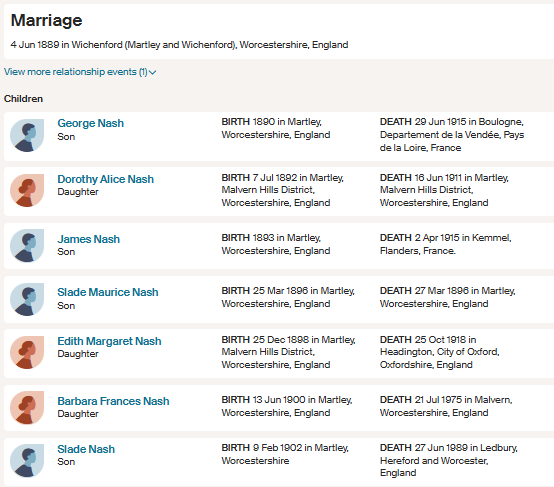
Here’s the direct link to the small tree I have compiled on Ancestry to go with these photos: Richard Slade Nash & Edith Day
Their family story is extremely sad, but no different to other families who lived through a War. They had the added sorrow of losing three other children, with only two surviving; they have no descendants.
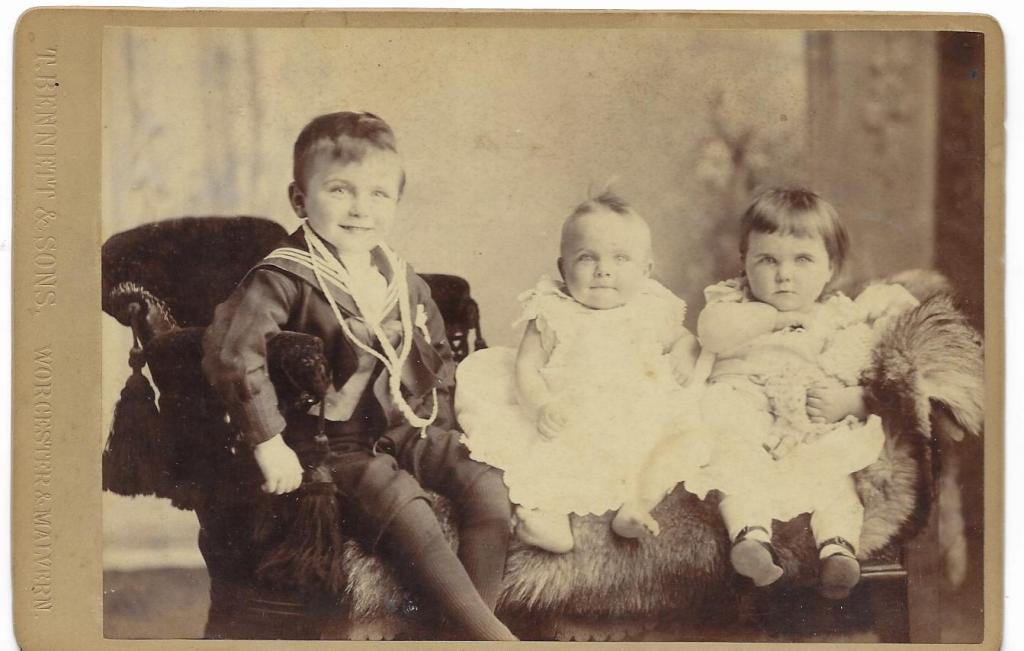
George, James and Dorothy Nash are the three eldest children who survived childhood. Their brother Maurice Slade Nash was born in March 1896 and was just two days old when he died.


James, George and Dorothy Nash. The three eldest are a little older here, a fabulous photo of them.

The family all lived at the Noak, a very large house that Richard Slade Nash had inherited in Martley, Worcestershire. There is a super pic of the Noak here on Historic England: The Noak, Martley. You can see where Edith and Richard were standing with young George in the entrance.
I came across this excellent article while researching the Nash family, so I have included some of the article here about the family and the history of their home the Noak:
It is written by Jeremy Campbell Grant. Taken from the book “Martley at the millennium” by David Cropp. Published on the Martley Village website. Full article here: Martley Website
Nash Close
Nash Close was named after the Nash family of the Noak, the Squires of Martley for nigh on 280 years. The Nash name thus lives on, although the male line died out in 1989 with the death of Mr. Slade Nash.
The Noak still dominates the village, standing as it does on a hill about half a mile north-west of the church on the road to Clifton-upon-Teme. This three-storyed handsome red brick house, listed Grade II, dates from the early years of the 17th century but was largely rebuilt in 1853.
Early records refer to it as “The Noak”. James Nash, who then lived in Pudford, purchased it during the Restoration of the English monarchy under Charles II (1660). He also purchased the manor of St. Peter’s, Droitwich, and either he or his son purchased Barbers, Martley. From 1660, the Noak remained in the Nash hands until 1937, when, following his father’s death, Slade Nash returned home from Sudan, where he was a cotton planter, and sold the Estate at auction on 9th August 1937.
Slade Nash himself died on 27th June, 1989, aged 87, at Redroofs, Everdine Lane, Colwall, but his ashes were buried alongside his father’s grave in St. Peter’s churchyard. Four years before he died, he set up “The Slade Nash Charity” to benefit the poor and sick, the schools and the church of Martley.
On the death of the second James in 1704, the Noak passed through the St. Peter’s Droitwich branch of the Nash family eventually to George Nash, one of whose close relatives was the Rev. Dr. Treadway Russell Nash (1725 – 1811), famous for his “Collections for the History of Worcestershire”.
The name `Slade’ came into the family when George Nash married Alice Slade of Bewdley in 1698.
Their son, George Nash, died without issue, and the Noak Estate was inherited by his nephew, Slade Nash of Bewdley, a son of his brother James and of his wife Theodosia Brettell of Wolverley.
Slade Nash married Mary Jervis at Stone, giving his occupation as a tanner, on 11th April 1757. They had at least seven children. Slade’s first son was a clergyman, and it was the second son, George, a twin of William, born in 1758, who inherited.
George had no children, and the Noak was inherited by Dr. James Nash, a descendant of the first James Nash’s marriage to Elizabeth Vernon. He was a prominent physician at the Worcester Infirmary, where he worked alongside Sir Charles Hastings, the founder of the BMA, whose childhood home had been Martley’s Rectory. Dr. James died aged 79 in 1880 at the Nash townhouse, 13 High Street, Worcester.
He left the Noak to his son Richard, who in turn left it to his son, Richard Slade Nash. He was 27 when he inherited the Noak Estate in 1884. Five years later, in 1889, he married Miss Edith Day from a well-known Somerset horse racing family. They had 7 children, 4 sons and 3 daughters, yet only two survived into old age: Miss Barbara Frances, the 6th child, and Slade Nash, the 7th child.
Their third son Maurice Slade Nash died aged 2 days.
Dorothy Alice, the eldest daughter, died suddenly of acute myelitis (a form of polio) at the Noak on 16th May 1911, within days of returning from a May Ball in Cambridge where her brother George was a student.
All three of the Nash boys, George, James and Slade, went to School House, King’s School, Worcester. This was to be expected as their mother was the daughter of the Rev. Maurice Day, Headmaster of King’s for 20 years from 1859 (and later vicar of Wichenford).
George, the eldest son, was at School House for 4 years from 1900 and then went on to Repton. From there, he won an open scholarship to Magdalene College, Cambridge, where, in 1912, he graduated with a BA Hons degree in History. Wishing to be ordained, he then studied Divinity at Cuddesdon Theological College, Oxford, and it was from there that he joined the Worcestershire Regiment.
The second son, James, was at School House for longer, 1903-12. He won a Meeke scholarship to Hertford College, Oxford, to read Classics, but before graduating, he joined the East Surrey Regiment in August 1914.
Within a year, these two bright young men were dead. Later, the George Nash Divinity Prize and the James Nash Classical Prize were endowed in their honour, both for the Fifth Forms of King’s School.
James was the first to fall in action, on the 2nd of April 1915, in the trenches north-east of Mount Kemmel near Ypres. He was killed by a bullet coming from long range from the right flank. He was buried in the Kemmel Military Cemetery, Flanders, aged 21.
Then, just two months later, Richard and Edith had another shock when a War Office telegram arrived at the Noak informing them that George had been seriously wounded in the head, on 10th June, during the Battle at Hooge.
An operation was at first thought to have been successful, but he deteriorated. His mother braved the dangers of travelling abroad during the war and was with him when he died at the Boulogne Stationery Hospital on Tuesday, 29 June 1915, aged 24.
On Thursday, 1st July, Edith arrived back in Worcester with her son’s body, which was taken on a gun carriage first to The Noak and then, on the next day, to St. Peter’s. His funeral was on Saturday afternoon, 3 July 1915, a detachment of King’s School O.T.C. lining the path.
All of the following information is courtesy of the 100-year Challenge Group on Facebook, well worth a follow: 100 Year Challenge
“Remembering the Fallen: on 2nd April 1915, Second Lieutenant James Nash, 4th Battalion attached to 1st Battalion, the East Surrey Regiment, was killed on the Western Front”.
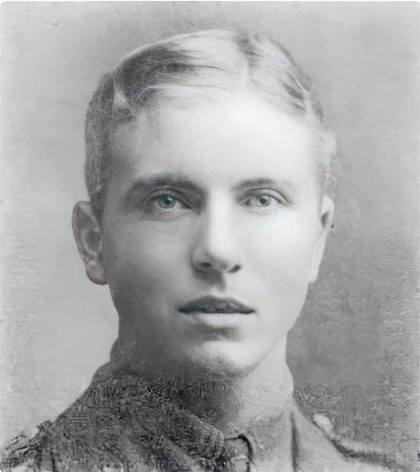
One of six children of a solicitor and gentleman farmer, he was educated at King’s School and Cathedral School in Worcester before attending Hertford College in Oxford, where he took Honours in the Classics. The outbreak of the Great War interrupted his studies, as he had gone on to read for History Honours. In August of 1914, Second Lieutenant Nash, who had joined the Officers’ Training Corps both at school and university, was commissioned into the East Surrey Regiment.
On the day of his death, he was in the trenches at Kemmel when he was killed by a bullet to the heart. One of his fellow officers sent a letter to Second Lieutenant Nash’s parents, part of which reads: “He was visiting one of his posts to the right of his trench. The Germans had sent up a starlight, and he had just turned round and told a man to keep down when he was hit. It was about 11:40 p.m. on Good Friday. Another officer, who was digging a trench nearby, was there at once, and had bandaged up the wounds and had done all that he could.”
Second Lieutenant Nash lies buried in the Kemmel Chateau Military Cemetery in Belgium; on his headstone are the words, “Follow me”. James, from Martley in Worcestershire, was 21 years old.”
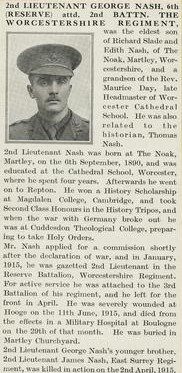
Two months later, his brother, Lieutenant George Nash, serving with the Worcestershire Regiment, was shot in the head, but survived for nineteen days before dying in hospital with his mother by his side. His story was told in this series on his anniversary in 2021.
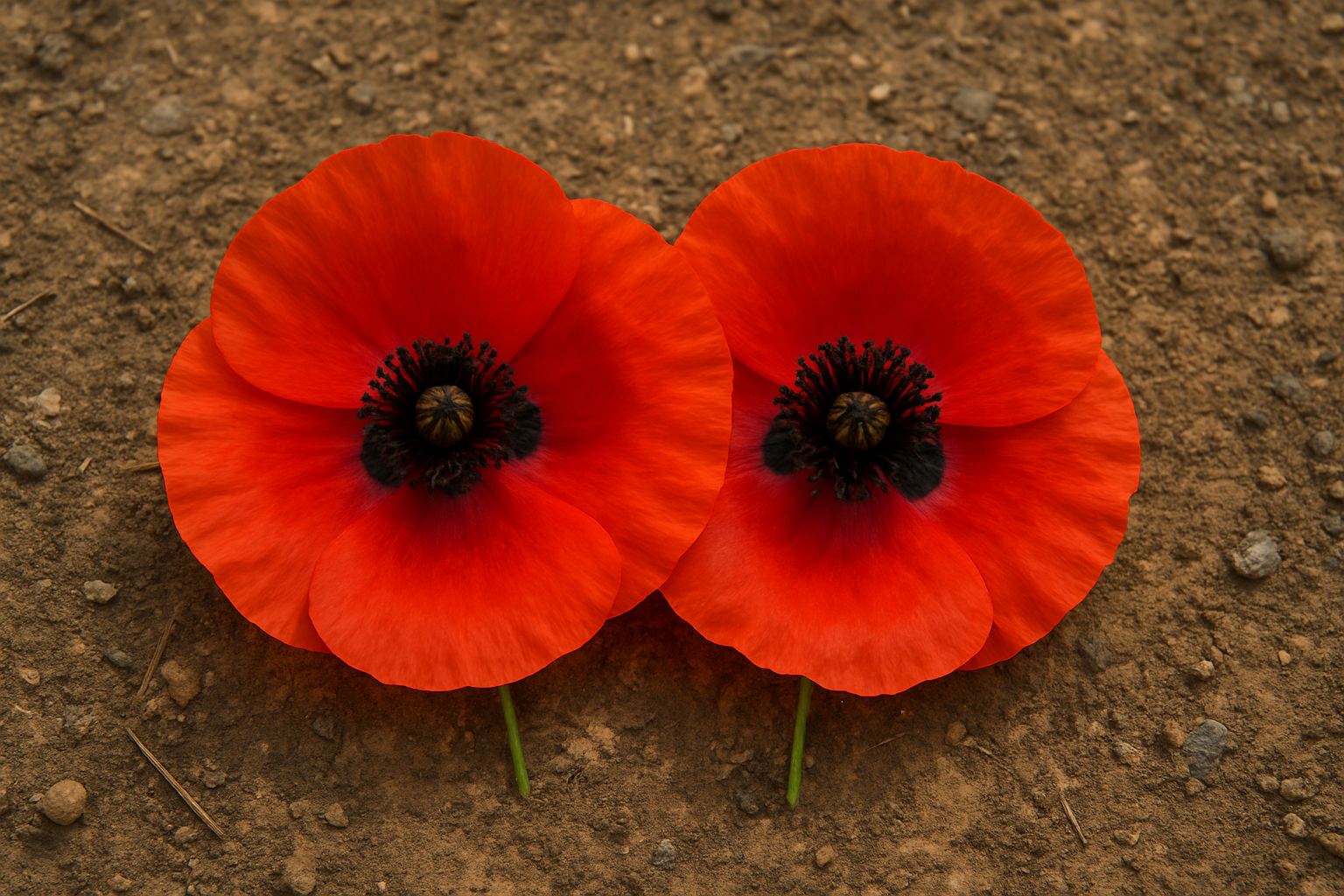
The following image is from the Imperial War Museum
This is the last of my photos of the family, it is such a beautiful image of these children

Slade, Edith Margaret and Barbara Frances Nash were the three youngest children. The beautiful child in the centre is Edith Margaret, who tragically died at the young age of 19. She contracted infuenza. She died at the Warneford Hospital, St Clement’s, Oxford, which was a Hospital for Mental disorders.


On the 1939 Register, Edith, at 75 years old, now a widow, was described as “House wifery”, Member of the VAD. She was living at no 27 St George’s Square, Worcester (after her husband died, the Noak was sold on 9th August 1937).
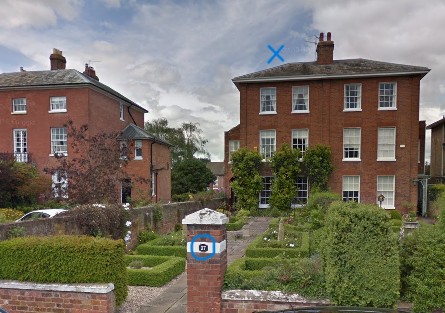
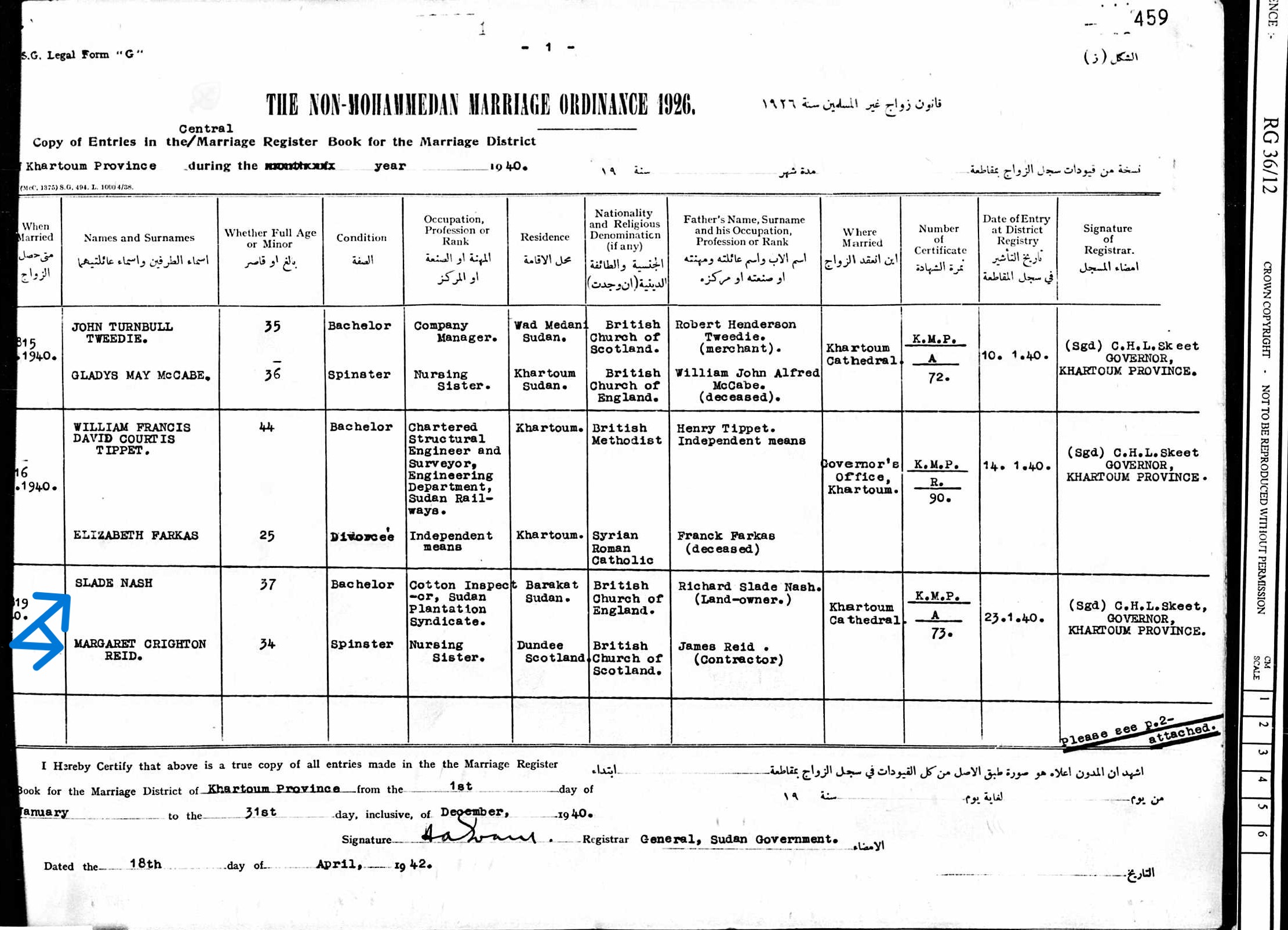
With her was her daughter Barbara Frances Nash and also Margaret Crighton Reid, a Nursing sister who, later on 23 January 1940, married Edith’s youngest child, Slade Nash, in Khartoum, Al Khartoum, Sudan.
Note: During World War II, Voluntary Aid Detachments (VADs) provided crucial support to the medical organisations of the Army, Royal Navy, and Royal Air Force, serving as nursing orderlies and general assistants both in the UK and overseas. VADs were trained by the St. John Ambulance Brigade and played a vital role in providing medical care during the war.
Edith died at 40 Barbourne Road, Worcester, on 22 September 1946. Edith was 82. Her husband Richard was 75 when he died on 26 October 1936 at the Noak, Martley.
Youngest child Slade Nash died in Colwall, Worcestershire on 27 June 1989. He left a lot of money! He was the last of the Nash family whose photos I have. His wife Margaret died the following year in Canada. I wonder if she had family there and moved after Slade’s death.


The couple had no children, and the other surviving daughter, Barbara Frances, never married or had any children. If you are a member of the wider family, please do get in touch, either with a comment on here or via email to lynnswaffles@gmail.com.

Till next time then………
 lynnswaffles.com