This is yet another absolute gem from the large collection of old Victorian photos that I bought at the Shoreham Postcard Fair in December.
I try to spend the shortest time possible looking at each photo, and for this one, I turned over the CDV and read quickly “Manager-ess of the Prince of Wales’s Theatre“ That was enough to go in my buying pile.

I’m so glad I did as I’ve found her fascinating to research, in fact, I’ve found so much of interest that it’s taken me far longer than I expected to actually finish this blog, I’ve had a lot of reading to do.

The majority of the quotes and information in this blog come from either the newspaper archives, the White Lodge website or the following books: the two volumes by Marie and Squire Bancroft, titled Mr and Mrs Bancroft: On and Off the Stage. Written in 1888. Also from the book published in 1933, ‘Dame Madge Kendal by Herself.‘
This website by Chris Gares is truly amazing, featuring a wealth of wonderful information and not just about the Bancroft/Wilton family, all of which is meticulously researched. www.oldwhitelodge.com
I highly recommend all the above if you are interested in the History of the Theatre.
Miss Marie Wilton
Marie Effie Wilton was born on 12 January 1835/36/39/43; her actual year of birth seems to differ among the records. One of six daughters, reportedly the eldest, born to Robert Pleydall Wilton (1801-1873) and Georgiana Jane Faulkner (1813-1866), both of whom were actors. Her sisters were Emma, Ida, Georgiana, Blanche and Augusta.
The actual year of her birth is very debatable, as I cannot find an exact date other than 12 January. Below is the 1841 census that I’m sure matches the family. Was Marie Effie called Mary at birth, born in 1835?

She spent a lot of her childhood learning parts for her performances on the stage, first appearing at around the age of five in 1845 with her father, and being taught elocution by her mother at home.
She didn’t ever remember playing with toys although she had a doll that permanently stayed on her bed that she wished she might spend her time with, other than sleeping.
After various children’s parts in provincial theatres principally at Norwich, Bristol and Bath, she made her debut in London on September 15, 1856, at the Lyceum Theatre, as the boy Henri, in ‘Belphegor’. The same evening, she also played Perdita in a burlesque by William Brough.
Charles Dickens, who saw her in H.J. Byron’s burlesque The Maid and the Magpie, called her “the cleverest girl I have seen on the stage in my time, and the most singularly original”
Marie’s first Theatre
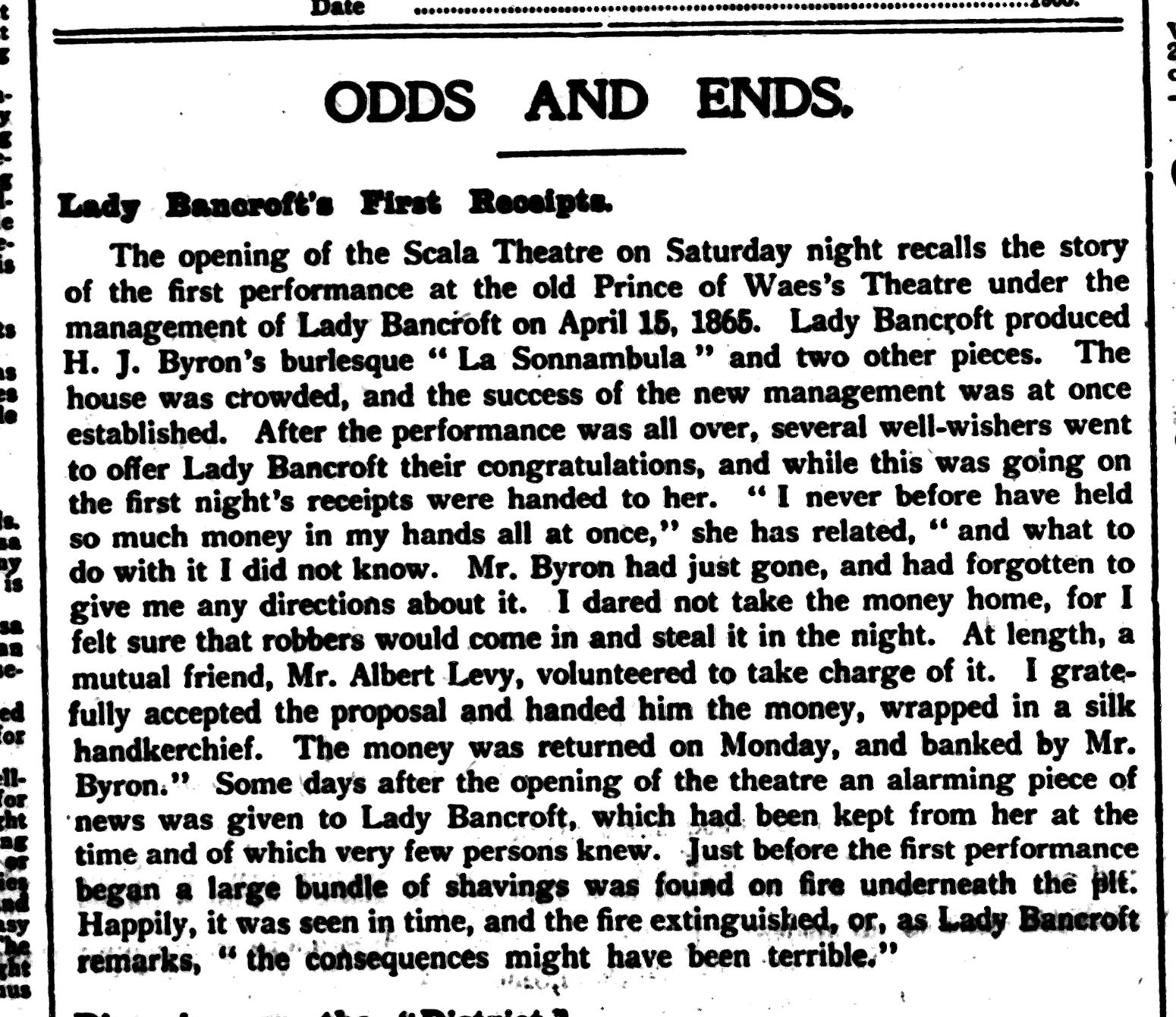
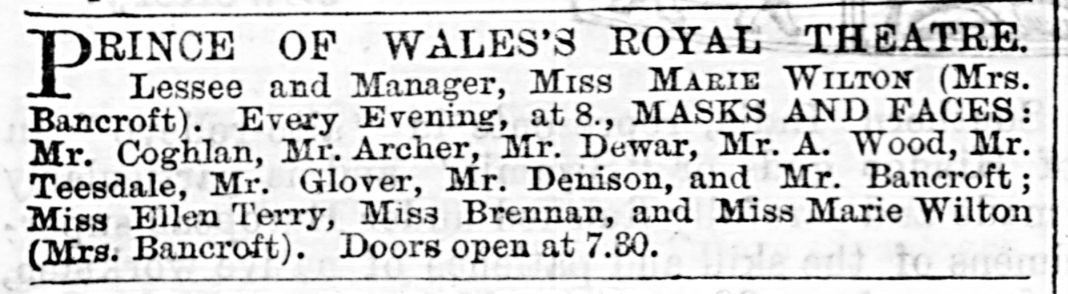
Marie borrowed £1000 from her brother-in-law, Francis Ashton Drake 1835-1901, a Barrister, who had married her sister Emma in 1863. He offered her the money at the end of 1864 so that she could enter Theatre management. She did so jointly with Henry James Byron (1835-1884), who was an editor, journalist, director, theatre manager, novelist and actor. (He was Lord Byron’s second cousin)This was in 1865, at the renamed Prince of Wales’s Theatre, where she produced and acted in many plays, including the comedies of Thomas William Robertson (1829-1871), (he was Madge Robertson/Kendal’s brother), such as Society in 1865.
When Marie took over, she provided the capital, and H.J. Byron wrote many of the plays. His first was a burlesque of La Sonnambula. The name of the playhouse/theatre was also changed to the Prince of Wales’s by special permission of His Royal Highness, King Edward VII. (Theatre now demolished) Marie’s small theatre was in Tottenham Street, Tottenham Court Road. The couple employed the services of Squire Bancroft as their leading actor.
Marie paid back Francis Drake before the production of ‘Caste’ in 1867, and the Bancrofts prided themselves on never owing or borrowing money after that.
Marie herself wrote three plays, a novel published in 1912, The Shadow of Neeme, and her memoirs with her husband, Squire Bancroft published in 1909.
There are so many mentions of her in the newspaper archives, telling of her activities on the stage from child to young woman and beyond. It seems the press and audiences at the various theatres that she performed at couldn’t get enough of her. She was a star celebrity in her day.
She, in turn, was absolutely determined to be a successful actress and businesswoman and always do her best.
Marie’s first two children.
On 28 December 1860, Marie gave birth to a daughter, Florence Ellen Blanch Baker Wilton, at 29 Bertrand Street, South Lambeth, London. As you can see on her birth record registered by her mother, Marie Effie Wilton, she just gave the name Effie Wilton with no father mentioned, but where does the name Baker come from? Is that a clue to the father of Florence? It’s not a family name that I have come across.

On 7 April 1861, the day of the census, the Wilton family, including Marie, are together at Felhampton House, Kennington Road, Lambeth, but Florence is not with them.
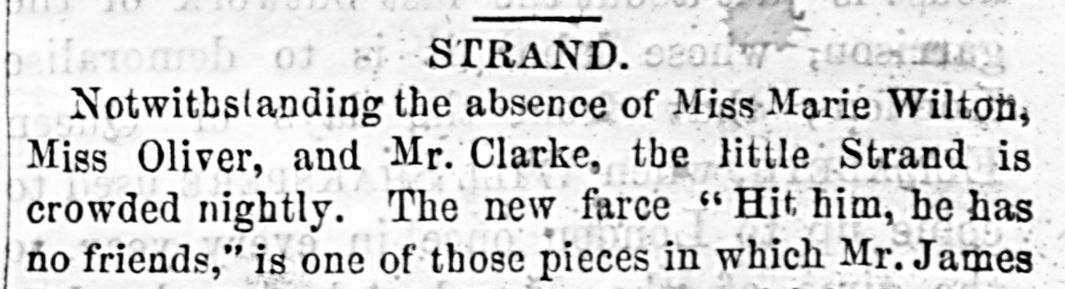
Previous to Florence’s birth, Marie was working at the Strand Theatre, and this is the last newspaper report before the birth, with her in the cast dated 30 July 1860.

Then a mention of the absence of Miss Marie Wilton in October 1860 from the Strand.
After the birth at the end of January, Marie was reported to be recovering from severe indisposition in this article below.
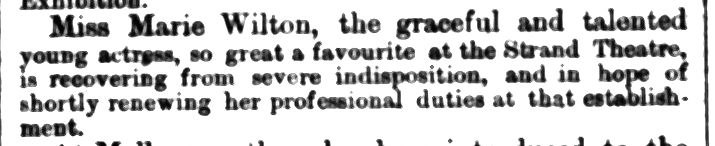
Then the reappearance of Miss Marie Wilton, her first appearance on the stage since the birth of her daughter.

So Marie had returned to the stage about six weeks after Florence’s birth.
I am unable to find Florence in the 1861 census.
I was sad to see that little Florence was just 22 months old when she died on 20 September 1862 at 107, Victoria Street, Westminster, London. A lady by the name of Martha Easton registered her death. Who was she? Also, it says Daughter of Robert Wilton, Gentleman (deceased). That is puzzling. Did Marie’s father, Robert, arrange for Marie’s baby girl to be looked after by Martha or even someone else after Marie went back on the stage? Maybe saying it was his child? Robert was not deceased either; he actually died on 27 November 1873.

I found Florence’s burial record on Family Search:
Name Florence Ellen Blanch Baker Wilton
Age 1 years
Birth Year (Estimated) 1861
Event Type Burial
Event Date 25 September 1862
Event Place: Lambeth, Surrey, England, United Kingdom
More questions than answers, I think, here, as I’ve found nothing more to help, I can’t find or identify Martha Easton. It also looks like 107 Victoria Street, Westminster, is missing from the 1861 census.
The following year after Florence died and two years before managing her first theatre, Marie took another break from acting during her second pregnancy with her illegitimate son Charles Edward Wilton. He was born on 20 October 1863. She was 24 at the time. She had about eight weeks off this time after Charles’ birth and was back on stage by the end of December.

Theatregoers at the time were informed by the newspapers that she was taking a break in the country. Looking at all the clues from this time and after, I believe it’s very likely her sister, Ida, looked after Charles when Marie returned to work. In the newspapers, it was reported that Ida married early in life and retired from the stage; she didn’t, in fact, marry until 1874 at the age of 34. But I have found, looking through the 1871 census for Ida, that she is living at 6 Ashley Place with her future husband, William Frederick Hamilton Fletcher (1837-1879), with three servants. She is using his name Fletcher and has also shaved three years off her age, as she was born in 1840. Later, the couple lived at number 7 Ashley Place.
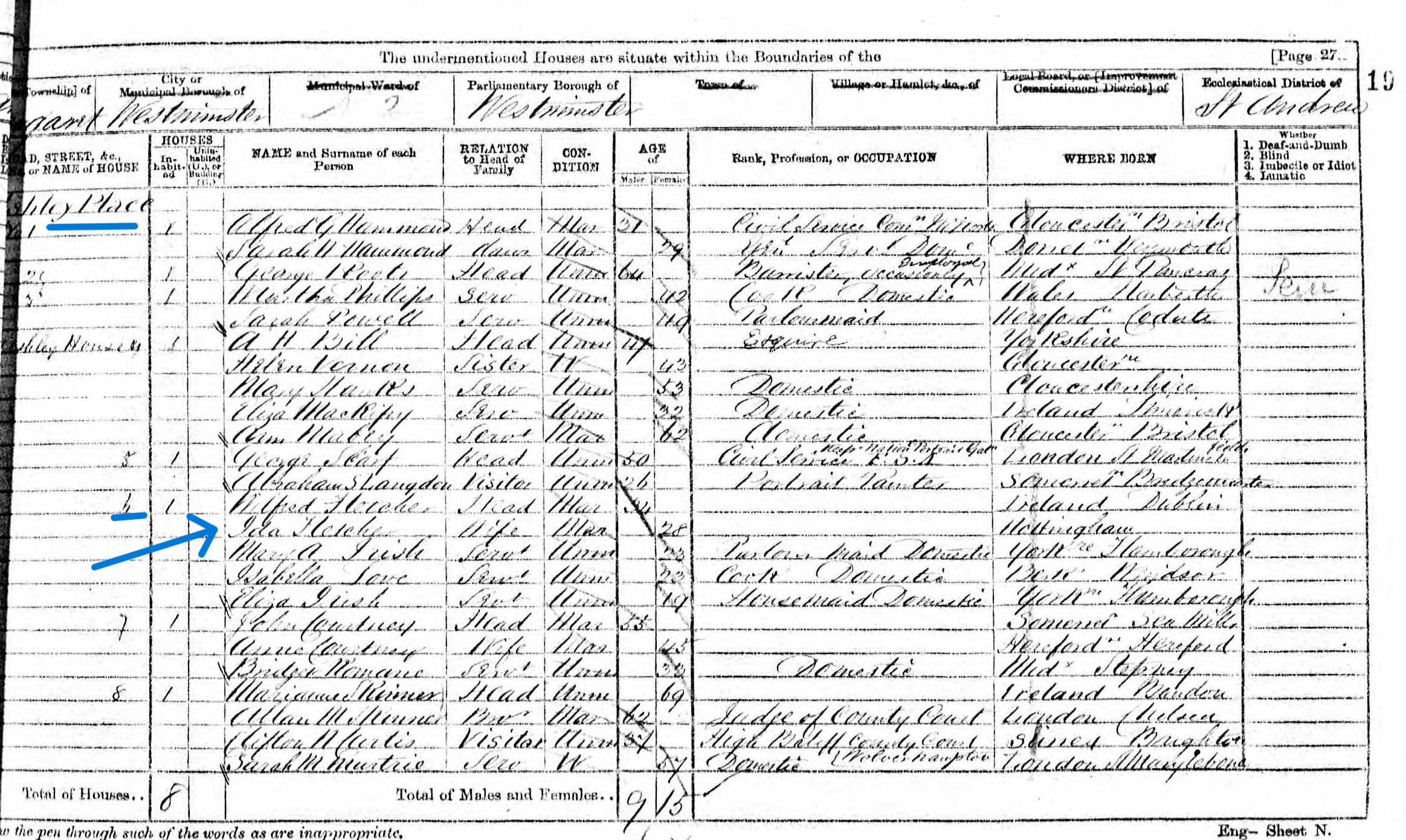

I wondered why they would hold their marriage ceremony at their home. Five years later, William’s death record below may answer that, as he suffered from an ‘old Kidney disease.’

His brother-in-law Francis Ashton Drake was present at his death. I have come across other records that show that the Wilton family kept in close touch with each other through the years.
So, having found all the rest of the family in the 1871 census, I haven’t found young Charles. I understand that, looking at reports about him that he was at School at Eton when he was 13 before going on to training for the military. I have no idea where he was before that in 1871, maybe at School abroad?
Marie’s Marriage
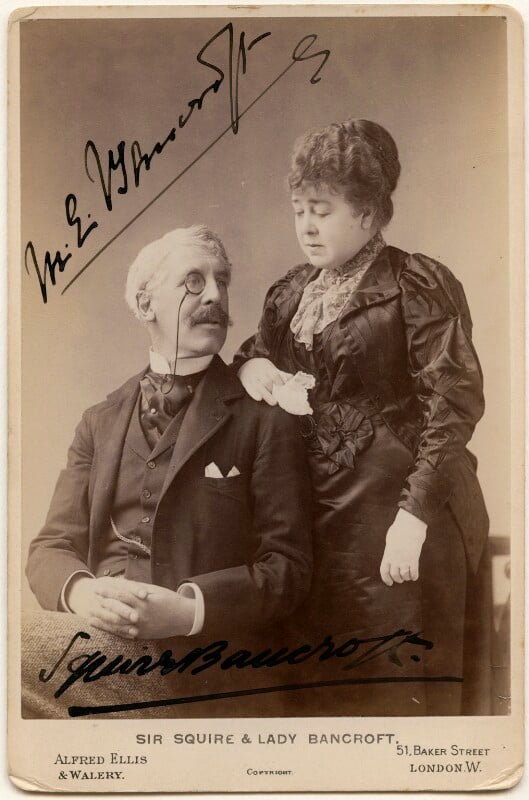
Marie Bancroft (nee Wilton), writes that following the 1866 season, her Prince of Wales’s company obtained an engagement in Liverpool: “Before starting, we were told that there was a sort of epidemic at Liverpool; so several of us decided to live at Waterloo, a pretty seaside place a few miles off, where the train could take us every night after the performance was over. We occupied several villas facing the sea, and formed quite a little colony of our own, including Mr. Robertson (who came down to finish and produce his new comedy, Ours), Mr. and Mrs. Byron, Mr. and Mrs. Hare, my sister Augusta, myself, and Mr. Bancroft. We spent a delightful six weeks there.” Note: “Mr. Bancroft” was the actor Squire Bancroft, who would soon become Marie Wilton’s husband and partner in the theatre company.
Charles, her son, was four years old when she married Squire Bancroft on 28 December 1867.

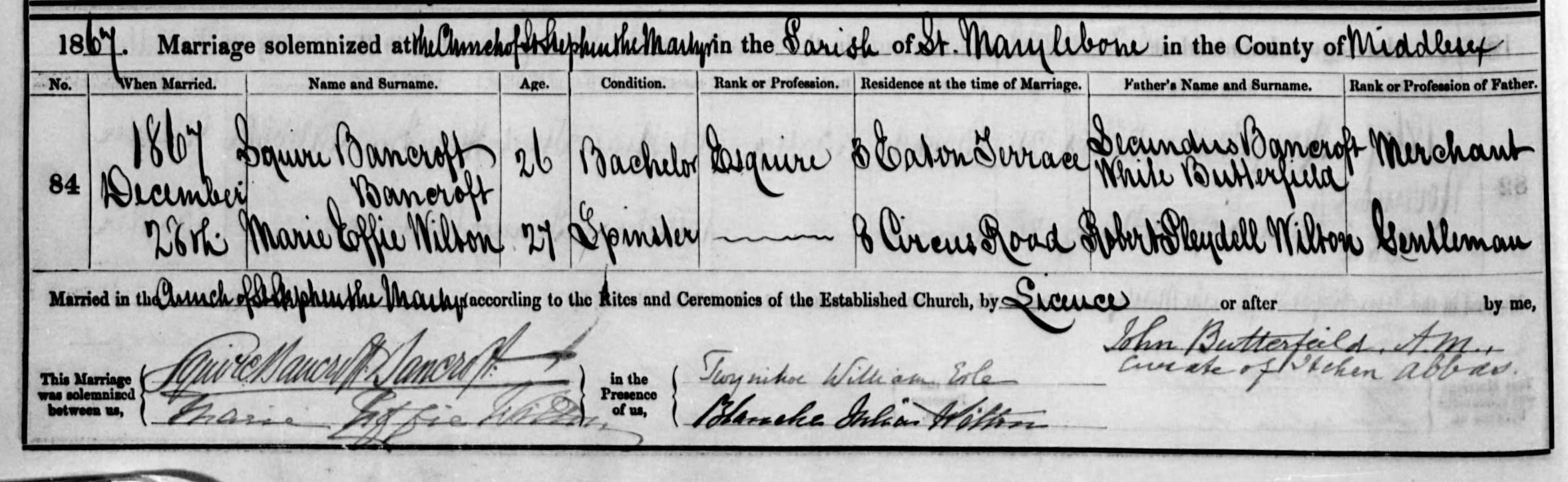
One of Marie’s sister’s Blanche Julia Wilton, was a witness at her marriage. Blanche also married an actor in 1870, Charles Henry Collette. Blanche and Charles had a daughter, Mary Effie Collette, who married Ernest Widdows Bryant in 1904. He was a clerk to Queen Alexandra, wife of King Edward VII.
The newspapers didn’t report the couple’s marriage until the first week of January. Squire Bancroft had been employed by Marie as her leading actor in her theatre before they became a couple.

Squire Bancroft had changed his name by Deed Poll on 13 December 1867, just two weeks before their marriage.

This is his original birth record: BUTTERFIELD, SQUIRE BANCROFT WRIGHT GRO Reference: 1841 J Quarter in ROTHERHITHE Volume 04 Page 379.
His parents were Secundus Bancroft White Butterfield and Julia Wright.
Marie Effie Wilton, Lady Bancroft (1836–1921) was an English actress and theatre manager. She appeared onstage as Marie Wilton until her marriage to Squire Bancroft in December 1867, when she adopted his last name.

Bancroft and her husband were important in developing Victorian-era theatre through their presentation of innovative plays at the London theatres they managed, first the Prince of Wales’s Theatre and later the Haymarket Theatre.
Madge Kendal
Madge was a very well known and loved actress, she was born into one of England’s oldest theatrical families in 1848, Madge Kendal was the daughter of William Robertson, an actor and theatre manager, and Margaretta Elisabetta Marinus, a Scandinavian-born actress who also distinguished herself by giving birth to 22 children, Madge being the youngest. Madge became a Dame Commander of the Order of the British Empire (DBE) in 1926.
Madge Kendall (Robertson) writes: “Marie Wilton was so impressed with the play ‘Society,‘ written by T.W. Robertson (Tom), that she decided to produce it. T. W. Robertson (Tom) was Madge’s brother. In this play, two actors, who later became very successful and received the honour of knighthoods, made their first appearance in London. They were John Hare and Squire Bancroft. At that time, they were performing at the Theatre Royal in Birmingham, and my brother Tom (Robertson) managed to get them both engaged to act in ‘Society.‘
When Marie Wilton took over the old Queen’s Theatre, it was in such ramshackle condition that it had earned the unfortunate nickname of “The Dust Hole.” However, under the able and brilliant management of the Bancrofts, which ultimately made them a fortune, the nickname was prefixed with the word “gold,” transforming it into “The Gold-Dust Hole.”–The Prince of Wales’s Theatre was often described as a charming, elegantly decorated venue, comparable to a bandbox. The auditorium’s design was delightful, and the scenery was as realistic as one could desire.
The doors were made of real wood rather than being mere painted canvas; the pictures were beautifully painted and framed authentically, rather than being depicted on the canvas walls. The china and silver used on stage were of the same high quality found in the drawing rooms of people from the same social class, and the acting was as realistic as the writing of the play.
However, there was a notable difference between the realistic acting of that time and contemporary performances: every word spoken in the theatre was clearly audible throughout the entire auditorium. In those days, acting conveyed emotion from the brain to the heart and then back to the brain“.
On stage, Madge, born Margaret Shafto Robertson, 1848-1935, and her husband William Hunter Grimstone, 1843-1917, also an actor and theatre manager, were known as Mr and Mrs Kendall, but in private, they were always Mr and Mrs Grimston. Madge came from a theatrical family just like Marie Wilton, and they had an enormous respect for each other and were good friends before a family upset ended their close bond, more on this later.
Another excerpt from Madge’s memoirs about her brother Tom: Although some people interested in drama may dismiss the plays of T.W. Robertson, it should not be overlooked that he played a pioneering role in bringing a more realistic form of drama to life. Regardless of what critics may say, one fact stands out: during the Bancrofts’ era, his plays were performed a total of 2,900 times over eighteen years. To put that in perspective, if they had been staged continuously, they would have run for ten years. No other playwright, in my experience or knowledge of English theatre history, has come close to achieving such numbers.
The Haymarket Theatre
In 1879, the Bancrofts moved to the Haymarket Theatre, which they renovated to include new electric lighting, the first time in an English theatre.
The couple were both so important in the Theatre world during the Victorian era through their acting as well as their presentation of new plays at the London theatres that they managed.

Retirement
The Bancrofts retired from the theatre in July 1885. They wrote two volumes of memoirs, published in 1888: ‘Mr and Mrs Bancroft On and Off the Stage, Written by Themselves’ and ‘The Bancrofts: Recollections of Sixty Years.’ (Link to where you can download these volumes at the end of the blog).
Throughout her working life, Marie was accustomed to being in the limelight. Her long battle with shingles and subsequent death received extensive coverage in many newspapers at the time.

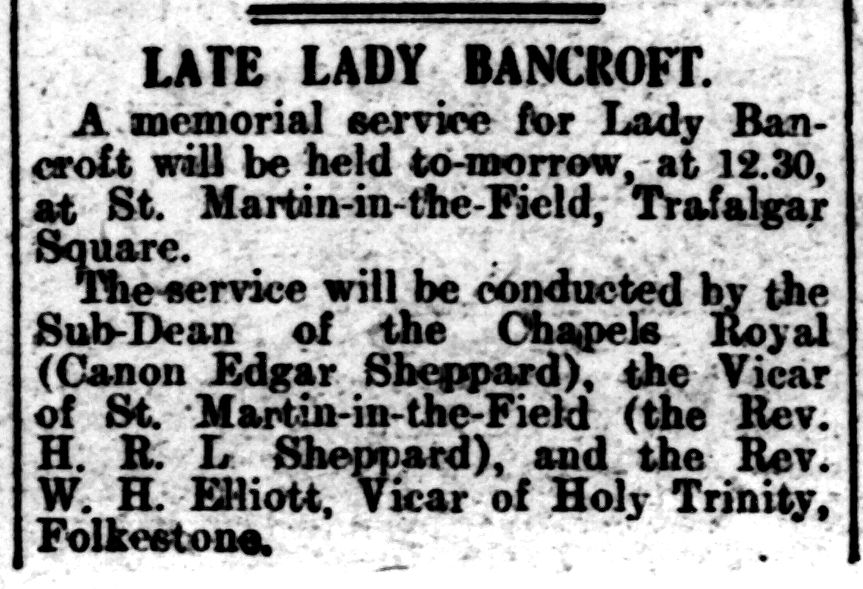
Sadly, it seems she never fully recovered and died at the Burlington Hotel, Folkestone, Kent, on 22 May 1921. I’ve included here a selection of newspaper reports about the death of Lady Marie Effie Bancroft.


23 May 1921


The Bancrofts built White Lodge in Westgate on Sea and lived there for nearly thirty years. Other members of Marie’s family also lived in Westgate on Sea in their later years.
Squire Bancroft travelled to India a year after Marie died. The record says ‘Sir Squire Bancroft of A1, Albany, Piccadilly, London, aged 80 years, travelling 1st class and contracted to land at Gibraltar. The record also says that his country of future residence was India.’ Maybe he had a long holiday there
Madge said: The last Christmas that Sir Squire Bancroft was alive, he spent the holiday with his son, Mr. George Bancroft, and his wife. Upon his return, he came to see me and said, “I have been to Westgate to spend the holiday with the family and my dear grandchildren. He died on 19 April 1926 at The Albany, Piccadilly, London, England
Buried alongside his wife in a private mausoleum in Brompton Cemetery, Fulham Road, London, SW10 9UG. The mausoleum was destroyed by German enemy action in World War Two, and the Find A Grave website shows his current memorial. Probate was granted jointly to his barrister son, George Louis Pleydell Bancroft and to Sir Gerald du Maurier on 9 July 1926 when his effects totalled £174,535-4s-11d.
This is what it looks like now, from Google Street, White Lodge, 12 Domneva Road, Westgate on Sea, Folkestone, Kent.


Family History and Mysteries of her children.
Marie had one daughter and three sons: Florence Ellen Blanch Baker Wilton, and Charles Edward Wilton, born before she was married, and then two sons with Squire Bancroft. Firstly, George Louis Pleydell Bancroft (1868-1956) was a Lawyer and Writer. He married Effie Lucy Hare on 10 April 1893, in Marylebone, Middlesex, England.
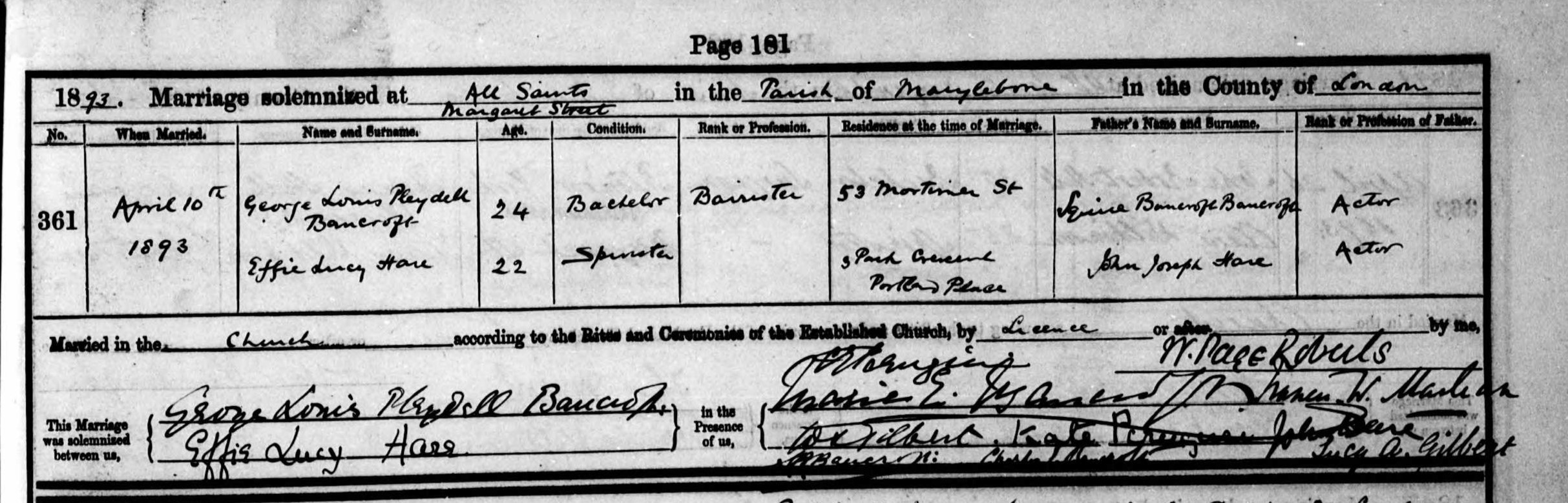
George and Effie had three daughters and a son. Barbara Mary 1897-1967, Squire John 1899-1900, Diana Marie 1906-1989 and Naomi 1909-1996.
Marie and Squire’s youngest son, Arthur Hamilton Bancroft, born in 1870, was just a month old when he died on 18 February.
Marie’s eldest living child, Charles Edward Wilton, was born on 20 October 1863, and over the years, there has been much speculation as to who his father was. To this day, no one knows who the real father was, and Charles was never mentioned in any of the ‘official’ material and autobiographies of Lady Marie and Sir Squire Bancroft.

Below is a Baptism record for Charles Edward Wilton dated 26th August 1866 in Broadwater by Worthing, Sussex, England. Mother’s name is Mary Wilton, saying they were living in Liverpool at the time.

It’s said by some that he may even have been fathered by the Prince of Wales! He later became Edward VII. He married Alexandra in March 1863, and they had their first child, a son, Albert, early in 1864. Edward was very well known for his mistresses and especially for socialising with Actresses of the day.
The other possible Father, and far more likely, I think, as does Chris, on the Old White Lodge website, for Charles was William Hunter Grimston Kendal.
If you read all the evidence that Chris has written, you couldn’t help but come to the same conclusion.
Charles went to Eton, then later he was first in the Duke of Cornwall’s Light Infantry in August 1883, then in the Royal Welch Fusiliers in October the same year. He was a Captain in the Royal Welch Fusiliers in 1893.
Marriage for Charles.
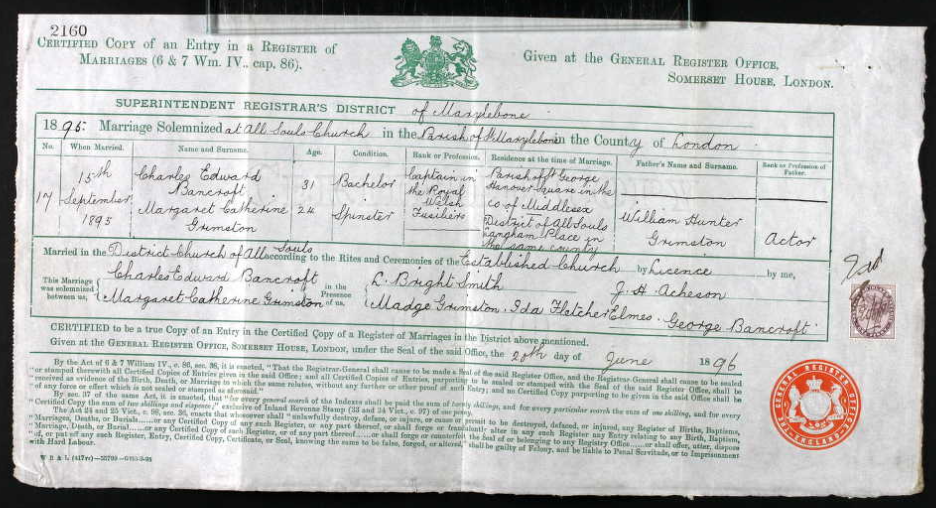
Charles was still a Captain in the Royal Welsh Fusiliers when he married Margaret Catherine Grimston on 15 September 1895.

Note that no father’s name was entered on the marriage record for Charles, and interestingly, the two witnesses were Madge Grimston, Margaret’s mother and Charles’s Aunt Ida Fletcher Elmes, his mother Marie’s sister, who I believe remained close to Charles throughout his life.

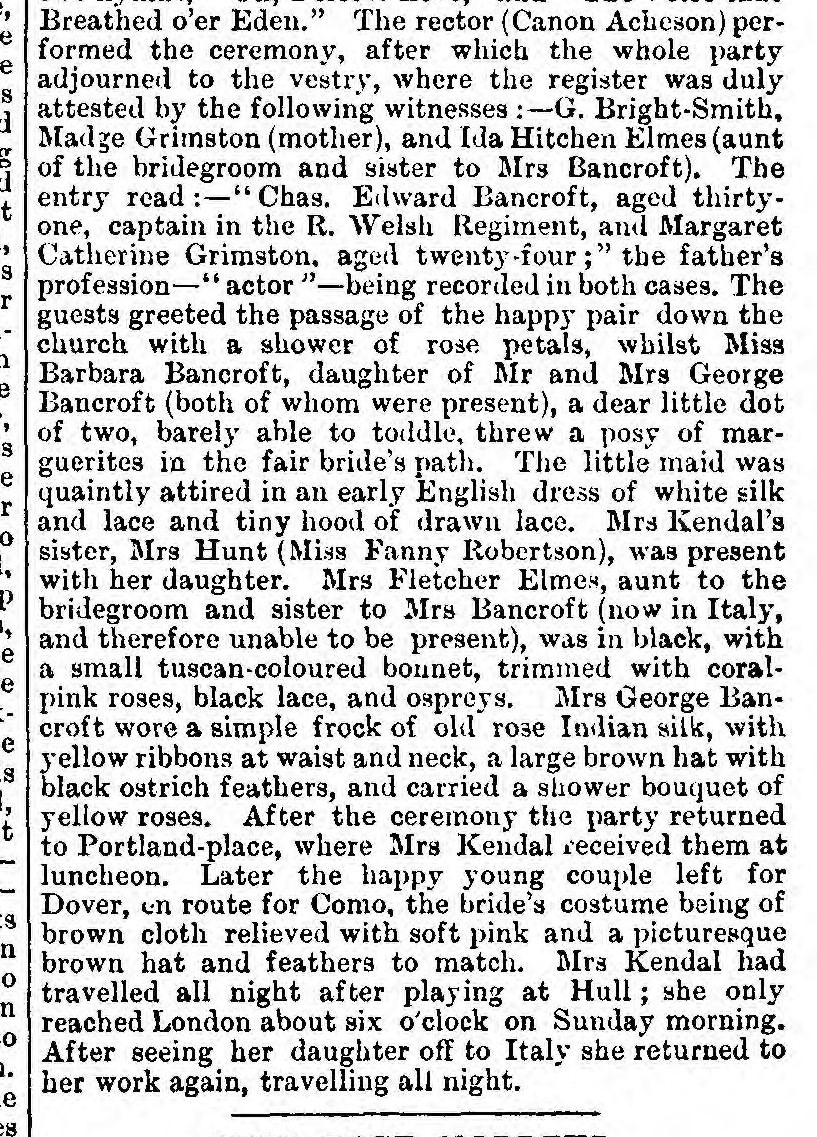
The happy couple were spotted in Calais later that day on their way to Italy for their honeymoon.

The young couple’s happiness was not to last; it seems that they made a very hasty decision to marry, with some members of their family not told at the time of their intention to marry with a special license. This certainly didn’t end well and caused huge upset not only for the couple themselves but much misery for both sides of the family.
Divorce for Charles.
National Archives, Divorce Court File: 18015. Appellant: Margaret Catherine Bancroft, otherwise Margaret Catherine Grimston. Respondent: Charles Edward Bancroft. Type: Wife’s petition for/of nullity
According to the annulment papers, Charles and Margaret lived together from their marriage on 21st September 1895 to 2nd January 1896, a period of only around twelve weeks. They came together again from the 2nd to the 17th June 1896. The prime reason cited in the annulment papers for cause was the impotence of Charles, which was not contested. I’ve included here most of the pages of the Divorce records for those who have no access to read them.
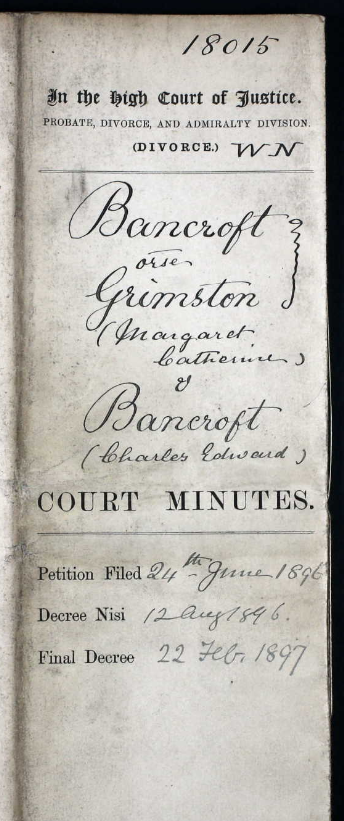
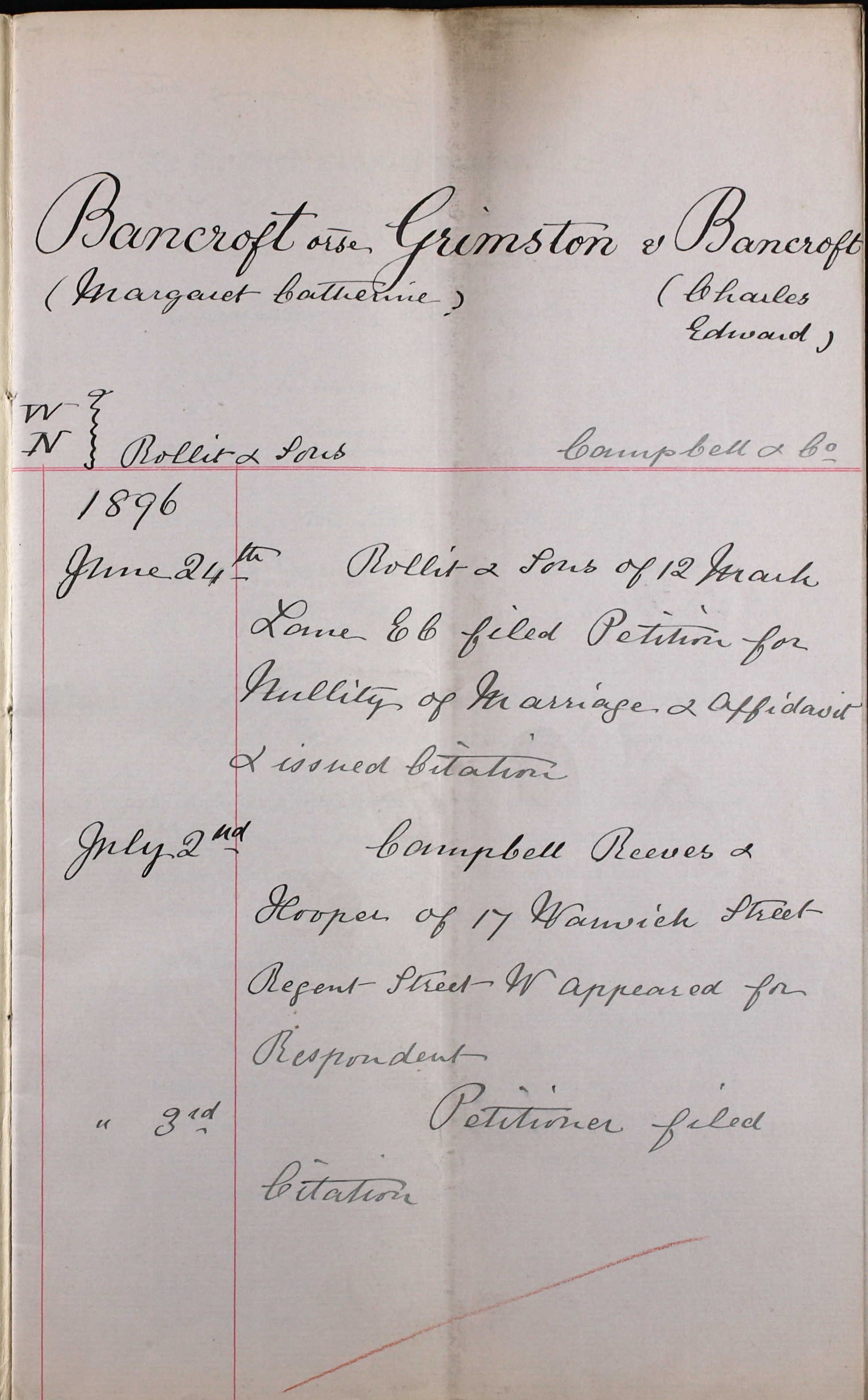
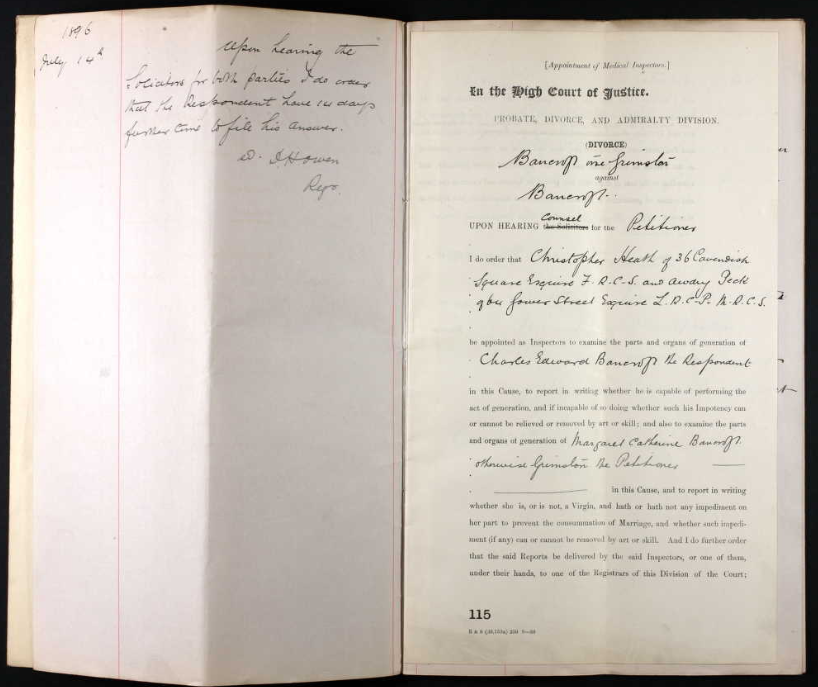
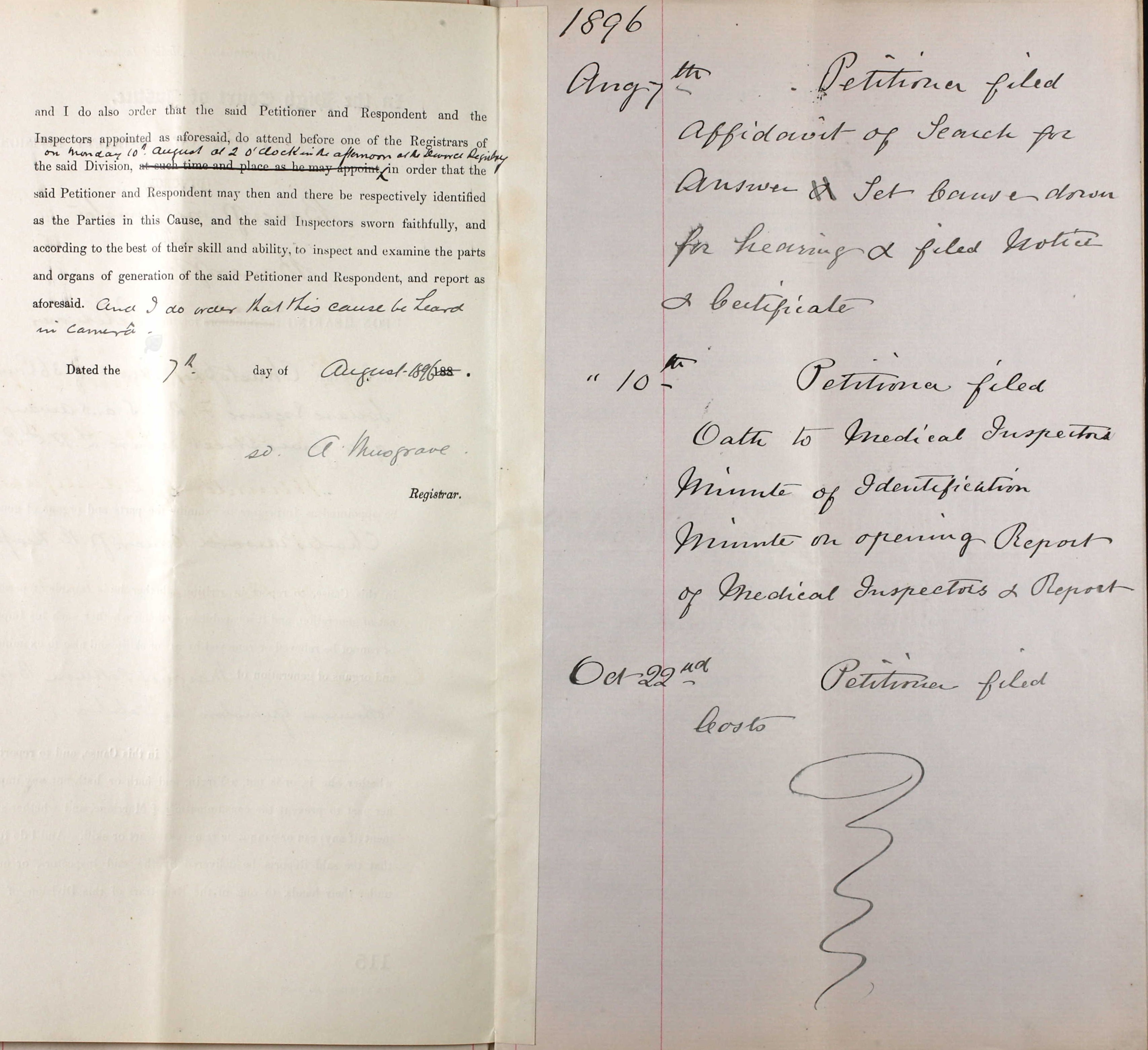
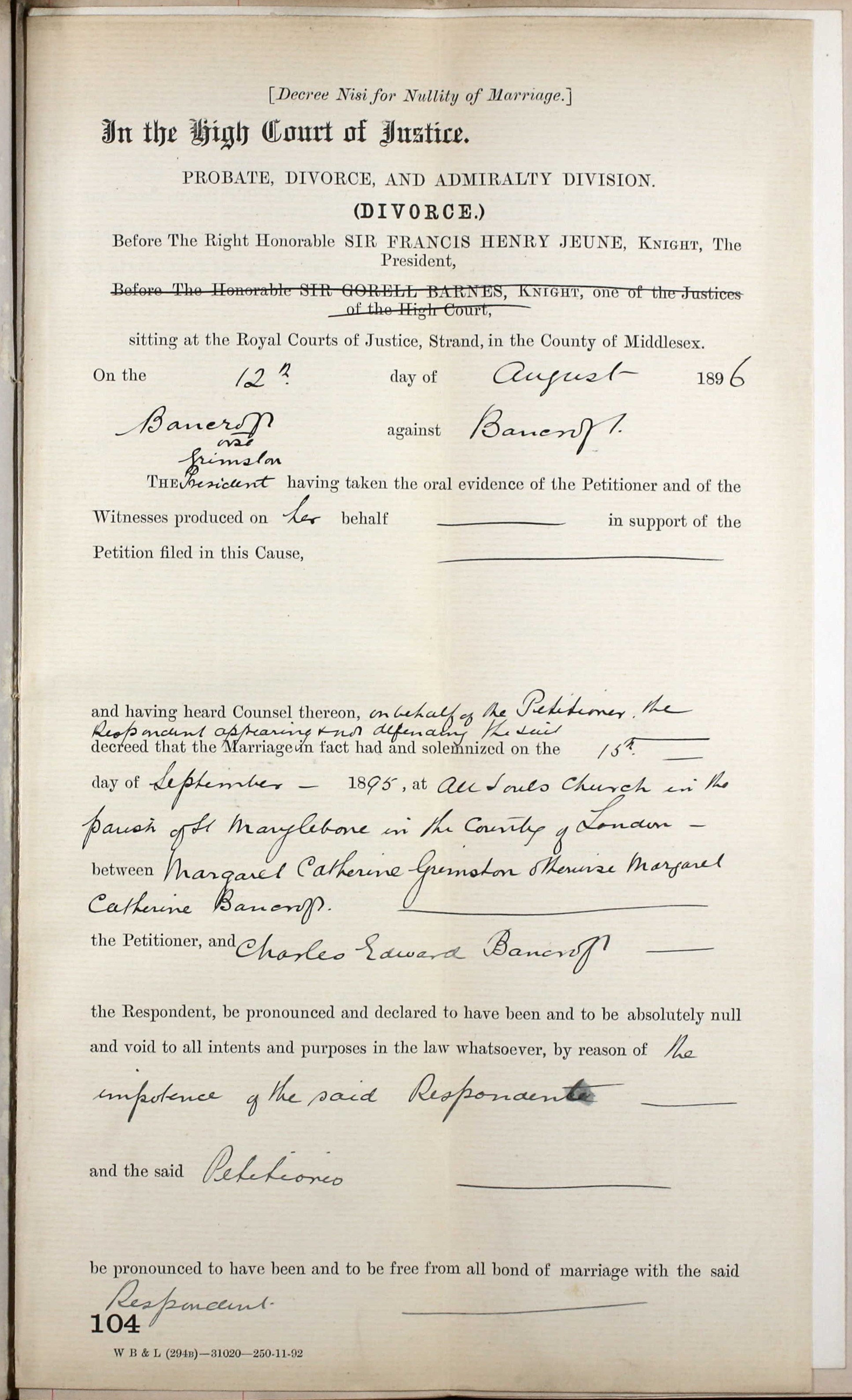

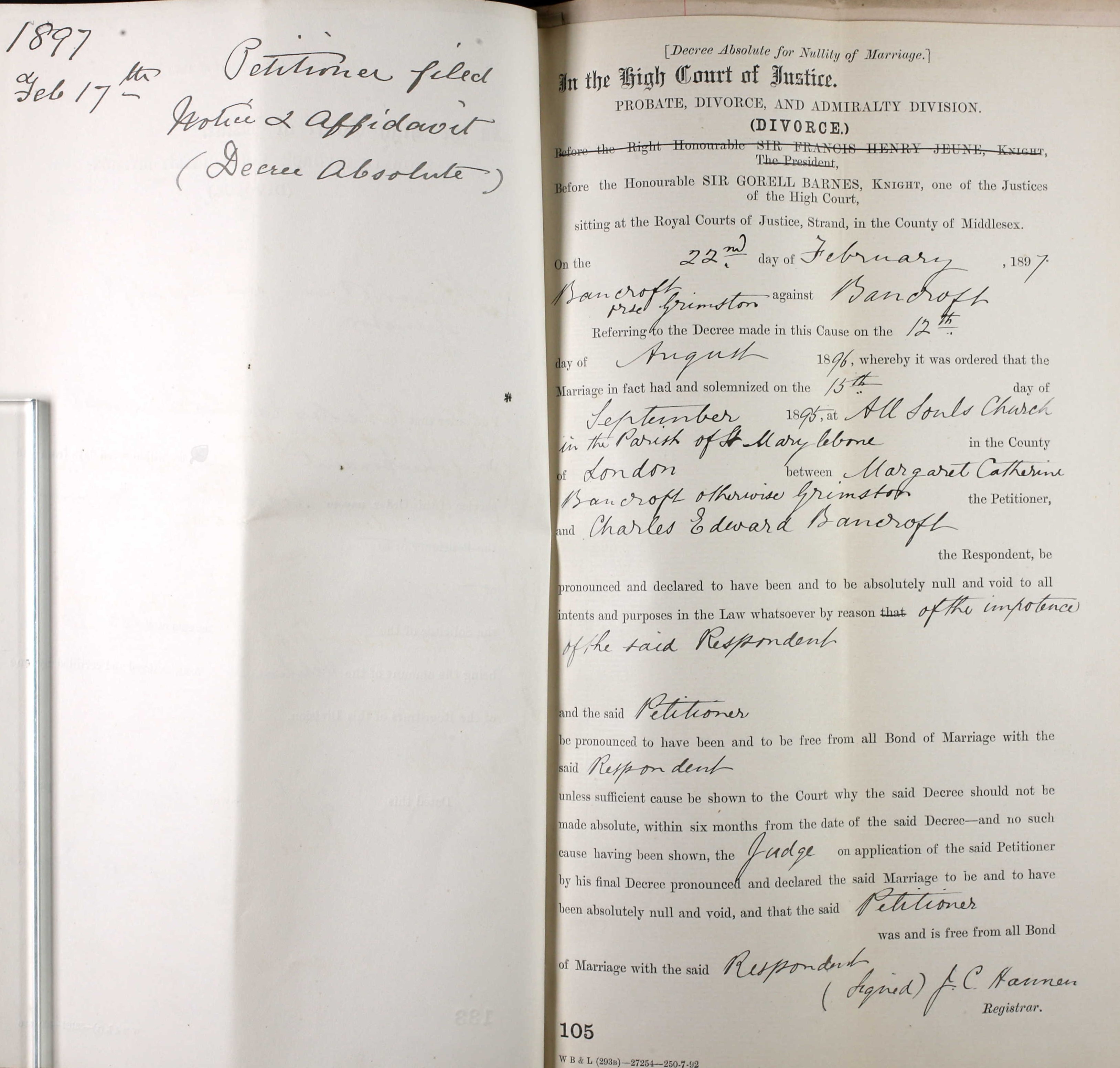

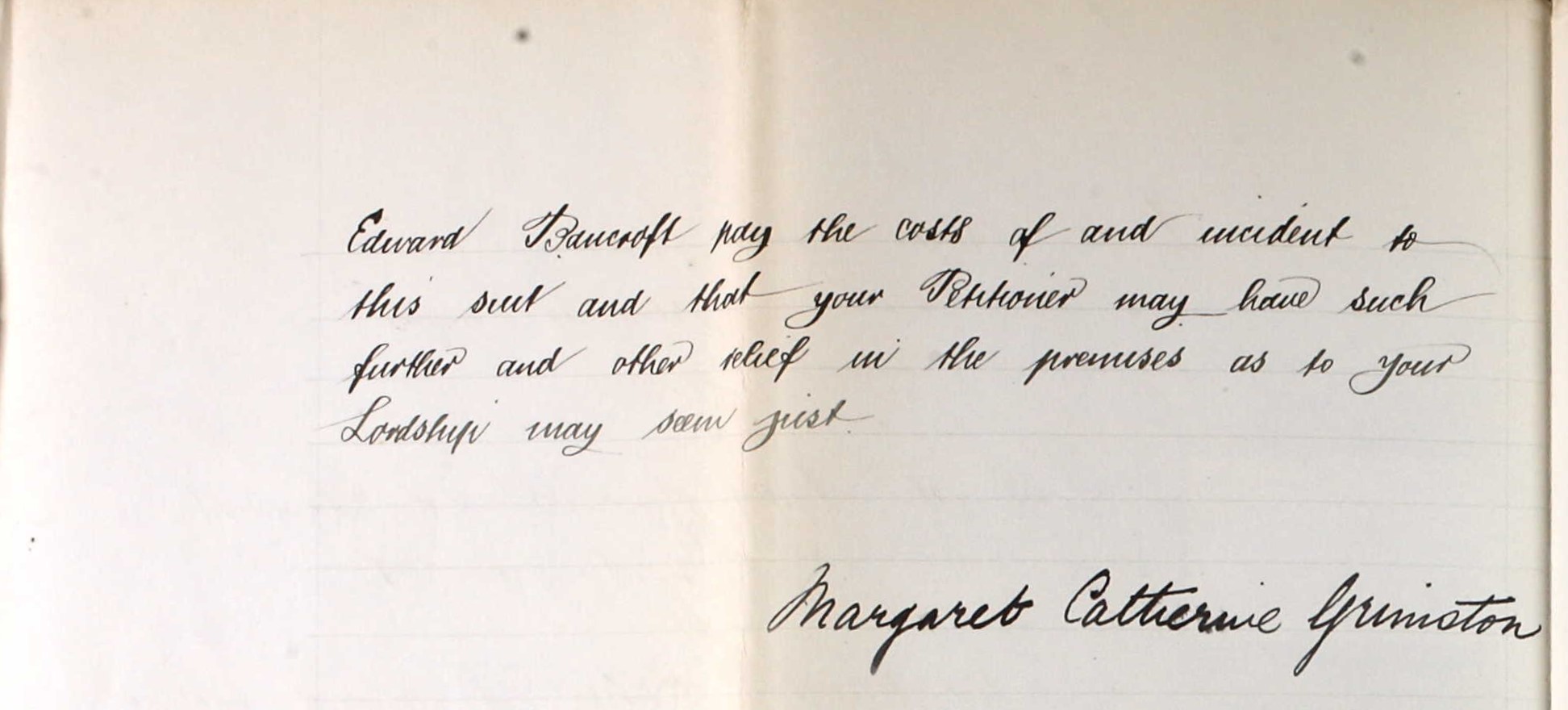

The Final Decree Absolute was issued on 22 February 1897.
So what was the real reason for the Divorce? The most likely reason is that Charles and Margaret had the same father.
Here are three photos for comparison. They are so very alike.
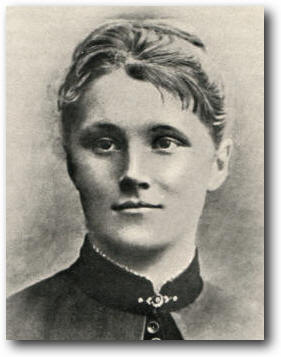

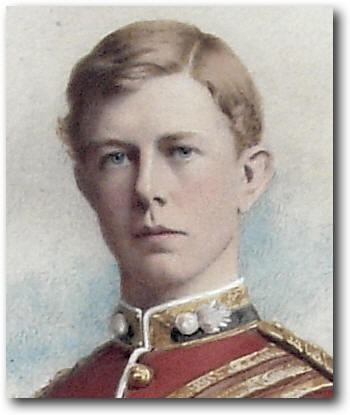

1) Margaret, aged 16, from Madge Kendal‘s autobiography.
2 & 4) William Hunter Grimston & wife Madge 1870s, CDV picture from the National Portrait Gallery.
3) Painting: Captain Charles Edward Bancroft of the Royal Welch Fusiliers. (Credit: Brenda Whitmore nee Bancroft) from the Old White Lodge website.
For me, these pieces of evidence tell the story, firstly that a photo taken of Charles aged around 11 was found in Madge Kendal’s scrapbook with Charles’s death record (dated 1906) from the Times being on the same page, now at the North East Lincolnshire Archives. Did this photo belong to her husband?
Secondly, Madge wrote: Although this event cast a shadow over my daughter’s life and continues to affect mine, she never recovered from the shock. The word ‘Shock‘ would imply being told something that changed everything, not to find out that your new husband was impotent.
On that subject, Charles did marry again on 1 August 1900 to Ellie Maude Moses, and they had a daughter, Primrose Marie Helen Bancroft, in 1902. From what I’ve read, he also had a daughter before that in 1898, Eva Marion Bancroft Wilton, by another woman, Florence Martha Youngman, although it doesn’t look like they were ever married.
Also, after I had read through Madge‘s book, something she said about Squire Bancroft sealed it for me. Madge’s words: “In spite of the severance of our relations through a domestic tragedy, he and I always remained constant to our old regard for each other“. He was always known as ‘Bogey’ to her.
Can you just imagine it if this were the case, his wife and her husband had a son before they had married their respective partners, and neither of them knew about this child until Madge and William’s daughter fell in love and suddenly married that son. The effect the bombshell news must have had when it reached Marie and William’s ears, and they had to tell not only their partners but also how however did they tell Margaret and Charles, the happy couple, it must have been devastating for all concerned.
Madge’s words: How often poetry, with all its beauty, has the power to wound and make us suffer! Years later, after my Margaret’s so-called marriage had taken place, I wrote to her:
“Nothing in the world is single,
All things by a law divine
In one another’s being mingle,
Why not I with thine?“
In response, she wrote back with a sharp clarity: “Mother, don’t quote Shelley to me again. Even he didn’t understand everything.”
When Margaret (known by some as Daisy) was twenty-one, I wrote her a poem, from which I will quote the following stanzas:
To Daisy: On Her 21st Birthday
Sweet child of my girlhood,
On this, your natal day,
In what language can I tell you,
In what feeble words can I convey
One thousandth part of all the love,
Of all the deeper joy
I feel for you, my gentle one—
My child without alloy.
If God in His high wisdom. Shall have sent thee ills to bear. Why He has sent thee strength and youth—two attributes so rare? To bear those other smaller griefs. To prove thou art a woman.
She certainly had ills to bear, and she bore them with strength, for when the time came for her to be married to the man of her choice, the marriage had to be annulled.
One day, when the matter had become public knowledge, I was summoned by Her Royal Highness the Duchess of Teck. She asked me, “Is this my little Daisy?” “Yes, ma’am,” I replied.
Her Royal Highness was very sympathetic and offered me valuable advice on how to approach the situation. Although this event cast a shadow over my daughter’s life and continues to affect mine, she never recovered from the shock. Despite this, her loyalty to the family of the man she married has never wavered.
Madge also recalled in her memoirs: When my husband and I were discussing the terms of our engagement at the Prince of Wales’s Theatre, I mentioned to the Bancrofts that I had been so accustomed to having a room to myself that I couldn’t share a dressing room with anyone else. Marie Wilton, who had many admirable qualities, immediately understood my feelings. She replied, “I completely understand. My own dressing room is very large, and I will divide it into two sections with long screens.” And she did just that. Whenever we wanted to see each other, we would knock on the screens.
Marie Wilton did more than just share her dressing room with me; she furnished it beautifully, making it as comfortable as possible. She was kind to me for many years and always referred to my brother Tom as “the maker of her fortune.” It was an additional sorrow during our time of great grief when our association was disrupted.
Madge’s daughter Margaret never married again after her divorce from Charles and sadly died aged just 31 from Rheumatic Fever. Her sister Dorothy who had been her bridesmaid, was with her when she died.

Four years later, Charles died, he was 42.

Charles Edward Bancroft’s death was reported in just a couple of newspapers, with no mention at all of whose son he was.

I did find this small mention of Lady Bancroft, 12 days after Charles’ death.
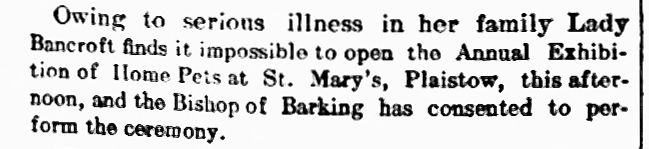
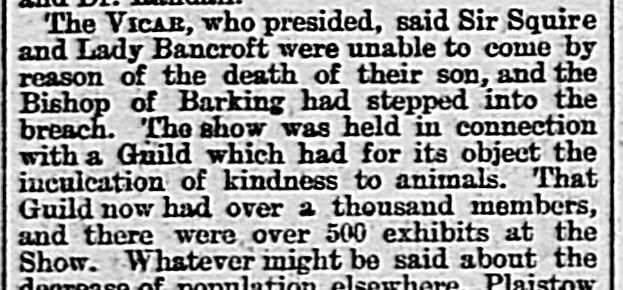
Then this was reported in a couple of newspapers on 19 October 1906. No mention at all of her son’s funeral.

Charles Edward Bancroft is resting in this Mausoleum above. But there is just one name on the outside, William F H Fletcher, who was Ida’s first husband. He died in 1879, then also interred here are Ida’s second husband, John James Elmes, who died in 1888, then Ida was placed here in 1920 after her death.
Sir Squire Bancroft and his wife Lady Marie Effie Bancroft are buried together in the same Brompton Cemetery.
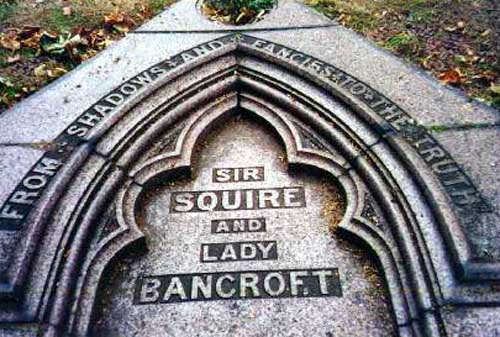
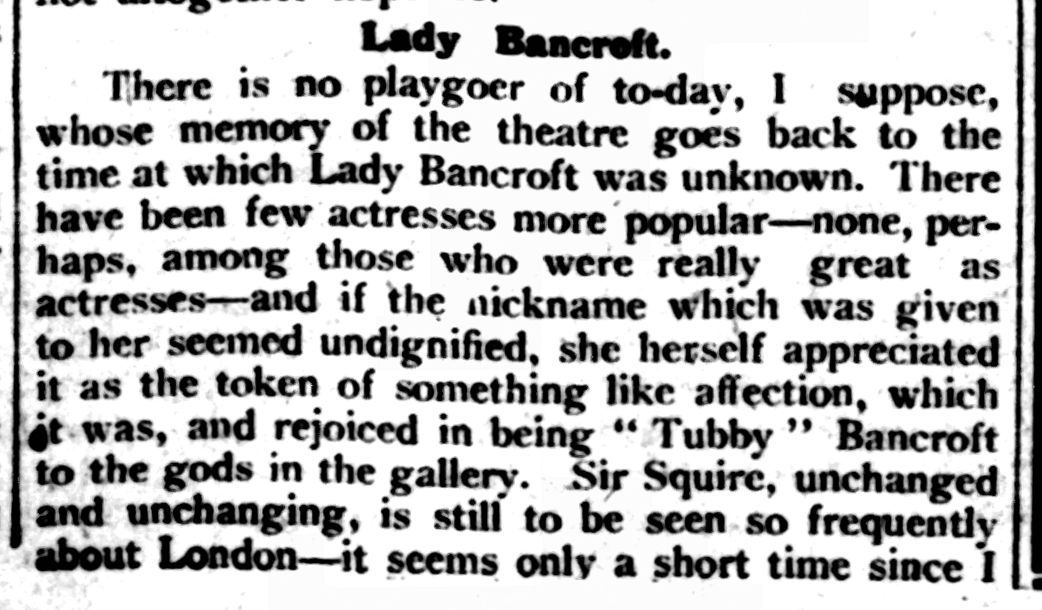

The Bancrofts and Kendals were closely connected not just through the theatre but also through their families. Living through this theatrical history must have been fascinating.
This is the link to the family tree on Ancestry I have compiled for Marie Effie Wilton: Marie Effie Wilton/Bancroft
Who was A.I. Broadwood?
Here’s Miss Broadwood on the 1881 census, not too clear, but it says Alice Isobel Broadwood, her father was Walter Stuart Broadwood, J.P. For Herefordshire & Radnorshire:

The family is much clearer on the 1891 census.


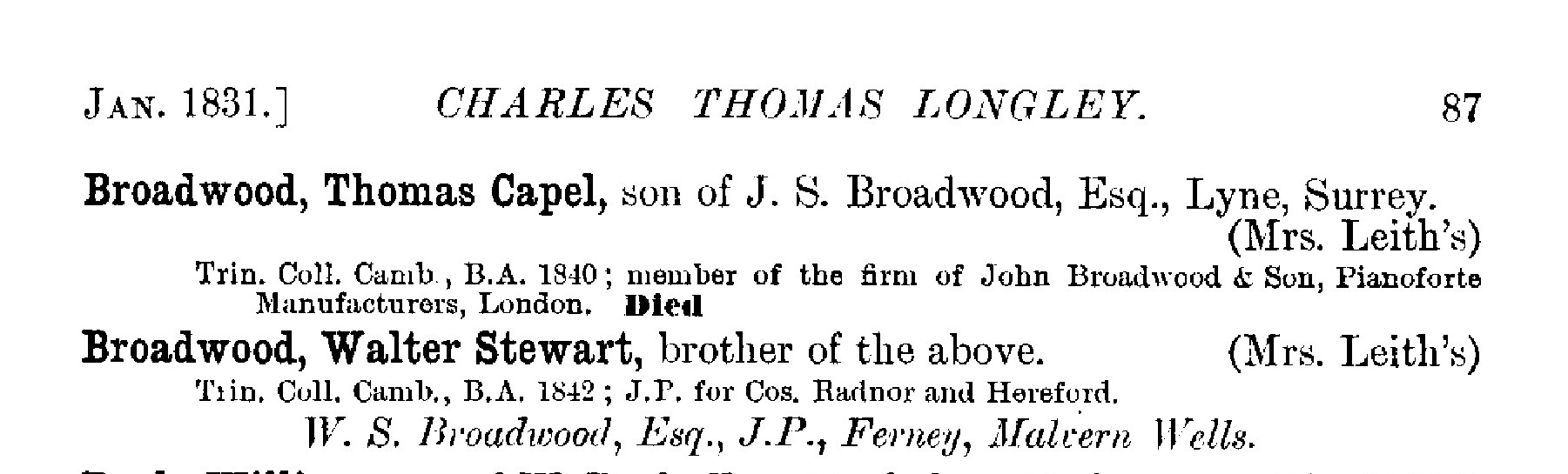
I would think, like many others, that Alice Isobel Broadwood was a theatre fan and that’s how she acquired Marie’s CDV photo. Alice was born on 7 January 1858. Her father was Walter, and her mother was Mary. She had one sister, Annie Agatha, born in 1859. Alice died on 23 January 1940 in Hendon, Middlesex, at the age of 82.
The last words go to Madge: “Suddenly, Mrs. Bancroft became quite serious and asked, ‘“What do you think the men are doing now?”
“I don’t know,” I replied. “They’re probably dining or, having dined, getting ready to go to the theatre to see ‘Dora.’”
It was then that I discovered this vivacious little lady was deeply in love with her husband, just as he was with her. He confessed that years before he met her to join her company, he had fallen in love with her at first sight“.
Some Sources:
Wikipedia: Marie Effie Bancroft
https://www.londonremembers.com/
Marie Wilton Bancroft Autobiography
Dame Madge Kendal Autobiography

Till next time then……..
 lynnswaffles.com