Earlier this year, I was fortunate to acquire three lovely CDVs from an eBay seller, depicting three siblings from the Gibbons family. When I started to research the siblings, I found that their father was a very well-known Artist in Plymouth, Devon, how exciting.
William Gibbons the Artist.
The modern City of Plymouth has developed from three neighbouring towns: Plymouth, Stonehouse, and Devonport, the latter of which is home to Admiral’s Hard.
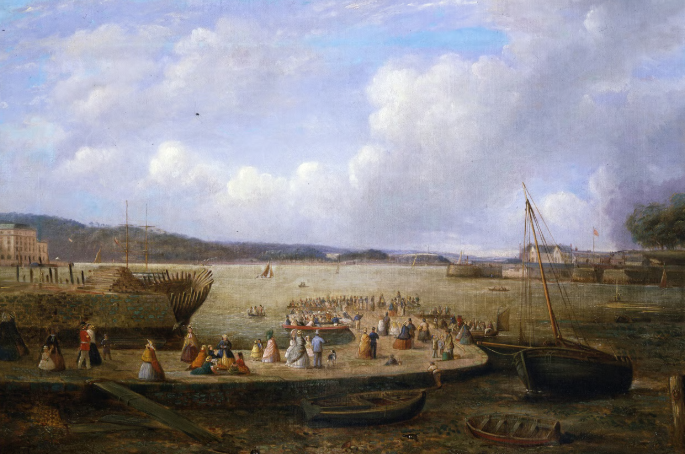
The sea around Plymouth always drew William Gibbons. Born inland in Exeter in 1840, he felt the pull of the coast early on. It wasn’t just the gentle wash of water in the harbour that captivated him; he loved the South Devon and Cornish coasts. He became a fixture in Plymouth, sketching tirelessly through the 1870s, a respected member of the local Arts Club.
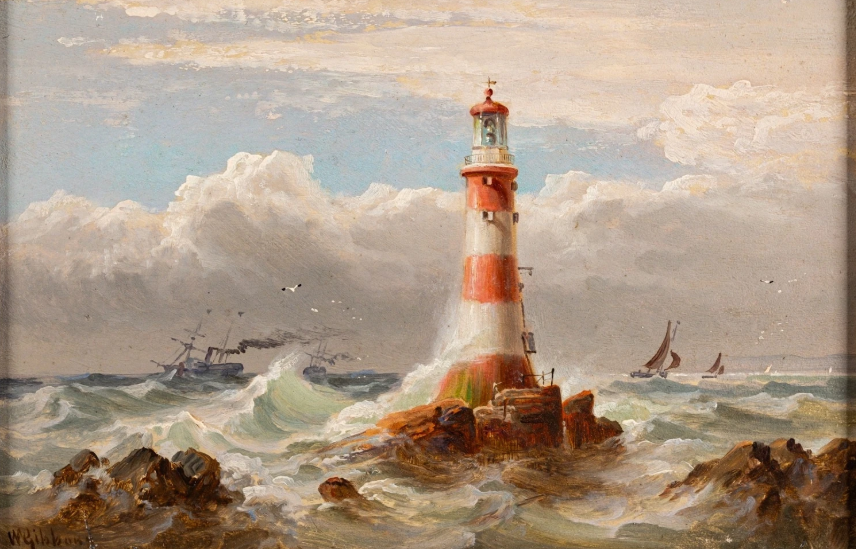
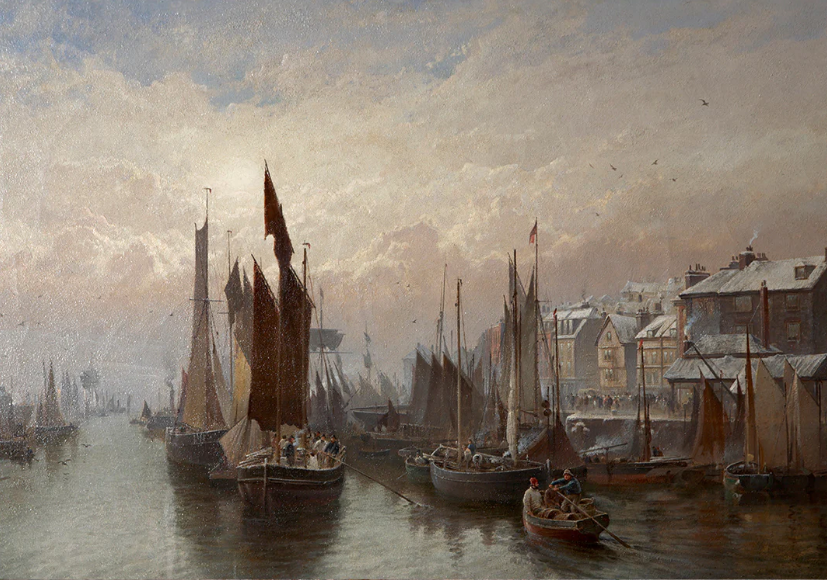
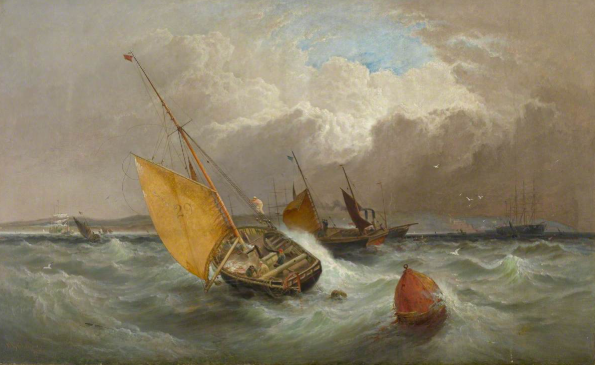
William’s style blended a realist’s eye for detail with a romantic’s soul for drama. He spent countless hours in the Barbican and around Sutton Pool, capturing the everyday life of the port, but his true passion lay in the turbulent waters of the Sound. He was known for rushing to the sites of recent maritime disasters, sketchbook in hand, to capture the raw aftermath before the sea swallowed the evidence whole.
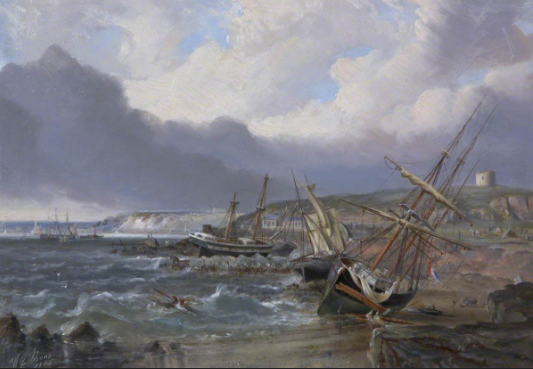
One stormy November, word spread like wildfire through the fishing community: the Seven Sisters had gone down hard. William arrived at the shore, battling the wind, and began to sketch the tragic scene. He worked feverishly, the salt spray stinging his eyes, translating the despair onto his canvas. The resulting painting, “Wreck of the ‘Seven Sisters’, in Plymouth Sound”, became one of his most powerful works, capturing the brutal force of the storm.
He painted other iconic local scenes too, multiple moody depictions of the enduring Eddystone Lighthouses and a vibrant canvas showing racing cutters running into the estuary at Dartmouth. He even painted a portrait of a local figure, Alfred Rooker, who was twice Mayor of Plymouth.
William overcame a difficult childhood in 19th-century Exeter to pursue his passion in Plymouth. There, working initially as a photographic artist, he developed a reputation for capturing the sea’s many moods, from gentle harbour scenes to dramatic shipwrecks, earning the respect of the local art community. The Box, Plymouth’s Museum and Art Gallery, holds at least seven artworks by William Gibbons in its collection. The four paintings above are in their collection. Other William Gibbons paintings are held by the Government Art Collection and the Royal Albert Memorial Museum and Art Gallery in Exeter, Devon.
After his passing, the local art community rallied, recognising his unique talent for capturing the spirit of the West Country’s maritime heritage. They successfully petitioned for his works to be held in the collection of the Plymouth Athenaeum, ensuring that William Gibbons, the painter of storms and shipwrecks, would not be forgotten.
William Gibbons and His Family.
William Gibbons was born on 4 July 1840 in the bustling cathedral city of Exeter, Devon, the third child of Thomas Gibbons, a Shoemaker/Boot Closer, and Mary Ann Best. He grew up in a lively household alongside his five siblings, Mary, Thomas, Sarah, John, and George.

By 1851, young William could be found living with his parents in the St Mary Major area of Exeter, Devon, recorded simply as the son in a typical Devon household. As he reached adulthood, he began to strike out on his own. In the 1861 census, William appeared far from his childhood home, living as a boarder in Christchurch, St Andrew, also in Devon.
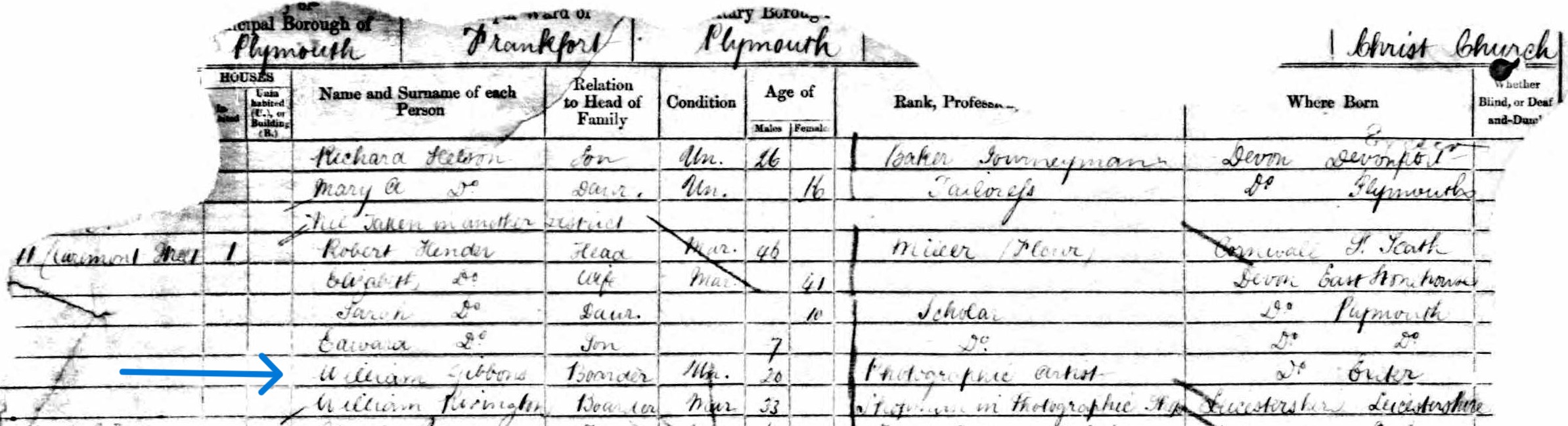
It was during these early adult years that William’s artistic talent began to take shape, a talent that would later define his life.
Sometime in the 1860s, William met Elizabeth Lewis. They married in the summer of 1863, and the two began a family. Their first child was Emily, who sadly died soon after she was born in the September quarter of 1866. Then came William John Gibbons, born in 1868 in Stonehouse, Devon. Two years later, on 28 June 1870, their daughter Emily E. Gibbons was born in Plymouth. On the 1871 census, Elizabeth is on her own at home in Plymouth with their first two children. As the 1870s progressed, the family continued to grow: Rose Gibbons arrived in January 1876, and Sydney Charles Gibbons followed on 11 October 1878, both in Plymouth.
By 1881, the Gibbons family had firmly planted their roots in Plymouth. William, married and head of the household, was listed proudly as an Artist (Painter), a career he had steadily built over decades. Yet even as his work flourished, sorrow touched the family. Later that same year, their eldest child, William John, died on 5 July 1881 in Plymouth.

William himself, however, faced a difficult final chapter; he was admitted on 15 March 1886 and died on 20 April 1886 at the Lunatic Asylum at Fisherton Anger, Alderbury, Wiltshire. (This institution was known as Fisherton House or Fisherton House Asylum, a large private mental hospital in the parish of Fisherton Anger, a suburb of Salisbury, Wiltshire.) A tragic close to a life marked by creativity, movement, and devotion to family.

Though his years ended away from his home, William’s legacy lived on through his surviving children, their descendants, and the artwork he produced as a passionate and gifted painter.
William’s Children.
How lucky was I to be able to have a photo of three of William’s children, always good when they are kept together.
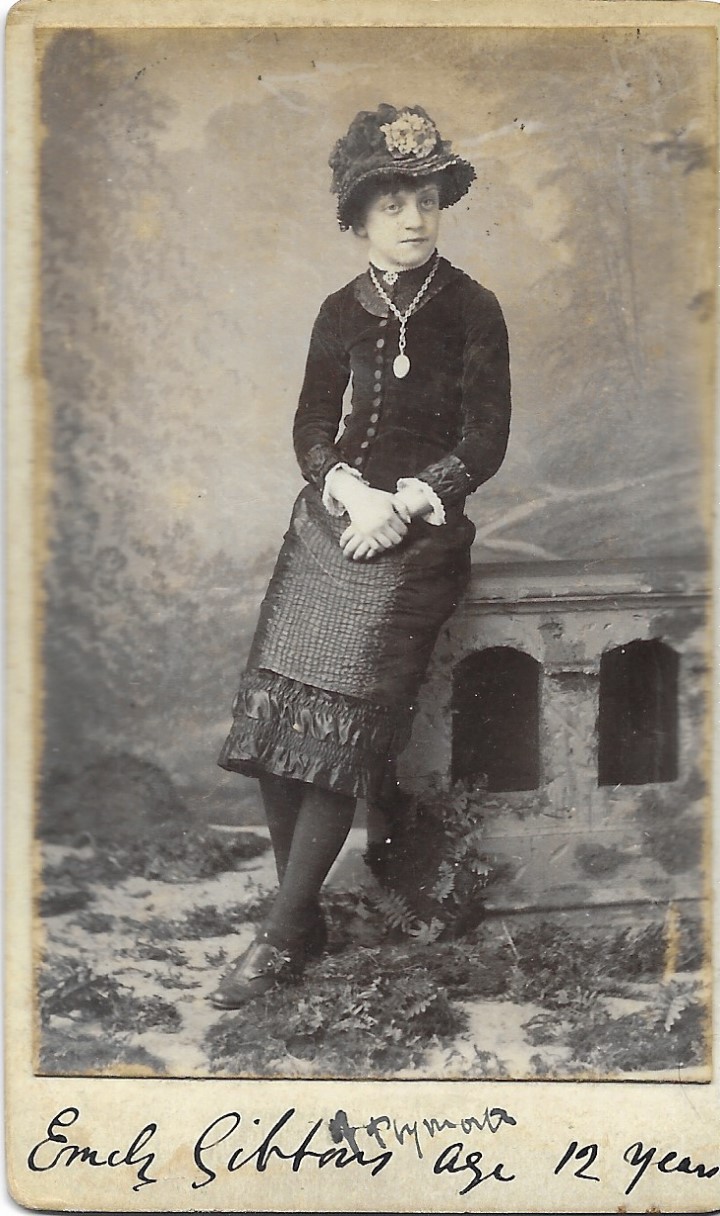
Emily E Gibbons was born on June 28, 1870, in Plymouth, Devon. She spent her earliest days in St Andrew, Plymouth, as noted in the 1871 census. Her childhood home soon grew busy with her siblings: William John, Rose, and the later arrival of Sydney Charles.
By 1881, the family had moved to the St Charles the Martyr area of Plymouth, and by 1891, they resided in Laira. It was in these familiar streets that Emily grew up.
In 1895, at the age of 24, Emily married Thomas Deering Selwood. The newlyweds settled in Plymouth, where the 1901 census recorded Emily as a proud wife in her own household.
Emily and Thomas began their family, first with the birth of Norman Leslie Selwood in October 1896 in Plympton St Mary. George Deering Selwood followed on June 28, 1900, born in Plymouth, and Kathleen Mary Selwood arrived on April 13, 1904, also in Plymouth.
The young family moved to Egg Buckland, Devon, where they were living during the 1911 census. Life held both joy and sorrow for Emily and Thomas. Their eldest son, Norman Leslie, tragically died on August 13, 1916, in Barrow in Furness, Lancashire. A long way from home, he was an apprentice Turner and Fitter. He would almost certainly have been employed at the massive Vickers-Armstrongs shipbuilding and engineering works, the main industrial employer in the town.

The 1921 census found Emily still living in Egg Buckland, managing “Home Duties” as a dedicated wife and mother.
In her later years, the 1939 register listed Emily as performing “Unpaid Domestic Duties” while living in Devon. She lived to see her daughter Kathleen Mary grow up, though Kathleen would not marry Walter H Bunbury until 1950, when she was 46 years old, and after Emily’s passing.
Emily died in July 1940 in Plymouth, Devon, the town of her birth and where she spent nearly all her life.
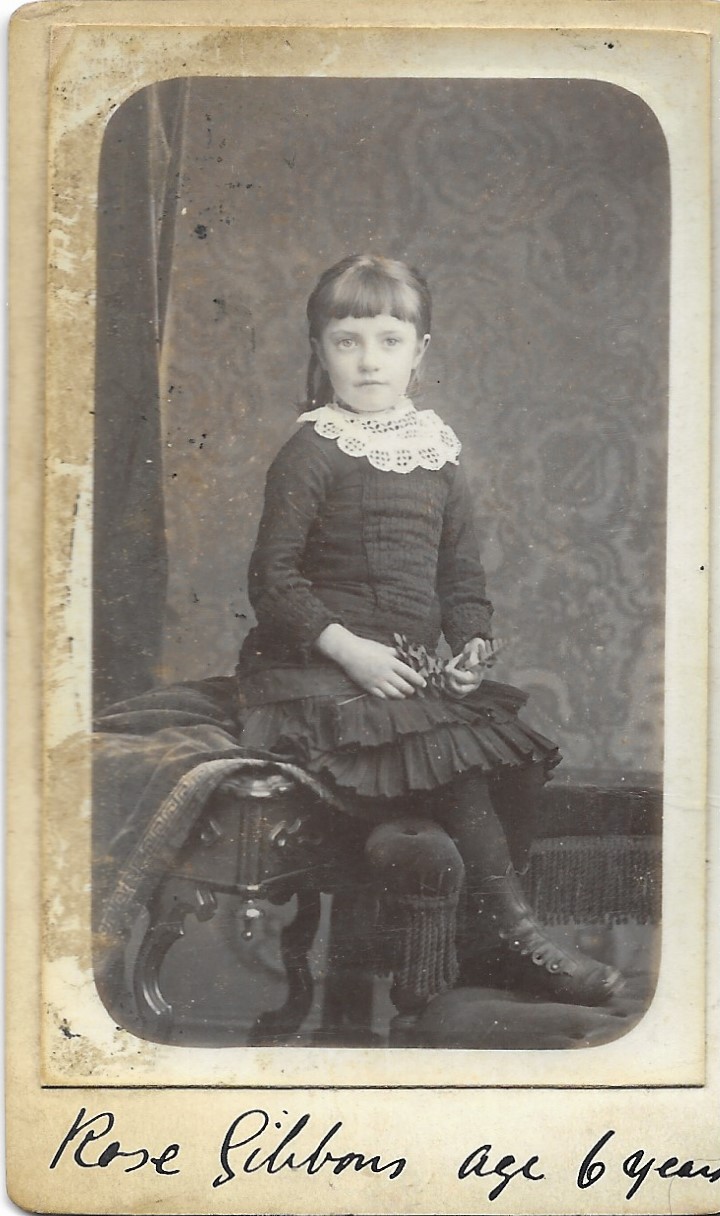
In the quiet seaside town of Plymouth, Devon, the Gibbons family welcomed their fourth child, Rose, in January 1876. She joined her older siblings, William John and Emily E, in the family home. Two years later, her younger brother, Sydney, was born.
By 1881, the census recorded the family living in the St Charles the Martyr district of Plymouth. Rose, at just five years old, was growing up in the busy port town.
Sadly, Rose’s life was brief. She passed away on 28 April 1889 in Devonshire, England, at the young age of 13, a loss deeply felt by her family.

Rose’s death was very likely caused by severe cardiac complications resulting from acute rheumatic fever, likely leading to pericarditis, inflammation of the heart.
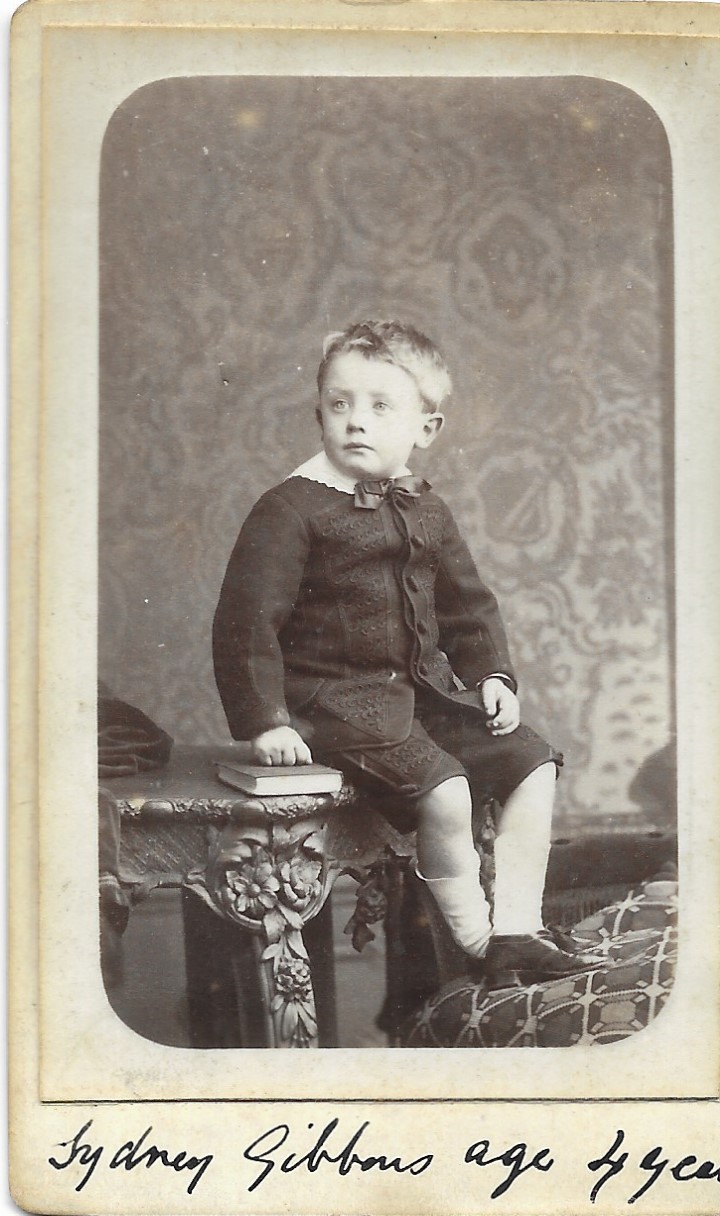
Sydney Charles Gibbons was born in the bustling naval town of Plymouth, Devon, on October 11, 1878, the fourth child of William Gibbons and Elizabeth Lewis. His childhood home was filled with the lively company of his siblings, William John, Emily E, and Rose. Shortly after his birth, on November 6, 1878, Sydney was baptized at the nearby St Charles the Martyr church. The 1881 census found the young family living in the St Charles the Martyr area, and ten years later, in 1891, they had moved to Laira.
Life moved quickly for Sydney. At just 19, he married his sweetheart, Florence Elizabeth Ellacott, in October 1898 in Plymouth. Their lives together began right there in their hometown, where Sydney was listed as the head of the household in the 1901 census.
The couple soon started their own family, welcoming their first child, Winnifred Emily, on June 17, 1899. William Herbert followed on July 13, 1901, and Hilda Marion on August 24, 1903.
By 1911, the census recorded Sydney as a “Writer” at the H.M. Dockyard in Devonport, a steady job that supported his growing family, which now included Phyllis Lilian, born July 15, 1907, and Gladys Ida, born May 7, 1910. Robert A, their last child, arrived on October 30, 1912.
1911: In 1911, Sydney was a writer at the Admiralty at HM Dockyard Devonport, an important job that involved various administrative and clerical duties. The Admiralty system was highly centralised and complex, relying heavily on the efficient work of its writers to manage the vast amount of paperwork generated by the maintenance and expansion of the fleet in the lead-up to the First World War. The role required discretion and the ability to work with people of all ranks and with various civilian departments.
The family continued to live in Plymouth, as shown in the 1921 census where Sydney’s occupation was listed as “Clerk.” Sydney and Florence saw their children begin their own lives: Hilda Marion married George H T Hicks in 1923, and Winnifred Emily married Harold C Hodgson in 1925.
Around this time, Sydney and Florence moved from their lifelong home in Plymouth to Brentford and Chiswick, England, in 1925. However, they didn’t stay long before moving to Kent by 1939, where Sydney worked in a “Higher Clerical Office, Expense Account Dept” at H.M. Dockyard.
Their later years were marked by further family milestones, including Phyllis Lilian’s marriage to Douglas C Bowley in 1930 and Robert A’s marriage to Kathryn M Bigelow in 1953.
Sydney Charles Gibbons passed away on April 10, 1948, in Edmonton, Essex, England, leaving behind a rich legacy through his six children and their families. His estate was probated the following year, on April 1, 1949, in London.
You can contact me either by commenting here or via email at lynnswaffles@gmail.com.
Till next time then…………
 lynnswaffles.com
Beautiful old family photos Lynn and fantastic research as always 👍
LikeLiked by 1 person
Thanks Simon x
LikeLiked by 1 person