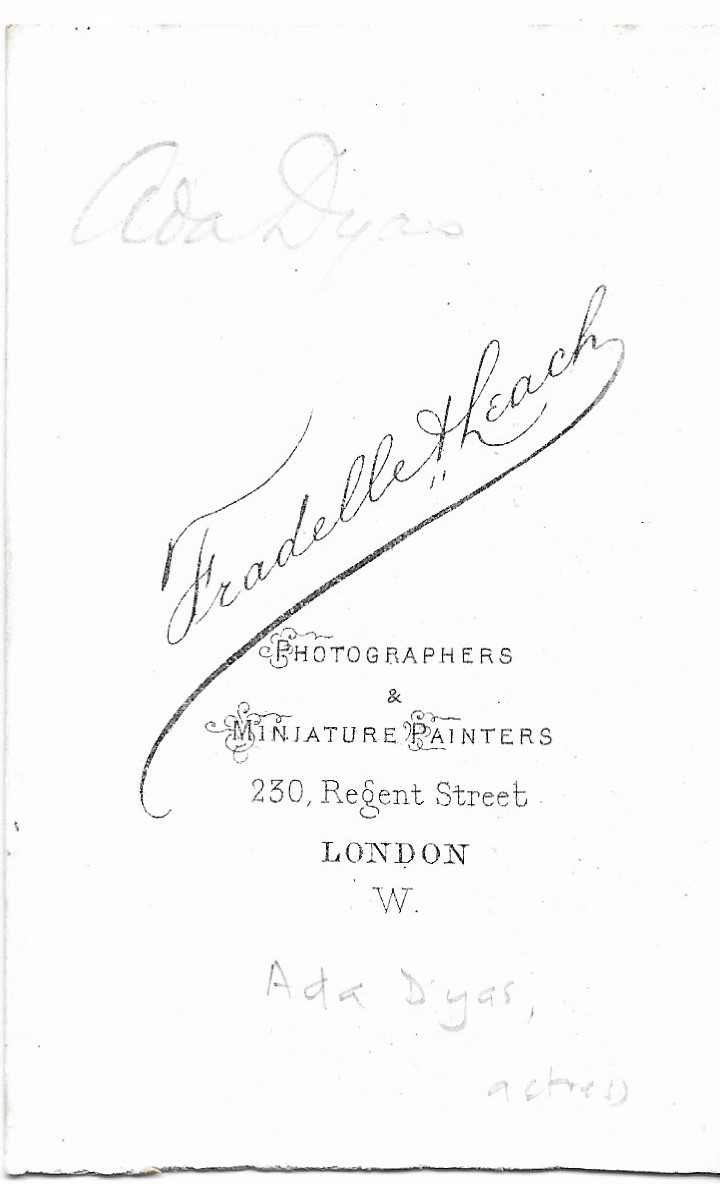
This very beautiful hand-tinted CDV (carte de visite) I saw for sale on eBay, I would have bought it without a name, as it’s fabulous, and I do have a lovely collection of hand-tinted CDVs. But with a name was a huge bonus!
Initial research on the internet told me that ‘Ada Dyas (1843-1908) was from an Irish family. She made her London debut in 1861 in Shakespeare’s Henry IV, playing Prince John of Lancaster, and later became famous in the 1871 play based on Wilkie Collins’s novel The Woman in White’. I had no idea that Ada was an actress when I bought the CDV. I seem to be drawn to the theatre this year!
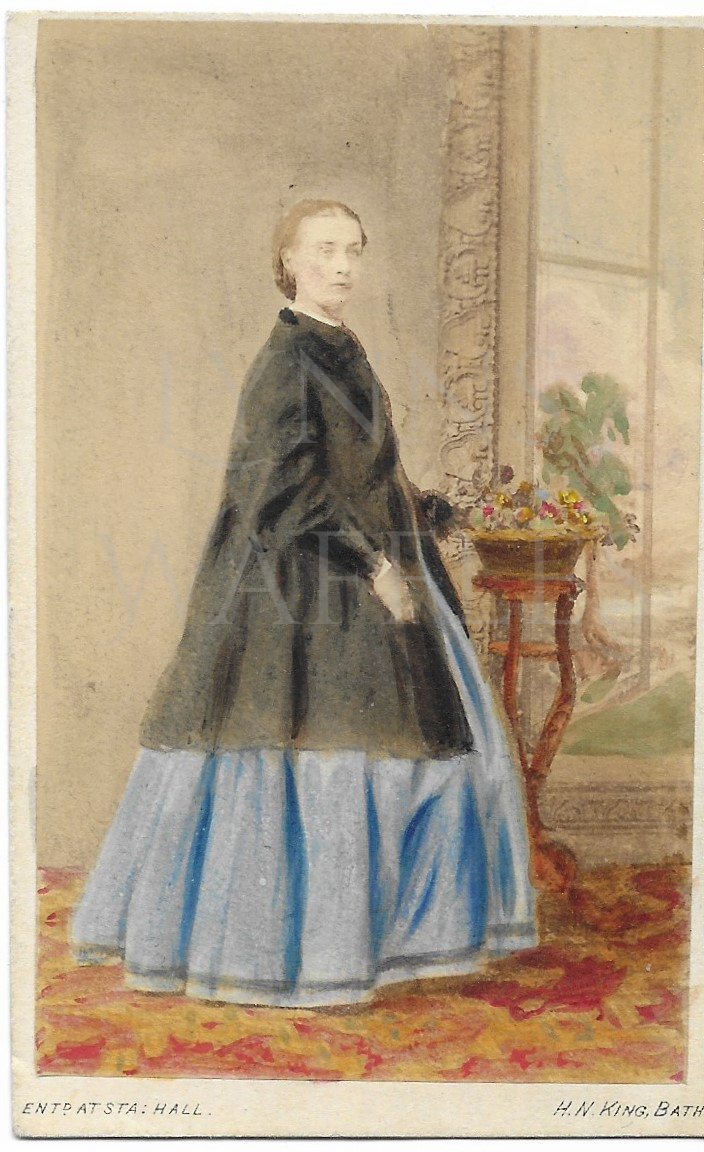
After researching in my reference books, I believe that this photo was likely taken in 1862-64. Her wide crinoline dress and her long-sleeved jacket fit this date. Maybe it was taken in 1864 for her 21st birthday, as that was a favourite time for a photo.

The Photographer.
The photographer H.N.King, was Horatio Nelson King. 1830? -1905. First at 42 Milsom Street from 1859-1861, then at 42A Milsom Street from 1861-1868. He’s listed at that address in the 1861 census. He moved later to 2 Seymour Street from 1868 to 1872.
At the bottom, it reads “ENTD AT STA: HALL” being entered at Stationers’ Hall, which means it was copyright registered, and “H. N. King, Bath”. This was a notice used when photographs were registered at Stationers’ Hall under the Fine Arts Copyright Act (1862), so it can’t be earlier than 1862.
Proprietors would submit a signed registration form and a fee to the Registrar at Stationers’ Hall. A physical description of the work, such as a sketch, outline, or unmounted photograph, had to be attached to the registration form. The registration forms and associated images created a substantial archive that is now held at The National Archives.
This collection provides invaluable insight into early photography, covering a period from 1862 to 1912. The archive contains a vast array of subjects, including photographs of people and places, press photographs, illustrations, and designs for various products, as photographers themselves chose what to register. Lots more information here: DHI Website. Exploring early photography.
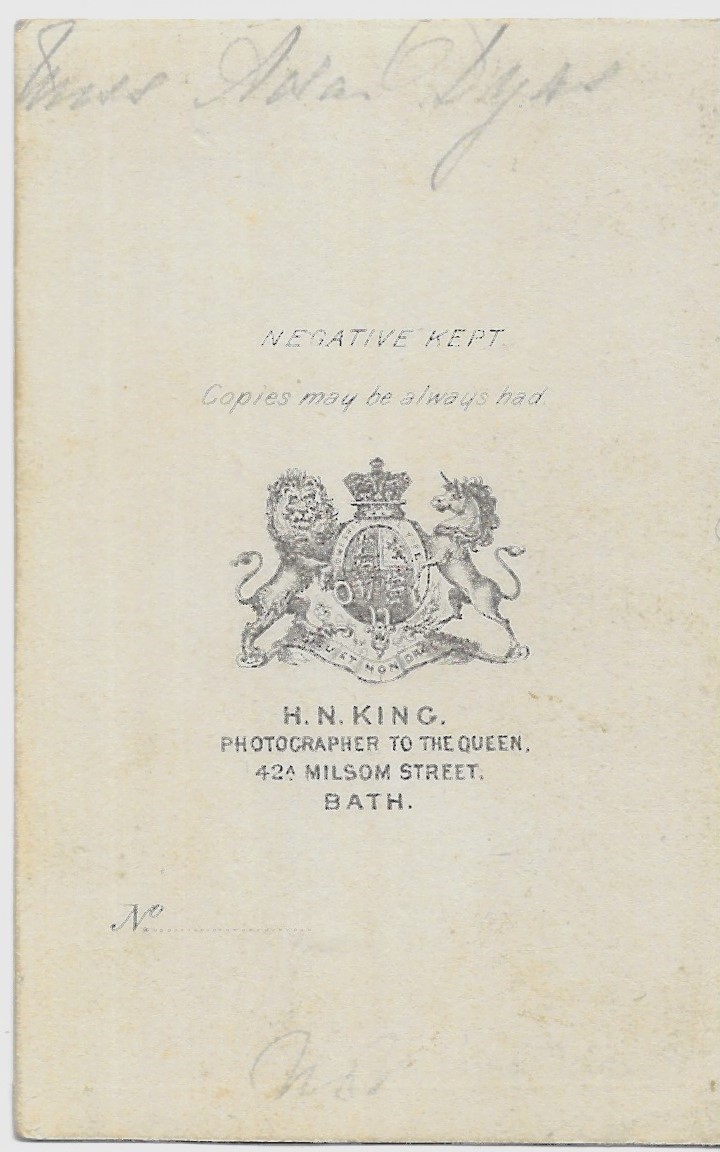
Miss Ada Dyas and her Family History.
I started a small family tree for Ada on Ancestry, with the details from Wikipedia, with her birth and death dates and a father called Edward Dyas. “Ada Dyas was the daughter of Mrs Edward Dyas, “an actress of some ability attached to the London theatres”.
From this information, I was able to gradually build up more details about Ada’s life.
I ordered her digital birth certificate from the GRO, as I knew this would help me enormously, especially with confirming information about her parents.

Her father is recorded here above and below as Edward Dyas, a Comedian. Her mother is Ada Dyas, formerly Cox. Her birth date varies by one day; I’m going with the 28th, that is on her birth certificate.

As with previous Theatrical subjects I have researched, the majority of interesting information has come from spending time reading through the many newspaper articles written about them; it seems that if they were well-known and well-liked, their lives were recorded in print from the first moment they stepped on the stage.
Below are just a few mentions of Mr Edward Dyas and Mrs Ada Dyas in the newspapers before their daughter, Miss Ada Dyas started making a name for herself.
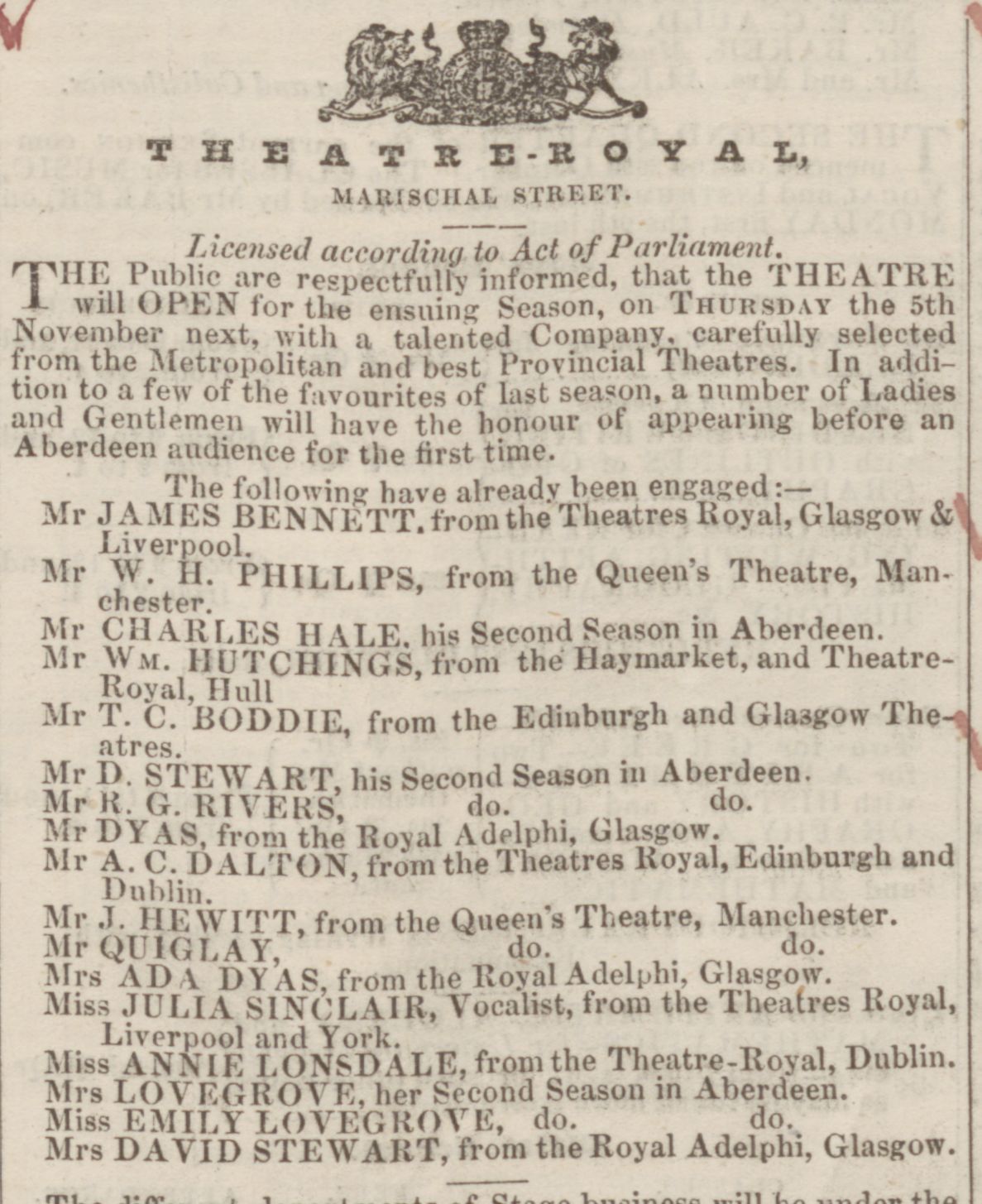
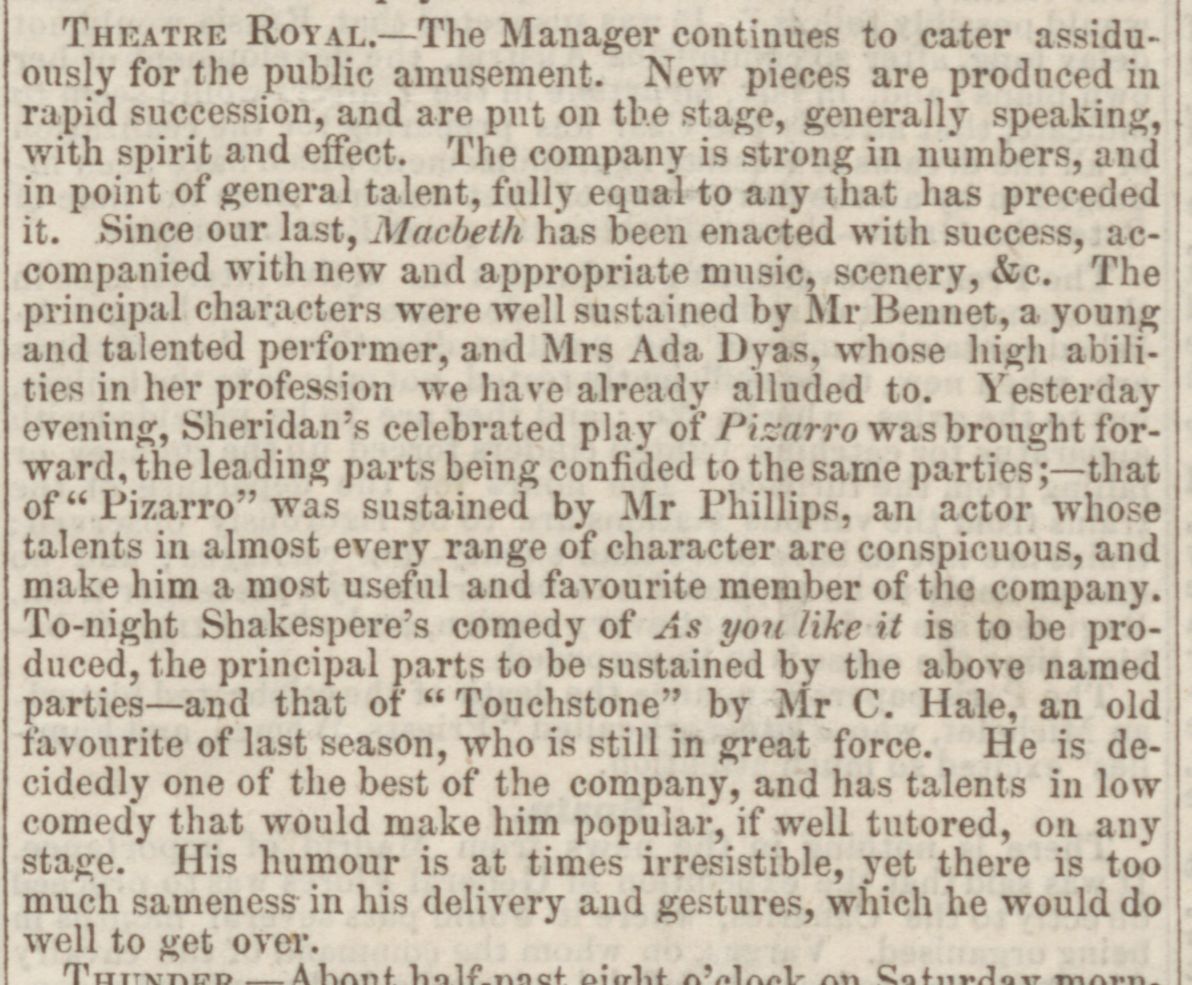
Mrs Ada Dyas is written here below as Miss Ada Dyas.
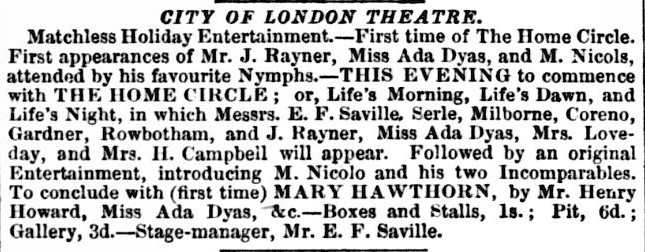
Mrs Ada Dyas had many good reviews; she was obviously a very talented Actress.
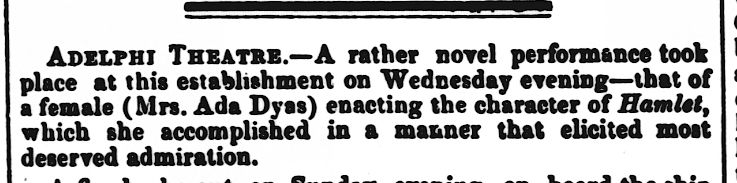
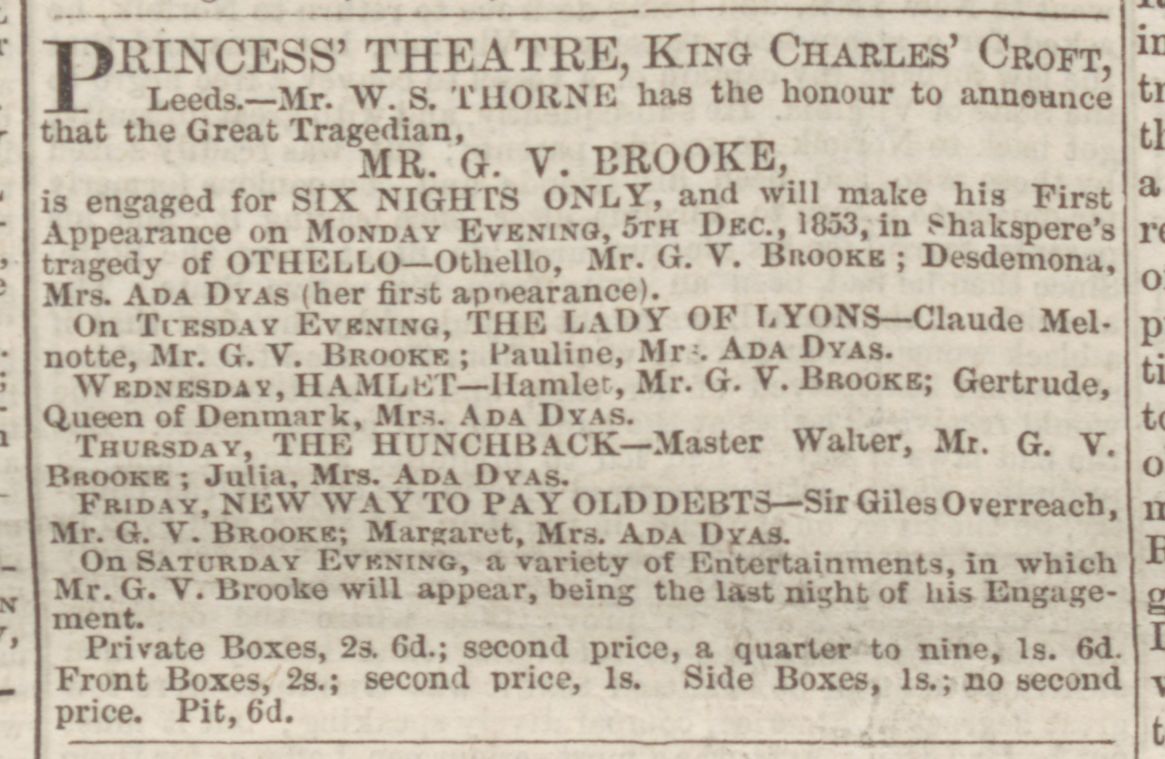
Mrs Ada Dyas obviously had other talents apart from acting as she dramatised this article into a play. The article was “The Soldier of Fortune: A Tale of the Crimean War,” which was in Cassell’s Illustrated Paper, referring to the Crimean War (1853-1856).
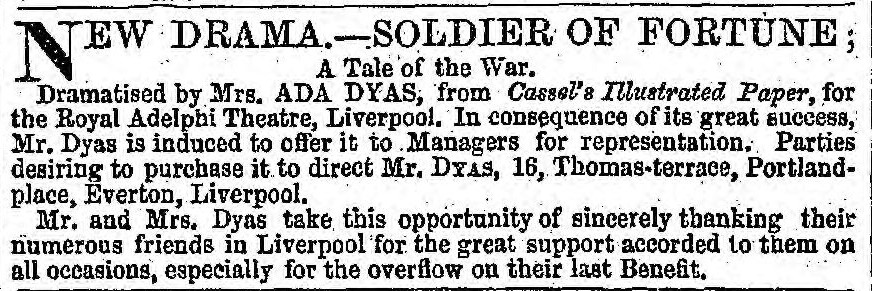
Mr and Mrs Dyas performed on provincial and London stages in the Victorian era, and they appear in the same companies in the 1840s–1860s.
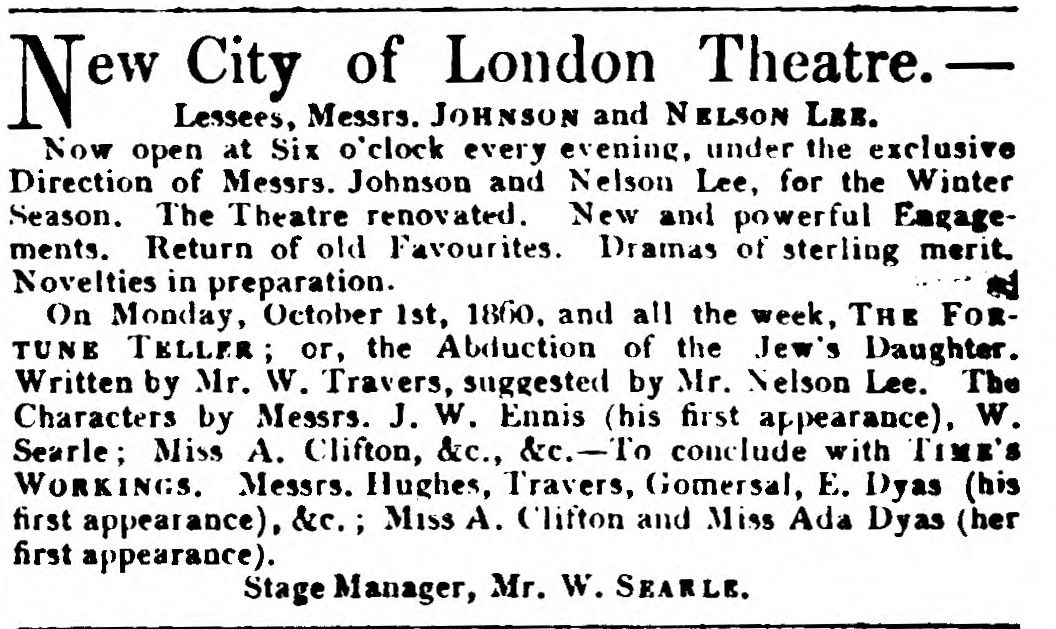
This newspaper report above is great as it is dated September 1860 and shows Miss Ada Dyas (Mrs Ada Dyas) first performed here at the City of London Theatre on Monday, 1 October 1860 in ‘The Fortune Teller.’ Edward, her husband was also performing at the same Theatre, his first appearance at that particular Theatre.
As I also found the following newspaper report from December 1860 showing Mrs Ada Dyas performing, and also her husband Edward Dyas at the same Theatre, I know it was Mother and not daughter here at the end of 1860.
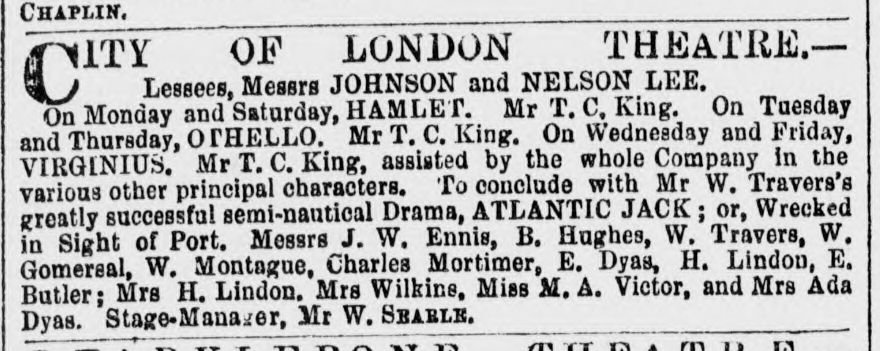
The City of London Theatre (sometimes referred to as The Royal City of London Theatre) was located at 35 and 36 Bishopsgate Street, in the Norton Folgate area of Bishopsgate. It opened on March 27, 1837, and was redecorated on October 7, 1844. The theatre closed for the final time as a theatre in January 1868 and reopened as a circus.
In March 1861 Miss Ada Dyas was performing in Birmingham. But by September 1861 young Ada was performing at Sadler’s Wells Theatre in London in Louis XI in her boys dress as the Dauphin.
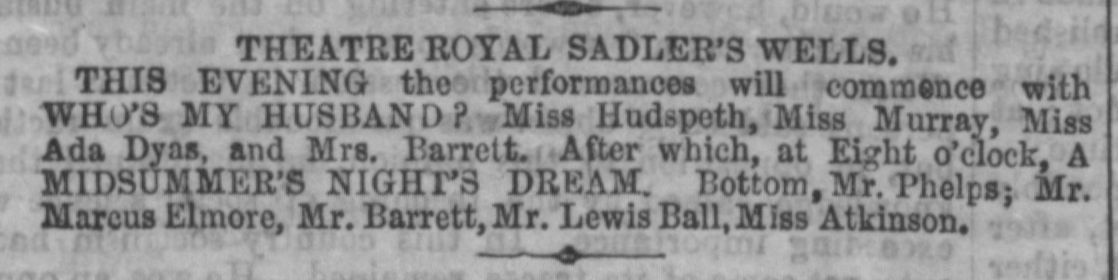
Many Actors and Actresses knew each other very well as they travelled around the country in their various performances on stage in our local Theatres.
The following little snippet is from the history of the Bristol Stage, which mentions not only Miss Ada Dyas but also the fact that she was appearing with Madge Robertson, who readers may remember was closely connected to Miss Marie Wilton, whom I wrote about in a previous blog.
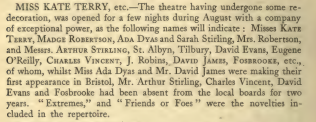
So after finding that, I was totally astonished to find that a few years later Miss Ada Dyas was actually a member of Miss Marie (Marie Effie) Wilton’s London Comedy Company from about 1867! Regular readers will remember that Marie Effie Wilton became Lady Marie Bancroft, see my blog from May this year. What a strange coincidence.
I loved reading this newspaper report below, excellent Dad looking after his daughter. Good for him!
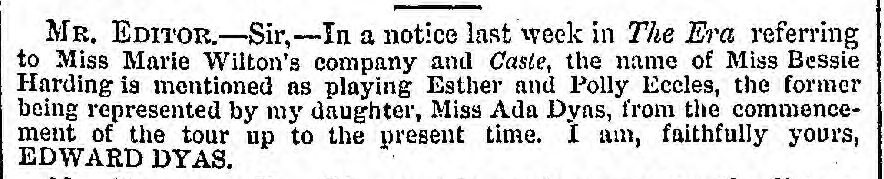
Ada Dyas performed in Thomas William Robertson’s plays at the Prince of Wales’s Theatre. She was in a version of ‘Caste‘ in 1867, a touring revival where Ada Dyas is recorded as ‘Esther Eccles’. Then she was in ‘School‘ that premiered on 16 Jan 1869 and M.P. that premiered the following year on 23 Apr 1870.
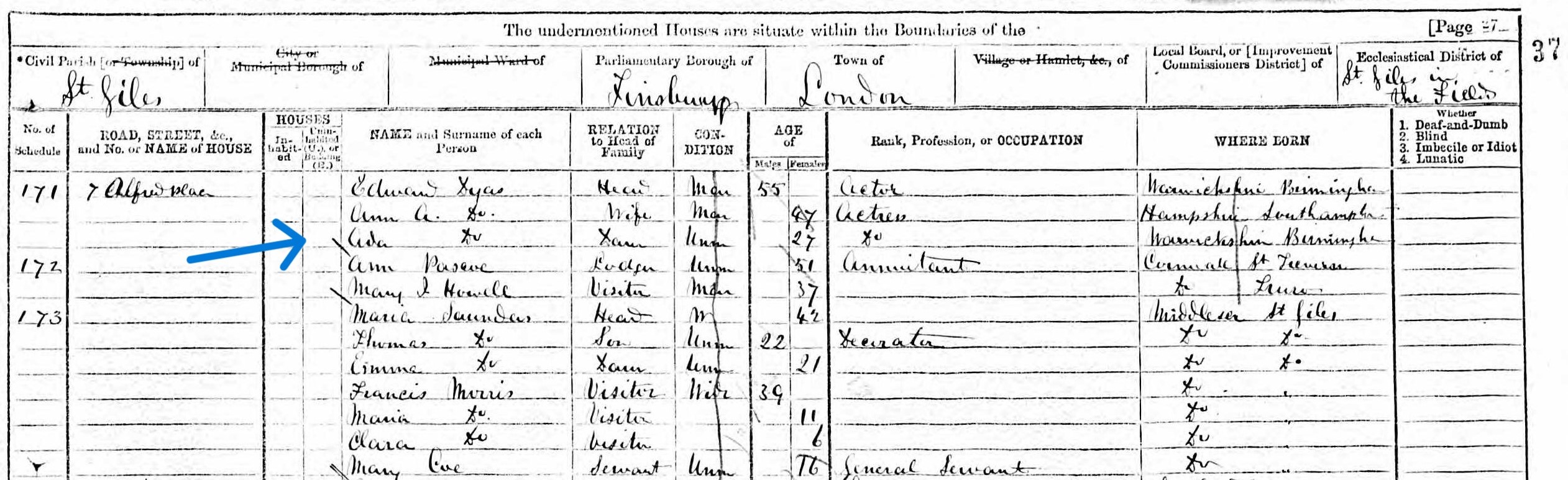
In 1871, as you can see above, Ada was living with her parents in St Giles, Finsbury, London, although she travelled around the country performing in Marie Wilton’s company for various productions. Her parents were both Actors. Edward, her father, was listed in most records as a comedian.

Mrs Ann Ada Dyas death.
Ada’s mum died in 1871; her cause of death was Phthisis pulmonalis, which is an outdated term for pulmonary tuberculosis (TB), a serious disease that affects the lungs and can cause emaciation, fever, and death.

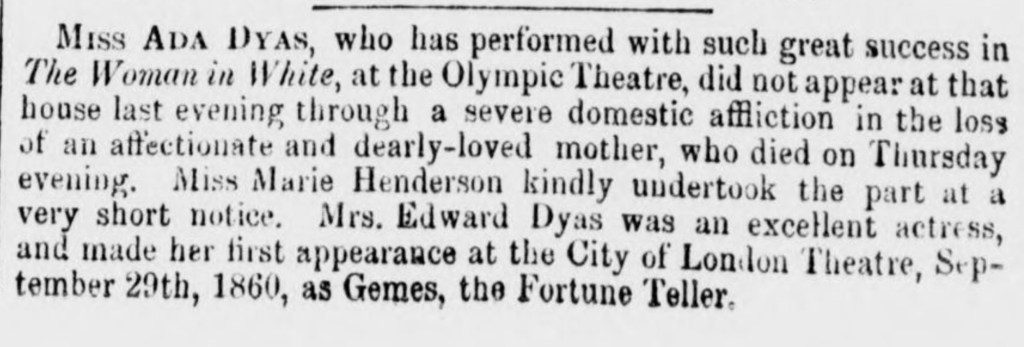
Her father Edward was still performing after his wife’s death.

Edward Dyas Junior.
While initially researching young Ada and adding records to the family tree, I found Ada aged 7 years old, on the 1851 census, living with her paternal Grandmother, Elizabeth, a widow and laundress, in Birmingham, Warwickshire.

So then I looked for Edward and Ann Ada Dyas. I thought, rightly, that they were probably working in a different area, which they were; they were living at a Lodging House in Liverpool with other performers.
But I was surprised to see on this census that they also had a son, Edward Dyas Jr.
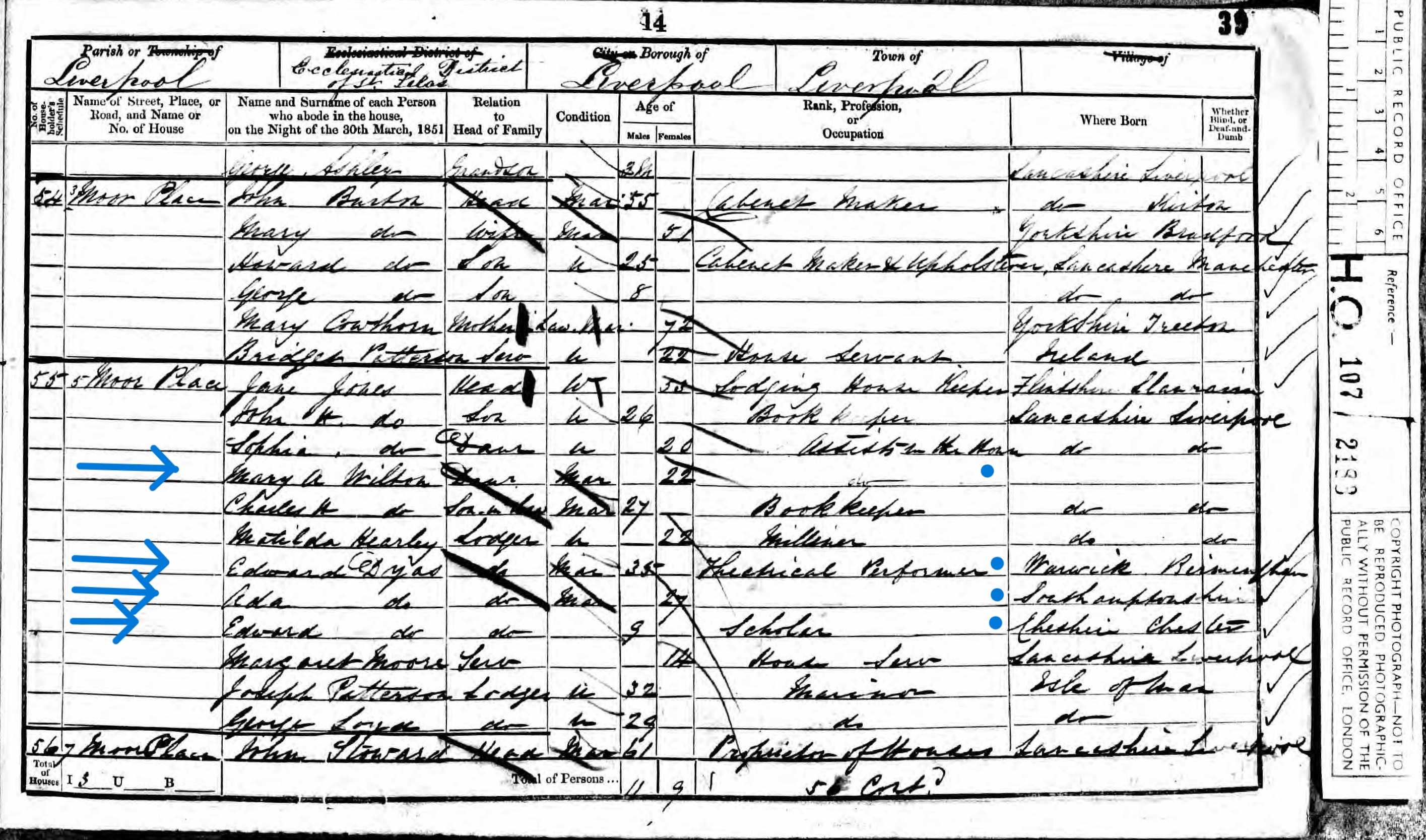
I’ve marked Edward, his wife Ada and son Edward aged 9 years old. Also, interestingly, in the same lodging house was a Mary A Wilton, aged 22 years old (marked above the Dyas family).
I suspected when I was researching Marie Wilton back earlier in the year that she had been born as Mary, but I couldn’t prove it. I also wasn’t able to find Marie on the 1851 census, despite searching with different variations of names and ages. Have I actually found her? More research needed!
Anyway, back to young Edward Dyas.
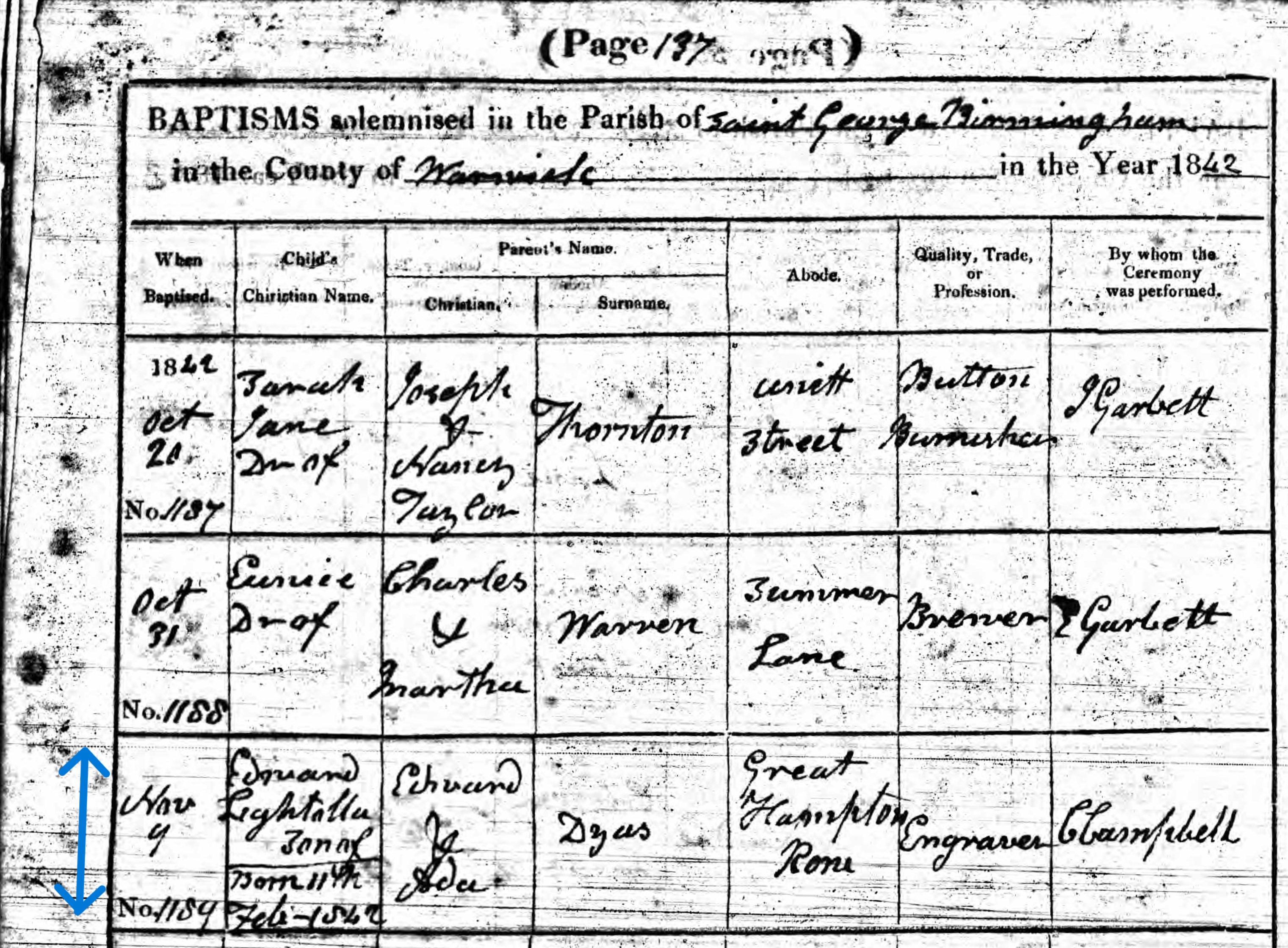
By the time of Ada’s birth, the following year after Edward, their father, had given up being an Engraver and turned to the Theatre as a Comedian.
Ada’s elder brother Edward, whose birth record lists him as just Edward, but his baptism record, shown above, identifies him as Edward Lightella/er Dyas, his middle name maybe a family name, born on 11 February 1842. I checked and found that there were no other children of the couple.
I couldn’t find any trace of him after this census. Why? I suspected the worst, and I was correct; he had died in August 1851, but what was his cause of death? Before I ordered a digital death certificate, I looked through the newspaper Archives and I found this detailed report just in one newspaper, the Liverpool Standard.
Distressing Case of Drowning.
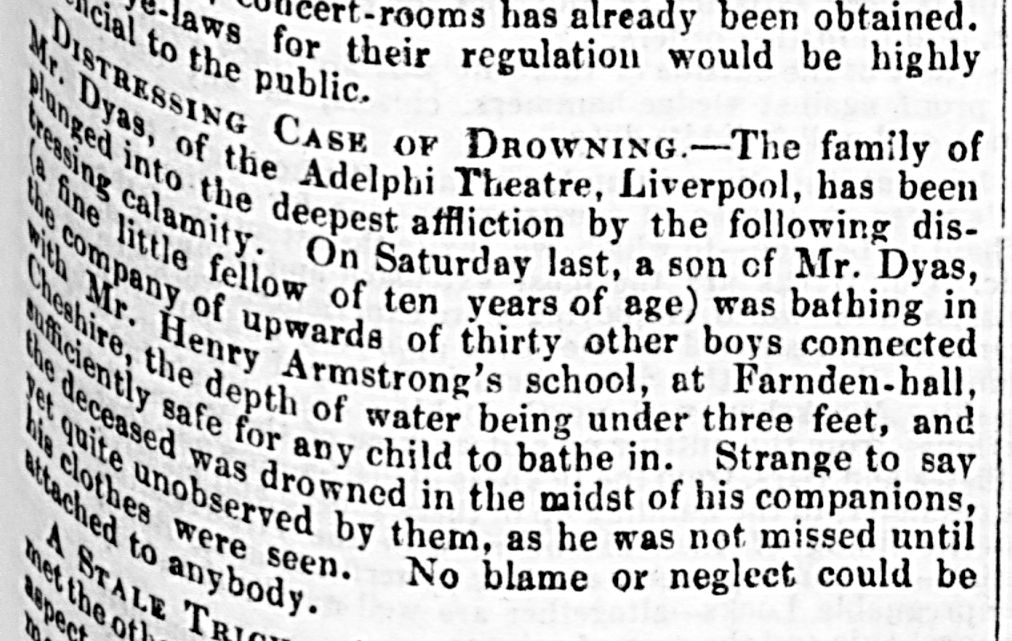
Mr and Mrs Dyas were obviously trying to ensure that their son had an excellent education, so he went to a private school. What a terrible tragedy. The family would have been devastated to learn of his death.
In the 1851 census Edward must have been home with his parents for the weekend from School.
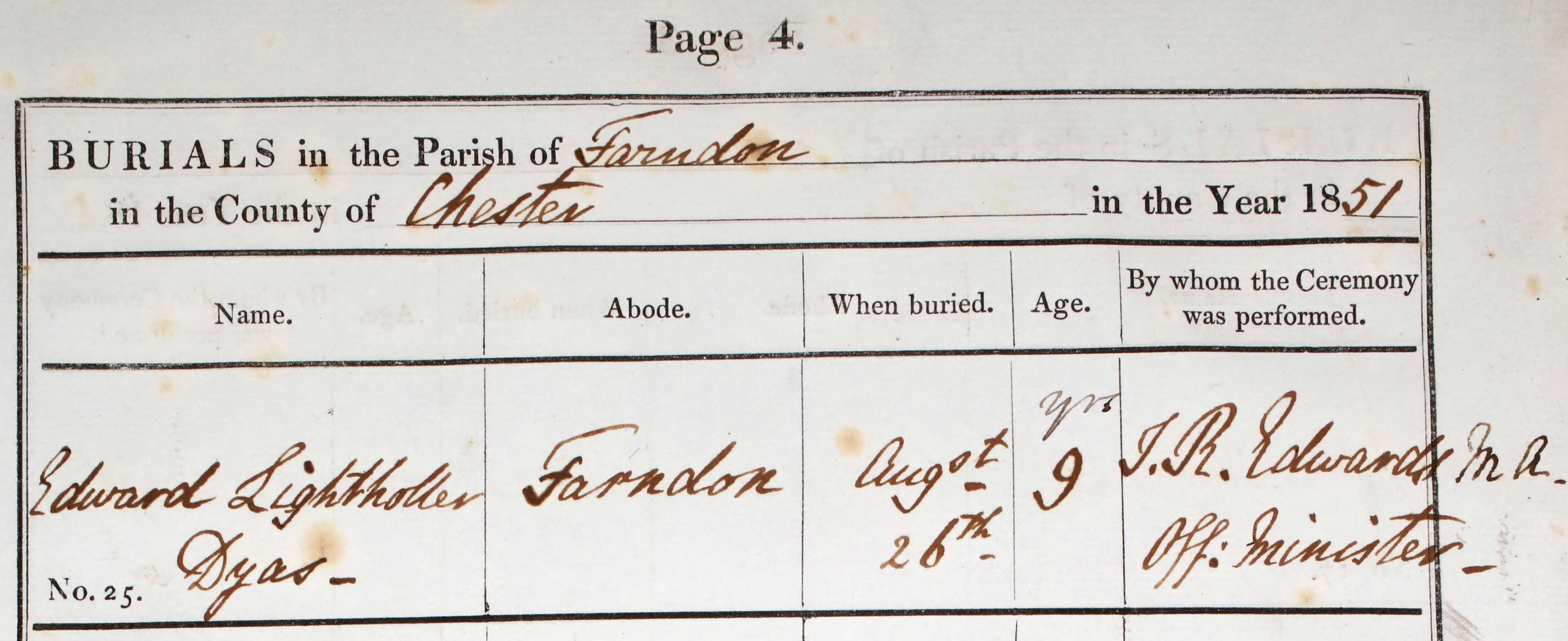
Edward was known as Edward Lightholler Dyas. He was buried on 26 August 1851 at St. Chad’s Church, Farndon, Cheshire, England.
Although the 1851 and most other censuses till 1901 were recorded on a Sunday. (The 1851 census was unique, however, in that it included a separate census of religious worship).
Ada Dyas goes to America.
Here’s one of the newspaper reports about a production in Dublin in the following year, 1872, that Ada performed in.
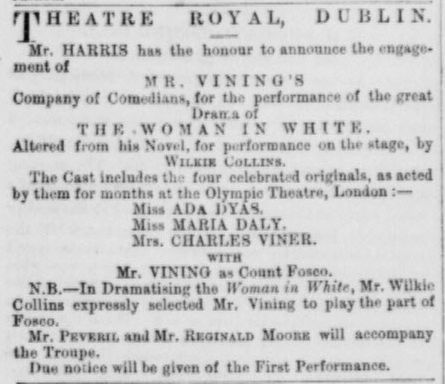
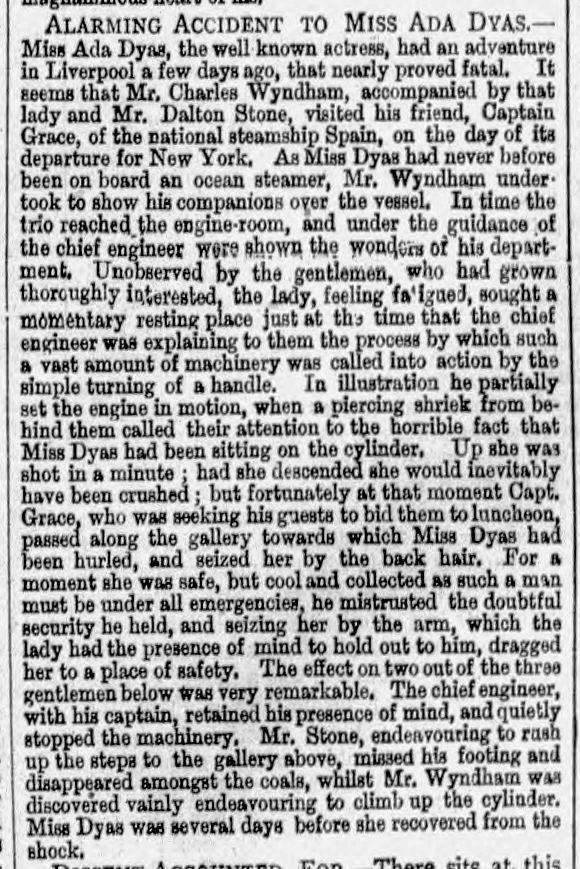
Contrary to most articles I’ve read about Ada, she did not go to America in 1872. She went to Dublin, Ireland, and appeared there in 1872, and she also still performed in London and the provinces, right up until late 1873. Although in July 1873 she made her first visit on board an ocean liner, with nearly tragic results!
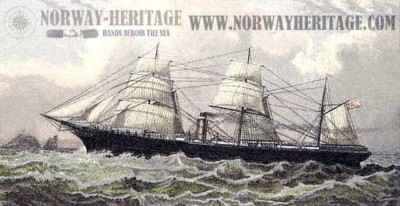
Then later that year, on 19 December 1873, Ada and her father Edward Dyas arrived in America on the S.S.Java.
They may have had meetings with theatres to see what they had to offer Ada. They were obviously successful, as at the end of November 1873, it was reported in the Northern Daily Mail newspaper that Ada was to make her first appearance in America the following month.
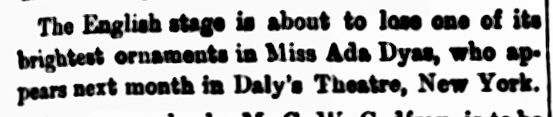
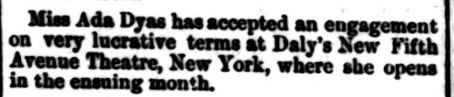
In fact, as you can see from this record below, Ada and her father travelled to America after leaving Liverpool on Saturday, 6 December 1873 that year.
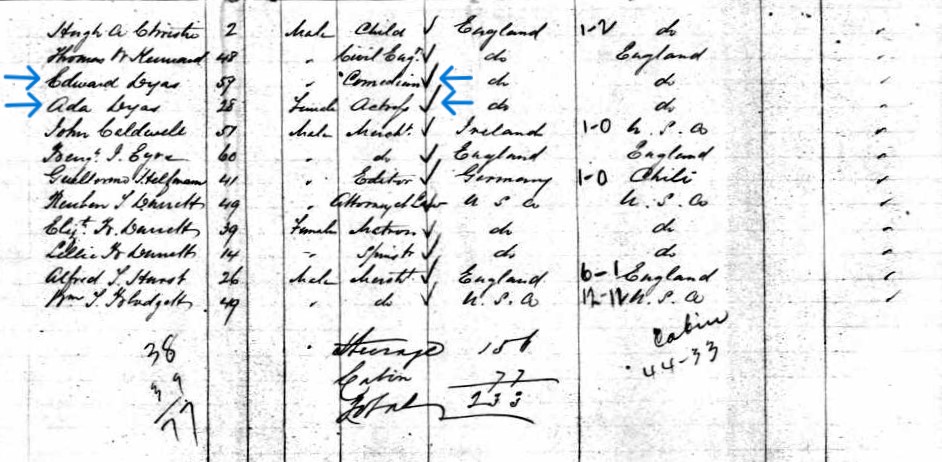
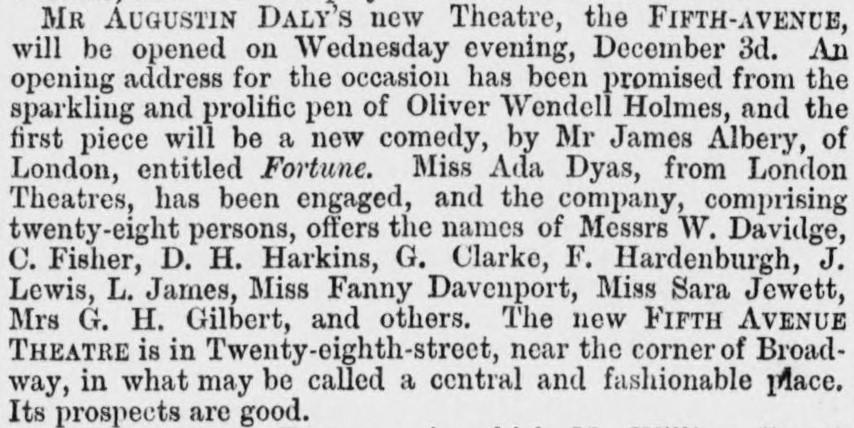
Just after she arrived in America on 31st December 1873, Ada Dyas was robbed while walking along Fourth Avenue from the Clarendon Hotel. A young man who had had several convictions for theft was caught after pick-pocketing her notebook, and when he was found guilty at court, he was sentenced to five years’ hard labour by the judge. So Ada and her father must have been staying there; the hotel was on the corner of 18th Street and Fourth Avenue. Ada was still in America on 24 March 1874, and ‘she was finding remarkable favour with audiences there’
It looks like Ada and her father came back to England for a short while after this engagement in Chicago.

Ada travelled back to America with her father, Edward, arriving on 26 Aug 1874 at the Port of New York, with her first appearance after this listed as being on 5th September 1874.
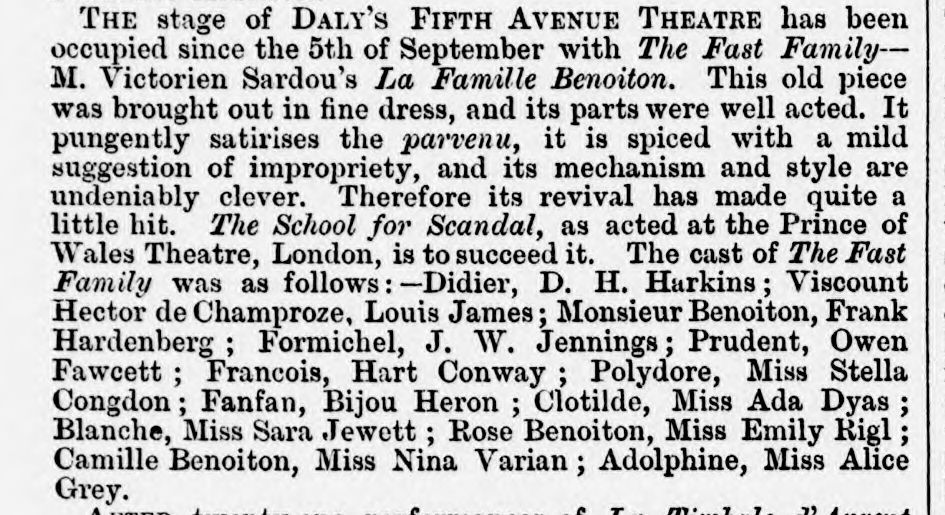
The ‘Fifth Avenue Theatre’ was located on West 28th Street near Broadway, and was Daly’s main venue before he built his later Broadway theatre in 1879.
Found in a Cronology of Dion Boucicault’s life: 1874: Journey to the Far West. Writes the burlesque Boucicault in California. Engages David Belasco, then a young actor, as his secretary. Belle Lamar (Booth’s Theatre). Revises Otway’s Venice Preserv’d. November: The Shaughraun premières at Wallack’s Theatre, New York. Engages Ada Dyas, now of Daly’s company, whom he had previously worked with in Hunted Down at the St. James’s Theatre’.
By the later part of the 19th century, Dion Boucicault was known on both sides of the Atlantic as one of the most successful actor-playwright-managers then in the English-speaking theatre (Wikipedia)
The next was an announcement, on the 10th and 11th October 1874, in the newspapers, that Miss Ada Dyas had left Daly’s company on Fifth Avenue and joined Wallack’s company. She is set to act as Lady Clancarty at Wallack’s Theatre.
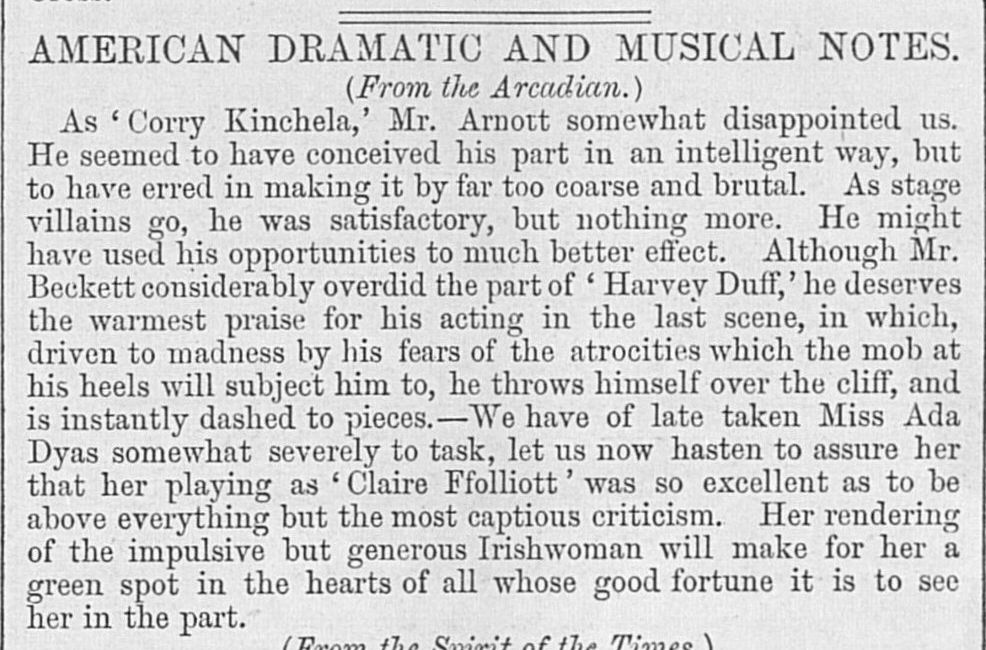
It looks like they both settled in America, and Ada’s Dad, Edward, was still looking out for her in 1876.
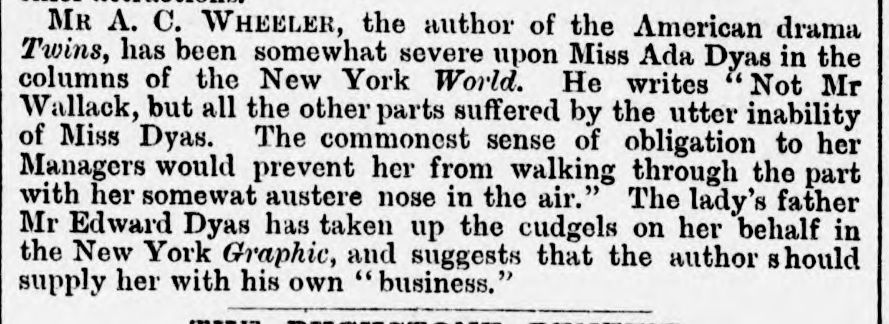
Mr Edward Dyas.
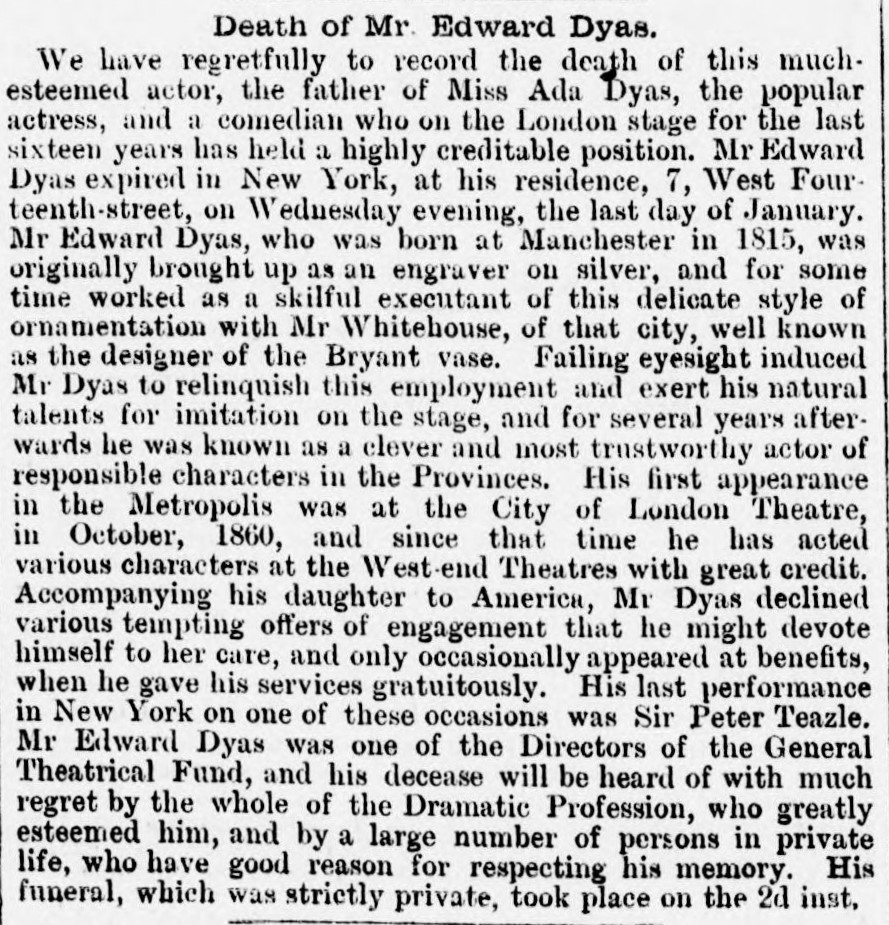
With news taking a few days from America, on 4 February 1877, it was reported in The Era that Edward Dyas was lying seriously ill at his New York residence.
Sadly, Edward Dyas had passed away on 31 January 1877 in Manhattan, New York. His loss must have been deeply felt by Ada, for he was not only her father but also her most devoted supporter. He was buried on 2 February 1877 at Green-Wood Cemetery, Green-Wood Heights, Kings County, New York, America. (Section 15, Lot 17263, Grave 897) Memorial ID154110708 on Find A Grave.
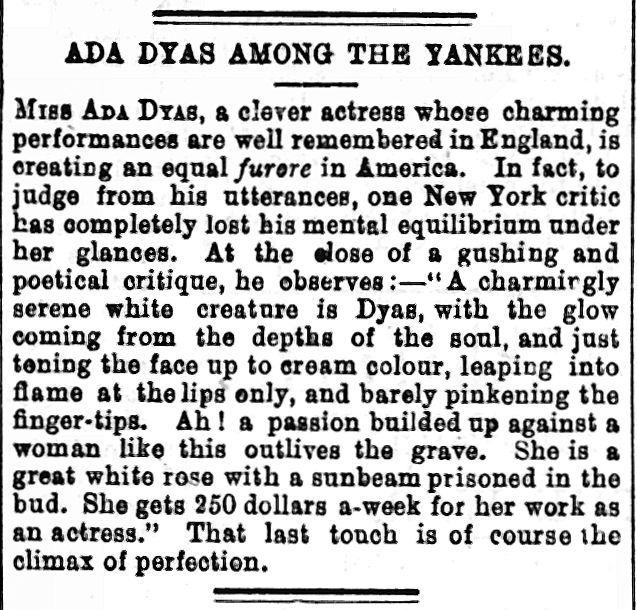
In 1878, the newspapers reported that Ada was earning 300 US dollars a week, equivalent to about £6,500 today.
She was a member of several prominent companies in New York, including Daly’s, Wallack’s, and the Madison Square Company.
Over the years, Ada did come back to England, visiting with another lady called Frances Peeslee, and then in August 1892, it was reported that she wished to perform once again in London, before she retired from the stage.
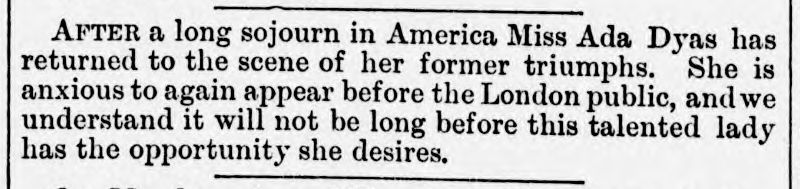
She actually appeared at the Lyceum in London in Sir Henry Irving’s revival of King Lear as Goneril at the end of 1892; she wore a brilliant robe of red and gold. Another actress you have probably heard of announced her retirement at this time, also performing in the same King Lear as Ada.
She continued to support The Royal General Theatrical Fund as her father had done, attending meetings for years after her retirement.
It was established in 1839 by a group of actors to support those in the profession who faced hardship. Charles Dickens was its first chairman. Today, it is still supported by the Royal Family and continues to be under the patronage of His Majesty King Charles III.
Death of Miss Ada Dyas.
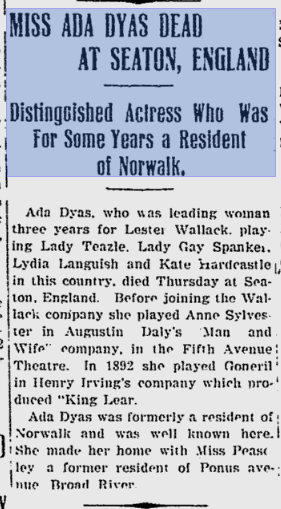
If you notice above, she stayed with a Miss Peasley/Peaslee of Ponus Avenue, Norwalk, Connecticut. I found Miss Frances Peaslee on the 1880 census of America, living at Ledgewood Farm, Norwalk, Fairfield, Connecticut, USA, and she was still there on the 1892 City Directory. Ada Dyas was also listed on the 1892 Directory, living with her. Frances Peaslee was still at the same farm until 1895 in the Directories of Norwalk. She must have been a good friend to Ada after being left on her own after her father had died.

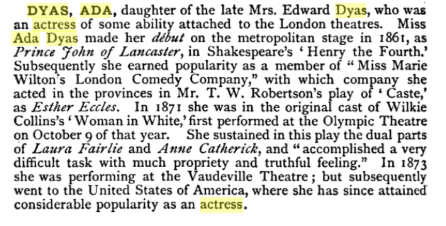
Our actors and actresses. Ada’s entry on the dramatic list by Charles Eyre Pascoe.
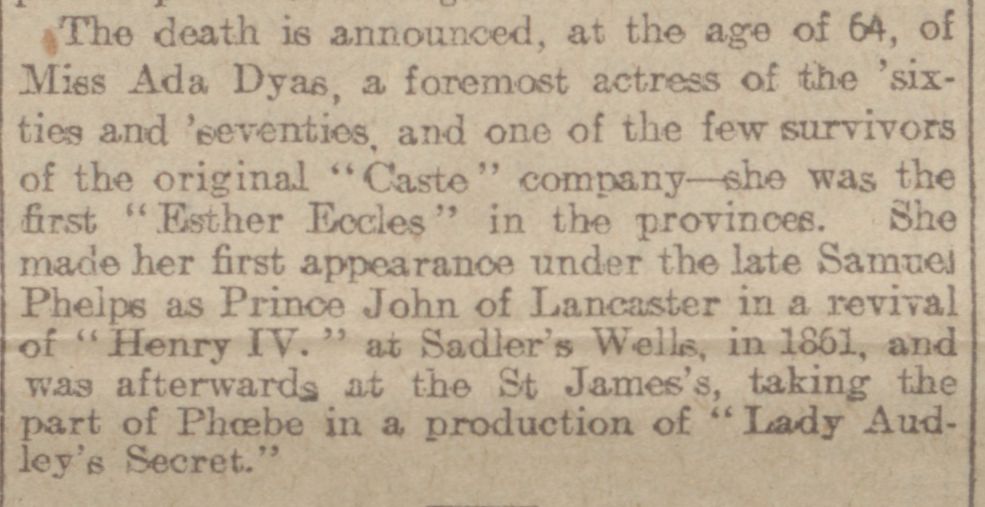
Of course, I wanted to know why she died so young at 64 and was sad to see that she had had breast cancer.

Frances may have moved to England after she left her farm in Norwalk. She was described as Ada’s adopted sister, so I’m assuming that she inherited her home in Seaton. A few months later, Frances went back to New York, America, arriving on 22 August 1908. Frances had been born on Christmas Day, 1844, in New Hampshire, America, and that was where she died aged 79 years old, on this day, the 16 October 1924. She was buried with her parents.

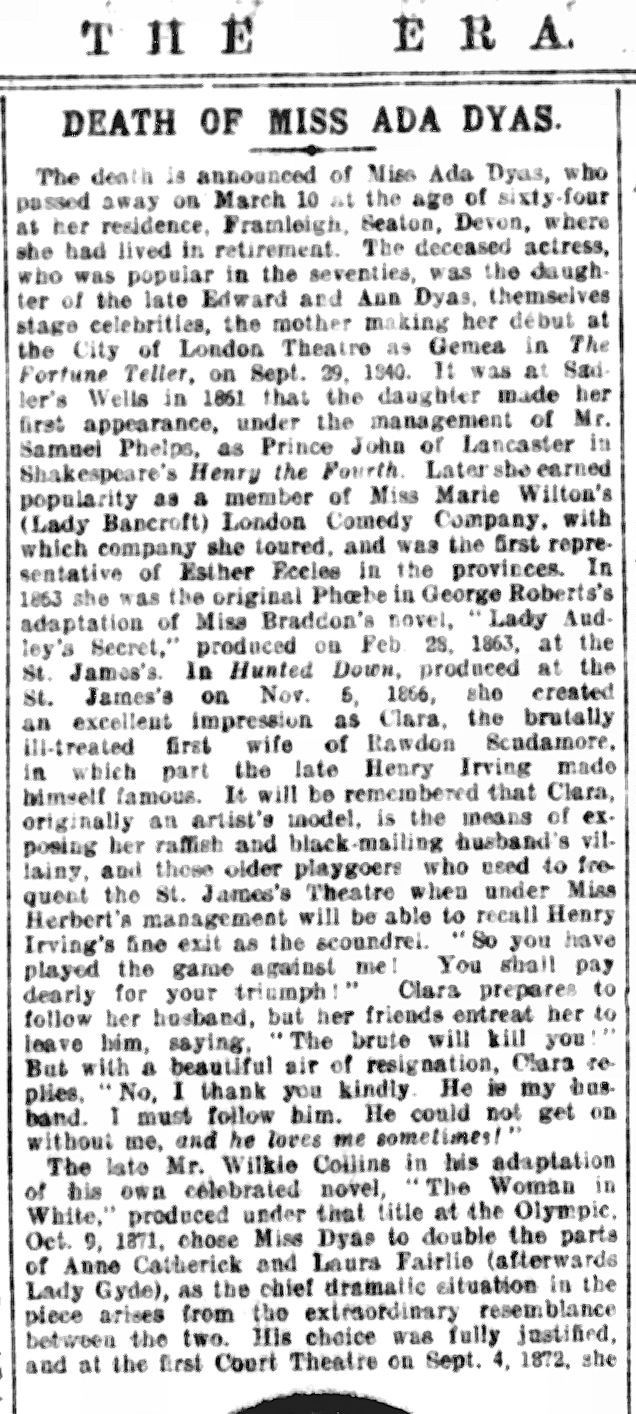
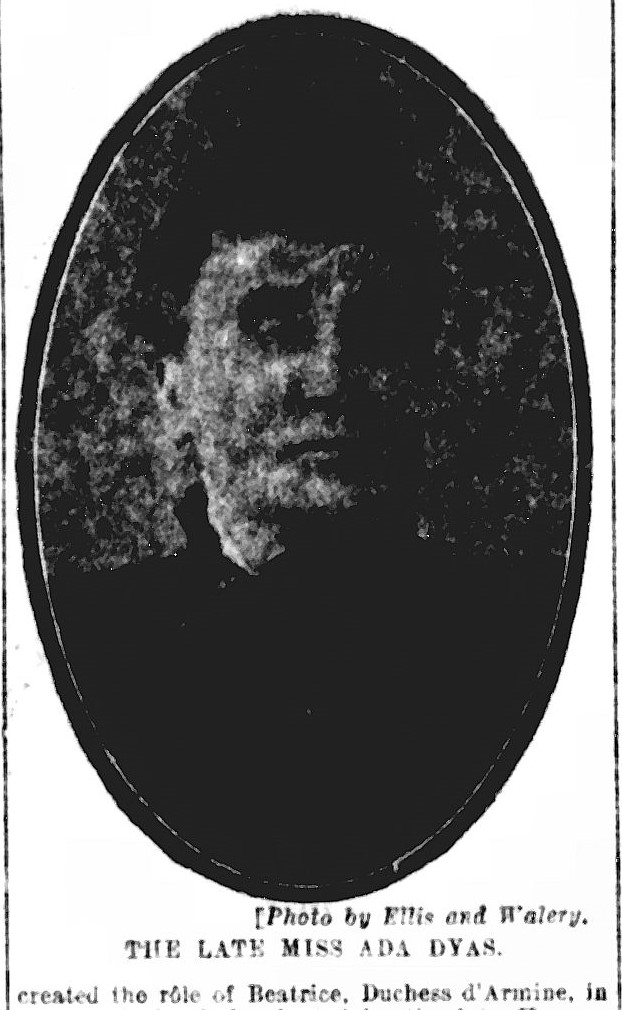
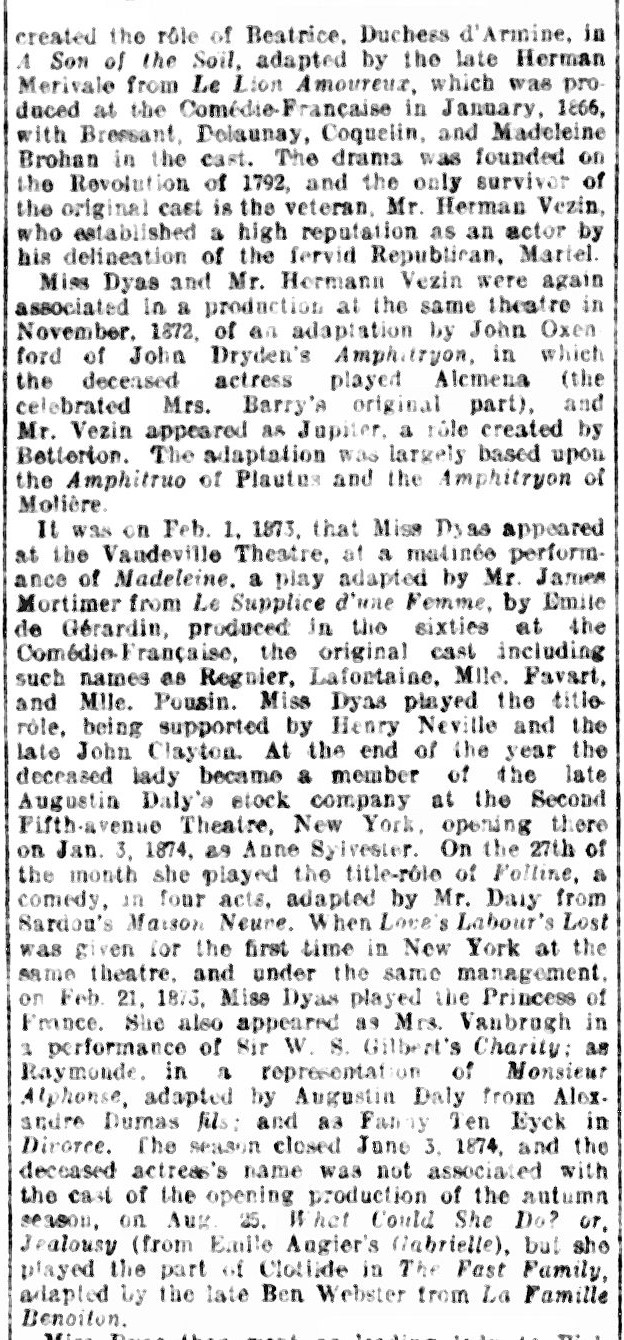
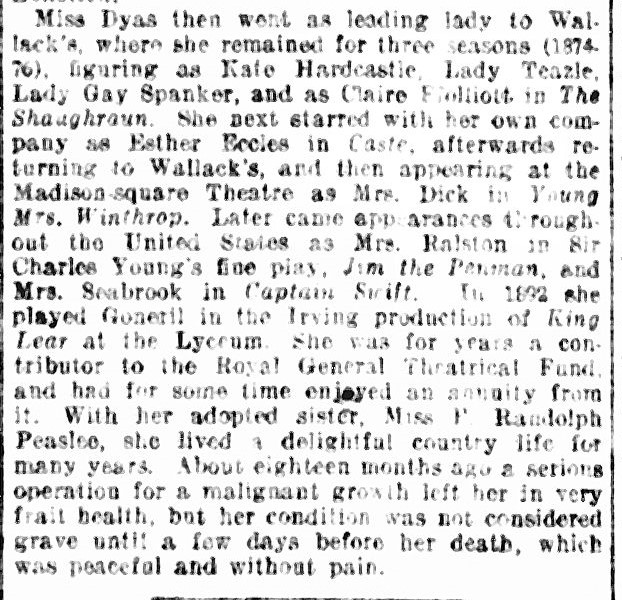
What a splendid obituary in the Era, giving us so much information, including some wonderful details about Frances Randolph Peaslee, who lived with Ada in Seaton after coming here from America. I have added Frances as Ada’s partner on the family tree I compiled on Ancestry, as I wanted to also do some research on her.
Here’s the small family tree on Ancestry: Miss Ada Dyas Family

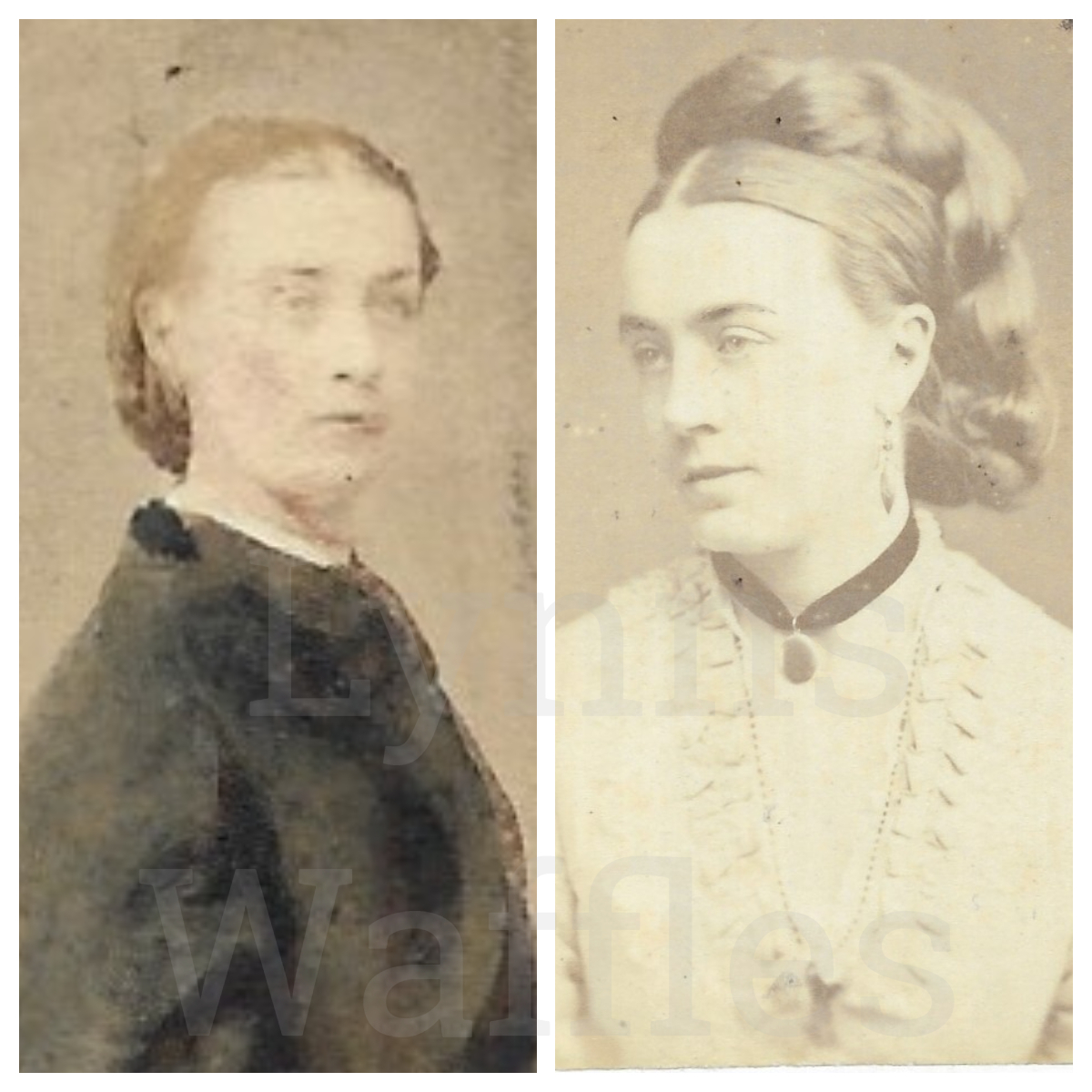
A little while after I bought the first CDV of Ada on eBay, I spotted another by a different seller for a good price, so I couldn’t resist, as it was taken a few years after the first CDV, and you can certainly see how Ada has changed and grown in confidence.
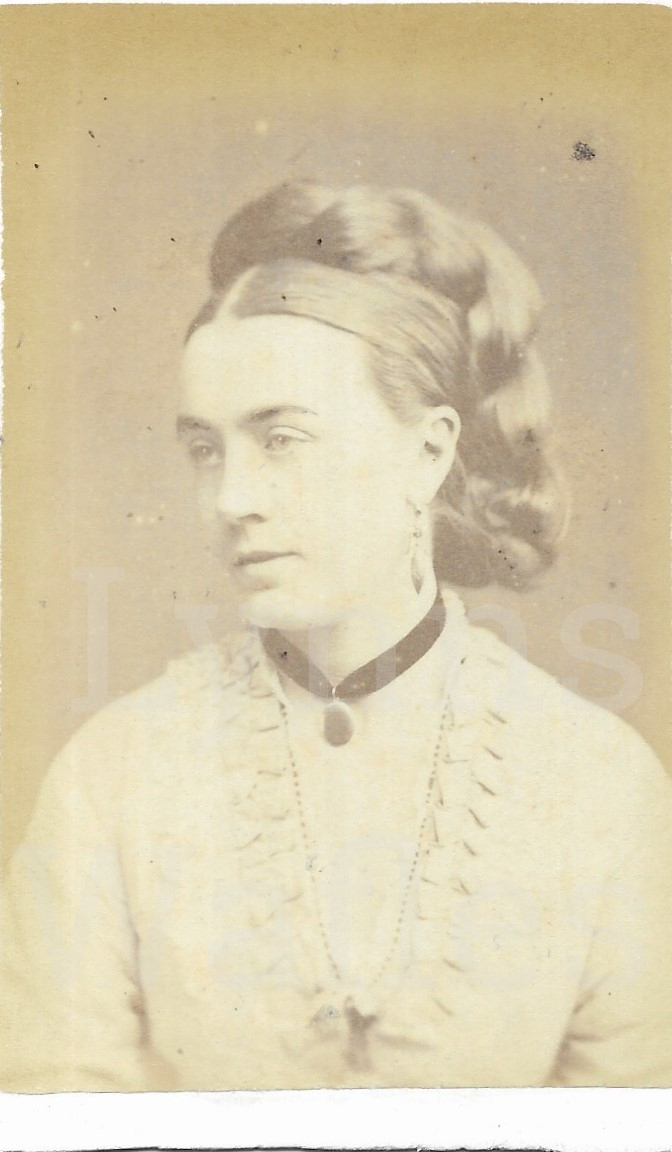
Comparison.

You can contact me either by commenting here or via email at lynnswaffles@gmail.com.
Till next time then…….
 lynnswaffles.com
All a little earlier than Mary Ansell! Most impressed with your blog piece on her in 2019, Lynn 👏🏻👏🏻👏🏻
LikeLiked by 1 person
Many thanks, that was really interesting to research too. Lynn
LikeLike