Update: As of 21 August 2025, I’m thrilled to tell you this whole collection is now in the very safe hands of a lady and her family who are descendants📚
Chapter 5

The Gellibrand & Gadesden Families.
Here we have two more families that have contributed to the existence of our couple through this collection of old photos. These are on the gentleman’s side, one from his paternal and one from his maternal side of the family. Starting in Hobart, Tasmania, Australia where this lady Annie Mary Gellibrand was born on 23 Sep 1861.

Annie married Frederick William Darby Robinson on 17 October 1893 in Marylebone, London, England. They had four children. Mary 1895-1949, Unnamed son 1896-1896, Walter Darby 1898-1978 and Frederic Darby 1899-1987. Annie died on 7 October 1934 in Barsham, Suffolk, England.
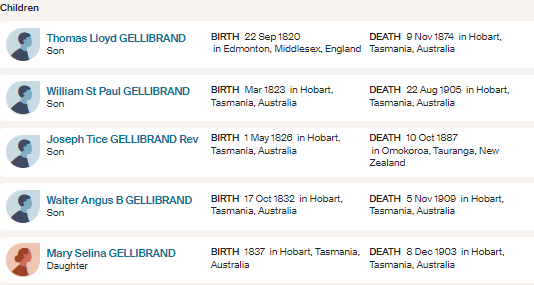
Annie was the eldest child of Thomas Lloyd Gellibrand (22 Sep 1820-9 Nov 1874) and Isabella (Brown). Thomas and his family were originally from Edmonton, Middlesex, England where he was born. His father Joseph Tice Gellibrand was born in Brentford, Middlesex, England on 8 Sep 1792. He has a fascinating life story “ He studied law, was called to the bar, and in August 1823 was appointed attorney-general of Tasmania at a salary of £700 a year, with the right “to practise as a barrister under the same restrictions as are observed in this country”. He arrived at Hobart accompanied by his father (William Gellibrand) on 15 March 1824″.(actually a year earlier)………more here from the Australian Dictionary of Australian Biography
Going by the dates of Joseph and his wife Ann Isabella (Kerby) Gellibrand‘s children, they must have travelled over to Australia between the births of two of their sons, Thomas Lloyd Gellibrand born 22 Sep 1820 in Edmonton, Middlesex, England and William St. Paul Gellibrand who I found out was born on the ship while travelling very close to Saint Paul between Africa and Australia, hence his middle name and he was Baptised 25 March 1823 in Tasmania, Australia. From what I’ve read Joseph’s father William Gellibrand (a non-conformist Preacher in England) definitely travelled to Van Diemen’s Land, later Tasmania, in Australia with the young couple and their eldest child and new baby son. William’s wife, Joseph’s mother, Sophia Louisa (Hynde) (29 Dec 1758-20 Nov 1793) had died when he was just a year old, he had no other siblings. William and his son Joseph went on to run very successful farming and other businesses in Australia.
William Gellibrand was the Grandson of another Preacher, the Rev Joseph Gellibrand (1726-1806) “The History & Antiquities of the Parish of Edmonton” By William Robinson p.120 1805-“Rev. Joseph Gellibrand, 48 Years pastor to a congregation of Protestant Dissenters in this Parish.” His Death Notice in The Gentleman’s Magazine 1806 Vol 26 part 1 ” 29 March Near 80 years old, the Rev Joseph Gellibrand, 50 years Pastor of the Presbyterian congregation at Edmonton. He had been dining at Mr Salte’s house at Totenham (sic), and after dinner, looking out of the window, and admiring the plants, he sunk down into his chair and expired. He was interred in the Edmonton churchyard in the week following.
Joseph Tice Gellibrand also became Attorney-General of Tasmania, but in 1826, was removed from office by Governor Arthur on charges made against him by persons who were later convicted of swindling, robbery of the Government, and murder. Joseph has an awful lot written about his life and death, with many conflicting versions of exactly how he lived and died but he is remembered in Australian history quite favourably in most. But after reading all the different reports I do have mixed feelings about him and the Gellibrand Family, especially as to how the family acquired all their land at the time.
Here is Joseph and Anne’s family group.

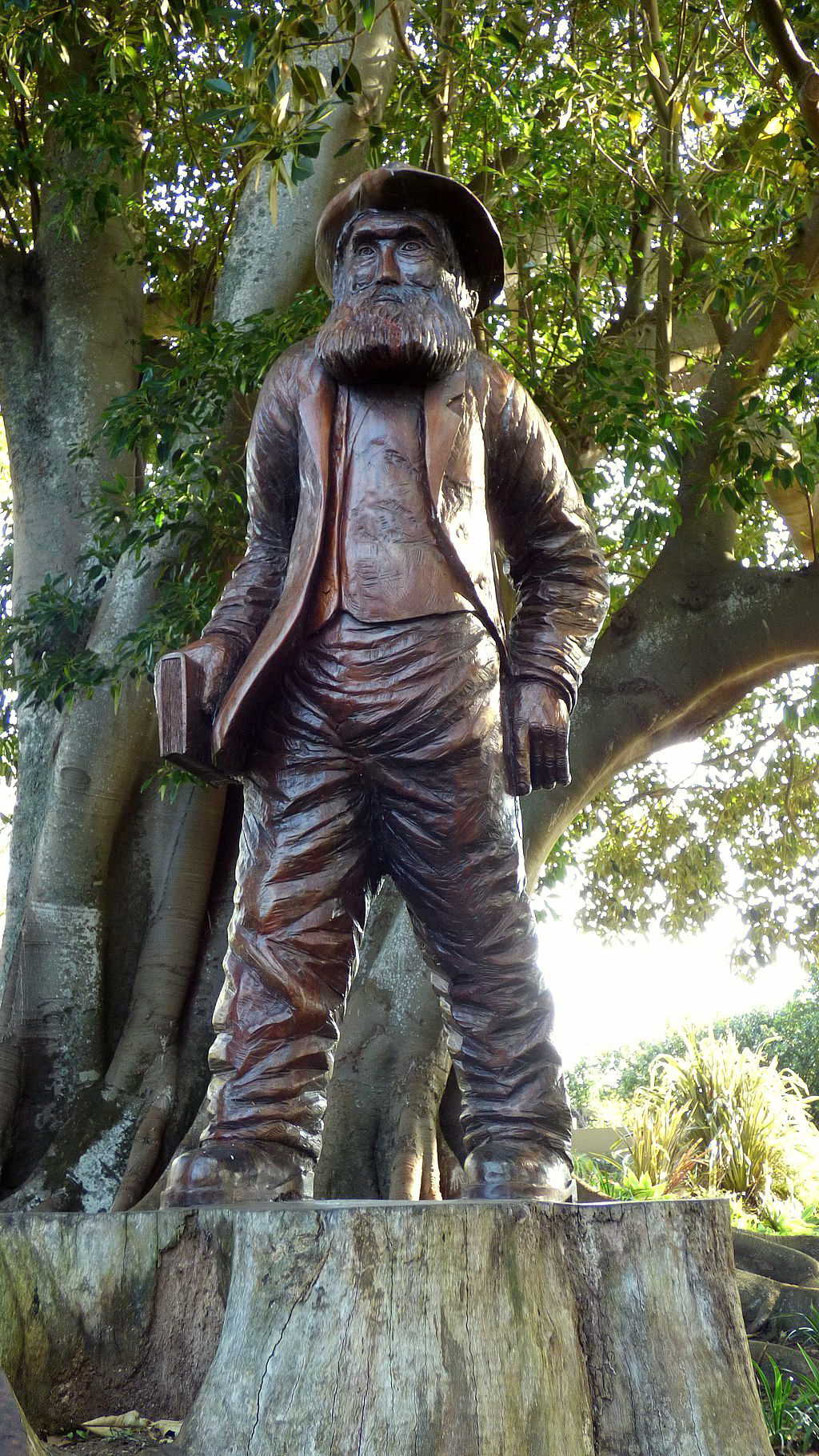
The couple’s third son Joseph Tice Gellibrand Jnr has a wonderful statue erected in his honour in New Zealand. “To commemorate Rev. Joseph Tice Gellibrand’s achievement and contribution to the history of European settlement in Omokoroa, a statue of Reverend Gellibrand was made and placed in the Crapp Reserve on the Omokoroa Peninsula. The sculptor was Warwick Lilley of Rotorua. It was unveiled on 25 March 2012“.
“Mr J T Gellibrand Jnr was a gentleman of sterling and unselfish
character, which might be exemplified by many incidents in his career. In a little memorandum book which he kept he had written his own epitaph thus: “In memory of Joseph Tice Gellibrand, born May Ist, 1826. To live in hearts we leave behind is not to die.“
The majority of the following paragraphs are snippets from various accounts written about family members in the press and Obituaries that I have read:
Joseph Tice Gellibrand was the first solicitor registered to practice in Van Diemen’s Land and was admitted to the bar of the Supreme Court of Tasmania today, by the Chief Justice. (Mr Justice Crisp), on the application of Mr Leo Doyle, M.H.A.
Joseph Tice Gellibrand was also a member of, the Port Phillip Trading Company. He drafted the famous treaty made by Batman in 1835 with the native chiefs of the Port Phillip district. His career in Tasmania was marked by energy, ability and independence, which led him often into conflict with Governor Arthur, under whom he was Attorney-General.
He lost his life in the bush in 1837.
This is one of the best full accounts of the disappearance and death of Joseph Tice Gellibrand and George Brooks Legrew Hesse, near Birregurra early in 1837:
FATHER AND SON. The Rev. John West, in his “History of Tasmania,” published In 1852, wrote of the original member of the Gellibrand family, and his son Joseph: “Mr William Gellibrand, was a person of intellectual tastes and lofty spirit. His early life had been spent among liberal politicians; he was a zealous advocate of freedom, but still more of knowledge and virtue. His son “Mr Joseph Tice Gellibrand was a lawyer of popular talents, whose practice as a barrister made the office of little importance and who, when discarded by Lieut Governor Arthur, opposed him with incessant vigour. His eloquence was never exhausted, and his learning as a lawyer obtained his consideration from the court, which his boldness as a leader often threw into jeopardy.”
Joseph Tice Gellibrand’s son Thomas Lloyd Gellibrand was born in 1820 and educated at Thompson’s Academy in Melville Street. In 1848 Sir H. Dennison placed the young colonist who had commenced farming on his own account in the Hamilton district, in the Commission of the Peace, and here on the banks of the Dee, Mr T L Gellibrand formed an extensive sheep farm.
In September 1855 he was elected a Member of the first House of Assembly for the district of Cumberland, in which he resided and sat in the House a useful active member till the dissolution of the House in 1861. In the I860 Session, he saw the necessity of protecting the game of his native country and brought in the first Bill which became law on the subject and which is still in force.
Here is Thomas Lloyd and Isabella’s family group.
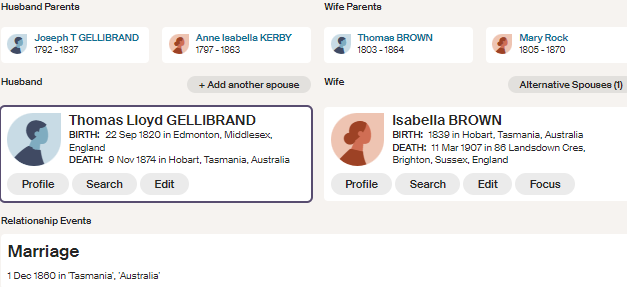

Obituary. Thomas Lloyd Gellibrand married a daughter of Mr Thomas Brown the well-known merchant of the New Wharf, and has several children, the youngest being only a few weeks old. His wife’s brother’s death (John Brown 1841-1874)by accident occurred on the 5th Nov 1874, and whilst mourning the death of a favourite brother, Mrs Gellibrand has now to mourn the death of a husband on 9 Nov 1874. To Mr Thomas L Gellibrand the inhabitants of the Bothwell and Hamilton Districts are indebted for the security of the water supply of the Clyde River, which is a well-known rise in the Lakes Crescent and Sorell and which in l856-7, he took great pains to legislate for. Useful colonists of this type, educated, active, zealous men, always eager to push on the latent resources of the colony, are fast fading away. Day after day has the record of the loss of one after another, whilst their places, which should be filled by their sons or relatives, are either vacant, by the emigration of those who should fill them, to other lands, where they are more highly appreciated, and much more highly remunerated. An active magistrate – a good master – a kind father and husband –Mr Thomas Lloyd Gellibrand has gone to the fullness of repose.

This next CDV photo is another of Joseph Tice Gellibrand’s sons. His Obituary gives you a complete account of his life.

No 2. HON. W. A. B. GELLIBRAND. OBITUARY. It is with deep regret that we have to record the death of the Honourable Walter Angus Bethune Gellibrand, who passed away at his residence, Belle Vue, Fitzroy-place, early yesterday morning. The late Mr Gellibrand was born at Derwent-park, Moonah, on October 17, 1832, and had thus attained the ripe age of 77 years. His father, the late Mr Joseph Tice Gellibrand, was, on the constitution of the Supreme Court of Van Diemen’s Land, appointed the first Attorney-General of the colony, and came here with the first Chief Justice (Sir John Lewes Pedder) in the transport ‘Hibernia’, landing at Hobart on March 15, 1824 (should be 1823). Mr J T. Gellibrand was accompanied by his wife and several of their children, and also by his father. On the voyage to Van Diemen’s Land the late Mr William St Paul Gellibrand, the elder brother of the Honourable Walter Angus Bethune Gellibrand, was born. Mr Joseph Tice Gellibrand at once took up the duties of his office and for some years the work incidental to this, coupled with the large private practice in which he became engaged, occupied his whole time. A man of commanding presence and great forensic power, he swayed the law courts in the early days of Van Diemen’s Land as no barrister has done since, and when the work of the Supreme Court was far greater than it now is, as the early records of the colony show, he enjoyed the major portion of the honours and emoluments of the bar. His adventurous spirit and love of enterprise, however, soon caused him to embark on another undertaking, and to take part in the first attempt to settle and colonise Port Phillip. All are aware of the disastrous result of the loss of Mr Hesse and Mr Joseph Tice Gellibrand somewhere between the sites now occupied by the town of Geelong and the city of Melbourne, and of the veil of mystery that still hangs like a dark shadow over their undiscovered fate. Mr Walter Angus Bethune Gellibrand received his early education in Tasmania, at the school in Macquarie Street conducted by the Reverend J. P. Gell. Some years after his father was lost at Port Phillip, however, Mrs Gellibrand returned to England with her young family, and Mr W. A. B. Gellibrand’s education was completed in the Old Country (England). He returned to Tasmania in the Wellington, then commanded by the late Captain William Crosby, in 1848, and shortly after his arrival here turned his attention to pastoral pursuits. After a few years spent in farm life, he went to the neighbouring colony of Victoria, which was then absorbed by the fever of the gold fields. A short sojourn was spent there, and he returned to Tasmania, and not long afterwards purchased the estate of Cleveland, at the Ouse, which had for many years previously been in the possession of the Gellibrand family. Here, almost without intermission, his remaining years were spent. The property was gradually added to and improved until it became one of the finest pastoral estates in the colony. On December 8, 1871, Mr. W. A. B. Gellibrand was elected in succession to the late Captain William Langdon to represent in the Legislative Council the constituency then known as Derwent, in which his property was situated, and he continued to represent this district uninterruptedly for the long period of 28 years. In 1884 he became President of the Council, a position which he held for several years. Throughout his long Parliamentary career, Mr. Gellibrand had ample opportunities to study and become intimately acquainted with the usages and practices of Parliament, and for many years he was regarded as one of the best authorities on constitutional law in this State. Mr Gellibrand was a man who held strong views on all subjects with which he was acquainted, and he never hesitated to speak his mind, his best friends, so to say, being not infrequently those who came in for the most caustic rebukes. A man of simple tastes and habits, and an able man of business, he rapidly accumulated money, and for many years past has been possessed of very considerable wealth, large portions of which he from time to time devoted to assisting and setting up in business relatives and friends who were not so amply endowed as he was with the comforts and luxuries that money can give. Indeed, it is not too much to say that Mr. Gelli- brand was always ready to render substantial assistance to a friend who was in distressed circumstances, and whom he felt satisfied would turn the money into a good account. Not uncommonly he did this by giving the recipient a start in life in the form of a cheque sufficiently large to clear off his liabilities or to stock a farm, and many who are now doing well owe everything they possessed to his generosity. His benefactions, moreover, were, never known. Mr. Gellibrand never spoke of them, and he made it clear to the friends whom he assisted that he did not wish them to do so; but the public ought to know, now that he has crossed the mists, that his munificent benefactions have totalled nearly £80,000, and very few people outside the recipients ever knew of it. During the last few years, Death has mowed down with a remorseless hand the descendants of the late Mr Joseph Tice Gellibrand, and the Hon W. A. B. Gellibrand at length remained the sole survivor of his generation. The splendour of Halley’s comet was approaching the confines of the earth when Mr W. A. B. Gellibrand was born. Seventy-seven years have rolled away, and once again, after its long journey of more than three-quarters of a century through the infinitude of space, the same great celestial visitor appears on the farthest horizon, heralding the close of his earthly career.

ARM END. At the northern end of South Arm, near Opossum Bay, is a historic vault, wherein repose the mortal remains of three members of a prominent Tasmanian family. William Gellibrand (1765-1840), Thomas Lloyd Gellibrand, and William Angus Bethune Gellibrand (1832-1909). “In respectful memory of William Gellibrand, Esq, J.P, the original grantee of South Arm, and father of the first Attorney-General of this colony, who died at Hobart Town on September 27, 1840, aged 75 years.” So runs a portion of the inscription on the tombstone relating to the ancestral head of a family that has played a notable part in the history of Tasmania and Australia.

The family arrived and settled at South Arm, where the vault is located. In the days before public cemeteries were proclaimed, many early settlers were buried on their own properties.
Williamstown Colony 29 Jun 1940. OUT OF THE PAST. On 29th June 1836, just 104 years ago, the cutter “Van Stittart” (Captain Leslie in charge) arrived at Port Phillip with 450 sheep from Van Diemen’s Land (now Tasmania). Its only passengers were Dr. Cotter and Joseph Tice Gellibrand who were associated with Batman and the Port Phillip Company, whence the selection of his name to denote the point on the peninsula of the seashore lands of the Doutta Galla territory, said to be acquired from the aborigines.
This is from the Arm End website: “Arm End at the Gellibrand Point Nature Recreation Area, is Aboriginal land. The spectacular headland at the tip of the South Arm peninsula forms part of the traditional lands of the Mumirimina People of the Southeast Nation who cared for the Country since Deep Time. Arm End acknowledges the Aboriginal people of Lutruwita / Tasmania as ongoing custodians of the Country“. Lots more here: Arm End
This page below on the Arm End website speaks volumes about the awful impact that the people from other countries had during these times on the native people of Australia, the Gellibrands included.


The Gadesden Family. Our first CDV photo of this family was taken pre-1865 by George and John Hall, photographers at 26 Westgate, Wakefield, Yorkshire.
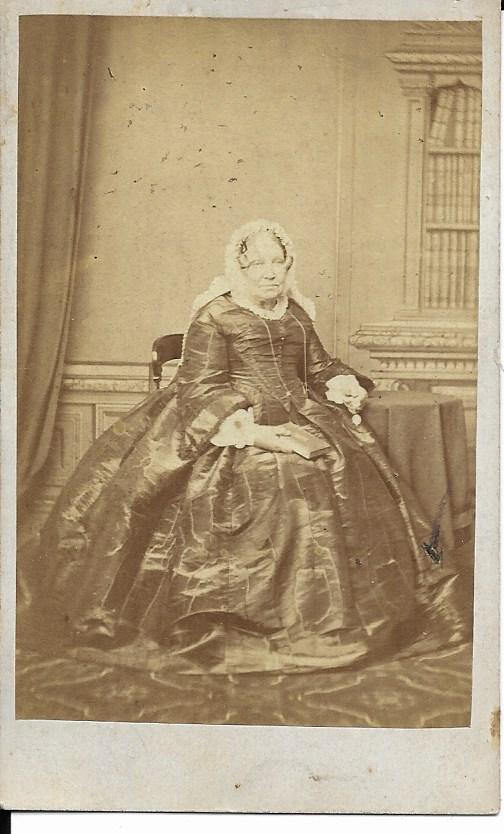
Once again due to the extensive tree I had compiled I was able to identify this lady as being Maria ANSELL who was born in 1791 in Penrith, Cumberland, the daughter of John Ansell and Margaret (Robison). She married James GADESDEN on 10 March 1811 in Lambeth, Surrey. They had six children Harriet Eliza 1811-1897, Mary Ansell 1812-1896, Maria Louise 1814-1830, Augustus William 1816-1901, Georgiana Day 1818-1820 and Emma Warden born in 1825. She died on 10 August 1877 in Ewell, Surrey.
James Gadesden bought Ewell Castle in 1852, although he was already there as a lessee in the 1851 census with his wife, Maria (Ansell). James was in sugar refining and had various partners, particularly a man named William Wainwright, and Samuel Thornton. He and Wainwright remained partners for many years and then when his only son, Augustus William, had completed his seven-year apprenticeship with Thornton, the business became Gadesden and Son, with premises in London. After James died in December 1856, Augustus inherited Ewell Castle and of course, the business and under Augustus William Gadesden the company flourished. Maria his mother moved to Hessle House, Ewell. Augustus William was in partnership with William Wainwright (1808-1888) William was married to Harriet Eliza Gadesden, Augustus’s sister. Harriet and William Wainwright lived at Hoe Place, Woking, Surrey. No 4. Below Augustus William Gadesden.

While researching the Gadesden family I came across this splendid website the Epsom and Ewell History Explorer. They have three super blogs with lots of photos, all about the Gadesden Family written in 2011 by Linda Jackson, well worth a read if you are interested in finding out lots more about the family. Link here to part 1: Epsom and Ewell
No 5. Mary Ansell GADESDEN was born on 1 October 1812 to James Gadesden and Maria (Ansell). Mary married Edward Priestley COOPER (he was a Barrister) on 8 May 1850 in Ewell, Surrey. Mary was 37 and Edward was 45. They had three children Maria b1853, Edward Augustus 1853-1923 and Charles Joseph 1855-1897. Tragically Edward died in October 1857 when the children were still young. Mary died on 19 February 1896 she was 83 years.

Both of these families as I have said at the beginning lead to the gentleman of this couple but the connection is a bit complicated, but aren’t all families!
No 1. Annie Mary Gellibrand was the eldest child and daughter of Thomas Lloyd Gellibrand and Isabella Brown. No 2. Walter Angus Bethune Gellibrand was one of Thomas Lloyd Gellibrand‘s brothers.
When Thomas Lloyd Gellibrand died his widow Isabella came back to England and there she met and married a gentleman by the name of Edward Ling in Plomesgate, Suffolk on 28 Dec 1876. The couple went on to have a daughter Muriel on 16 November 1877.
When Muriel was 23 she met and married in January 1901 to Ernest Wainwright in Kensington, London.
Ernest Harold Wainwright was the son of Sir James Gadesden Wainwright and his wife Emma.
Sir James Gadesden Wainwright was the son of William Wainwright and Harriet Eliza Gadesden.
Harriet Eliza Gadesden‘s parents were James Gadesden and No 3. Mary Ansell and No 4. Augustus William Gadesden and No 5. Mary Ansell Gadesden were Harriet‘s siblings.
A lovely mystery CDV, that I hopefully will be able to come back to in a later Chapter.

In Chapter 6 I will be sharing more old photos from this collection and we’ll find out a little more about the Ling and the Wainwright families.

Till next time then…….
 lynnswaffles.com