Update: As of 21 August 2025, I’m thrilled to tell you this whole collection is now in the very safe hands of a lady and her family who are descendants📚
Chapter 4

Badmondisfield
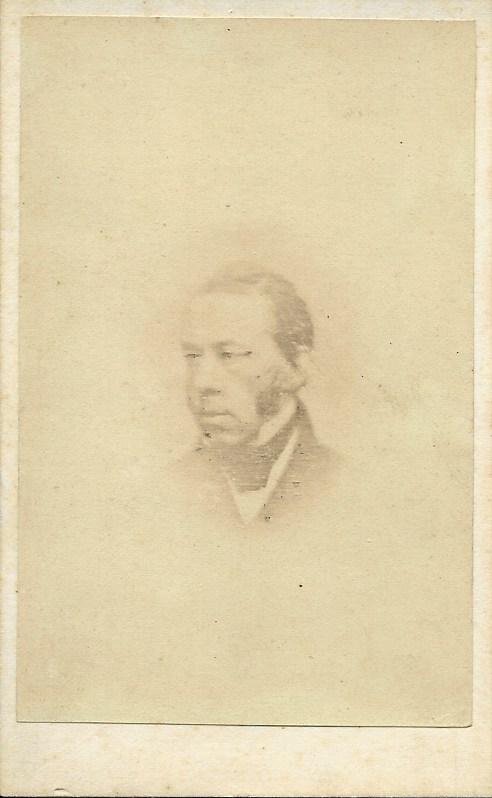
This first photo of Nathaniel Warner Barrett Bromley is very significant in the history of Badmondisfield Hall and Estate, originally and still through the years referred to sometimes as the Manor of Bansfield. This is the chap that lost it to the family in 1932 after over 250 years of ownership that started with the Warner’s. Nathaniel was not a good manager of finances or of the estate and sadly it had to be sold to recoup his losses, was it lost to the family though, his story is interesting, mostly told through the newspaper articles all about his downfall. But there was a twist in the tale to the family story because of the chap that bought it in 1932, so do read on.
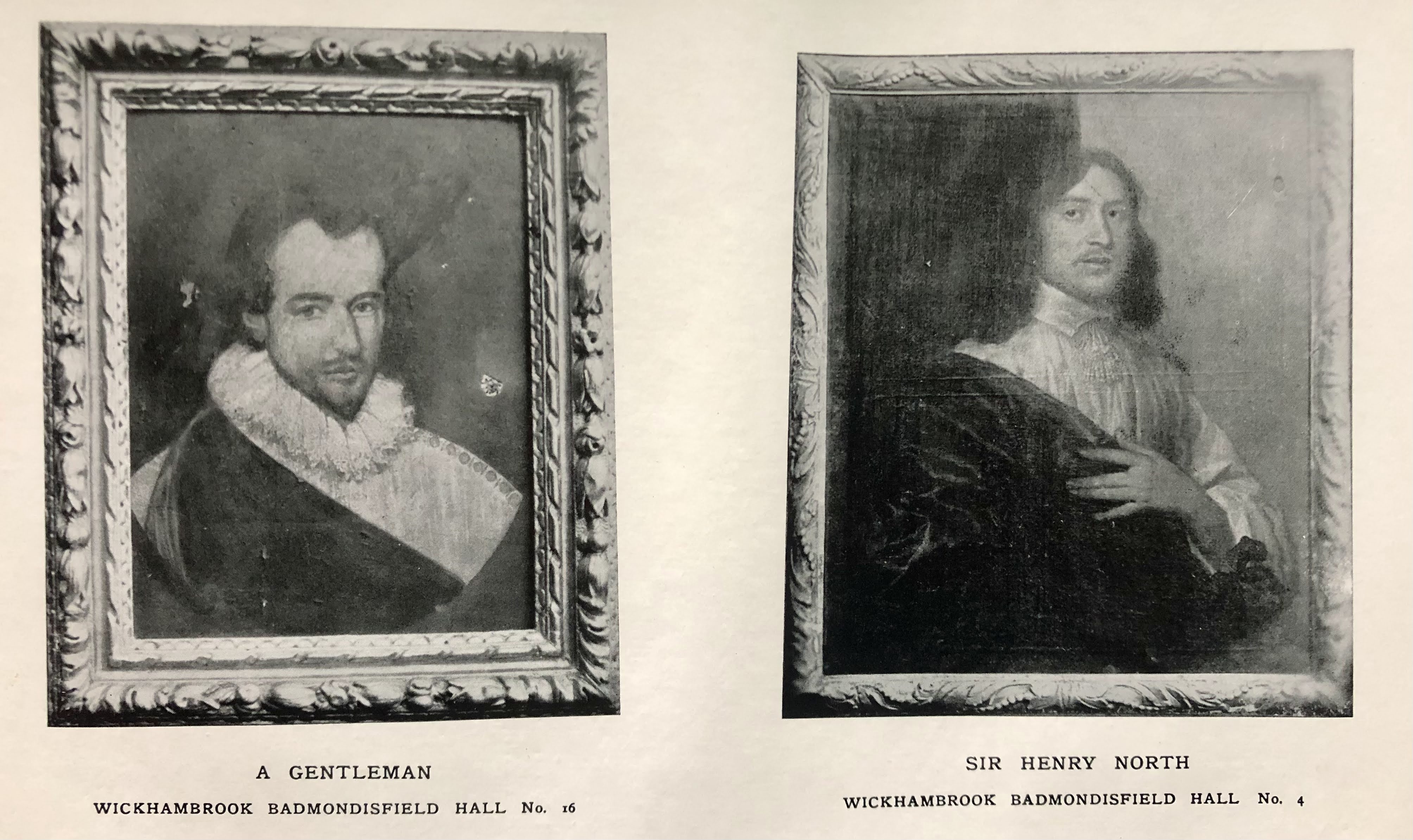
What I have tried to do, purely because I have become fascinated by the place, is to build up a timeline of Badmondisfield and who owned the hall and estate pre-1932 and beyond where I can. By looking at everything online, especially newspaper articles, going through mentions of the Hall and Estate and the people in the family, I have also been searching in Baptisms, Marriages and Deaths, and Wills to fill in lots of gaps and the Internet Archive website showing the text of some books was really helpful for building up the family tree, one book was ‘The Manors of Suffolk, The Hundreds of Lothingland and Mutford, Plomesgate, and Risbridge’, giving me lots of information about who owned what and when. I also found an absolute gem there of the text of ‘Portraits in Suffolk Houses by Edmund Farrer, published in 1908.’ I managed to find one on the internet and so I’ve sent off for it (11 Aug 23). I’m really excited for it to arrive and to be able to ‘see’ some of the people I’ve been researching. It will delay this blog a little but worth the wait I hope! (15 Aug 23) So the book wasn’t what I’d hoped for as the majority of the portraits were just described and not shown, so disappointing, but never mind it had one owner with his portrait Sir Henry North.
Excellent information on Badmondisfield Hall from the Suffolk County Council Heritage website, although the family history is a repeat of the text in the book ‘The Manors of Suffolk’ mentioned earlier. I have added some names and dates to some of the paragraphs below to make it clearer to understand.
Saxon Times. “Under the head Bademondesfelda no doubt Badmondisfield Hall we find Algar holding it in the Confessor’s time as a manor and as 10 carucates of land“.
“Badmondisfield Manor, or the Manor of Bansfield, as it was originally called, was given by Henry I (1100-1135) with the Honor of Montgomery to Baldwin de Boulers or Bulers on his marriage with Sibil de Falaise, to be held of the King in chief, and the Lord at the time of the compiling of the Hundred Rolls. Maud, the daughter and heir of Baldwin and Sibil, married Richard Fitz Urse, and they were succeeded by their son and heir, Reginald Fitz Urse, who left a daughter and heir Maud, married to Robert de Curtenai, who left a son, William de Curtenai, who died without issue. He died before 1242, as at that date Illaria Trusebut, widow of Robert de Bellers, held it in dower, and a partition was made of the estates of William de Curtenai between his heirs, William de Cantilupe and Vitalis Engaine. Vitalis Engaine, who had a moiety, died about 1249“.
“George de Cantilupe, grandson and heir of William, had a moiety, and died in 1273, leaving an infant heir. In 1274, a grant was made by King Edward I (1271-1307) to Eleanor, his consort, of the manor during the minority of the heir of George de Cantilupe, late tenant in chief. In 1292 John Engaine, 2nd son of Vitalis, sold his interest to Robert de Bures, Alice his wife, and James brother of Robert. The infant heir of George de Cantilupe, seems to have died young, and he was succeeded by his father’s nephew and heir, John de Hastings, 2nd Baron, who died seised of the lordship in 1312, leaving his wife Isabella and a son John“.
“There is an order on the Close Rolls this year to deliver to Isabella, late wife of John de Hastings, in dower with the assent of John, son of the said John, this manor, then of the yearly value of 19. 2s. 8d.” On the death of his mother John de Hastings, 3rd Baron, took the manor, and from this time to the death of Sir George Somerset in 1560 the manor devolved in the same course as the Manor of Reydon, in Blything Hundred“. More later *
“The manor is specifically mentioned in the inquest. p.m. of John de Hastings, 3rd Baron, in 1325, ‘ of Laurence Hastings, 4th Baron, in 1375,” and of Anne, widow of John, 2nd Earl of Pembroke, in 1382” Note: the 3rd Duke of Pembroke John de Hastings married King Edward III’s (1327-77) daughter Margaret and their son died with no children.
“The year previous to the extinction of the earldom, of Pembroke (as in 1389) the King exercised his right as guardian of the infant tenant-in-chief to present to the church of Badmondisfield. The presentation was of William Bauky ” to the free chapel of Badmonsfield ” void by the resignation of Simon Gaunstede.“
“On the Patent Rolls, we find this same year, no doubt shortly after the 3rd Earl of Pembroke’s death (1389) a grant for life to Thomas Upton of the keepership of the parks of Badmondisfield and Lidgate so long as they remain in the King’s hands”. Richard II (1377-1399)
“In 1541, the year his stepmother died, Sir George Somerset was called upon to show by what title he held the manor. He died in 1560 and was succeeded by his son and heir Charles Somerset. A fine was levied on the manor in 1565, by William Humberston against this Charles. Charles Somerset, it is said, sold the manor to Sir Henry North, and son of Roger, Lord North“.
More here* “In a letter written by Peter Le Neve to Sir John Rous, July I2th, 1725, referring to the descent of this manor, he says, strangely, that it came to “Reginald Lord Grey, of Ruthyn, his son John, Lord Grey, of Ruthyn, and grandson Edmund, 1st Earl of Kent, of this family; his son George and his son Richard, both Earls of Kent, succeeded in the possession thereof, but the last Earl consumed most of his great estate at play and among the rest, he first mortgaged and then sold this manor, and Reydon, to Charles Somerset, Earl of Worcester, who was then Lord Chamberlain to King Henry VIII (1509-1547) ancestor of the Duke of Beaufort, who by will dated 21st March 1574 and then Henry VIII gave it to his countess Elinor for life. Sir George Somerset, 3rd son to the said Earl, had it and Reydon by settlement, lived and died here on 10th May in the 2nd year of Elizabeth I (1560) his son and heir Charles had livery of Badmondisfield, who I suppose was possessed thereof in Elizabeth I (1558-1603) and after (1569) of the Queen, sold this and all other his lands, for I can find nothing of him after”.
“In the 1st year of King James I (1603-1625) or thereabouts Sir Henry North, Kent, youngest son of the Lord North, lived here in or about the year 1620, when he was High Sheriff of Suffolk. He left it to his son, Sir Roger North, Kent, and he to his son, Sir Henry North, Esq,(1600-1671) after he was made 1st Baronet of Mildenhall, who lived here before his father’s death, and he then removed to Mildenhall, (Sir Henry, was a melancholy man who shot himself in the manor house, Mildenhall on 29 August 1671) Sir Henry was succeeded by his son and heir, Sir Henry North, 2nd Baronet, and he died in 1695 without issue. So I suppose it is enjoyed by Sir Thomas Hanmer, Baronet, with the rest of the estate of that family”. Referring to this, the Mildenhall estate passed to Sir Thomas Hanmer, Henry’s nephew, who became a famous speaker of the House of Commons”.
“In 1674 Sir Henry North (the son) had 19 hearths here and 3 `for the Lodge. (Checked and Confirmed, Hearth taxes for Suffolk 1674. Page 309)” “He seems to have sold before his death, probably to Francis Warner, 2nd son of Robert Warner, of Cratfield and Elizabeth his wife, daughter of Alexander Courthorp, of Cromebroke in Kent“. Yes, he did sell to Francis Warner between 1675 and 1685 when Francis Warner died.
“The last Warner died in 1753 and by 1783 the estate was owned by Nathaniel Barrett and by Nathaniel Warner Bromley in 1837 “. This last paragraph confirms roughly what I had already found out about the owners from Francis Warner onwards.
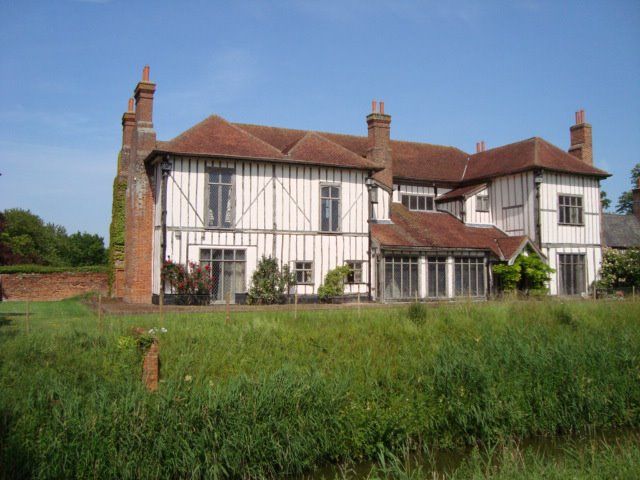
From The Suffolk County Heritage Website, a description of the property: Large sub-rectangular moat of 2.1 acres containing a substantial 15th-century timber-framed building with exposed framing, partly with plaster infill and partly with brick-nogging. Restored in the 20th century (S4). The house was considerably altered in the 18th century when the W cross-wing was largely rebuilt; the main access was by a 2-arched 18th-century brick bridge across the moat (S5). `Graceful little summer house with white plaster walls and a Georgian porch and windows’ beside the moat at TL 7473 5710 (S6). To the N of the moat is a large 6-acre enclosure bounded on the N by large ponds (?for fish). The enclosure was named Dovehouse Meadow in 1841 (S7). In 1841 there was an entrance causeway in line with the road approaching from the NE, destroyed by 1886 by the amalgamation of two ponds (S8). A tree-lined avenue, shown in 1841 and 1886, led from the entrance across the enclosure towards the bridge across the moat. To the NW of the moat, there is another linear pond (?again for fish, though possibly formalised in mid 19th century) and a smaller rectangular pond is shown between the linear pond and the moat in 1841 but had gone by 1886. A park adjoins the moat on the S side (see WBK 011), to which there is access by a timber bridge.
A chapel at Badmundisfield is mentioned in 1254 and 1291 (S9). In 1369/70 a grant of land was given to Walter Amyas, guardian of the chantry in the chapel of the manor of Bademundesfeld (S10). A free chapel dedicated to St Mary at Badmondisfield was granted to William Mansey, ironmonger of London in 1583 (S11). A free chapel known as St Edward’s Chapel is said to have stood `on a little island called St Edward’s Island within the moat before the hall door on the right side’. Built of timber, panelled with brick and covered with tiles.
“William Randall, of Thurlow Parva, aged 74, made a deposition to the following effect: “He doth remember when he was a child he did see our old decayed chapel standing within the great moat of Badmondesfield Hall, environed also by itself within a little island, which chapel being utterly decayed was pulled down by the appointment of Sir George Somerset. He well remembereth that about 50 years past, when Sir George came to live at Badmondesfield Hall, there was used in place of a chapel a little chamber over the porch, called the chapel chamber, unto which the gallery at the end of the hall did adjoin, and lie in part open, and that the household servants unto Sir George Somerset, and divers of the inhabitants of Badmondesfield each repairing unto the said gallery did usually hear divine service there, which they had notice of by the ringing of a bell which did hang next unto the said chapel chamber.“
Here are a few other little snippets of information that I have found in various records and books about Badmondisfield:
This statement is interesting but the date is incorrect, according to the records I’ve found: “In 1668 a city alderman Francis Warner bought it. The house contains panelling, carving, a great hall and musicians’ gallery, and moulded beams“.
The majority of the families that lived at Badmondisfield were Dissenters and non-conformists and supported worship on the Badmondisfield Estate in their own buildings.
“Richard Rawlin 1687-1757 was an Independent Minister, son of Richard Rawlin also an Independent Minister. He was trained by William Payne of Saffron Walden, Essex. His first settlement was as domestic Chaplain to Andrews Warner 1658-1717 (He was Francis Warner’s son) of Badmondisfield Hall, where he ministered to the congregation meeting in a barn on Warner’s estate. In 1716 he was chosen as Pastor for the Independent Church at Bishop’s Stortford, Hertfordshire“
Free chapel. “St. Mary at Badmondisfield
Mentioned in 1256. In patronage of the Hastings and Grey families. Granted to William Mansey (1538) No trace remains (1844) Free Chapel. St. Edward. Said to belong to Badmondisfield Hall and stood within its moat on an island called St. Edwards. Believed pulled down (1591) by order of Sir George Somerset, it being in a decayed state“.
“In 1717, when the manor passed to his son and heir, Poulett Warner, who married on 12th May 1713, Margaret (Mary, not Margaret I’ve found) daughter of Joseph Brooksbank, of London, died on 26th August 1721, leaving three daughters, all of whom died without issue, and the manor vested in Poulett’s brother, Nathaniel Warner, who married Ann (Parman?)(Seems it is PAMAN, parents Thomas and Anne (Stuteville) Not found a marriage yet) and died without issue on 8th Aug 1753“
“In 1789 the manor seems to have been vested in Nathaniel Barrett, and it belonged to Warner Bromley (Nathaniel Barrett’s sister Elizabeth had married William Bromley) in 1837. The manor in 1855 was held by Nathaniel Warner Bromley, who in 1861 married Henrietta Martha, daughter of Thomas Bradbury Winter, of Brighton, and died in 1896, leaving a son, Nathaniel Barrett Bromley, and the manor passed to his mother Henrietta, who is now Lady of the Manor“.
This is from a page in my book Suffolk Portraits, both from Badmondisfield Hall, shame the man on the left is unidentified but it’s good to see Sir Henry North, 2nd Baronet on the right he had suceeded his father as owner of Badmondisfield in 1671 and sold it to Francis Warner between 1675 and 1685.
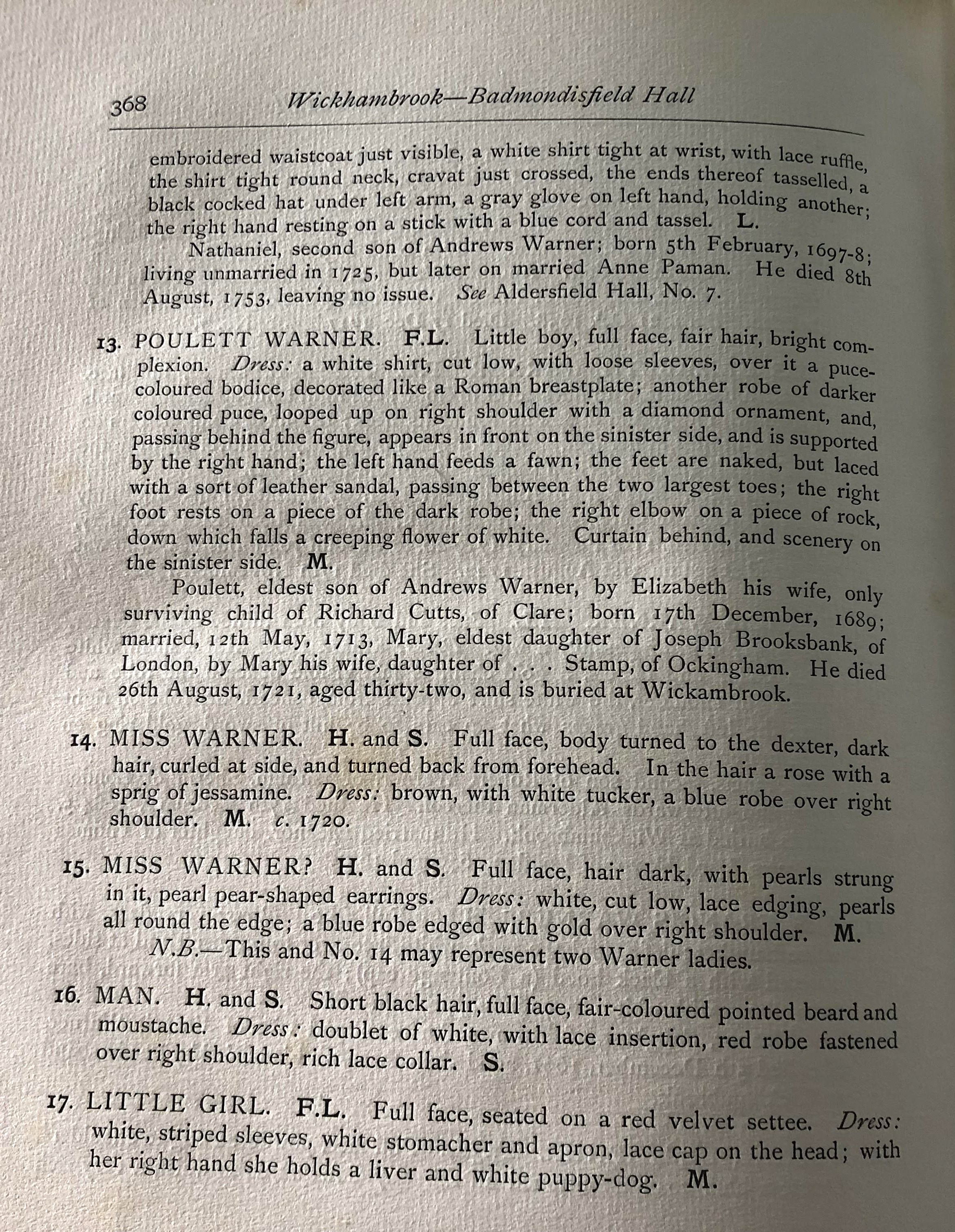
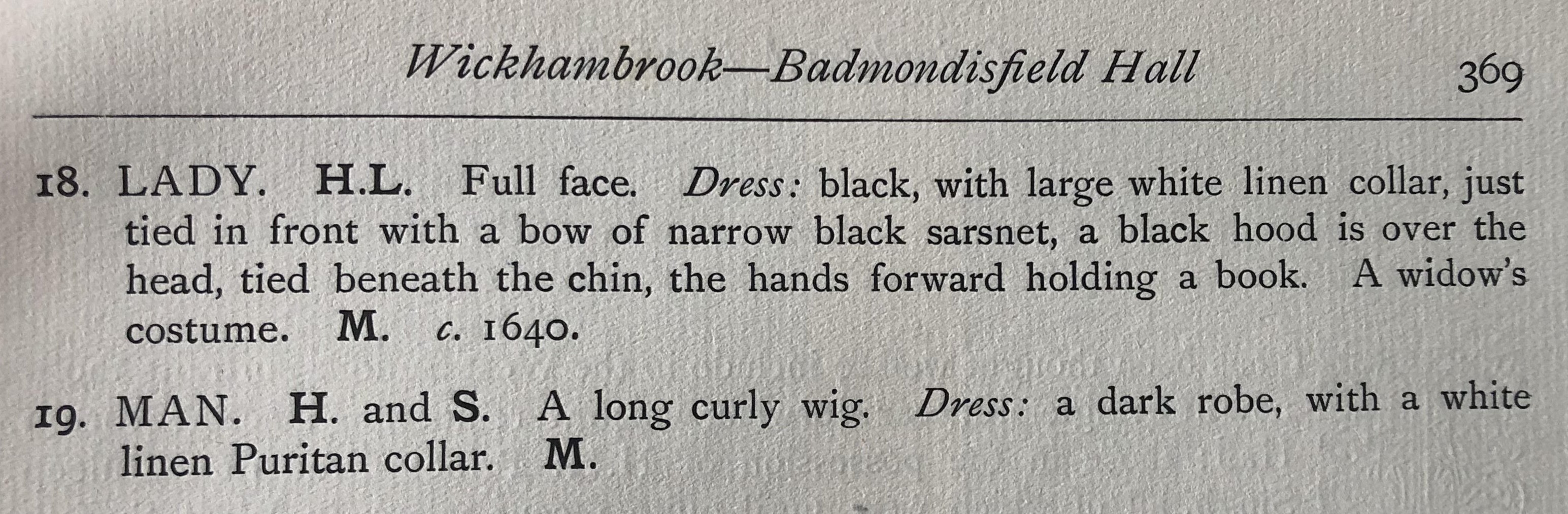
These are the pages of descriptions of the family that were in the Suffolk Portraits book, I would dearly love to have seen them all, I wonder where they are now?

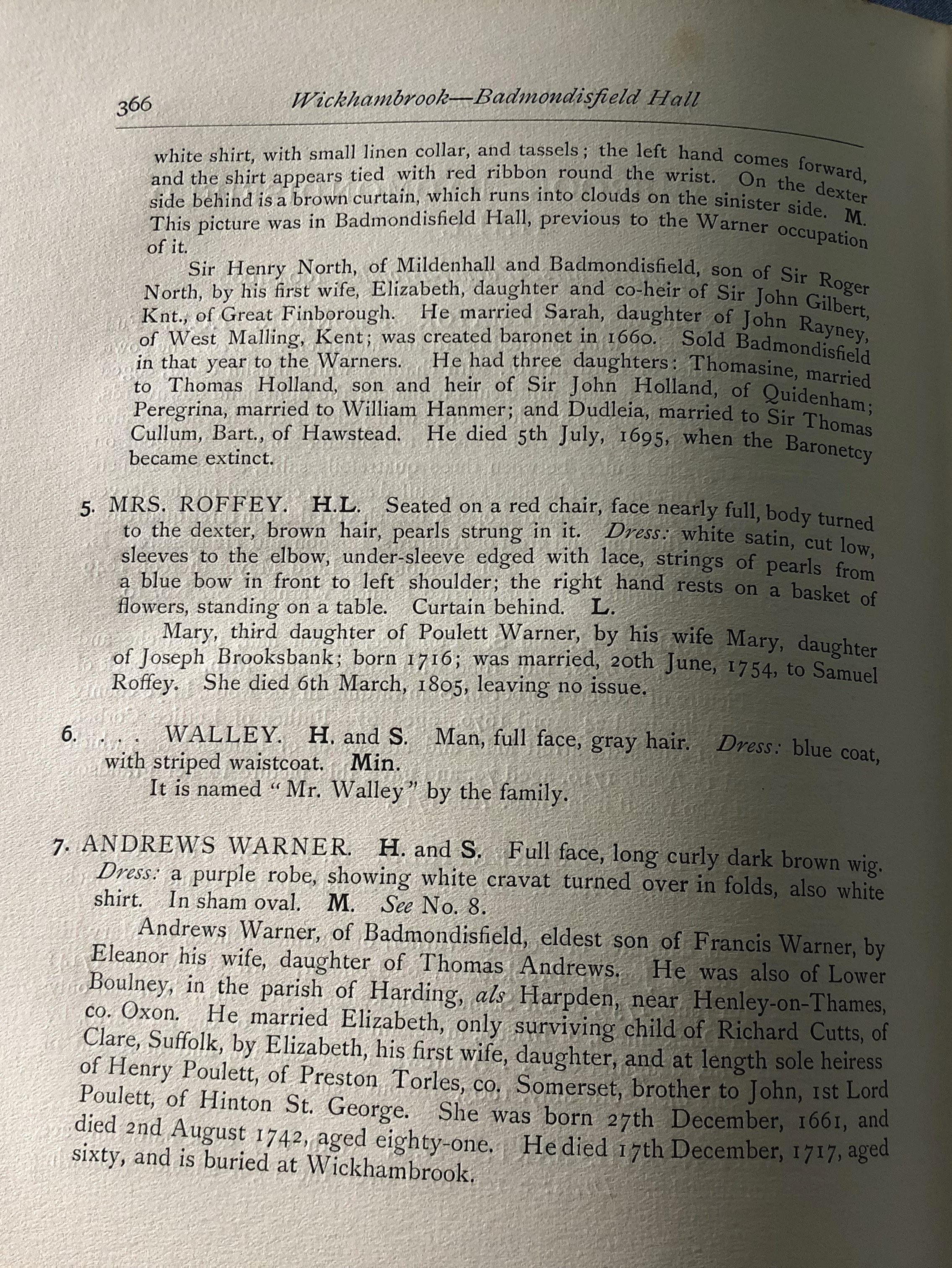
Good to have some family history mentioned on these pages, a couple of errors but on the whole correct with what I have found. This book was published in 1908 and written by Rev Edmund Farrer, FSA. Hinderclay Rectory, Suffolk.
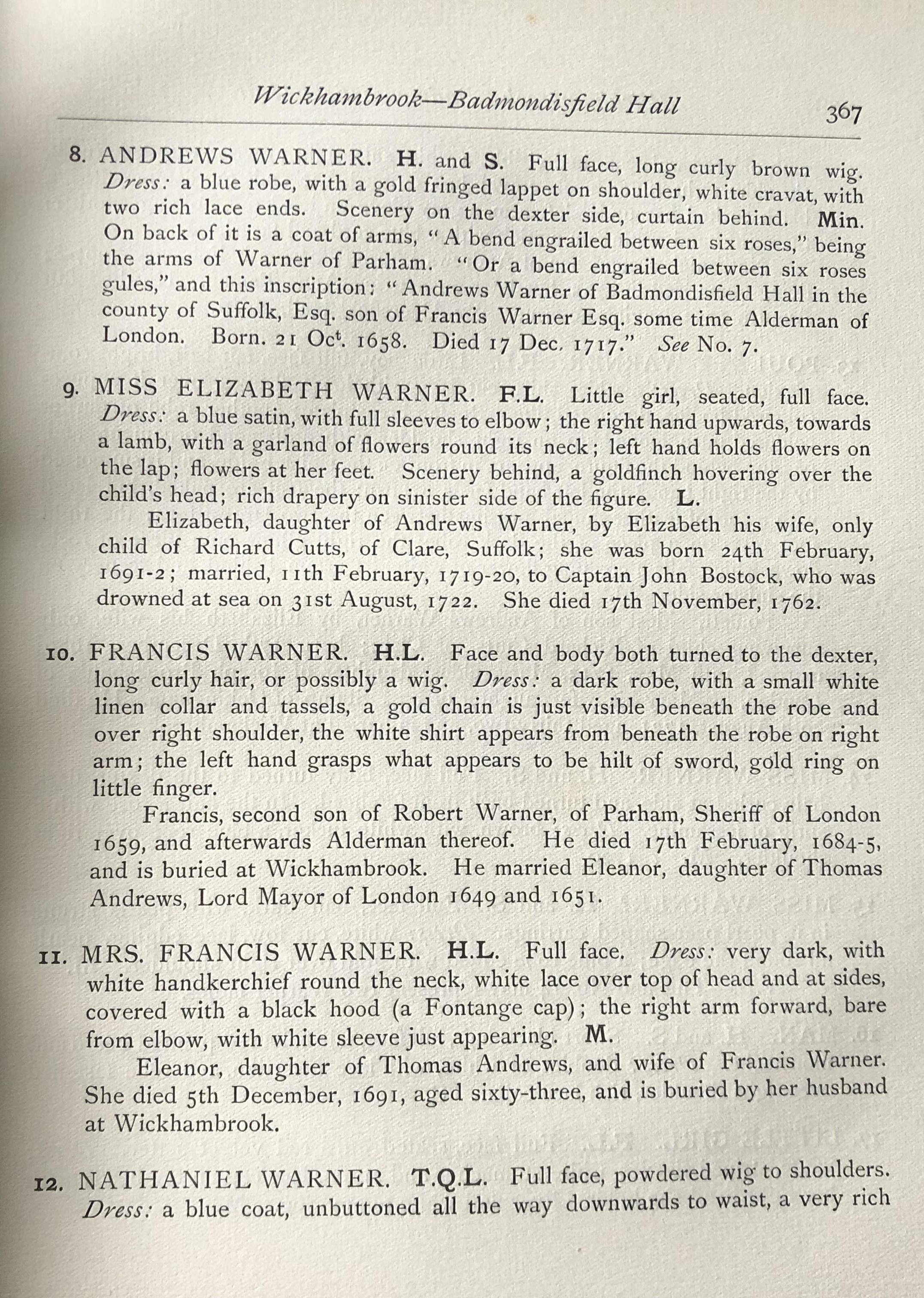
So after all my research, this is the line of ownership of Badmondisfield that I have compiled according to my extensive family tree:
Francis Warner 1614-1685 acquired Badmondisfield in the last ten years before his death.

it then passed to his son Andrews Warner 21 Oct 1658-17 Dec 1717

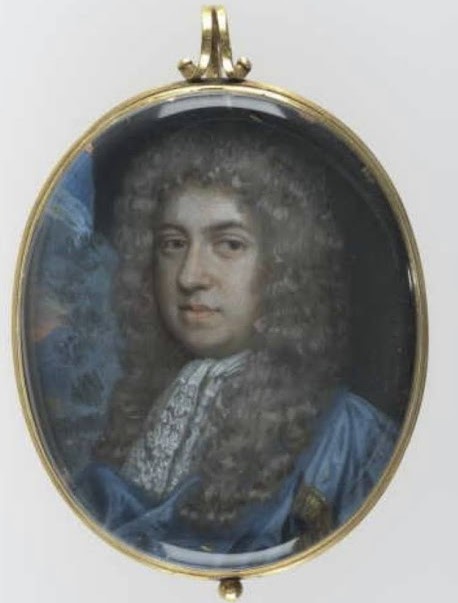
This decorative oval of Andrews Warner is described in my book and I was lucky to find this image of the same portrait on Ancestry. “H and S. Full face, long curly dark brown wig. Dress: a purple robe, showing white cravat turned over in folds, also white shirt. In sham oval“.
then to his eldest son Poulett Warner 17 Dec 1689-26 Aug 1721
next, it passed to his brother Nathaniel Warner 5 Feb 1697-8 Aug 1753
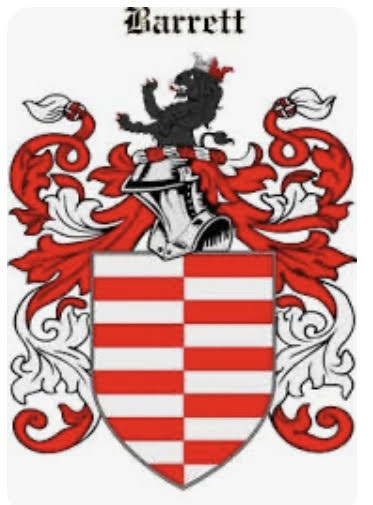
then onto his sister Demaris (Warner) Barrett 1700-1760 (Demaris had married Joseph Barrett 1698-1744) and nephew Nathaniel Barrett 1723-1789 jointly (son of Demaris and Joseph Barrett).
Heraldry and Family History. Information from a public tree on Ancestry: “Joseph Barrett was married (on 6 April 1721) to Demaris Warner. He was a Goldsmith and Silversmith in Cheapside, in the City of London. For a Goldsmith, banking business was often joined and several wealthy dissenters deposited their cash and title deeds with him. He also had an extensive knowledge of Heraldry that he put to good use in preparing pedigrees not only of his own family but also of families whose concerns came under his inspection. It may be the case that he documented much of the family information that was recorded on a document that was prepared soon after 1721. Joseph was also a liveryman and court assistant of the Worshipful Company of Goldsmiths but died in 1744 before he could serve in high office”.
Nathaniel Barrett was then the sole owner from 1760, after his mother Demaris’s death, until his death in 1789. Nathaniel had married in 1762 to Sarah Edwards but they had no children, Sarah remained at Badmondisfield until her death in 1796.
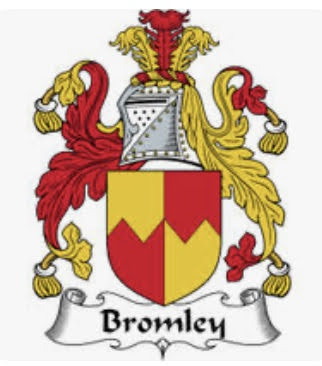
then it passed on to his nephew Nathaniel Warner Bromley 1756-1844, who was his sister Elizabeth Barrett‘s son, and daughter of Demaris and Joseph Barrett. Elizabeth (1722-1756) married William Bromley (1726-1802) in 1754 and they had just had one son as Elizabeth died 11 days after her son was born.
It seems Nathaniel Warner Bromley was a good caretaker of Badmondisfield, he married Sarah Wright (1759-1808) in 1783 and they had ten children. His will was originally written citing his eldest living son William Bromley to inherit from his father. Unfortunately, if you remember from Chapter 2, William Bromley was up in court around the time of his father’s death in 1844 and was declared bankrupt after committing fraud for many years. Before his death, his father Nathaniel Warner Bromley had added a codicil to his will naming his second living son Joseph Warner Bromley as his heir and not William, you will also find lots more about him and his family in Chapter 2 if you missed it. When Joseph Warner Bromley (1792-1860) died in 1860 his wife Amelia (Robarts) and daughter Clara, who was unmarried still continued to live at Badmondisfield for a while and then moved to Worcester after the 1861 census.
Following this move, Joseph and Amelia’s son Nathaniel Warner Bromley (1822-1896) took up residence at Badmondisfield with his wife Henrietta Martha (Winter) (1828-1914) and their family, they had 5 daughters and one son.

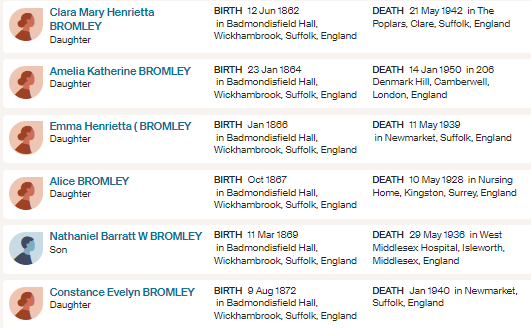
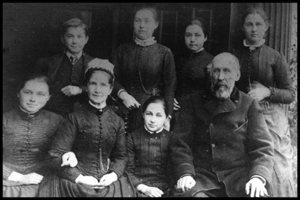
The photos below are from the Bansfield Benefice History site How absolutely wonderful to see the family, photos taken in the first half of the 1880s I would think looking at the ages of the children.
Front row left to right – Alice,b1867, Minnie (Henrietta Martha), Evelyn, b1872 and Nathaniel. Back row left to right – Nathaniel, b1869, Mary,b1862, Nettia, b1866 and Katie, b1864. It was Katie (Amelia Katherine) that would be the last Bromley to live at Badmondisfield, more on her later.
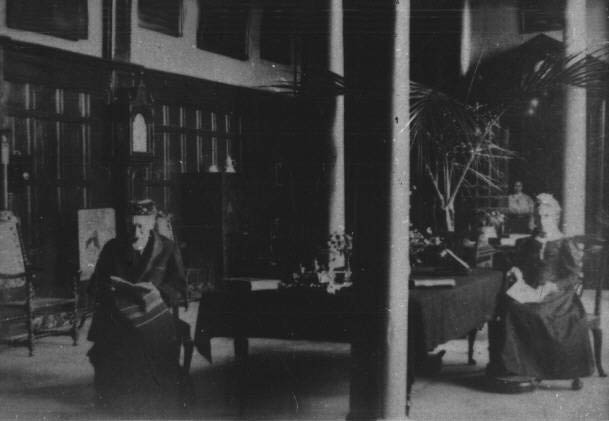
In 1884. 22 April, a Tuesday, there was an earthquake that shook Badmondisfield Hall, it lasted 45 seconds and happened at 17 and a half minutes past 9 in the morning.
After Nathaniel died in 1896 Henrietta continued to live at Badmondisfield with her unmarried daughters and her son who was a Solicitor, after his father’s death he became Lord of the Manor of Badmondisfield Hall, although he was still working as a Solicitor and his name was Nathaniel Warner Barrett Bromley. Yes, he’s the chap at the beginning of this Chapter. This is a transcription of newspaper articles detailing his affairs that lost him Badmondisfield and were discussed in court.
Mr N. B. W. Bromley’s Affairs.
Haverhill Echo – Saturday 20 February 1932
“In the London Bankruptcy Court on Wednesday a sitting was held before Mr Registrar Warmington for the public examination of Nathaniel Barrett Warner Bromley, described in the receiving order as late of Blomfield Street, London and of Uplands Park Road, Enfield, Middlesex. The debtor is well known at Wickhambrook, near Newmarket, having in 1896 inherited the Badmondisfield Hall estate. The debtor, who on October 13th last, was sentenced to three years’ penal servitude for fraudulent conversion, was brought up in the custody of warders. According to his statement of affairs. his gross liabilities are £66,571, of which £20,979 are due to 79 unsecured creditors. The total ranking liabilities is £23,019, and the assets are estimated to produce a net sum of £3,030. The latter include freehold land and the dwelling-house, Primrose Villa, aud freehold land at Nunnery Green, Wickhambrook, and also debentures in Worth Park Nurseries, Limited and another company.
Mr H. H. Gain, Assistant Official Receiver, attended, and, on examination by him, the debtor said that he was admitted as a solicitor in 1896. For about four years afterwards, he was a junior partner in a firm of solicitors. In 1900 he began to practise on his own account at the Wool Exchange, London, where he remained for a few years and then removed to Finsbury House, Blomfield Street, London, where he practised until recently. Conveyancing in general family work had formed his main business, and for some years he had a junior partner, who was called up for military service in 1914, In 1917 the partnership ended. As a result of the war he lost several clerks, and for part of that period was himself engaged in a Government department, Before the war he made about £2,000 a year, but the events mentioned caused his practice to fall off considerably, In fact, it had never recovered, and latterly it had declined owing to his being engaged in too many enterprises to enable him to give proper attention to it. The debtor considered that during the last three years, his average net profits had been about £7OO a year. 1t was on his father’s death in 1896 that he inherited the Badmondisfield Hall estate, comprising about 300 acres and including a mansion, arm lands and cottages. He expended considerable sums on the property and in acquiring and repairing other adjoining farms and cottage property. Over a number of years, he had increased the extent of his holding to some one thousand acres. This was for investment purposes, and he raised the necessary finance on a mortgage of the properties. He let the estate in farms, allotments, or cottage holdings, but in recent years he had taken over and farmed two of the properties himself, cultivating black currants and osiers (shoots of willow). These proved profitable, especially the osiers. However, in general, farming operations, he had sustained losses. Agriculture had been, the debtor said, at its worst state. He had made the estate his hobby to the detriment of his practice and his financial gain. In fact, he had given too much time to Suffolk. With a view to the development of the estate, he conceived the idea of running in conjunction a nursery business. In April 1921, he registered a private company called Worth Park Nurseries, Limited, with a nominal capital of £5OO. The Company rented part of his Suffolk estate and also land at Worth Park, Sussex. Ultimately, he became the sole shareholder, although the shares were now worthless, Late in 1923 or early 1924 a Debenture issue of £lO,OOO was authorised. He also financed the Company to a very considerable extent, but it proved a failure and in August last a receiver and manager were appointed. He anticipated that his loss in connection with the Company would be at least £7,000, The debtor attributed his failure to heavy expenditure on the upkeep and maintenance of his Suffolk estate and loss on farming operations, to loss on financing Worth Park Nurseries Ltd, to embarking on commercial enterprises to the detriment of his practice and to decline of his practice owing to lack of full attention; and to heavy payments for interest and life insurance premiums. In answer to counsel representing creditors, the debtor added that his downfall was not in any way due to the Hatry collapse, nor had he ever made any such allegation. As a matter of fact, Mr Hatry had treated him most generously regarding cash and expressed appreciation for his services. The examination was adjourned until March 9th“. Sentenced to three years in Jail. Name: Nathaniel Barrett Warner Bromley. Trial Age: 62. Record Type: Criminal Trial. Birth Date: 1869. Trial Date: 15 Oct 1931. Criminal Date: 1931. Occupation: Solicitor. Charge: Fraudulent Conversion, Sentence 3 years. Nathaniel died on 29 May 1936 in West Middlesex Hospital, Isleworth, Middlesex. Probate £5 only. To Frederick Bradbury Winter, Solicitor. Most likely one of his mother’s family.
More from the newspapers: 1932. “We note the following in the Times. A moated house in Suffolk, Badmondisfield Hall, Wickhambrook, is for sale with 72 acres or more by Messrs Kemsleys (Bishopsgate)“. 1932. “Good furniture for sale at Badmondisfield Hall“. 1932. “We understand that Mr F Griffiths Woollard, well-known in London’s automobile and civil engineering circles and Managing Director of Steele-Griffiths (Westminster) Ltd, is connected with purchasing Badmondisfield Hall, Wickhambrook. He is a direct descendant of the Warner family who were the owners of this old Elizabethan estate as far back as 1668“. In fact, it wasn’t Mr F Griffiths Woollard that bought Badmondisfield but Mr Frank Joseph Woollard.
1940. March. “An invitation had been received by Mr F J Woollard to hold the Wickhambrook and South Suffolk Agricultural Show at his home Badmondisfield, but due to the war, it was decided not to hold the show because of transport issues“.
Frank‘s father was Thomas Richard Woollard (1839-1914) a Grocer and Draper in Wickhambrook, his mother was Jane Elizabeth Pargeter (1843-1926). As yet I haven’t found a link back to the Warner family from his side. But the lady he was married to, did have links, in fact, she was Amelia Katherine Bromley (1864-1950)and one of Nathaniel Warner Barrett Bromley‘s five sisters! I’m sure her father Nathaniel would have been pleased to see it back in good hands. The couple really embraced living at Badmondisfield and enjoyed a good relationship with the local community too.
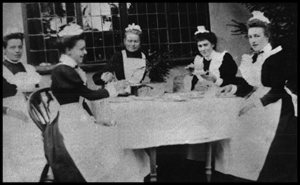
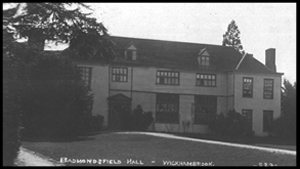
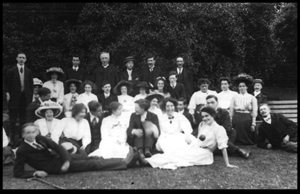
Frank died in 1947 at Badmondisfield, it looks likely that Amelia or maybe one of their three sons went to live at Badmondisfield till Amelia died in London on 14 January 1950, as after her death when it was sold, the family deposited all the family documents and history with Suffolk Archives, over 1,000 items! What a super thing to do! So Amelia was in fact the last Bromley to live there. So that makes 275 years owned by the same family beginning with Francis Warner. The photos below are also on the Bansfield Benefice History website.
After 1950 what I am able to find out about Badmondisfield is very sketchy but here’s a little of what I’ve found, mostly from the British Newspaper Archives:
1955. 13 Oct. Messrs Steele and Griffiths opened a new garage near Newmarket. They came from a local family who had owned Badmondisfield.
1957. 24 Jan. Mr Thomas Wilkin Everett died, he had worked in the past for some years for Mr N B Warner Bromley at Badmondisfield Hall.

1959. November. Badmondisfield Hall was withdrawn from the auction.

1960. 18 Feb. Badmondisfield sold to Mrs Jenny and Micheal Butterworth of Stebbing, Essex, a well-known writer and scriptwriter.
1972. 4 May. Badmondisfield Hall is for sale with Knight, Frank and Rutley, guide price £40,000-£50,000.
Update: I now know that the Prebbles Family bought it in 1972, see my Blog dated 2 November 2023. Private family photos.
1981. 26 Mar. Mr Basil Day, Ashcroft Rural Services is working at Badmondisfield Hall and estate, reclaiming an old pond and turning it into a lake, building dams and also improving the large wood in the hall’s grounds.

1986. 8 Aug. The Dissenters Charter for Badmondisfield Hall is to go on view. It is held by Suffolk Archives and is dated 1695.

1989. 20 July. Members of the Suffolk History Society were invited by the owner to make a visit to Badmondisfield Hall, no mention of who the owner was though!
1992. 22 May. Badmondisfield Hall is for sale with Hamptons.
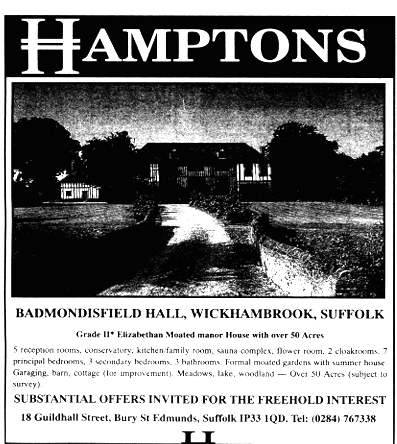
1992. 18 June. Newspaper Article. Mr Robert Medcalf died aged 86, he was an expert grower of roses and fruit trees and he learned his skills in the Nursery of Nathaniel Bromley, Badmondisfield Hall, he was born in Wickhambrook.
1993. 26 Aug. For Sale with Hamptons estate agents. Badmondisfield Hall with over 50 acres.
1995. 16 Feb. FIRE severely damaged Badmondisfield Hall, Wickhambrook. The hall has had a succession of owners over the last forty years and is now said to be owned by a Greek shipping magnet. The cause it has been determined was a result of refurbishment work being carried out at the time. In 1996 they wrote, costs are estimated to be about £1,000,000.
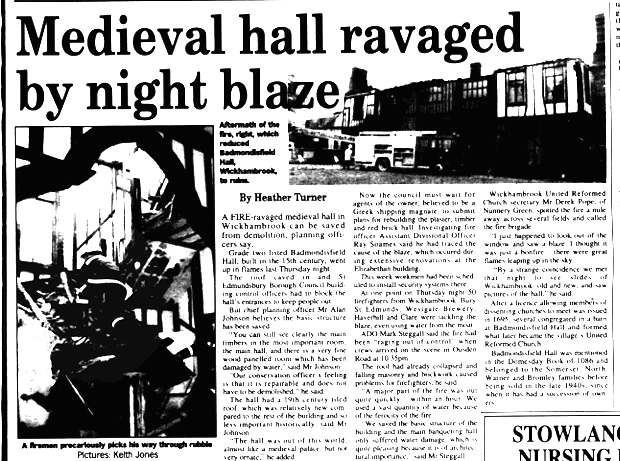
1997. 23 May. Newspaper Article. Plans put in for internal alterations at Badmondisfield Hall for Surland Ltd.

Joseph Warner John Charles BROMLEY was a first cousin to the six siblings of Nathaniel and Henrietta Bromley, his father Joseph Robarts Bromley was Nathaniel Warner Bromley’s brother.
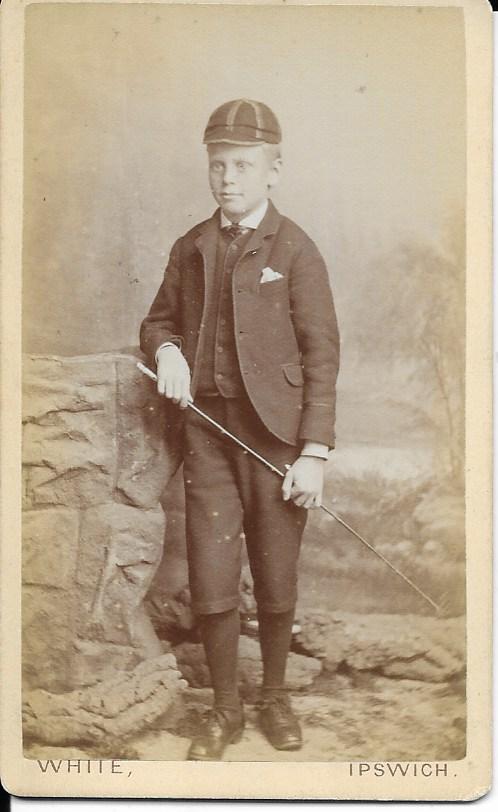
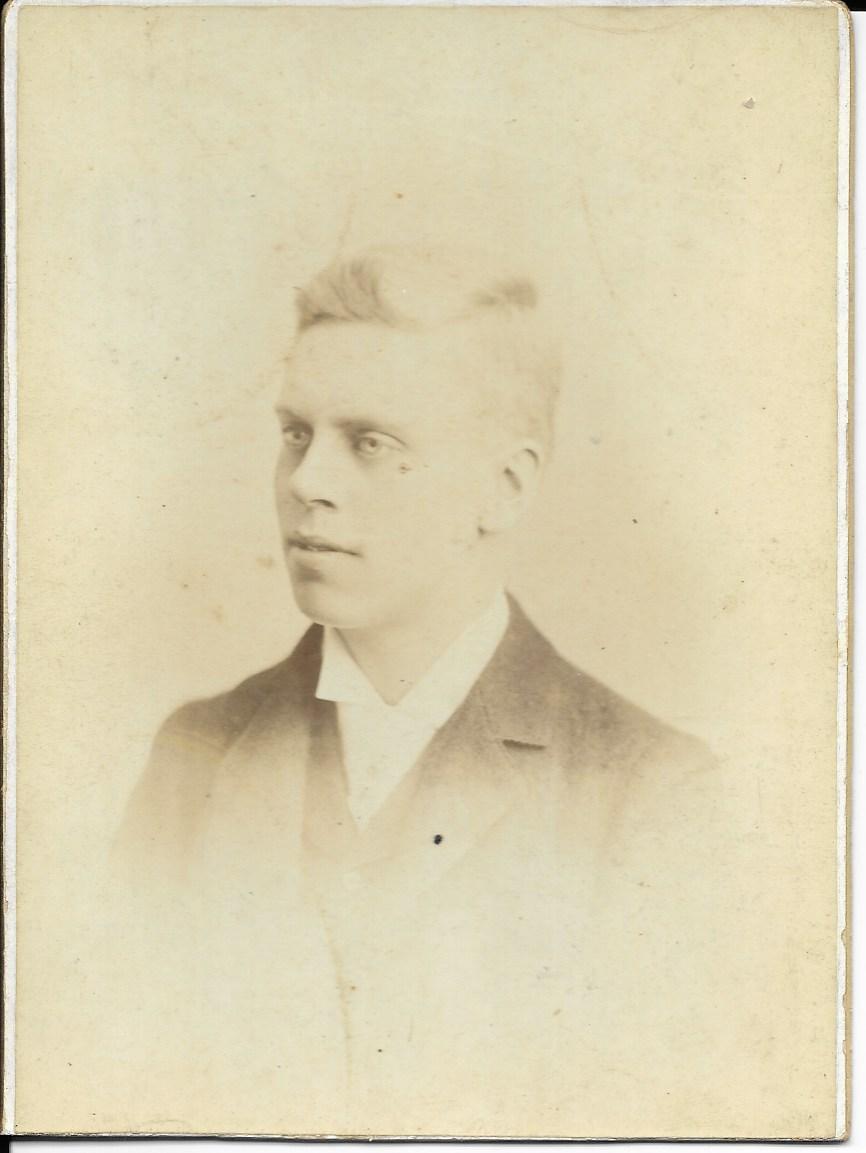
Known as just Charles within the family, which is something it took me a long time to find out! If it hadn’t been for the extensive family tree I had compiled I would never have identified him as it just says Charles Bromley on the back of these two photos.

But filling in everyone’s full names was the key as he was the only one with Charles in his name, then when I looked for his records I saw his death notice in the newspaper that said Charles Bromley, which matched the date on his probate record, see below.

I haven’t found a marriage or any other information out about Charles and I don’t know his cause of death.

I couldn’t write about Badmondisfield without mentioning Henrietta Martha Winter’s niece Ada Ellen BAYLY, she was born in 1857 in Brighton, Sussex, her father, Robert, was 51, and her mother, Mary, Henrietta’s sister was 32. She had one brother and three sisters. She was 11 when her father died and just 14 when her mother died. She spent time with various relatives in the following years including Henrietta and Nathaniel at Badmondisfield.
The following information is mostly from Wikipedia: “Ada Ellen Bayly (25 March 1857 – 8 February 1903), also known as Edna Lyall, was an English novelist, who “supported the women’s suffrage movement from an early age.
Bayly was born in Brighton, the youngest of four children of a barrister. Early in life, she lost both her parents, so she spent her youth with an uncle in Surrey and in a Brighton private school. Bayly never married. She seems to have spent her adult life living with her two married sisters and her brother, a clergyman in Bosbury, Herefordshire.
In 1879, she published her first novel, Won by Waiting, under the pseudonym “Edna Lyall” (apparently derived from transposing letters from Ada Ellen Bayly). The book was not a success. Success came with We Two, based on the life of Charles Bradlaugh, a social reformer and advocate of free thought. Her historical novel In the Golden Days was the last book read to John Ruskin on his deathbed; while Hope the Hermit was a bestseller set in the Lake District and later an inspiration for Hugh Walpole’s Rogue Herries. To Right, the Wrong (2nd ed. 1894) is a historical novel about John Hampden and the English Civil War.
Bayly wrote in all eighteen novels, many of them offering interesting explorations of the writer’s creative process. Part of her success was due to her practice of using characters from one novel in a different capacity in her next“
Edna Lyall’s book, In the Golden Days (1885), a historical novel set in the reign of Charles II (29 May 1630-6 February 1685) was her first truly popular work, dramatised by Mr Edwin Gilbert. It’s based on Badmondisfield and the family at that time, she called it Mondisfield in the book. I bought a secondhand copy of the book hoping to find some interesting details about the house but I’m finding it really hard going and have only got to chapter 6 so far, I might have to give up on it.
The following information and lots more I found about Ada/Edna Lyall on the super website https://www.oocities.org/helenvict0r/Lyall.html
In 1889 Ada Bayly had been taken seriously ill with pericarditis and passed her last years as a semi-invalid. In 1897 she attended the Women Writers’ Dinner for the only time. Miss Rowland-Grey wrote of that occasion:
“ I remember how she seemed to enjoy it, and how she regretted that her health did not allow her to be more often present on such occasions. She was essentially a good comrade, with a deep, unselfish interest in her fellow women”.
She died at the age of 46 on the 8th February 1903 having arranged all the details of her funeral and asking that no one should go into mourning unless they very particularly wished and then very slightly. In her will, she desired her body be cremated and the ashes placed at the foot of the old cross in Bosbury Churchyard and should her friends wish to raise another stone in her memory it should say, “My trust is in the tender mercy of God for ever and ever.” Childless she donated three bells named after characters in her books – Donovan, Erica and Hugo – to her church, St Saviour’s, Eastbourne.
She died on 8 February 1903 in Eastbourne, Sussex, at the age of 46.
For Chapter 5 we’ll be starting over in Tasmania in Australia.
Till next time then…….
 lynnswaffles.com
I worked for a man that I believe owned Badmondisfield Hall in the 1990s. His name was Christopher (Kit) Whitehouse. He lived there with his wife and son David. They were probably the family who sold it in 1992. He was the director of a freight forwarding company operating originally out of Haverhill and latterly Clare under the name of Caramed Ltd. They went into liquidation I believe in the early 1990s.
LikeLike
Hi Maria. Thank you so much for getting in touch with me. It’s always fascinating to hear more information about Badmondisfield. Many thanks, Kind Regards Lynn
LikeLike